Cut Your AI API Bill: 7 Levers That Actually Work
Seven mechanisms that actually move an LLM API bill, each with a modeled saving and a deep-dive.
AI-drafted, reviewed by Muhammad Qasim Hammad on July 3, 2026. See our AI disclosure.
Table of contents
Your AI bill crept from a rounding error to a line item, and the advice you keep finding is useless: "write better prompts," "use AI responsibly," "monitor usage." None of that is a mechanism. To reduce AI API costs you need levers that change the bill by something you can verify, and there are seven of them that actually work.
This is the hub for the whole cost topic. Each lever below comes with its mechanism, a modeled saving derived from published rates, and a link to the deep-dive that proves it. No invented "we cut our bill 73%" numbers; the savings are arithmetic on provider pricing, and where a deeper post exists, this page hands you off rather than re-deriving everything.
Why your AI bill grows (and the one rule before you optimize)#
To reduce AI API costs you first have to see the bill, and almost every runaway LLM bill is one model running one workload at full price, with output tokens doing most of the damage. The one rule before you touch anything: audit first, because pulling the wrong lever wastes the migration.
The whole bill reduces to one equation: (input tokens × input rate + output tokens × output rate) × runs. Every lever below attacks one term. Caching attacks the input rate on repeats, batch attacks both rates, right-sizing attacks the rates wholesale, and token discipline attacks the token counts. Knowing which term dominates is the difference between a fix and a wasted week.
Output is the half that surprises people. Generation usually costs four to six times the input rate, so a workload that returns long answers is dominated by output tokens no matter how lean your prompt is. That is why "switch to a cheaper input rate" often barely dents the bill: you optimized the small half and left the expensive one untouched.
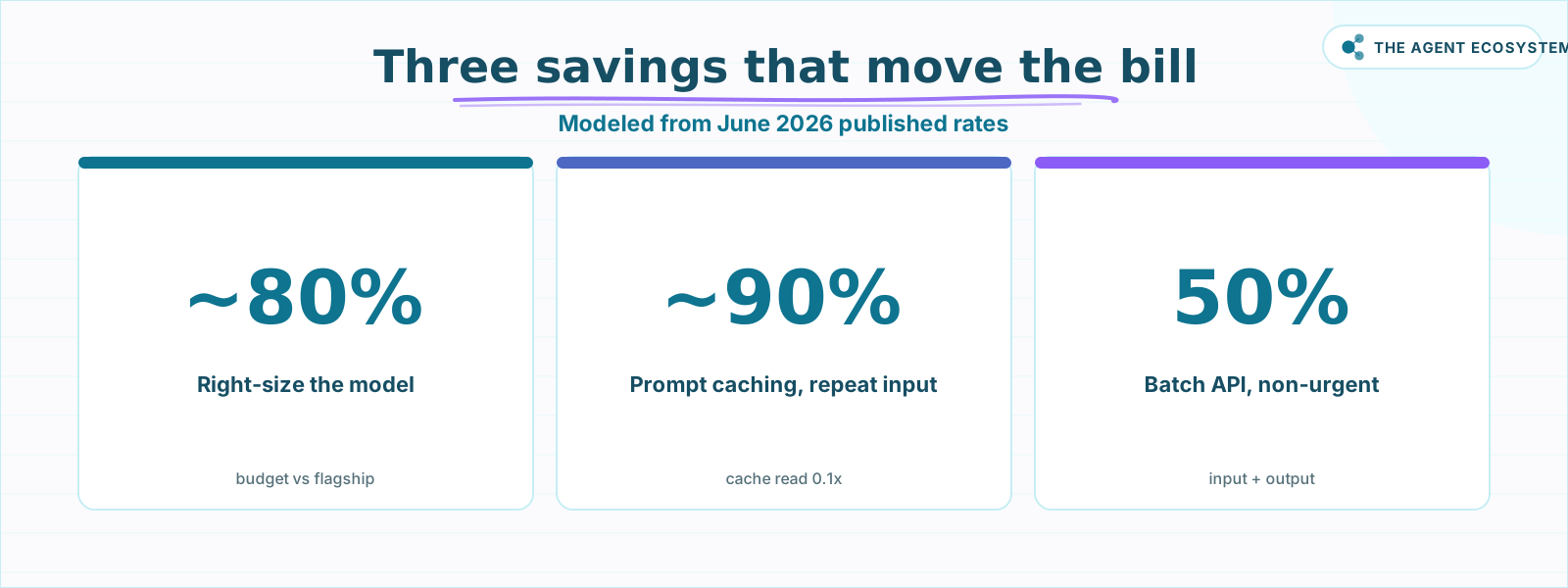 Modeled from published rates. These three stack, so the real win is combining them, not picking one.
So audit before you optimize. If you switch providers to chase a cheaper input rate while your real problem is an output blowup, you did a migration for nothing.
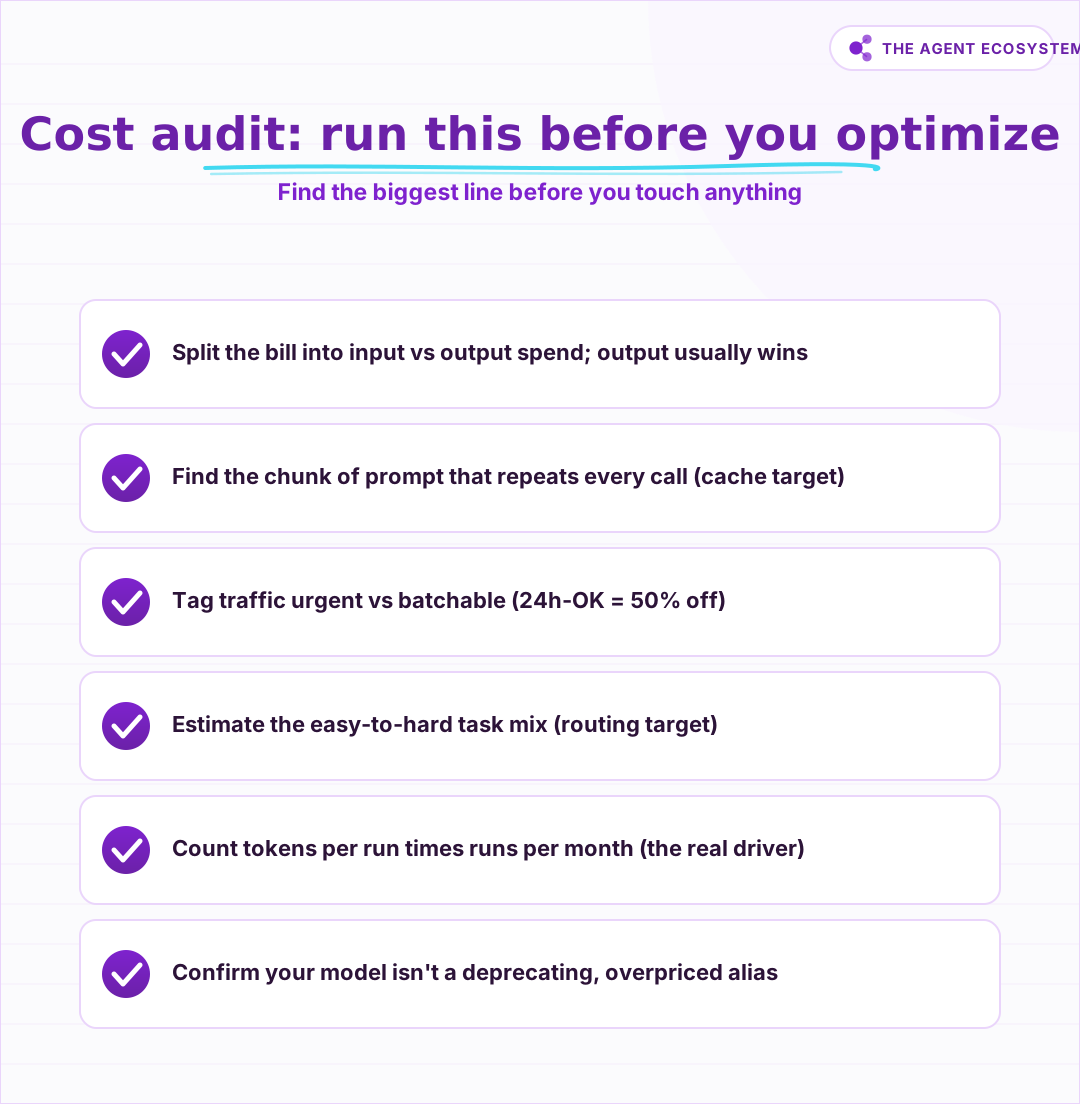 Optimize the biggest line first; most bills are dominated by one model on one workload.
The 7 levers (mechanism + modeled saving + the deep-dive)#
Seven levers actually move an LLM bill, and each works by a mechanism you can verify: right-size the model, prompt caching, the Batch API, model routing with fallback, local versus API, token discipline, and RAG instead of long-context. Here is each one, its modeled saving, and the deep-dive that proves it.
They are roughly ordered by effort-to-payoff: the first three are mostly configuration and return the most, while the last few need more engineering or steady volume. Pull from the top unless your audit points elsewhere.
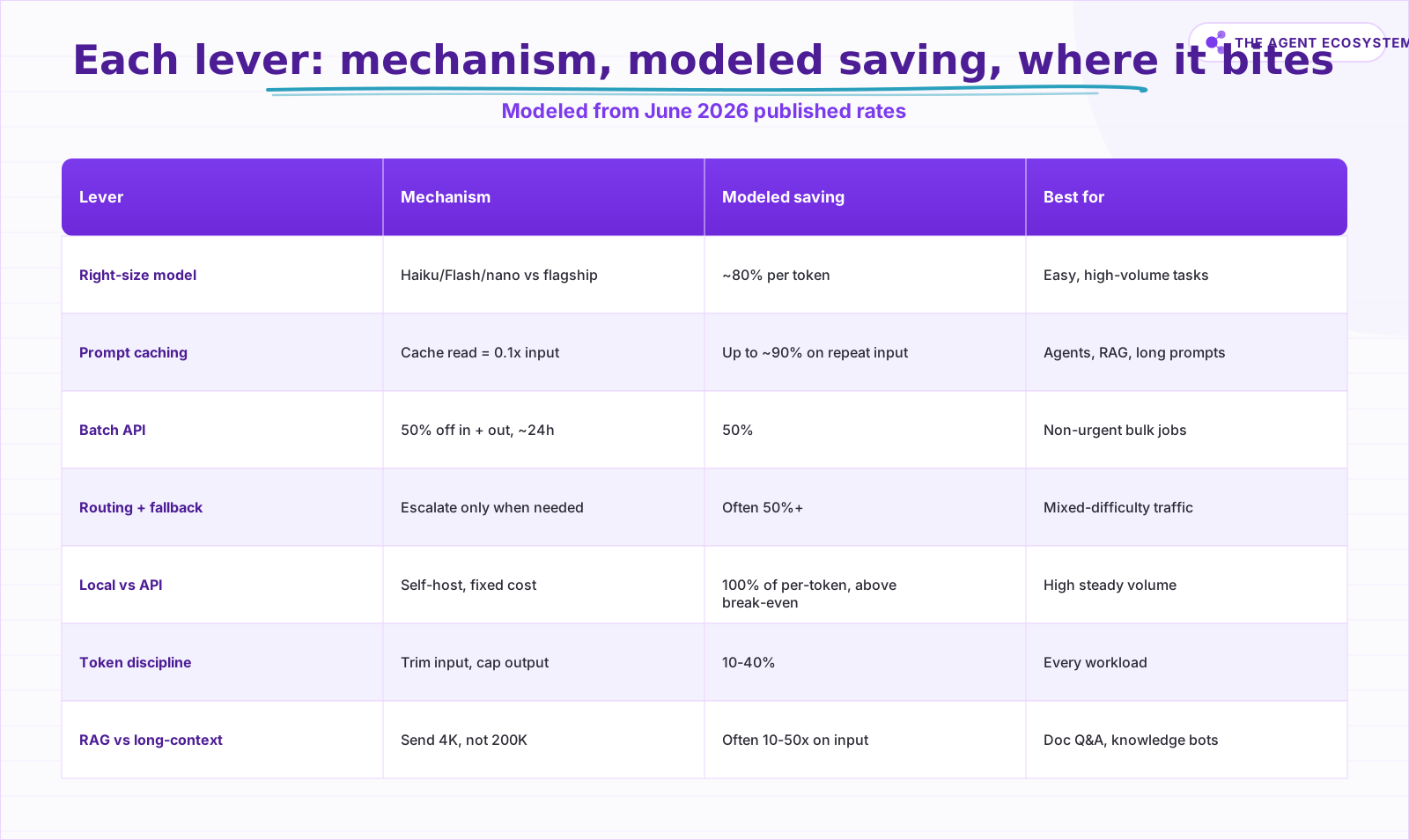 Savings are modeled from published rates; they stack, so combined savings are multiplicative, not additive.
1. Right-size the model. The single biggest win. A flagship costs roughly 5 to 25 times the budget tier, so easy, high-volume work should not run on it. Here is the spread that makes the case:
| Provider | Budget tier ($/MTok) | Flagship tier ($/MTok) | Spread (in / out) |
|---|---|---|---|
| Claude | Haiku 4.5: $1 / $5 | Opus 4.8: $5 / $25 | ~5x / ~5x |
| OpenAI | GPT-5.4-nano: $0.20 / $1.25 | GPT-5.5: $5 / $30 | ~25x / ~24x |
| Gemini | 2.5 Flash-Lite: $0.10 / $0.40 | 3.5 Flash: $1.50 / $9 | ~15x / ~22x |
Move easy tasks down a tier and validate quality; Claude vs GPT vs Gemini tested in n8n compares them on real work. The catch is that the cheapest model is the smallest, so a wrong answer you have to redo is not a saving. Right-size where the task is forgiving, and keep the flagship for genuine reasoning.
2. Prompt caching. A cache read costs 0.1x base input, so a stable system prompt, tool list, or RAG context reused across calls saves close to 90% on that prefix (modeled). Anthropic, OpenAI, and Gemini all support it, and DeepSeek caches automatically on disk. Deep-dive: prompt caching.
3. Batch API. 50% off both input and output for work that can wait about 24 hours, with OpenAI allowing up to 50,000 requests per batch, and Claude and Gemini also at 50%. The tradeoff is latency: results return in a window, not in real time, so reserve it for reports, enrichment, and bulk classification. Deep-dive: batch processing in n8n.
4. Model routing and fallback. Send each request to the cheapest model that can handle it and escalate only on low confidence or failure. The win comes from routing most traffic to the cheap model and only the hard minority to the expensive one, and it also keeps you running when a provider is down or over budget. Deep-dive: reliable n8n workflows and fallback.
5. Local versus API. Above a break-even volume, a self-hosted open model turns per-token cost into a fixed compute cost. It is not free, it is fixed, and it only wins above the crossover. Deep-dive: Ollama vs LM Studio vs Jan.
6. Token discipline. Trim bloated prompts, drop dead few-shot examples, strip boilerplate from injected context, and cap max_tokens so a runaway generation cannot blow the output side. A modeled 10 to 40% depending on how fat the prompts are. Deep-dive: cap agent spend with token budgets.
7. RAG instead of long-context. Retrieving the 4,000 relevant tokens beats stuffing a 200,000-token document into every call, and on some providers the input rate steps up above 200K, so long-context is doubly expensive. It also keeps answers sharper, because the model reads the relevant passage instead of hunting through a haystack. Deep-dive: pick the right RAG vector store.
How the levers stack (and where they don't)#
The levers stack multiplicatively, not additively. Right-sizing cuts the bill to a fraction, then caching takes a fraction of that, then batch halves what remains, so combining three or four is what really moves the number. But each has a limit: batch is not interactive, caching needs a byte-identical prefix, and local needs steady volume.
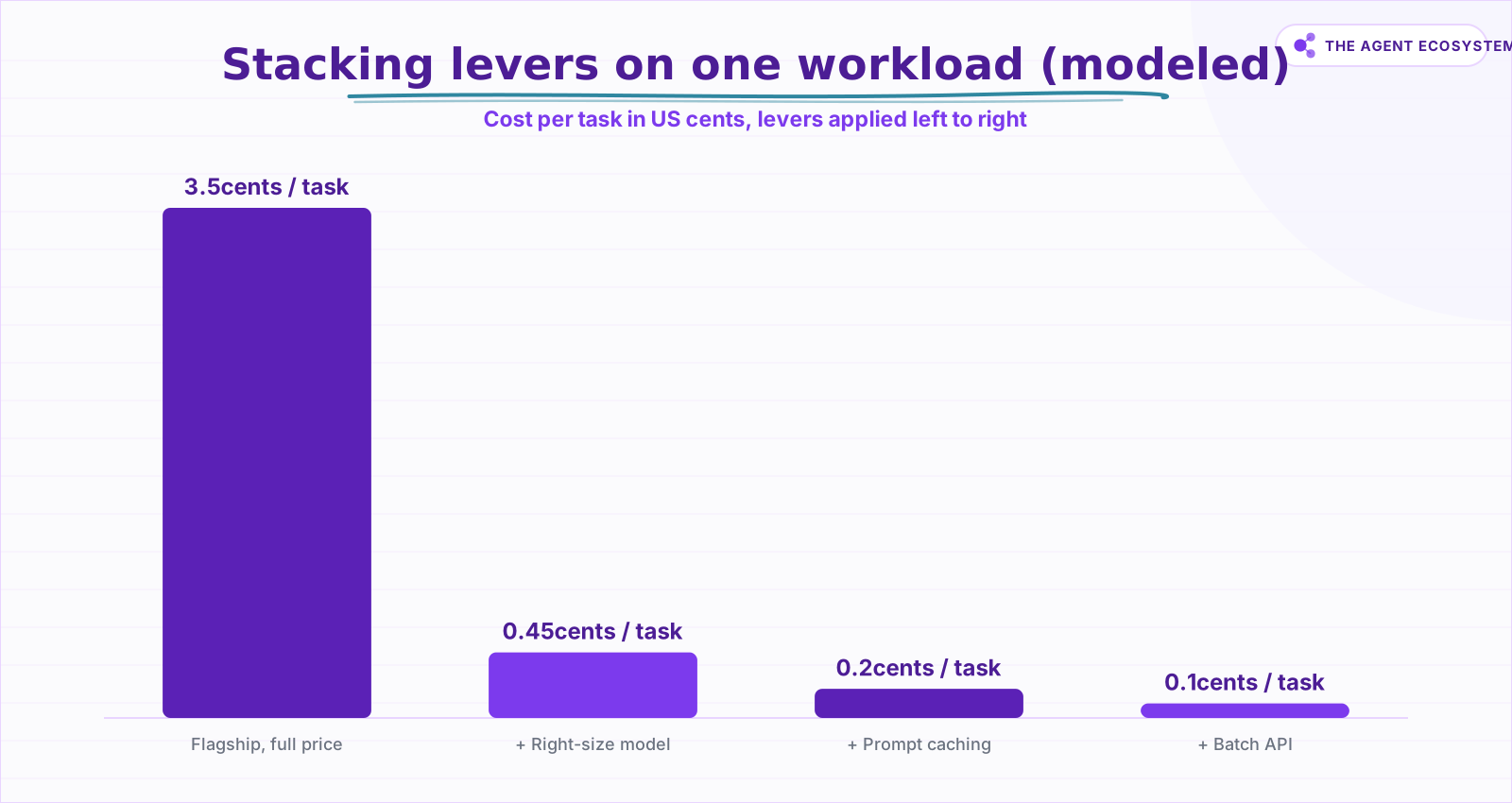 Modeled: same task, levers applied left to right. Each bar assumes the one before it; this is multiplicative, not additive.
The staircase makes the compounding concrete: a task at flagship full price, then right-sized, then cached, then batched, each bar applied on top of the last. The percentages multiply, they do not sum past 100%. Right-sizing to roughly 13% of flagship cost, then a 50% batch discount on that, then 90%-off cached input on the repeated prefix, all apply to the running total.
Put numbers on it. Say a task costs about 3.5 cents on a flagship. Right-sizing to a budget model that still handles it drops it to roughly 0.45 cents, an 87% cut on its own. Caching a large repeated prefix takes the input side down further, to about 0.2 cents. Running it through the Batch API halves what is left, to about 0.1 cents. That is the same task at roughly one thirty-fifth of where it started, and every step is a separate, checkable mechanism rather than a vague "spend less."
Where they conflict, say so plainly. The Batch API cannot serve a live chat, because the turnaround is hours. Caching only forms on a byte-identical prefix, so a timestamp or per-request ID inside the cached block resets it. Routing adds latency and a little complexity. Local only pays off above its crossover volume. And there is an honest ceiling: you cannot optimize a metered API to zero. Past a steady-volume threshold, going local or accepting the cost is the answer.
Which lever should you pull first?#
Pull the biggest line first. If one model on one easy workload dominates the bill, right-size the model, the single largest win. If a big chunk of the prompt repeats, turn on caching. If the job can wait a day, batch it. Otherwise trim tokens, then stack the rest on top.
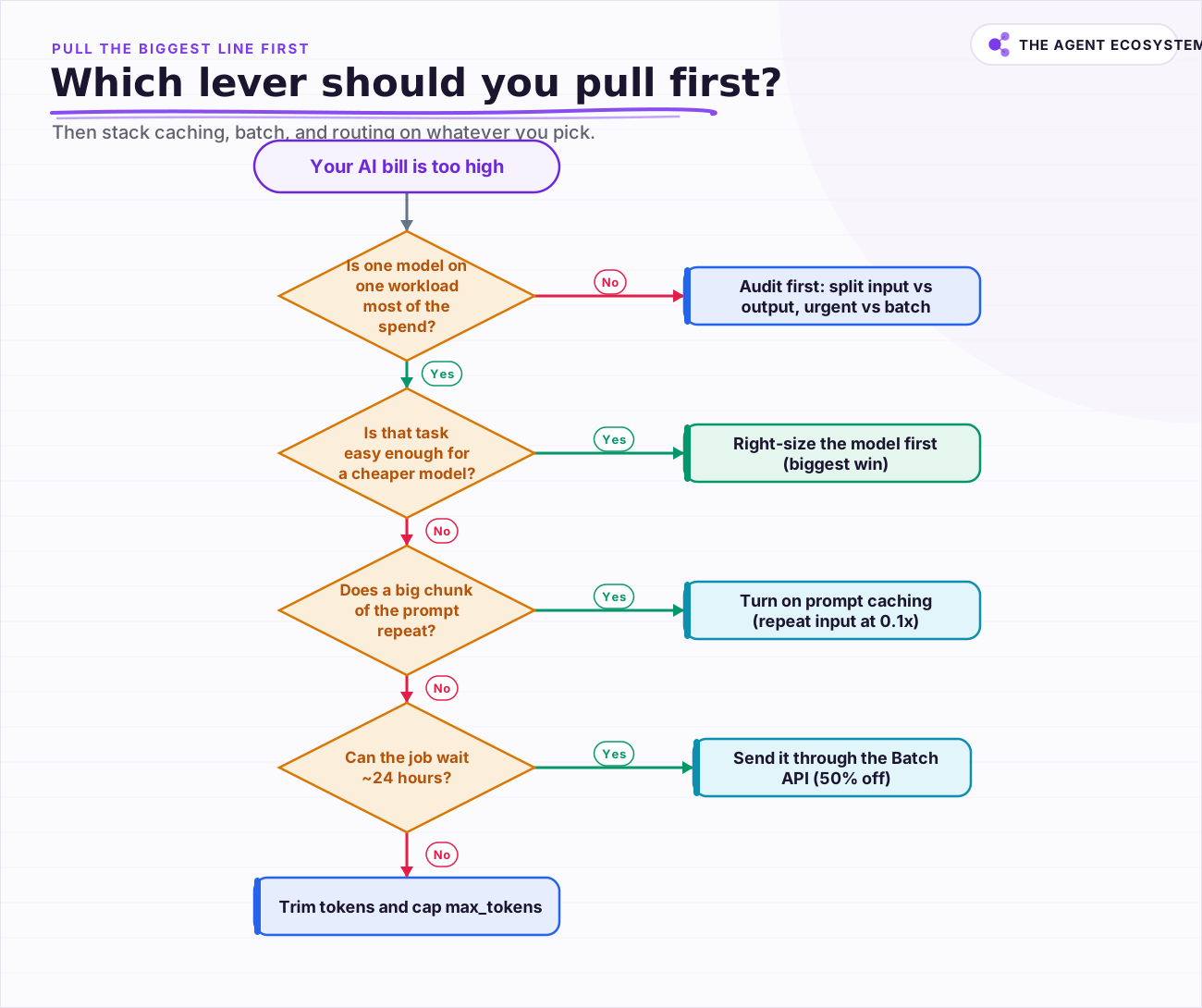 Pull the biggest line first: right-size, then cache, then batch, then trim, and stack the rest on top.
For most builders the endpoint is the same combination: right-size plus caching plus batch for bulk work, with routing added for mixed-difficulty traffic and local reserved for steady high volume. That stack, not one magic switch, is what moves the bill.
Then go deeper on the lever you are pulling. Start with prompt caching if you run agents or RAG with a stable prefix, batch processing if you have non-urgent volume, and token-budget guards to keep any agent from spending more than you planned. Estimate the saving before you build, pull the biggest lever first, then stack the rest.
Frequently asked questions
What is the single fastest way to reduce AI API costs?
Do these cost levers stack?
Which cost lever needs the most engineering?
How do I know which lever to pull first?
Can I get my AI API bill to zero?
Sources
Primary references and vendor documentation used while drafting and reviewing this article.
- Anthropic Claude pricing (model spread, Batch 50%, cache read 0.1x, stacking)
- OpenAI API pricing (GPT-5.x flagship vs nano spread)
- OpenAI Batch API (50% off, ~24h, 50k/200MB per batch)
- Google Gemini API pricing (model spread, 200K input step-up, batch ~50%)
- DeepSeek automatic disk caching (~10x cheaper on cache hits)
- Anthropic context windows (1M at standard price, but you pay for every token stuffed in)
Written by

Muhammad Qasim Hammad is an AI agent and automation expert and the founder of Cart Gaze LLC (cartgaze.com). He builds product for the love of it: when an idea lands, a working prototype is usually running within hours, built with the same AI agents and automations he sells. He puts his own output at roughly 20× what it was before agents, and the Agentic OS behind this site is the working proof, documented in public with the tools he actually ran and what they really cost.
AI & Automation Services
Want a pipeline like this running in your business?
I'm Qasim — I design and ship AI agents and n8n automations for solo operators and small teams. Tell me what's eating your team's week, and I'll scope a fix.
Related reading
Cheapest AI API in 2026: DeepSeek vs Claude vs GPT vs Gemini
The cheapest AI API by published token rate in June 2026 is DeepSeek V4 Flash, but the lowest sticker rate is rarely the lowest bill. Here is a dated, source-linked price table for DeepSeek, Gemini, GPT, and Claude, the cost-per-task math that output tokens dominate, and the

n8n AI Agent Pricing: What It Really Costs to Run
An n8n AI agent has two bills that behave nothing alike: a flat n8n platform fee and a per-run LLM token cost. Here is what each one comes to, with modeled per-run math across Claude, GPT, and Gemini, and the levers that actually lower the total.
Estimate Any LLM Bill Before You Build: Token Math for n8n Builders
A single LLM call costs a fraction of a cent, until you multiply by 10,000 runs a month. Here is the reproducible token math: chars over 4 for tokens, the input and output rates, and the per-run times volume multiply, with one support-reply run priced across five models.
How to Choose an LLM for Your n8n AI Agent (2026)
Kimi K3, GLM-5.2, DeepSeek V4, Claude, and GPT all plug into an n8n AI Agent, and they are not interchangeable. Here are the 5 questions that decide the pick for your agent, and why the honest answer for most workflows is to route by task, not standardize on one.
Prompt Caching: Cut Claude and Agent Costs Without Losing Quality
Prompt caching stores the unchanging part of your Claude prompt once and bills every later read at a tenth of the price, same model, same output. Here is the token math, the break-even point, and how to wire it into an n8n agent loop.
Claude vs GPT vs Gemini in n8n: Tested Cost and Speed
There is a 25x cost spread between the cheapest and priciest LLM tier for the exact same n8n AI Agent workflow. This post prices all three providers across 11 model tiers so you can pick the right Chat Model sub-node and stop overpaying.