The 2026 Model Wave: What It Changes for Automation Builders
A builder's take on Fable 5, GLM-5.2, and GPT-5.6: match the model to the workload, not the headline.
AI-drafted, reviewed by Muhammad Qasim Hammad on July 23, 2026. See our AI disclosure.
Table of contents
Three big model releases landed inside two weeks in June 2026, and your feed turned into a benchmark leaderboard overnight. If you run n8n or agent workflows, the useful question is not which model won a chart. It is what any of this changes for the pipelines you already ship.
Which AI model for automation in 2026 actually matters?#
Picking an AI model for automation in 2026 is now a portfolio choice, not a single pick. The June wave gave you a cheap open-weight frontier option, a premium ceiling, and a limited-access flagship. The move that pays is matching each workflow step to the cheapest model that clears its bar, then verifying the live figures yourself.
Here is the honest shape of the three, dated to their June 2026 launches, and you should treat these as inputs to your own test, not settled truth. Claude Fable 5 is generally available at $10 / $50 per 1M tokens, and Anthropic reports 80.3% on SWE-bench Pro. GLM-5.2 ships as open weights plus a hosted API at $1.40 / $4.40, with VentureBeat citing 62.1 on SWE-bench Pro. GPT-5.6 Sol lists $5 / $30 but is a limited preview, and its SWE-bench Pro score is not public. Prices and specs come from Anthropic's Fable 5 announcement, VentureBeat's GLM-5.2 report, and OpenAI's GPT-5.6 preview, all as of early July 2026.
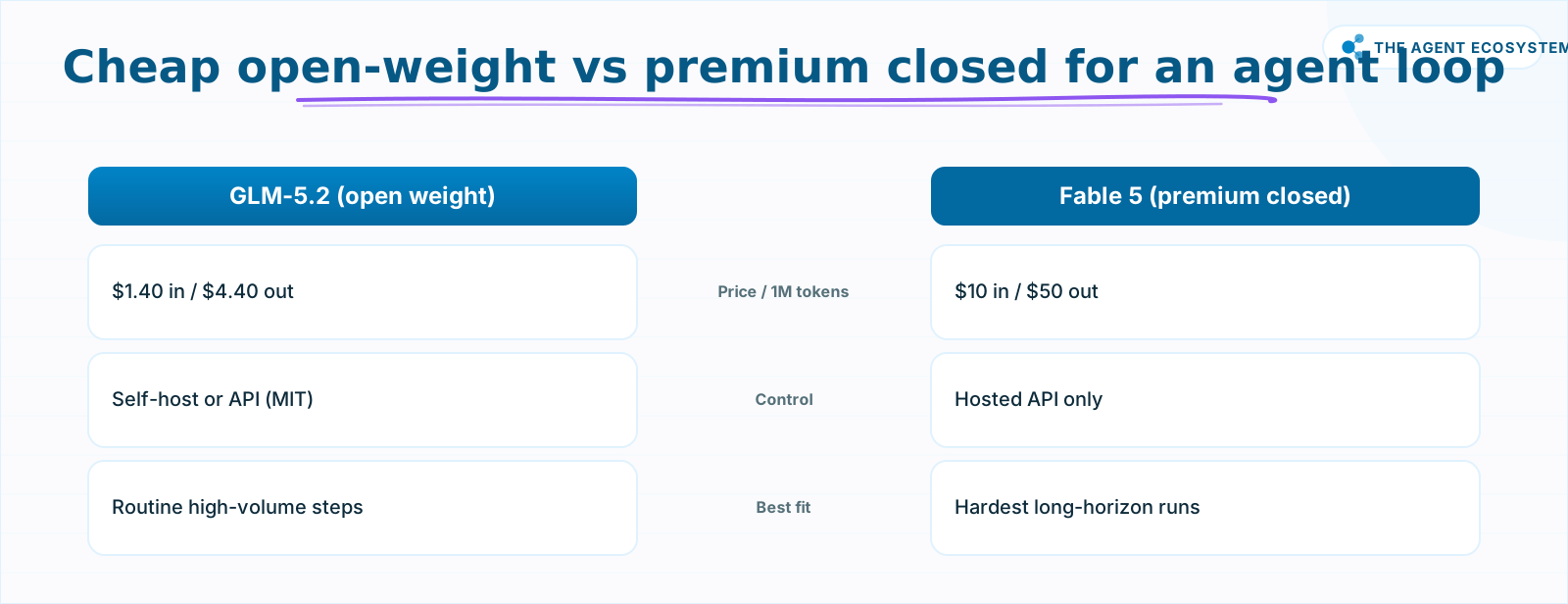 Figures dated to the June 2026 launches (Anthropic, VentureBeat) and volatile as of early July 2026; verify before relying on them.
Is a cheap open-weight frontier model now real?#
Yes, and that is the biggest shift for high-volume builders. GLM-5.2 shipped on June 13, 2026 under a permissive MIT open-weights license, priced at $1.40 in and $4.40 out per million tokens on the Z.ai API. VentureBeat reports that is roughly one-sixth of GPT-5.5's blended cost, and self-hosting the weights drops the marginal price further.
GLM-5.2 is a Mixture-of-Experts model with about 744B total parameters and roughly 40B active per token, per VentureBeat, with a 1M-token context. On coding evals it posts 62.1 on SWE-bench Pro (ahead of GPT-5.5's 58.6) and 74.4% on FrontierSWE Dominance against GPT-5.5's 72.6%, near Claude Opus 4.8's 75.1%. One caveat matters: TechTimes reports the hosted API carries a China data-residency risk, so route sensitive data to self-hosted weights instead.
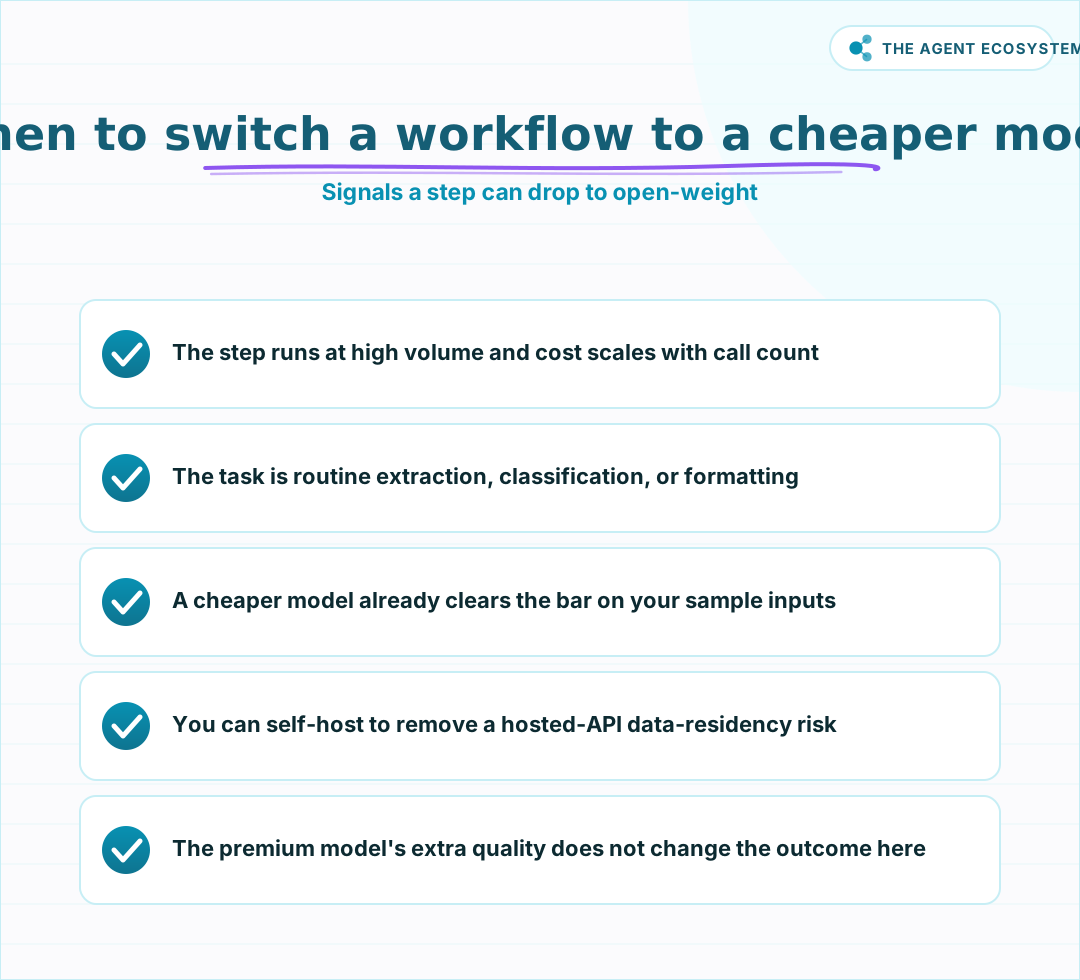 If several of these hold for a step, test the cheaper model on your own inputs before you keep paying the premium.
When is the premium model (Fable 5) worth $10 per 1M?#
Reserve Fable 5 for the hardest long-horizon work, not routine nodes. Anthropic released it on June 9, 2026 at $10 input and $50 output per million tokens, which Forbes notes is roughly twice the price of Opus 4.8. Anthropic reports 80.3% on SWE-bench Pro, about 11 points ahead of the next frontier model.
That price gap is the whole argument for tiering. A five-times cost difference between Fable 5 and GLM-5.2 on input tokens does not matter on a simple classification step, where both clear the bar easily. It matters enormously on a step you run thousands of times a day. Anthropic also notes the existing 90% prompt-caching input discount still applies to Fable 5, and that under 5% of sessions get safety-rerouted to Opus 4.8 on average, so budget for a stable-price model on the routine bulk and call Fable 5 only where difficulty justifies it.
Should you architect around GPT-5.6 yet?#
No, because you probably cannot get it. OpenAI previewed GPT-5.6 on June 26, 2026 in three tiers (Sol, Terra, Luna), but Axios and VentureBeat report the launch was restricted to roughly 20 approved partners "at the behest of the U.S. government," with general availability promised "in the coming weeks."
Published pricing is $5 in and $30 out per million for Sol, $2.50 and $15 for Terra, and $1 and $6 for Luna, per OpenAI's preview page. The tiers look competitive on paper, and OpenAI cites gains in coding, scientific reasoning, and long-horizon agentic work. But its SWE-bench Pro figure is not public, and limited access is a hard blocker for a production pipeline. Do not design a workflow around a model you cannot call today; note it, and revisit when general availability actually lands.
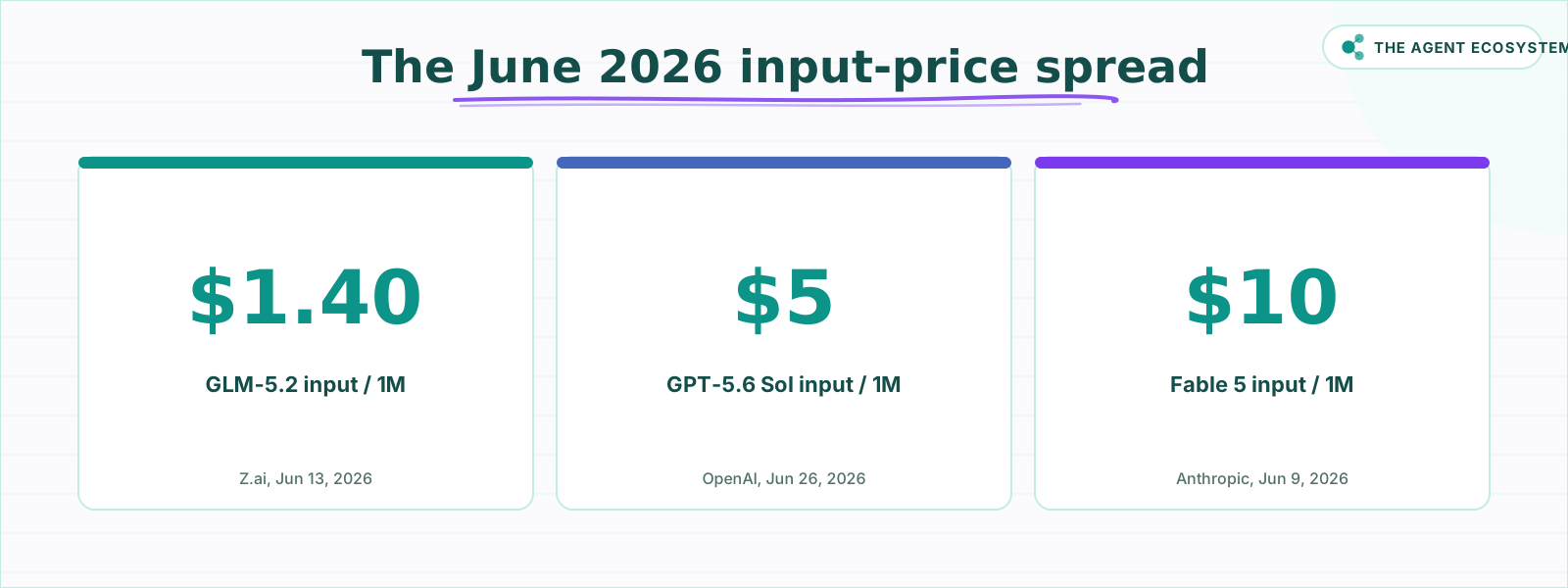 Input price per 1M tokens at the June 2026 launches (Z.ai, OpenAI, Anthropic). Output prices differ; verify all as of early July 2026.
How do you match a model to each workflow step?#
Route by the difficulty of the step, not the fame of the model. Cheap open-weight models handle routine extraction, classification, and formatting at high volume. Premium models earn their price only on genuinely hard reasoning or long-horizon planning. A tiered setup with a fallback, cheap by default and premium by exception, captures most of the savings.
Here is a decision matrix for common automation steps, using the June 2026 launch figures above. The "why" column is qualitative on purpose: real quality depends on your own prompts and data, so treat this as a starting hypothesis to test.
| Workload | Sensible pick | Why (test it yourself) |
|---|---|---|
| High-volume classify / extract | GLM-5.2 ($1.40/$4.40) | Cheapest per call; clears routine bars |
| Sensitive data at volume | Self-hosted GLM-5.2 | Avoids the flagged hosted-API data risk |
| Hardest long-horizon agent run | Claude Fable 5 ($10/$50) | Highest attributed SWE-bench Pro (80.3%) |
| Anything needing GPT-5.6 | Wait / fallback | Limited preview; not generally callable |
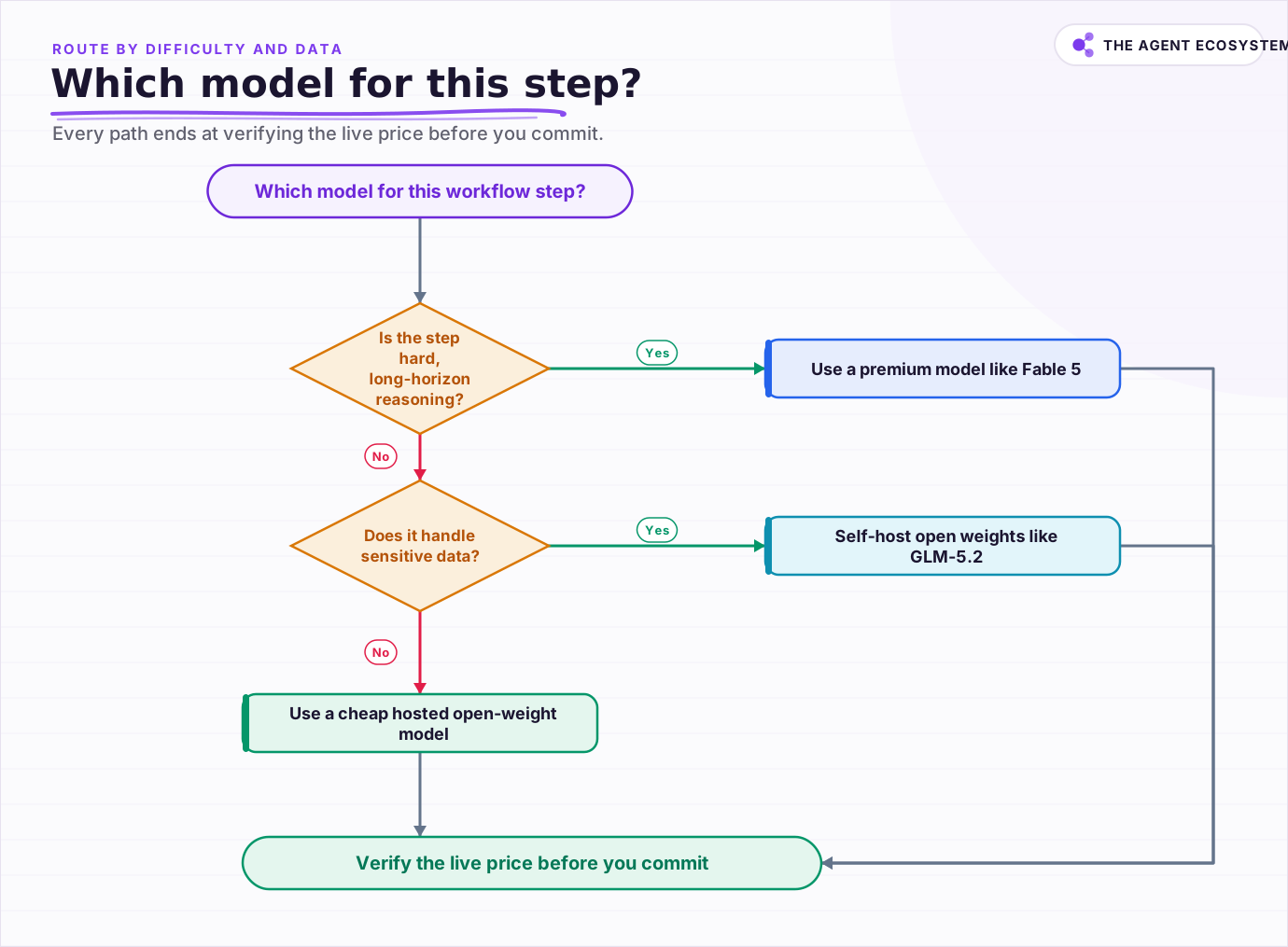 Route each step by difficulty and data sensitivity; every path ends at verifying the live price before you commit.
Wire the cheap model as the default and the premium model as a conditional escalation. Our guide to a multi-model fallback in n8n shows the routing pattern, and the seven levers to reduce AI API costs covers the caching and batching that stack on top.
What is the practical move for builders?#
Build a tiered stack and test it on your own data. Default routine, high-volume steps to a cheap open-weight model like GLM-5.2, escalate only the hardest steps to a premium model like Fable 5, and treat GPT-5.6 as future work until it is generally available. Match the model to the workload, verify the numbers, and re-check them often.
None of this is a permanent ranking. The wave that reshuffled these prices in June 2026 will reshuffle again, so wire your workflow to swap models cheaply and keep your cost controls tight. For the discipline of keeping an agent's spend predictable step by step, our Claude API cost control walkthrough applies the same match-cost-to-need thinking to a single agent loop.
Frequently asked questions
Which is the cheapest capable model for automation in 2026?
Is Claude Fable 5 worth $10 per 1M input tokens for a workflow?
Can I use GPT-5.6 in production right now?
How should I route models across an n8n or agent workflow?
Is there a privacy risk with GLM-5.2?
Sources
Primary references and vendor documentation used while drafting and reviewing this article.
- Anthropic: Introducing Claude Fable 5 and Claude Mythos 5
- VentureBeat: Z.ai's open-weights GLM-5.2 beats GPT-5.5 on multiple long-horizon coding benchmarks for 1/6th the cost
- TechTimes: GLM-5.2 open weights live, but API use carries China data risk
- OpenAI: Previewing GPT-5.6 (Sol, Terra, Luna)
- Axios: OpenAI's GPT-5.6 limited preview and the U.S. government
- Forbes: Anthropic Fable 5 AI model cost
Written by

Muhammad Qasim Hammad is an AI agent and automation expert and the founder of Cart Gaze LLC (cartgaze.com). He builds product for the love of it: when an idea lands, a working prototype is usually running within hours, built with the same AI agents and automations he sells. He puts his own output at roughly 20× what it was before agents, and the Agentic OS behind this site is the working proof, documented in public with the tools he actually ran and what they really cost.
AI & Automation Services
Want a pipeline like this running in your business?
I'm Qasim — I design and ship AI agents and n8n automations for solo operators and small teams. Tell me what's eating your team's week, and I'll scope a fix.
Related reading
Fable 5 vs GLM 5.2 vs GPT-5.6: The 2026 Frontier Landscape
Three frontier models landed in June 2026: Claude Fable 5, Z.ai's open-weight GLM-5.2, and OpenAI's limited-preview GPT-5.6. The numbers do not all measure the same thing, so here is an honest, dated comparison on coding score, price, and openness.

One Default Model per Agent Job: the 2026 Frontier Field
In July 2026 you can call five frontier models before lunch, at prices that range tenfold. More choice is not an easier choice. Here is a job-by-job map of which model to default to, with every price dated and a reminder to test on your own data.
Claude Sonnet 5: The Agent Model I'd Actually Default To
Anthropic shipped Claude Sonnet 5 on June 30, 2026 as a cheaper way to run agents, the same week the $10/$50 Fable 5 flagship landed. Here is the verified price-and-benchmark picture, plus my honest take: for most real agent work, the Sonnet tier is the model to default to.
How to Choose an LLM for Your n8n AI Agent (2026)
Kimi K3, GLM-5.2, DeepSeek V4, Claude, and GPT all plug into an n8n AI Agent, and they are not interchangeable. Here are the 5 questions that decide the pick for your agent, and why the honest answer for most workflows is to route by task, not standardize on one.
GPT-5.6 Is Now Public: What GA Changes for Builders
For two weeks GPT-5.6 was a limited preview most builders could not touch. On July 9, 2026, OpenAI made Sol, Terra, and Luna generally available across the API, Codex, and ChatGPT. Here is what changed for builders, and what to verify before you adopt it.
Claude vs GPT vs Gemini in n8n: Tested Cost and Speed
There is a 25x cost spread between the cheapest and priciest LLM tier for the exact same n8n AI Agent workflow. This post prices all three providers across 11 model tiers so you can pick the right Chat Model sub-node and stop overpaying.