Claude Sonnet 5: The Agent Model I'd Actually Default To
Anthropic's June 30, 2026 midsize model runs agents at roughly one-fifth the flagship price, and it is close to Opus 4.8.
AI-drafted, reviewed by Muhammad Qasim Hammad on July 26, 2026. See our AI disclosure.
Table of contents
You run agents for a living, or you want to, and every launch week you face the same quiet question: which model actually does the work, and which one just does the headlines. On June 30, 2026, Anthropic gave that question a sharper answer, and I think most builders are about to read it backwards.
What is Claude Sonnet 5, and why does it matter?#
Claude Sonnet 5 is Anthropic's midsize model tuned for agentic work at a lower price, and it now runs as the default for Free and Pro accounts, plus Max, Team, and Enterprise (Anthropic, June 30, 2026). Anthropic calls it its most agentic Sonnet yet, with performance close to the pricier Opus 4.8.
That framing matters because "close to the flagship at a fraction of the price" is exactly the tier where real agent economics live. Anthropic describes Sonnet 5 as able to make plans, use tools like browsers and terminals, and run autonomously at a level that recently needed larger, pricier models (Anthropic, June 30, 2026). It also reports a lower rate of undesirable behaviors than the previous Sonnet 4.6. That last point is Anthropic's own claim from its launch materials, not an independent audit, so weigh it as such.
How good is Claude Sonnet 5 on the benchmarks?#
On Anthropic's own launch numbers, Sonnet 5 scored 63.2% on agentic coding, against Opus 4.8 at 69.2% and the older Sonnet 4.6 at 58.1%, and it slightly outperformed Opus 4.8 on a knowledge-work benchmark (Anthropic, June 30, 2026). So the flagship-class model still leads on coding, by roughly 6 points.
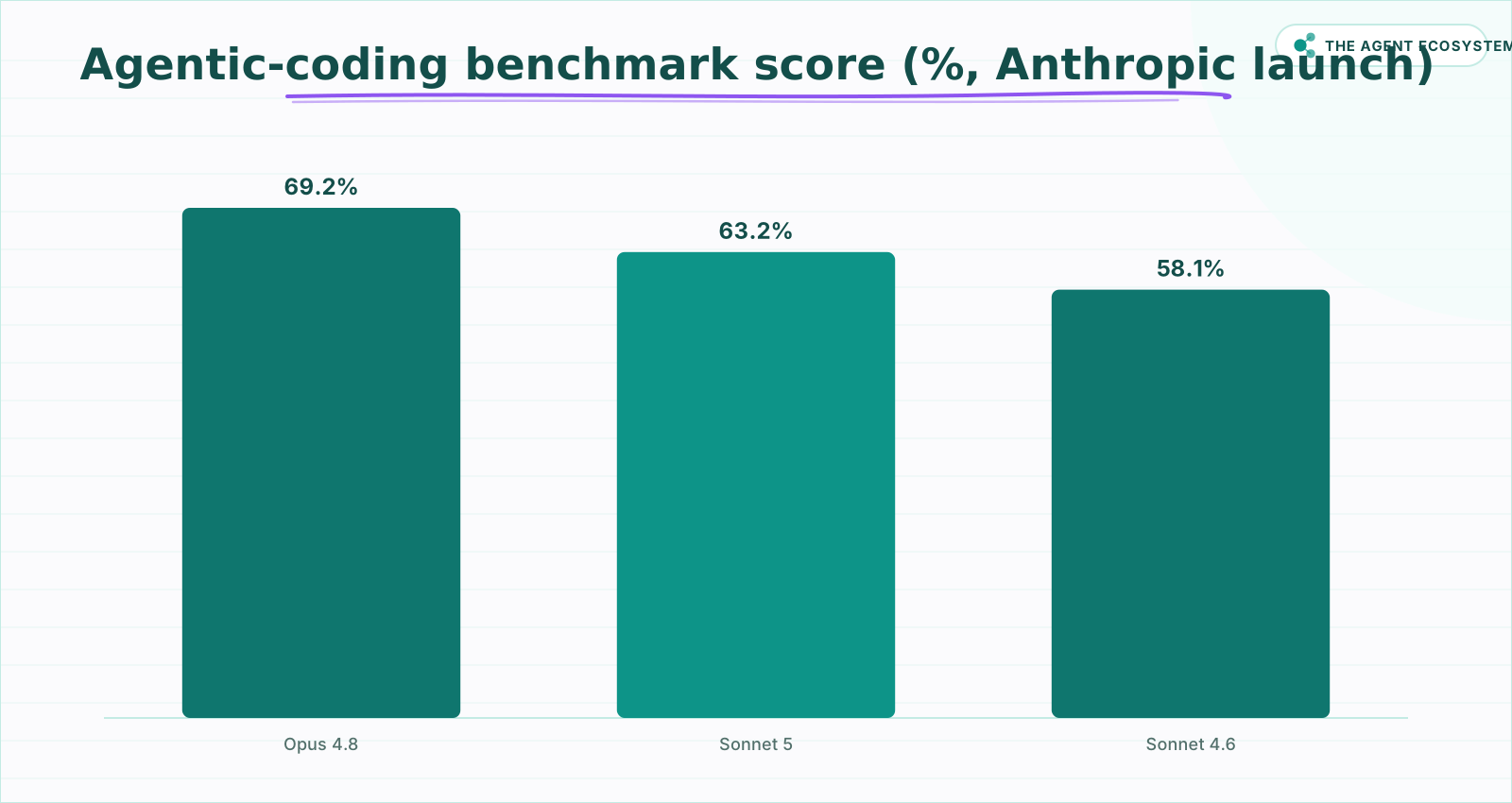 Source: Anthropic launch benchmarks, June 30, 2026. As of early July 2026, verify before relying.
Read that gap honestly and it cuts two ways. Sonnet 5 closed about 5 of the 11 points that separated the old Sonnet from Opus, which is a real jump for a mid-tier model in one generation. But 63.2% is not 69.2%, and on a hard, multi-step coding job that 6-point spread can be the difference between a run that lands and one you babysit. The knowledge-work win, where Sonnet 5 edged Opus 4.8, is the more interesting signal to me: it says the mid-tier is now genuinely competitive outside narrow coding tasks. These are vendor benchmarks, though, so treat them as a starting hypothesis, not a verdict.
What does Claude Sonnet 5 cost to run?#
Sonnet 5 launched at an intro price of $2 per 1M input tokens and $10 per 1M output through August 31, 2026, then moves to a standard $3 input and $15 output (Anthropic, June 30, 2026). Against the flagship, that is the whole argument in two numbers.
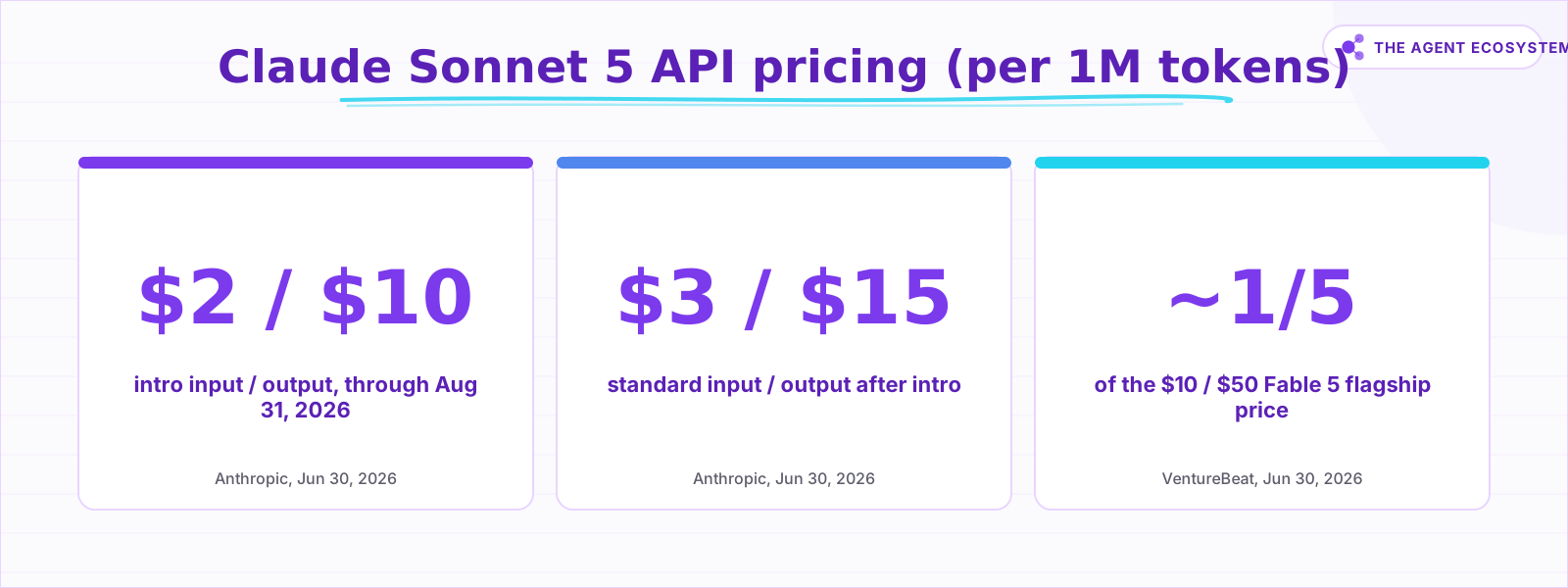 Source: Anthropic, June 30, 2026. Intro rates run through August 31, 2026. Verify before relying.
Here is the context that makes those numbers land. The same week, the Fable 5 flagship arrived at $10 input and $50 output per 1M tokens (VentureBeat, June 30, 2026). So Sonnet 5 runs at roughly one-fifth the per-token price of the top model. For an agent that fans out across dozens of tool calls and long transcripts, output tokens dominate the bill, and a 5x gap on output is not a rounding error. It is the difference between an experiment you can leave running and one you watch like a taxi meter.
| Attribute | Claude Sonnet 5 |
|---|---|
| Released | June 30, 2026 |
| Default for | Free and Pro (also Max, Team, Enterprise) |
| Intro price / 1M | $2 input, $10 output (through Aug 31, 2026) |
| Standard price / 1M | $3 input, $15 output |
| Agentic-coding score | 63.2% (vs Opus 4.8 69.2%, Sonnet 4.6 58.1%) |
| Positioning | "Most agentic Sonnet yet," close to Opus 4.8 |
Source: Anthropic and VentureBeat, June 30, 2026. As of early July 2026, verify before relying.
My take: default to the Sonnet tier, not the flagship#
Here is where I land, and it is an opinion, not a measured result: for most real agent work, I would default to the Sonnet tier and reserve the flagship for the hardest long-horizon jobs. The flagship earns the launch-day headlines. The Sonnet tier does the actual runs.
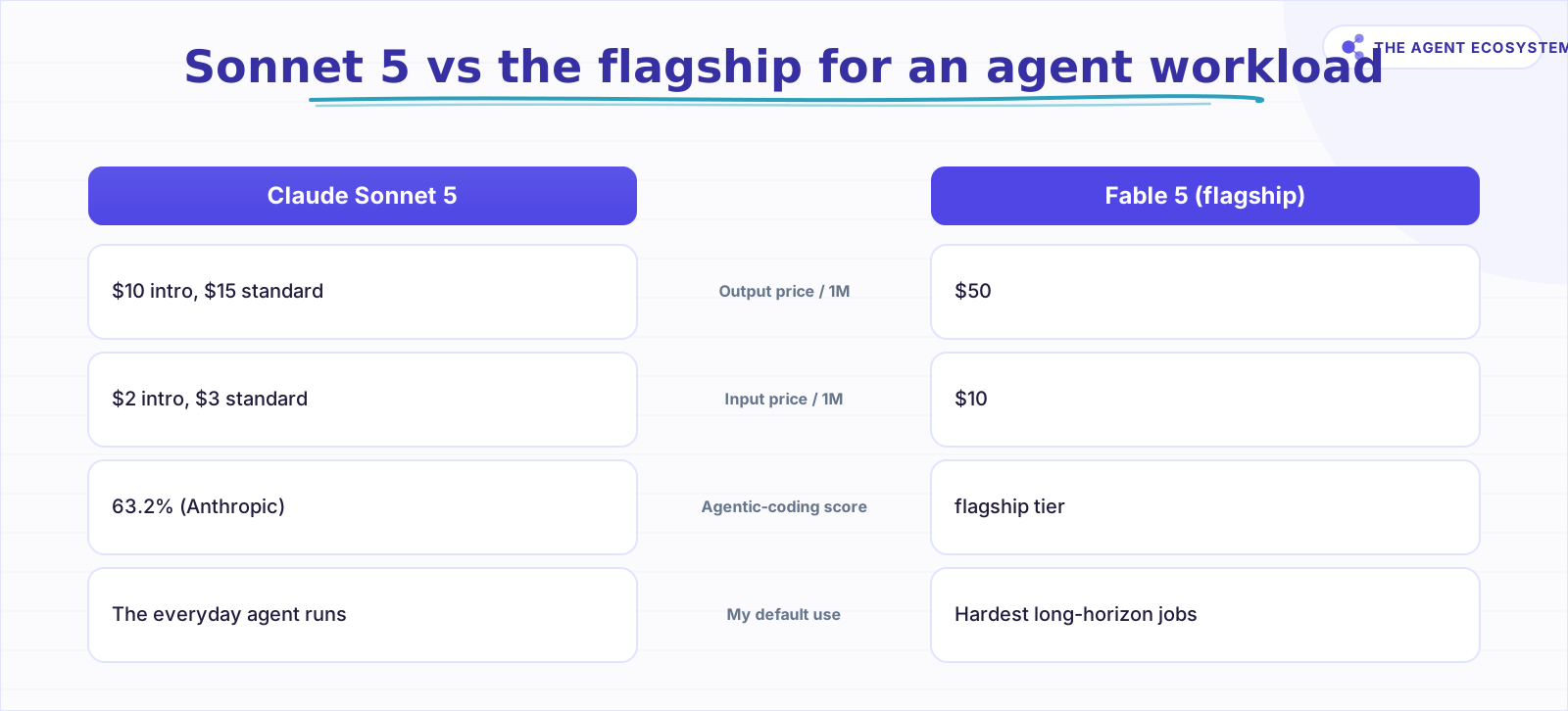 Source: Anthropic and VentureBeat, June 30, 2026. Fit column is the author's opinion. Verify before relying.
My reasoning is about where the money and the quality curve cross. Sonnet 5 sits at 63.2% agentic coding for roughly one-fifth the flagship's price. For a solopreneur or a small team, that ratio is decisive, because you are not paying for the last few benchmark points on every routine run, you are paying for them only when a job truly needs them. I would wire Sonnet 5 as the default in my agent stack, watch where it stumbles, and route just those cases up. If you are optimizing spend broadly, the same logic runs through our seven levers to reduce AI API costs, and a cheap default model is lever one.
Where I'd still reach for the flagship#
I want to represent the other side fairly, because "always default down" is its own kind of hype. Some jobs genuinely need the top model: long-horizon tasks where a 6-point coding gap compounds across many steps, or work where a single wrong autonomous action is expensive. For those, the flagship earns its price.
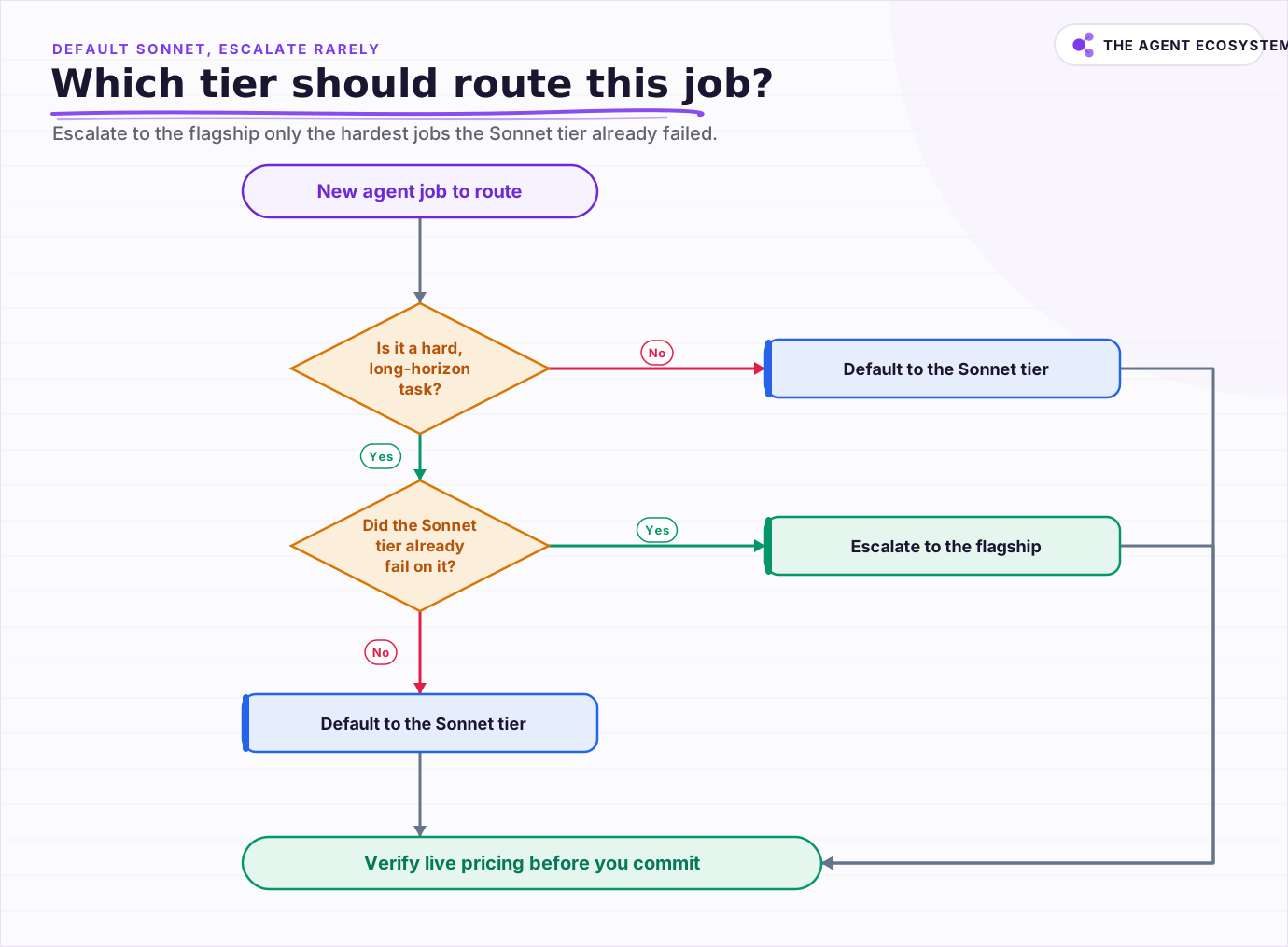 The author's routing rule: default to the Sonnet tier, escalate only the hardest jobs. Verify pricing before relying.
The honest counter-argument is that benchmark deltas understate real gaps on the hardest problems. A model that is 6 points behind on a scored test can be much further behind on a sprawling, ambiguous task where errors cascade, and paying 5x to avoid a failed 40-step run is easy math. My rule handles this without abandoning the default: start on the Sonnet tier, and escalate a specific job only after the Sonnet tier actually fails it, not before. That keeps the flagship as a targeted tool, not a reflex. A model-agnostic setup makes this trivial, which is why I like an n8n multi-model fallback as the plumbing.
So where does this leave your model choice?#
My read is that Sonnet 5 shifts the default, not the ceiling. The flagship still owns the hardest long-horizon work, but the mid-tier now does the everyday agent runs at close to flagship quality for roughly one-fifth of the price (Anthropic, VentureBeat, June 30, 2026), and that is the tier most builders actually live in.
The move I would make this week is small and reversible: set Sonnet 5 as your default, keep a one-line switch to the flagship, and let real failures, not launch-day benchmarks, decide when to escalate. If cost is the whole question for you, our roundup of the cheapest AI API in 2026 applies the same dated-pricing discipline across providers. Whatever you choose, re-verify the live price this week, because this is still early July 2026 and these numbers move.
Frequently asked questions
What is Claude Sonnet 5 and when did it launch?
How much does Claude Sonnet 5 cost?
How does Claude Sonnet 5 compare to Opus 4.8 on benchmarks?
Should I default my agents to Claude Sonnet 5 or a flagship model?
Is Claude Sonnet 5 safer than the previous Sonnet?
Sources
Primary references and vendor documentation used while drafting and reviewing this article.
Written by

Muhammad Qasim Hammad is an AI agent and automation expert and the founder of Cart Gaze LLC (cartgaze.com). He builds product for the love of it: when an idea lands, a working prototype is usually running within hours, built with the same AI agents and automations he sells. He puts his own output at roughly 20× what it was before agents, and the Agentic OS behind this site is the working proof, documented in public with the tools he actually ran and what they really cost.
AI & Automation Services
Want a pipeline like this running in your business?
I'm Qasim — I design and ship AI agents and n8n automations for solo operators and small teams. Tell me what's eating your team's week, and I'll scope a fix.
Related reading
Claude Fable 5: Anthropic's Mythos-Class Model, Explained
Anthropic's Claude Fable 5 shipped on June 9, 2026 topping the coding benchmarks it publishes and priced near twice Opus 4.8. Here is an honest read on the reported numbers, the real trade-off, and who should pay the premium.

One Default Model per Agent Job: the 2026 Frontier Field
In July 2026 you can call five frontier models before lunch, at prices that range tenfold. More choice is not an easier choice. Here is a job-by-job map of which model to default to, with every price dated and a reminder to test on your own data.
The 2026 Model Wave: What It Changes for Automation Builders
Three model releases landed in two weeks in June 2026: Fable 5, open-weight GLM-5.2, and limited-preview GPT-5.6. Skip the leaderboard drama. Here is the builder's take on which model belongs on which workflow step, with every price and benchmark dated and attributed.
Claude vs GPT vs Gemini in n8n: Tested Cost and Speed
There is a 25x cost spread between the cheapest and priciest LLM tier for the exact same n8n AI Agent workflow. This post prices all three providers across 11 model tiers so you can pick the right Chat Model sub-node and stop overpaying.
Meta Muse Spark 1.1: A Low-Cost Computer-Use Agent Model
On July 9, 2026, Meta put a frontier-class model behind a paid, self-serve API for the first time. Muse Spark 1.1 is agentic, handles computer use and parallel subagents, and undercuts GPT-5.6 and Fable 5 on price. An honest, dated read for builders.
Fable 5 vs GLM 5.2 vs GPT-5.6: The 2026 Frontier Landscape
Three frontier models landed in June 2026: Claude Fable 5, Z.ai's open-weight GLM-5.2, and OpenAI's limited-preview GPT-5.6. The numbers do not all measure the same thing, so here is an honest, dated comparison on coding score, price, and openness.