Running a local LLM cuts your AI API bill to $0 and keeps client data off third-party servers. This breakdown of Ollama, LM Studio, and Jan tells you exactly which tool fits a solo operator's workflow.
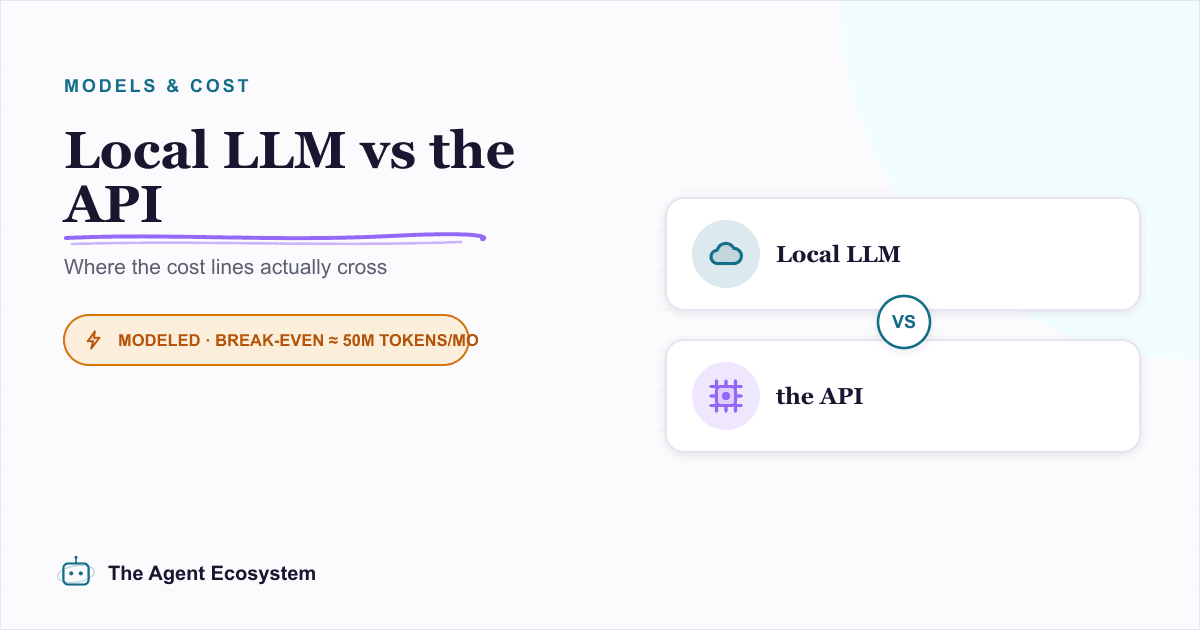
A local LLM is not free; it trades a per-token API bill for a mostly fixed monthly cost. This reproducible break-even model loads both columns (hardware, electricity, and token volume) and shows exactly where local stops costing more than the API.
Should you call a closed API like Claude or GPT, or self-host an open-weight model like DeepSeek or Qwen? Skip the hot takes. This is a four-axis framework (cost, quality, control, privacy) plus a decision flowchart, using dated June 2026 facts.
Local RAG with Ollama lets you ask questions across hundreds of private documents without uploading a single file to the cloud. This guide covers three paths from 20-minute desktop setup to n8n pipelines, all at $0 running cost.
Most "local RAG" setups still send your documents to a cloud embeddings API. This guide closes every leak: local embeddings via Ollama, a self-hosted Qdrant or PGVector store, and a local answering model, all in n8n.
A context window is the token budget for one request, and input plus output share it. Bigger windows hold more text but do not read it all equally: the lost-in-the-middle effect means facts buried mid-context get recalled worse. Here is how tokens, limits, and placement actually
Z.ai's GLM-5.2 ships open weights under MIT and reportedly leads the open-weight field on SWE-bench Pro while trading blows with Opus 4.8 on FrontierSWE and MCP-Atlas, at roughly one-sixth of GPT-5.5's blended cost. The catch is a hosted-API data-residency caveat.
To reduce AI API costs you need levers that change the bill by a verifiable mechanism, not vague advice. This hub names all seven, right-size the model, prompt caching, the Batch API, routing and fallback, local versus API, token discipline, and RAG over long-context, with a
The n8n Basic LLM Chain is the simplest AI building block: one prompt in, one model response out, no tools, no memory, no loops. Wire it up in minutes and keep your token bill predictable at about $1.40 per 1,000 calls on Claude Haiku 4.5.
The credential test fails because n8n looks inside its container, not at Ollama on your host. This guide shows the exact Base URL for every setup: native, Docker Desktop, and Linux server.
The cheapest AI API by published token rate in June 2026 is DeepSeek V4 Flash, but the lowest sticker rate is rarely the lowest bill. Here is a dated, source-linked price table for DeepSeek, Gemini, GPT, and Claude, the cost-per-task math that output tokens dominate, and the
Compare pgvector, Chroma, and Qdrant for local RAG pipelines. Get the three-line decision: already on Postgres, use pgvector; prototyping locally, use Chroma; need scale or heavy filtering, use Qdrant.