The Government Wants 30 Days With Frontier Models: My Take
A June 2026 US executive order invites voluntary early access to frontier models, and GPT-5.6's gated launch shows where it points.
AI-drafted, reviewed by Muhammad Qasim Hammad on July 30, 2026. See our AI disclosure.
Table of contents
A new US executive order asks the makers of the most powerful AI models to let the government look first. It sounds procedural. Read alongside GPT-5.6's quiet, gated launch, it reads more like the outline of a world where the best models reach you later, and on terms you did not set.
What the AI executive order on frontier models actually says#
The June 2, 2026 ai executive order on frontier models invites a developer of a designated covered model to voluntarily give the federal government up to 30 days of pre-release access for security review, per the White House action. It attaches confidentiality, cybersecurity, insider-risk, and intellectual-property protections. Crucially, it is voluntary, not a license.
That single word, voluntary, is doing a lot of work, so it is worth pinning down what the order sets up versus what people fear it does. The framework and benchmarking deliverables are due by August 1, 2026, and the NSA director makes the model designations alongside the national cyber director, OSTP, and CISA (WilmerHale client alert, June 2, 2026). No agency gets a veto over a launch, and nothing in the text transfers ownership of a model or its weights.
| Provision | Detail | Source |
|---|---|---|
| Order signed | "Promoting Advanced Artificial Intelligence Innovation and Security," June 2, 2026 | White House action, June 2, 2026 |
| Early access | Developer may voluntarily give the government up to 30 days pre-release | White House action, June 2, 2026 |
| Legal form | Voluntary framework, not a license or approval mandate | WilmerHale client alert, June 2, 2026 |
| Who designates | NSA director, with the national cyber director, OSTP, and CISA | WilmerHale client alert, June 2, 2026 |
| Deliverables due | Benchmarking process and framework by August 1, 2026 | White House action, June 2, 2026 |
| First visible case | GPT-5.6 previewed to about 20 approved partners, June 26, 2026 | CNBC reporting |
Table: key facts of the June 2, 2026 executive order (sources dated June 2, 2026 and CNBC reporting; verify as of early July 2026).
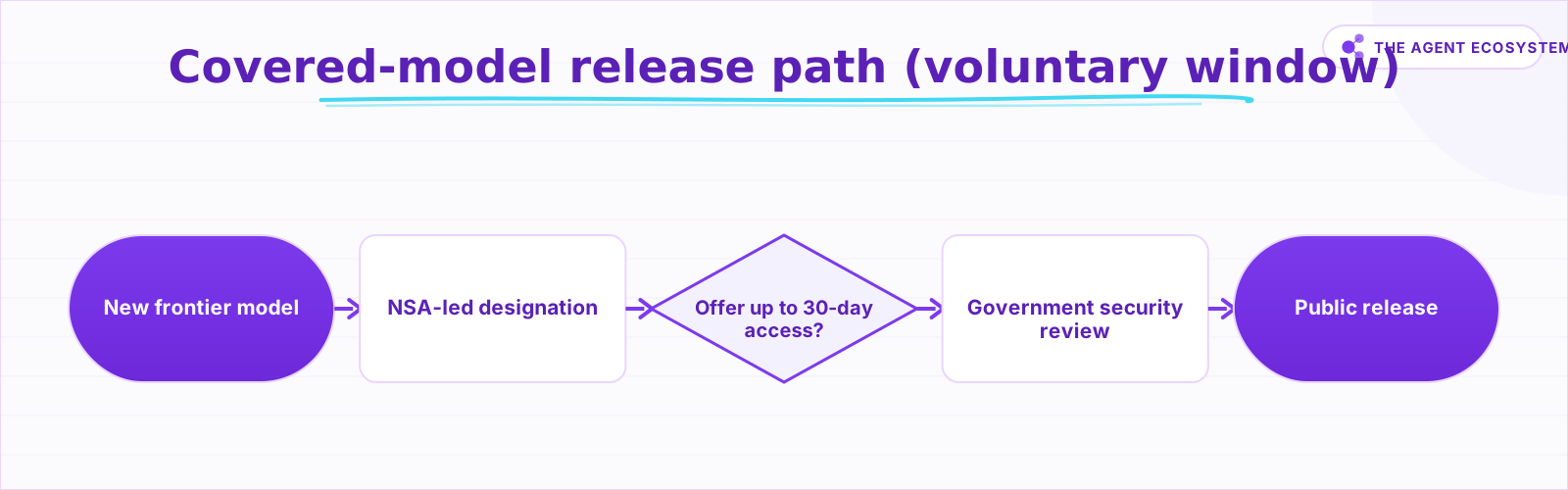 The release path a designated covered frontier model can follow under the June 2, 2026 order (White House action, June 2, 2026). The 30-day window is voluntary.
The mechanics matter because the headline framing is easy to overshoot in both directions. This is not nationalization, and it is not a rubber stamp. It is a structured invitation with legal guardrails, aimed at the handful of labs building the models the government considers most sensitive.
What the order does, and what it explicitly does not do#
Here is the honest ledger. The order does invite up to 30 days of pre-release access, does set up a voluntary framework, and does give the NSA director the job of naming covered models. It does not require any access, does not create a license, and does not let an agency block your public release (WilmerHale, June 2, 2026).
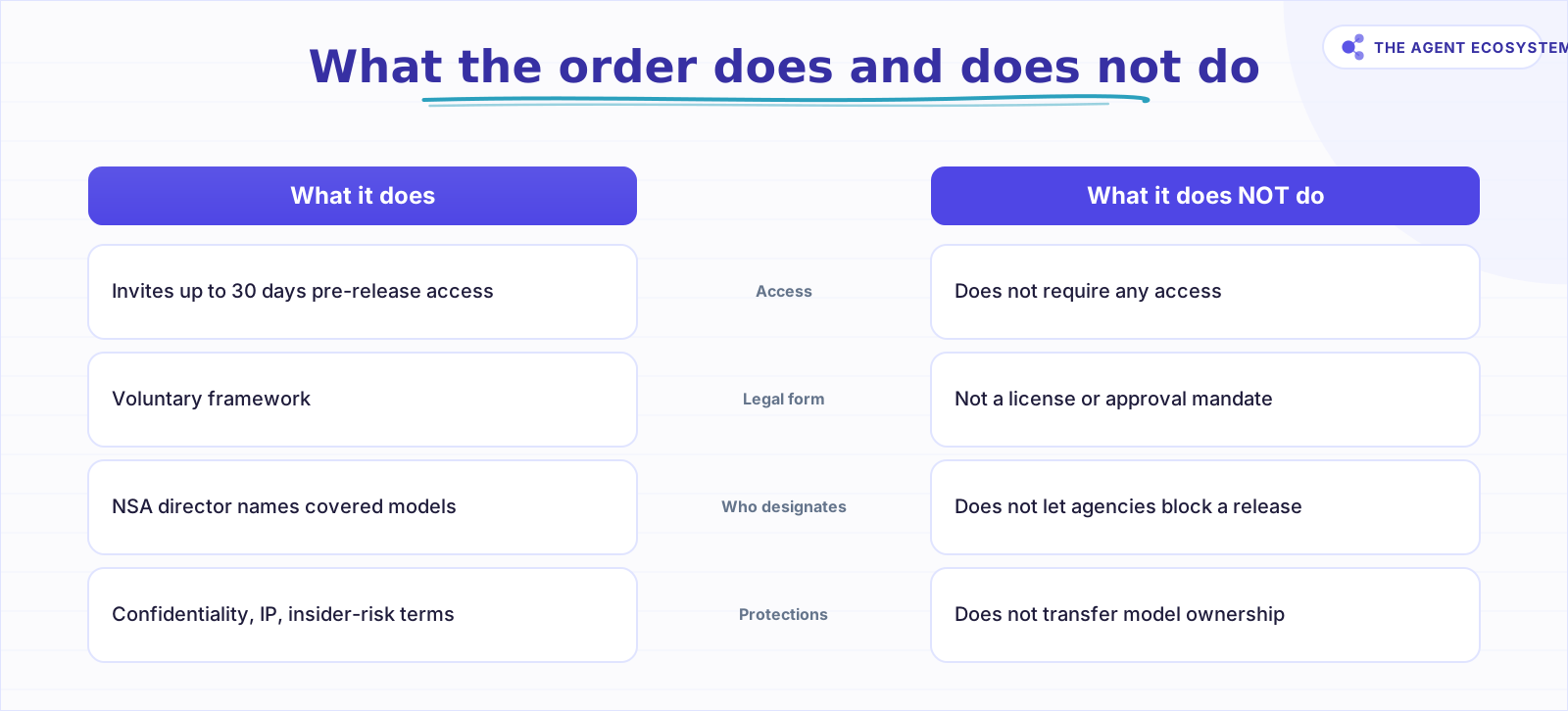 What the order sets up versus what it does not require (WilmerHale client alert and White House action, both June 2, 2026).
I keep both columns in view because the loudest reactions collapse them. Say "government access to AI models before release" out loud and it sounds like a gate. Read the text and it is an opt-in with protections. Both readings can be fair at once: the mechanism today is genuinely voluntary, and the direction of travel is still worth watching. Holding those two thoughts together is the whole point of an honest take, and it is where most hot coverage falls short.
Who counts as a "covered frontier model"?#
A covered frontier model is one designated through a forthcoming classified, NSA-led benchmarking process, per the White House action of June 2, 2026. Its developer may then voluntarily offer the government up to 30 days of pre-release access. Because that benchmarking process is not finished, the exact list of covered models is not public yet.
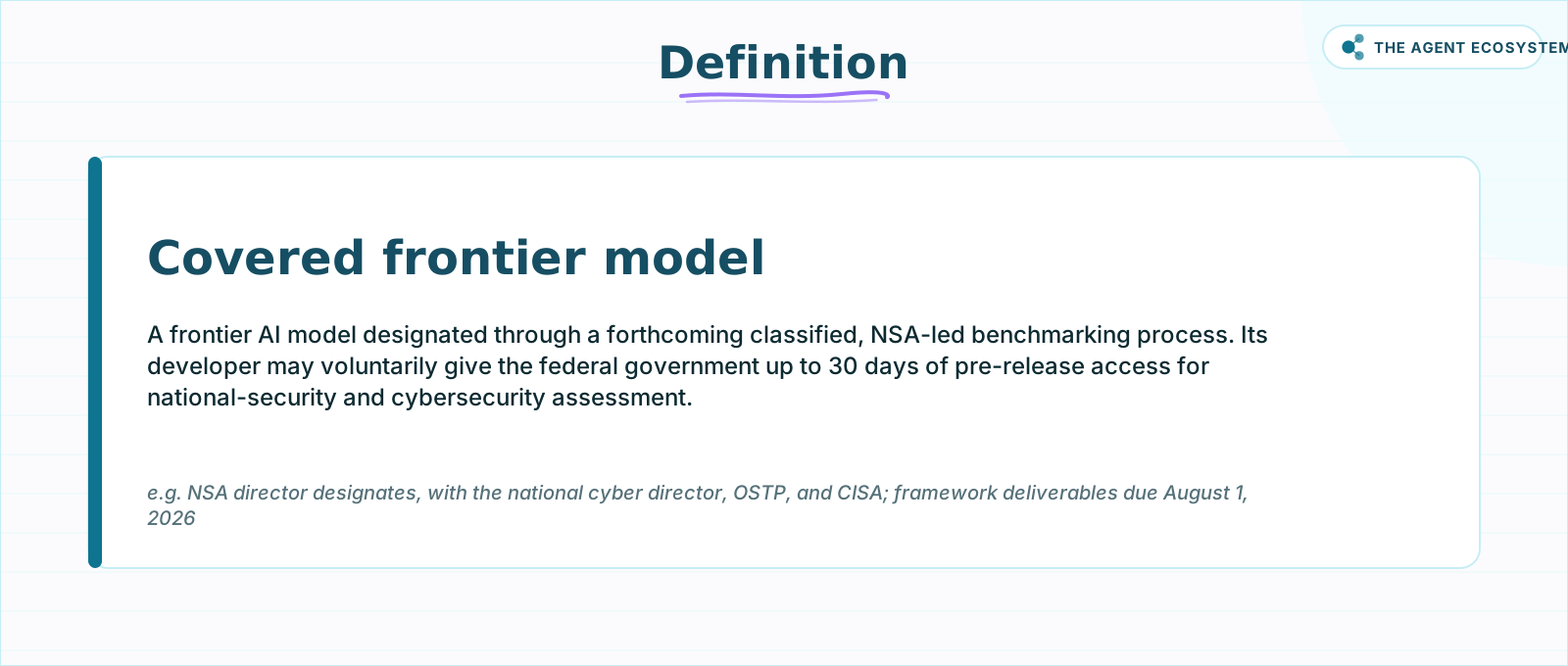 How the order defines the models it covers (White House action, June 2, 2026).
The definition is the part I would watch most closely. A classified benchmarking process means the criteria for "frontier" are set behind closed doors, by the NSA director with the national cyber director, OSTP, and CISA. That is defensible for genuine national-security screening, but it also means the boundary of who is covered can move without a public debate. Today it plausibly touches a few labs. Where that line sits in a year is the open question, and it is not one you or I get to see the math on.
The security case, taken seriously#
Steelmanned properly, the security argument is not hard to make. The most capable models can accelerate cyber intrusion, vulnerability discovery, and other national-security-relevant misuse. Giving a small government team up to 30 days to probe those failure modes before a global launch, under confidentiality and IP protections, is a reasonable precaution, not paranoia (White House action, June 2, 2026).
I want to be fair here, because it is easy to be reflexively anti-oversight. If a frontier model can meaningfully lower the bar for a serious cyberattack, a short, protected pre-release review is a small price against that tail risk. The order's insider-risk and intellectual-property terms show someone thought about the obvious objection: labs will not hand over their crown jewels without protection. On its own terms, the mechanism is measured. My unease is not with this step. It is with the pattern it could set.
My take: watch the precedent, not just the order#
Here is where I land. On its own, this order is a defensible, voluntary security measure, and I would not lose sleep over the June 2, 2026 text alone. My concern is the precedent it normalizes, especially read next to GPT-5.6, which launched June 26, 2026 as a limited preview to about 20 approved partners.
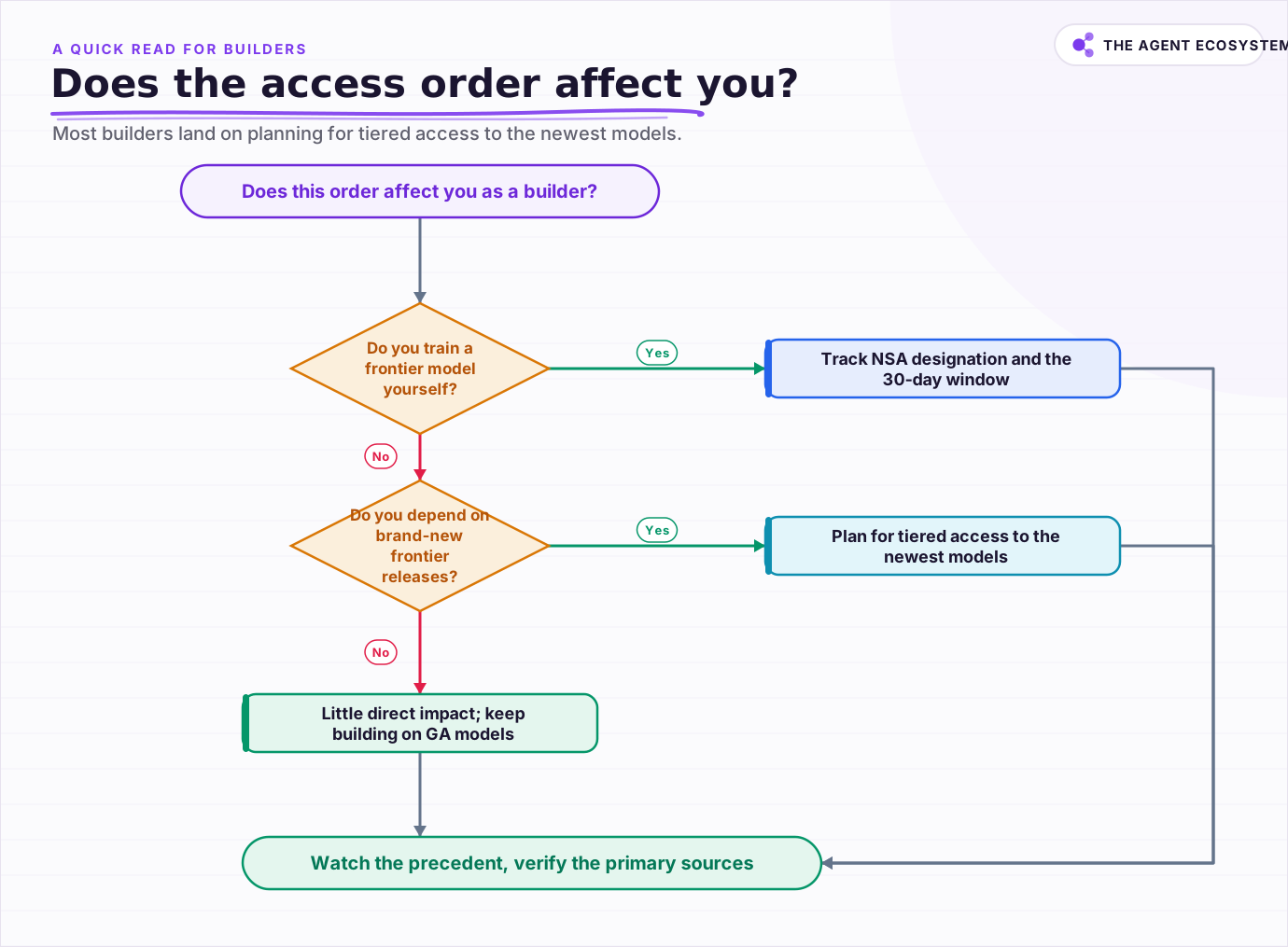 A quick read on whether this order touches your work today; most application builders land on plan for tiered access (author's framing of the June 2, 2026
That GPT-5.6 launch, released "at the behest of the U.S. government" to roughly 20 partners per CNBC reporting, is the first visible case of the dynamic I actually worry about. Stack the two together and a pattern appears: the newest, strongest models arrive first for a vetted inner circle, then for everyone else, later. "Voluntary" and "30 days" are benign words. The world they gently point toward is one where frontier access becomes tiered and time-shifted, and where a solopreneur or small team is structurally at the back of the queue.
My read, stated as opinion and not as any measured claim: for builders, the practical risk is slower and more gated access to frontier models, not this order's letter. I would treat the newest release as a preview I might wait on, keep building on models that are already generally available, and avoid architecting a product around a model I cannot reliably get on day one. I would also watch whether "voluntary" quietly hardens into the expected path to a smooth launch, because that is how soft norms become hard ones.
Where this leaves a small builder#
For most of us, the near-term answer is calm: keep shipping on the models you can already get, and watch the precedent rather than the panic. The order is voluntary today, application builders are not its target, and generally available models are more than enough for real work (author's view, early July 2026).
The move I would make is boring and durable: design for model portability, not model hype. If your product only works with next month's frontier release, a gated or delayed launch can strand you, which is exactly the risk this new access pattern raises. Cheaper, slightly older, already-shipping models cover the overwhelming majority of real tasks, and our guide to the cheapest AI API in 2026 makes that case with dated pricing. If your bill is the pressure point, the same discipline shows up in our seven levers to reduce AI API costs. Treat frontier access as a nice-to-have, not a dependency, and this whole debate becomes something you monitor rather than something that can break your roadmap.
As always, treat every figure and date in this piece as accurate to early July 2026 and verify before relying, because AI policy and model timelines move fast. You can read the order at the White House action and a plain-English legal summary in the WilmerHale client alert.
Frequently asked questions
Does the June 2026 executive order require approval before releasing an AI model?
What is a covered frontier model under the executive order?
How does GPT-5.6 relate to this executive order?
Does the executive order affect me if I build with model APIs?
Is the 30-day early access mandatory for AI labs?
Sources
Primary references and vendor documentation used while drafting and reviewing this article.
Written by

Muhammad Qasim Hammad is an AI agent and automation expert and the founder of Cart Gaze LLC (cartgaze.com). He builds product for the love of it: when an idea lands, a working prototype is usually running within hours, built with the same AI agents and automations he sells. He puts his own output at roughly 20× what it was before agents, and the Agentic OS behind this site is the working proof, documented in public with the tools he actually ran and what they really cost.
AI & Automation Services
Want a pipeline like this running in your business?
I'm Qasim — I design and ship AI agents and n8n automations for solo operators and small teams. Tell me what's eating your team's week, and I'll scope a fix.
Related reading
GPT-5.6 Explained: Sol, Terra, Luna, and a Limited Launch
OpenAI previewed GPT-5.6 on June 26, 2026 in three tiers, Luna, Terra, and Sol, with public per-token prices. The twist is access: launch was limited to roughly 20 partners at the behest of the U.S. government, with general availability promised in the coming weeks. Here is the

Fable 5 vs GLM 5.2 vs GPT-5.6: The 2026 Frontier Landscape
Three frontier models landed in June 2026: Claude Fable 5, Z.ai's open-weight GLM-5.2, and OpenAI's limited-preview GPT-5.6. The numbers do not all measure the same thing, so here is an honest, dated comparison on coding score, price, and openness.
GPT-5.6 Is Now Public: What GA Changes for Builders
For two weeks GPT-5.6 was a limited preview most builders could not touch. On July 9, 2026, OpenAI made Sol, Terra, and Luna generally available across the API, Codex, and ChatGPT. Here is what changed for builders, and what to verify before you adopt it.
The 2026 Model Wave: What It Changes for Automation Builders
Three model releases landed in two weeks in June 2026: Fable 5, open-weight GLM-5.2, and limited-preview GPT-5.6. Skip the leaderboard drama. Here is the builder's take on which model belongs on which workflow step, with every price and benchmark dated and attributed.
DeepSeek V4 Is '8 Months Behind' the Frontier. That's Fine.
An official US evaluation says DeepSeek V4 Pro lags the frontier by about eight months. It gets quoted as a verdict. My take: for most real coding and automation work, an open-weight model that is eight months behind at a fraction of the price is not a compromise, it is the
Open-Weight vs Closed LLMs in 2026: Cost, Quality, Control
Should you call a closed API like Claude or GPT, or self-host an open-weight model like DeepSeek or Qwen? Skip the hot takes. This is a four-axis framework (cost, quality, control, privacy) plus a decision flowchart, using dated June 2026 facts.