Open-Weight vs Closed LLMs in 2026: Cost, Quality, Control
A cost, quality, control, and privacy framework for picking your 2026 model, with a decision flowchart instead of a hot take.
AI-drafted, reviewed by Muhammad Qasim Hammad on July 10, 2026. See our AI disclosure.
Table of contents
You are staring at two boxes on an architecture diagram and one open question: call a closed API like Claude or GPT, or download an open-weight model like DeepSeek or Qwen and run it yourself. The SERP is wall-to-wall opinion, half of it stale. This post gives you a four-axis framework and a decision flowchart instead of a hot take.
Open-weight vs open-source vs closed: what the words actually mean#
The open weight vs closed llm choice is not "free versus paid" or "open source versus proprietary." It turns on who holds the model file and on what terms. Open-weight means the trained weights are downloadable and you self-host them, though the license may restrict use. Closed means the weights never leave the vendor.
That distinction sounds pedantic until a license bites you. MIT (DeepSeek, GLM) and Apache 2.0 (Qwen, Mistral's open tier) are genuinely permissive: commercial use, self-hosting, fine-tuning, all allowed. Llama 4 is different. It ships under Meta's custom Llama 4 Community License, which requires companies above 700 million monthly active users to request a separate license at Meta's discretion, and it forces a "Built with Llama" attribution. That is "source available," not OSI-open. The 700-million-user clause will never touch a startup, but the attribution requirement and the fact that Meta can decline to grant the license at scale are real terms a legal team should read before standardizing on it.
Closed models such as Claude, GPT, and Gemini give you the model's behavior through an API and never the file, so "open versus closed" really turns on whether you can ever hold the weights at all. Here the leading open shortlist actually favors the permissive end: DeepSeek V4 and GLM-5.2 are MIT, Qwen3 is Apache 2.0, and Mistral ships an Apache-licensed open tier. The conditional licenses are the exception on this list, not the rule, which is good news if a permissive license is a hard requirement for you.
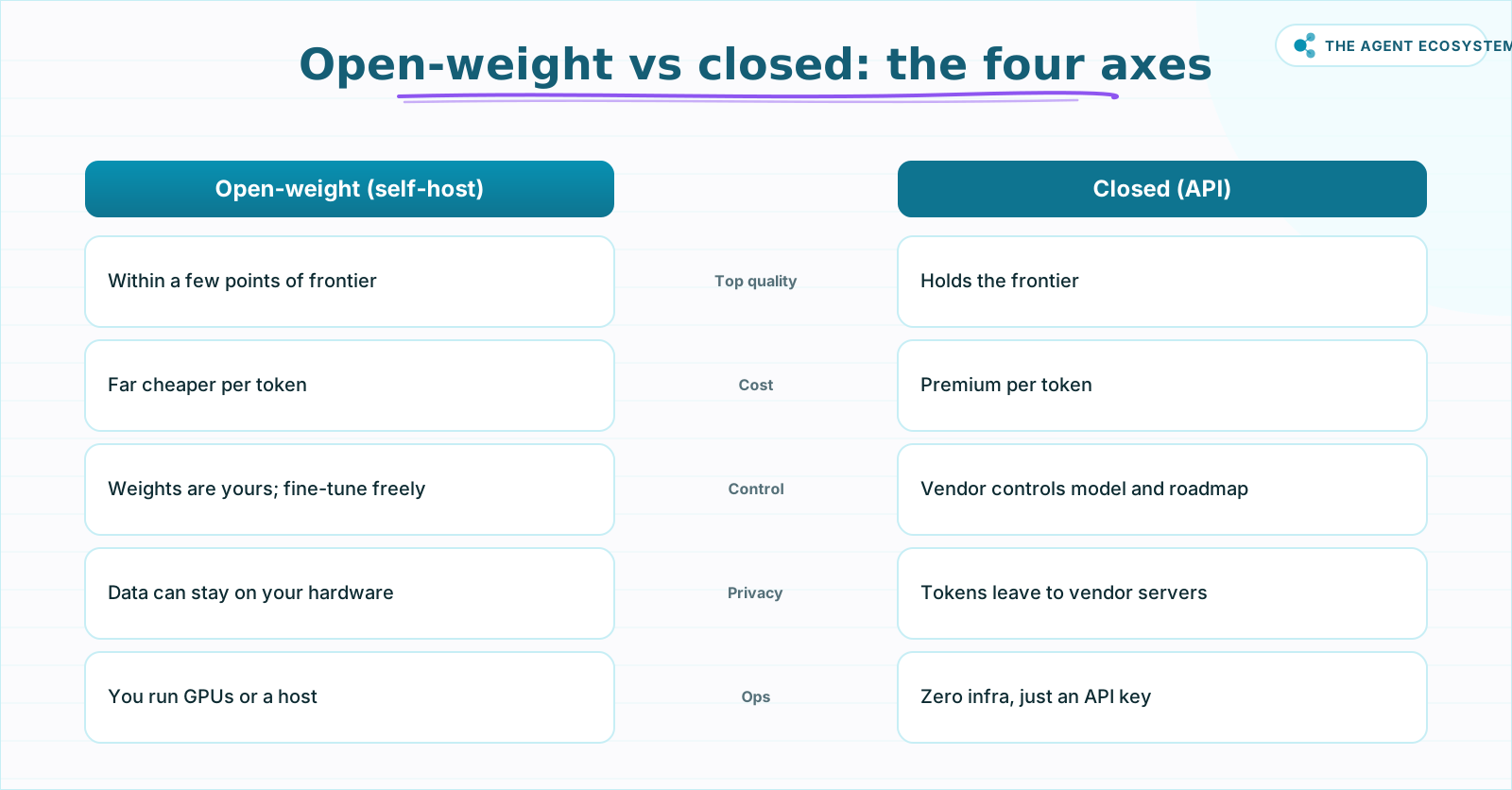 Closed wins the quality ceiling and zero-ops; open wins cost, control, and data sovereignty. Most teams end up running both.
Keep the three buckets straight before you compare anything else: closed (API only), open-weight permissive (MIT/Apache, run and modify freely), and open-weight conditional (community licenses with scale or attribution strings). Most of what people call "open source AI" lives in that middle and third bucket, not the first. The practical test is simple: can you download the file, run it offline, and modify it for commercial use without asking anyone? If yes, it is open-weight and permissive. If you can download it but a clause caps who may use it or forces attribution, it is open-weight conditional. If you can never get the file at all, it is closed. Sorting a candidate model into one of those three before you look at benchmarks saves you from a license surprise after you have already built on it.
How big is the quality gap in 2026, really?#
The honest number is small. On the Artificial Analysis Intelligence Index June 2026 snapshot, the best closed models sit near 55 to 56 (Claude Opus 4.8 around 56, GPT-5.5 around 55), and the best open-weight model, GLM-5.2, sits near 51. That is roughly five points, not a chasm. Treat these as dated figures.
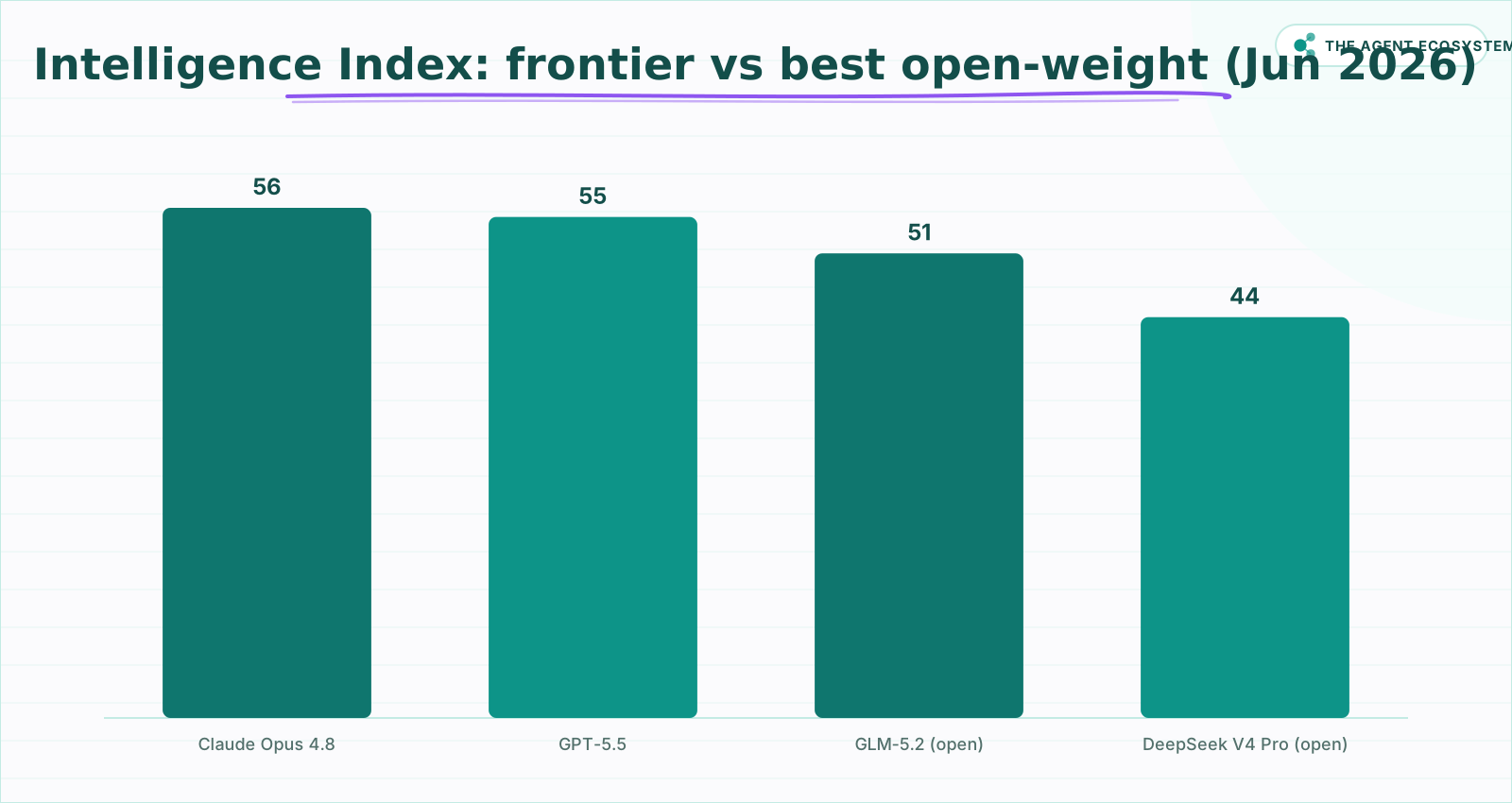 Best open-weight (GLM-5.2) trails the best closed (Claude Opus 4.8) by roughly five points on this snapshot. Source: Artificial Analysis, Jun 2026, verify
Where the gap is widest: the hardest agentic and long-horizon tasks (WebArena and OSWorld style browsing and tool use) and the toughest science reasoning still favor the frontier, per Hugging Face's open-model analysis. That is the last meaningful moat, and it is narrowing. Where the gap is effectively closed: routine generation, classification, extraction, summarization, and a large share of everyday coding. For the bread-and-butter work most automations actually run, open-weight models are at or near parity.
The caveat that decides how you use any of this: the leaderboard moves monthly. New closed flagships land, new open challengers land, and rankings reshuffle. OpenRouter frames the lag as a rolling three-to-six-month gap behind the frontier, not a permanent one. Treat any single ranking as a snapshot with a date on it, and re-check the week you actually choose.
One more warning about third-party numbers: you will see blog superlatives like "34x cheaper" or "the number four model on Earth" thrown around this topic. Those are un-anchored marketing claims. Do not restate them as fact. Stick to a dated leaderboard snapshot and the vendor's own price page, both of which you can reproduce, and you will avoid quoting a figure that was already stale when it was published.
What does the cost picture look like?#
The cost gap runs opposite to quality and is large. Anchor to official price pages. DeepSeek lists its open-weight v4-flash near $0.14 input and $0.28 output per million tokens. A closed frontier like GPT-5.5 runs $5 input and $30 output, and Claude Opus 4.8 is $5 and $25. That is an order-of-magnitude difference per token.
But "API price" is not "self-host cost." Running open weights yourself swaps per-token fees for GPU rental or ownership, plus engineering and ops time. The economics only flip in open's favor above some steady volume, and the break-even is genuinely fuzzy: third-party estimates for where self-hosting beats an API range widely, roughly a few million to a few tens of millions of tokens per day depending on the GPU, utilization, and salary assumptions baked in. That range is wide enough that you should distrust any source quoting a single clean number. The two variables that move it most are GPU utilization (an idle rented A100 still bills you) and whether you count engineering time honestly. Present the break-even to yourself as a directional band, never a precise threshold, and model your own numbers with your own hardware and your own salaries in the spreadsheet.
| Model | Access | Input $/MTok | Output $/MTok |
|---|---|---|---|
| DeepSeek V4 Flash | Open-weight (MIT) | 0.14 | 0.28 |
| DeepSeek V4 Pro | Open-weight (MIT) | 0.435 | 0.87 |
| Claude Opus 4.8 | Closed (API) | 5 | 25 |
| GPT-5.5 | Closed (API) | 5 | 30 |
There is a pragmatic middle path most comparisons skip: you can rent open weights through a hosting provider and never buy a GPU. That keeps most of the per-token cost win without the ops burden, sitting between "call a closed API" and "own a cluster." If cost is the whole question, the same dated-pricing discipline runs through our guide to the cheapest AI API in 2026, and the levers in reducing AI API costs apply before you ever consider self-hosting.
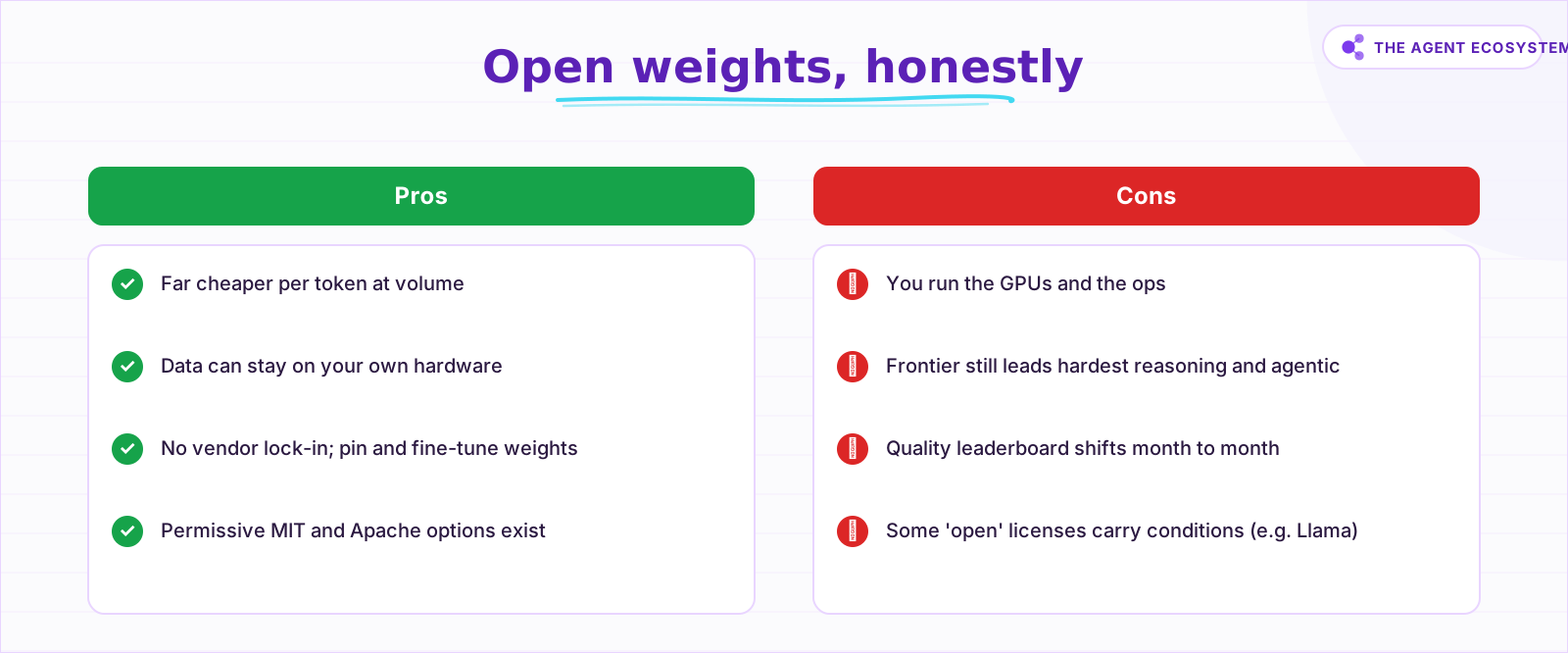 Open weights trade vendor convenience for control and cost. The cons are mostly operational, not capability, but agentic tasks still favor the frontier.
So which should you pick? A workload-first decision#
Let the workload's hardest constraint decide, in order: privacy and control first, then the quality ceiling, then cost. Pick open-weight when data cannot leave your infrastructure, you must fine-tune or pin a version, or steady volume makes API cost dominate. Pick closed when you need top reasoning, want zero infrastructure, or run bursty volume where the premium is noise.
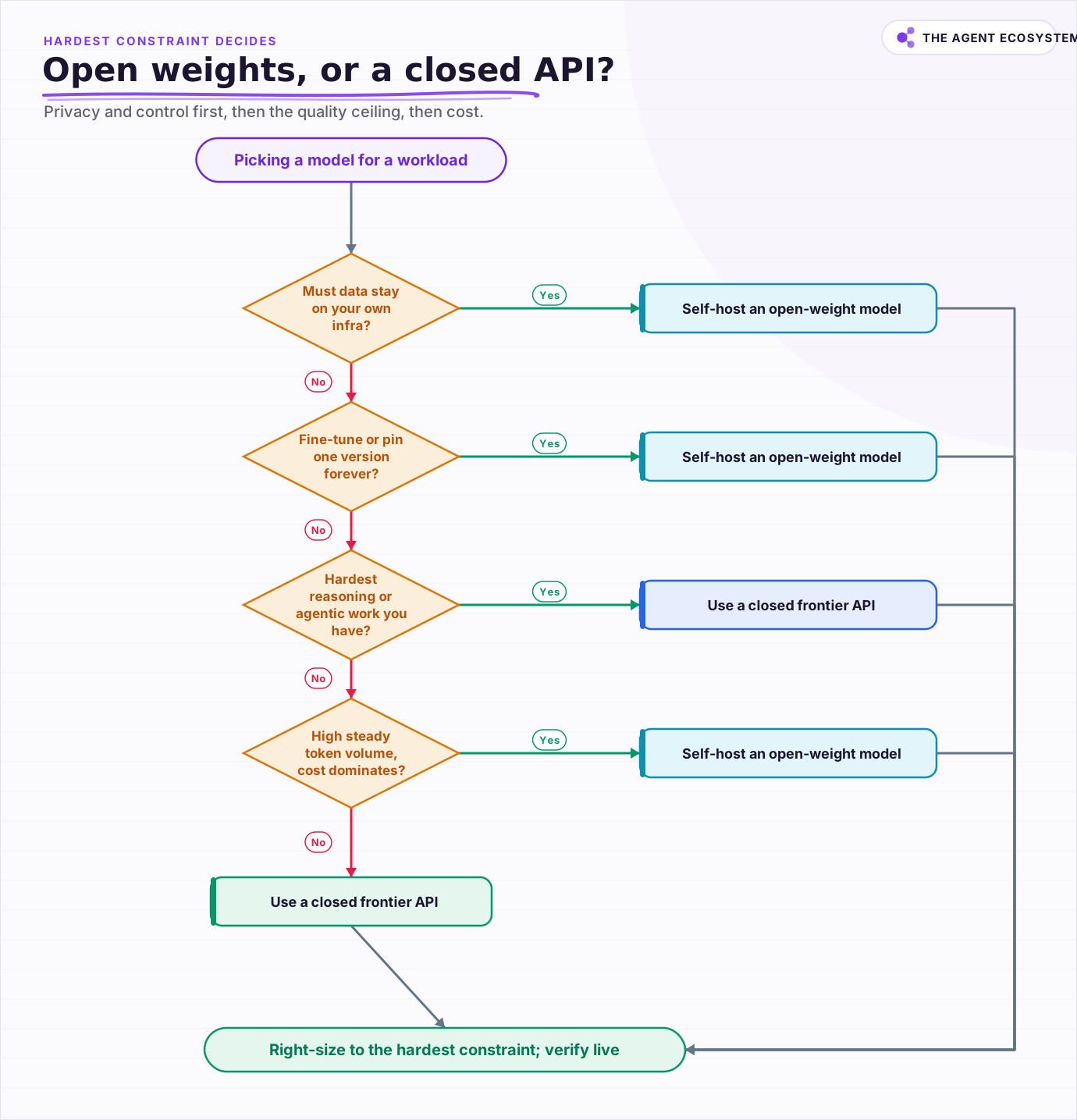 Let the workload's hardest constraint decide: privacy and control first, then the quality ceiling, then cost.
Some constraints are hard requirements that a closed API literally cannot meet, and those settle the question before quality or cost enters the room. If your data legally cannot leave controlled infrastructure (PHI, certain financial or defense data, residency-bound personal data), the tokens simply cannot go to a vendor's servers, and zero-retention enterprise tiers reduce but do not erase that legal exposure. Air-gapped inference, permanent version pinning, and fine-tuning the actual weights are the same kind of non-negotiable.
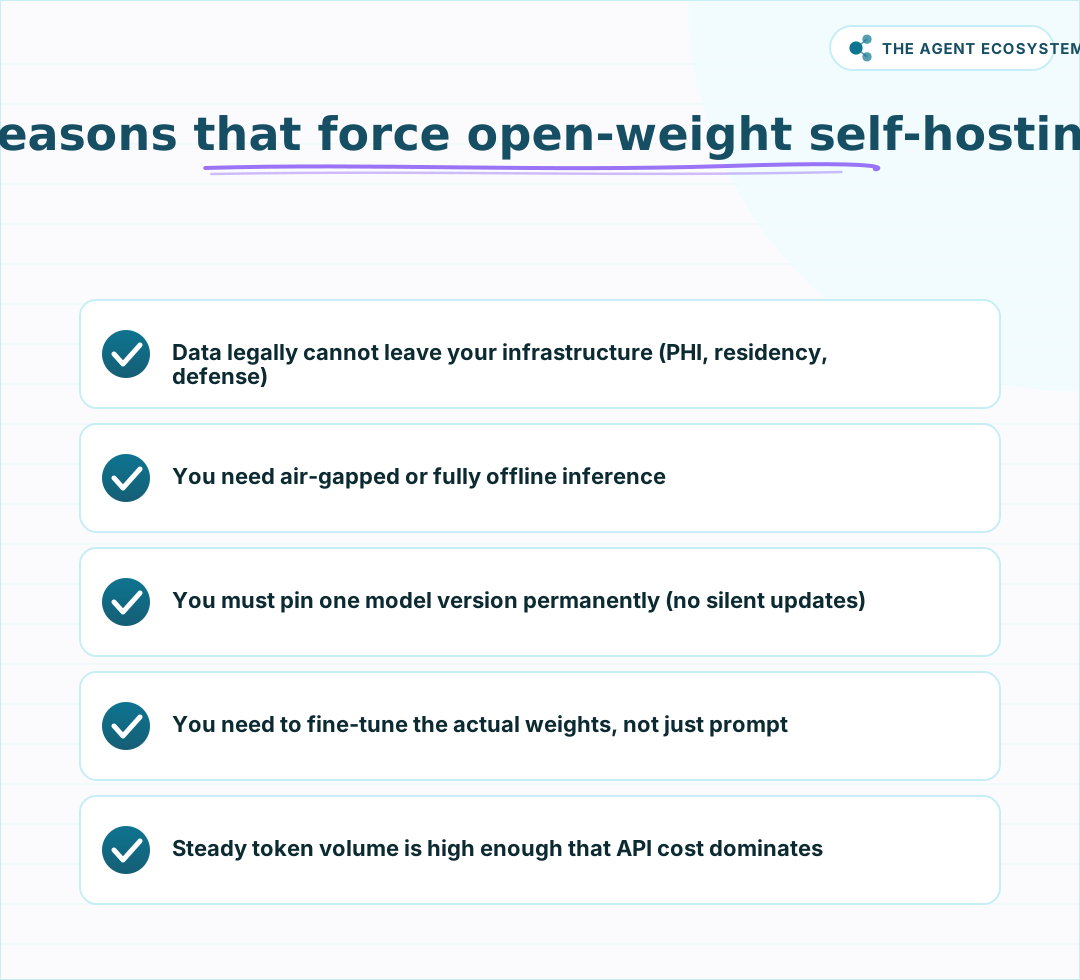 If any one of these is non-negotiable for your workload, open-weight self-hosting is the answer regardless of the quality gap.
The real-world answer for most teams is usually "both." Route sensitive, high-volume, or commodity work to self-hosted open weights, and send the hardest reasoning and bursty spikes to a closed API. Surveys of enterprise deployments increasingly describe this hybrid pattern as the mature default, with most orgs running several models and operating some inference themselves. Frame hybrid as the grown-up choice, not a fence-sit.
A concrete version of hybrid looks like this. Your classification, extraction, and summarization jobs, the ones that run millions of times and touch customer data, go to a self-hosted open-weight model where the tokens never leave your network and the per-call cost is a rounding error. Your one hard planning agent, the feature nobody can ship a worse version of, calls Claude or GPT and eats the premium because it runs a few thousand times a day, not a few million. You get the sovereignty and cost win where volume lives and the quality ceiling where it matters. If you are testing open weights locally before you scale, our comparison of Ollama, LM Studio, and Jan covers the runners that make it painless.
What is the honest bottom line?#
Decide by the workload, not the hype. The quality gap to the frontier is now small (about five points on the June 2026 index) and widest only on the hardest agentic work. The cost gap runs the other way and is large, but self-hosting adds GPU and ops that pay off only above real volume. Most teams end up hybrid.
Frequently asked questions
Is "open-weight" the same as "open-source"?
Are open-weight models as good as Claude or GPT now?
Which is cheaper, open-weight or closed?
When must I use an open-weight model?
Llama vs Claude, which wins?
Sources
Primary references and vendor documentation used while drafting and reviewing this article.
- Artificial Analysis Intelligence Index (June 2026 model leaderboard and blended prices)
- OpenRouter: the open-weight models that matter (June 2026), licenses and 3-6 month gap framing
- Hugging Face: open-model analysis (licenses, agentic-task gap)
- Llama 4 Community License (700M-MAU clause, Built with Llama attribution)
- DeepSeek official API pricing (v4-flash, v4-pro per MTok, 1M context)
- OpenAI API pricing (GPT-5.5 per MTok, cached input)
- Claude pricing (Opus 4.8 per MTok)
- Enterprise open-weight vs proprietary comparison (hybrid pattern, self-hosting break-even range)
Written by

Muhammad Qasim Hammad is an AI agent and automation expert and the founder of Cart Gaze LLC (cartgaze.com). He builds product for the love of it: when an idea lands, a working prototype is usually running within hours, built with the same AI agents and automations he sells. He puts his own output at roughly 20× what it was before agents, and the Agentic OS behind this site is the working proof, documented in public with the tools he actually ran and what they really cost.
AI & Automation Services
Want a pipeline like this running in your business?
I'm Qasim — I design and ship AI agents and n8n automations for solo operators and small teams. Tell me what's eating your team's week, and I'll scope a fix.
Related reading
GLM-5.2: Open-Weight Frontier Coding at a Fraction of the Cost
Z.ai's GLM-5.2 ships open weights under MIT and reportedly leads the open-weight field on SWE-bench Pro while trading blows with Opus 4.8 on FrontierSWE and MCP-Atlas, at roughly one-sixth of GPT-5.5's blended cost. The catch is a hosted-API data-residency caveat.

How to Choose an LLM for Your n8n AI Agent (2026)
Kimi K3, GLM-5.2, DeepSeek V4, Claude, and GPT all plug into an n8n AI Agent, and they are not interchangeable. Here are the 5 questions that decide the pick for your agent, and why the honest answer for most workflows is to route by task, not standardize on one.
DeepSeek V4 Is '8 Months Behind' the Frontier. That's Fine.
An official US evaluation says DeepSeek V4 Pro lags the frontier by about eight months. It gets quoted as a verdict. My take: for most real coding and automation work, an open-weight model that is eight months behind at a fraction of the price is not a compromise, it is the
Local LLMs for Business: When Running Your Own Is Worth It
Local is free is the sentence that starts most bad local-LLM projects. Eleven lessons on naming a real reason, the costs that never appear on an invoice, sizing hardware to the model, proving privacy properly, and knowing when to give it back.
Fable 5 vs GLM 5.2 vs GPT-5.6: The 2026 Frontier Landscape
Three frontier models landed in June 2026: Claude Fable 5, Z.ai's open-weight GLM-5.2, and OpenAI's limited-preview GPT-5.6. The numbers do not all measure the same thing, so here is an honest, dated comparison on coding score, price, and openness.
The 2026 Model Wave: What It Changes for Automation Builders
Three model releases landed in two weeks in June 2026: Fable 5, open-weight GLM-5.2, and limited-preview GPT-5.6. Skip the leaderboard drama. Here is the builder's take on which model belongs on which workflow step, with every price and benchmark dated and attributed.