Best AI Agent Framework in 2026: CrewAI vs LangGraph vs AutoGen vs n8n
An honest chooser that adds the no-code lane and tells you when to skip frameworks entirely.
AI-drafted, reviewed by Muhammad Qasim Hammad on July 2, 2026. See our AI disclosure.
Table of contents
Search "best AI agent framework" and page one is a wall of posts comparing CrewAI, LangGraph, and AutoGen, almost none of which mention the no-code option or that one of those three is now frozen. The honest answer is that there is no single best AI agent framework: there is the best fit for your task, your team, and whether you want to write code or build no-code.
So this comparison does two things the listicles skip. It puts n8n's no-code AI Agent node on the same table as the three Python frameworks, because a large share of agent work is automation-shaped. And it is current on each project's mid-2026 state, including the most important fact most roundups bury: AutoGen is in maintenance mode.
What makes a "best" AI agent framework in 2026?#
There is no single best AI agent framework, only the best fit for your task, your team, and whether you want code or no-code. Score the options on four things: control versus speed to ship, multi-agent orchestration, durable state with human approval, and project health, meaning whether the project is active or frozen.
Those four criteria do most of the work, and project health is the one the listicles forget. A library can go from "default choice" to "maintenance mode" inside a year, which is exactly what happened to AutoGen. Here are the four contenders side by side:
| Tool | Type | Best for | Curve | Status |
|---|---|---|---|---|
| CrewAI | Python (standalone) | Role-based teams of agents | Easiest | Active, v1.x |
| LangGraph | Python (graph) | Durable, branching, human-in-loop | Steepest | Active, v1.0 GA |
| AutoGen | Python (chat) | Multi-agent conversations | Medium | Maintenance mode |
| n8n AI Agent | No-code / low-code | Tool-using agents in automations | Low | Active, built-in node |
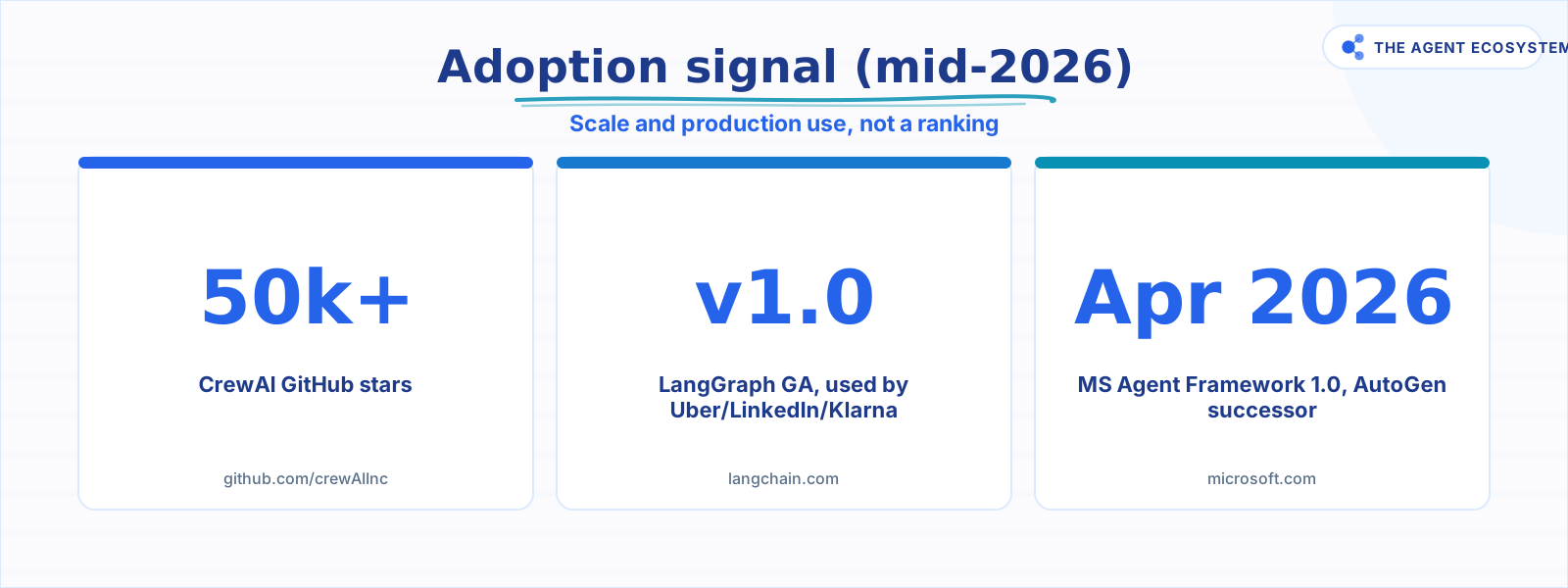 Popularity and production use, not a quality score. Stars and logos are signals; pick on fit, not fame.
Read the adoption numbers as signals of scale and production use, not as a quality score. Popularity tells you a project has community, examples, and staying power; it does not tell you it fits your job. Pick on fit, not fame.
CrewAI: role-based teams, easiest on-ramp#
CrewAI models an agent system as Crews, teams of role-playing agents each with a role, goal, tools, and tasks, with Flows adding event-driven control, state, and retries. It is the easiest framework to start with and the fastest path to a working multi-agent team when the work splits cleanly into specialists.
The mental model maps neatly onto real work: a researcher agent gathers, a writer agent drafts, a reviewer agent checks, and a Flow wires the control around them. As of v1.x, CrewAI is a standalone Python framework that dropped its old LangChain dependency, and it carries a large community of roughly 50,000-plus GitHub stars as of mid-2026. The commercial CrewAI AMP control plane adds managed deployment, observability, governance, SSO, and on-prem or VPC options.
The honest read: it has the gentlest learning curve and gets you to a working crew fast, with less low-level control than LangGraph. CrewAI's own materials claim it runs as much as 5.76x faster than LangGraph on certain QA tasks; treat that as their benchmark, not an independent result, since methodologies differ.
Where CrewAI shines is the on-ramp. You describe each agent in plain terms, a role, a goal, and the tools it may use, then wire them into a task pipeline, and you have a running crew in an afternoon. If your problem genuinely decomposes into named roles, that speed is the whole argument for it.
LangGraph: control, durable state, and human-in-the-loop#
LangGraph models an agent as a stateful graph of nodes and edges where you own the control flow, so cycles, branching, retries, and pauses are explicit. It is the most powerful and the steepest to learn, and its built-in checkpointing gives durable runs that resume exactly where they stopped after a crash or a human pause.
LangGraph 1.0 reached general availability on 22 October 2025 with a stability pledge of no breaking changes until 2.0. Its persistence layer is the headline feature: a long-running agent can pause for human approval or survive a crash and pick up exactly where it left off, which is hard to hand-roll. It is used in production by Uber, LinkedIn, and Klarna, and LangChain 1.0's higher-level abstractions now build on top of it.
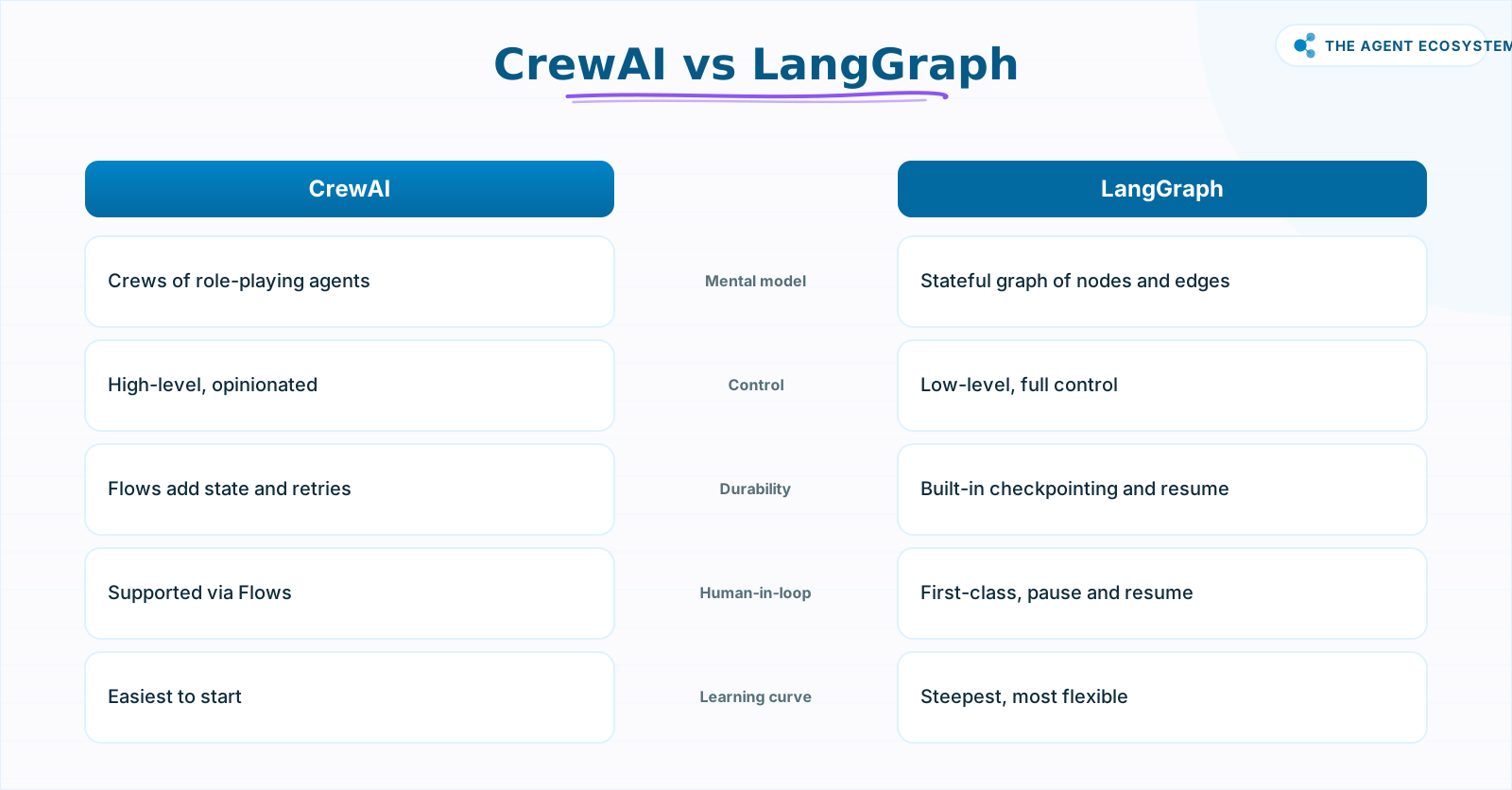 CrewAI optimizes for fast role-based teams; LangGraph optimizes for control, durable state, and resumable runs.
Durable execution is worth a concrete picture. Say an agent drafts a contract, then must wait for a human to approve a clause. With LangGraph the run checkpoints at that pause, the process can shut down entirely, and when the approval arrives the graph resumes from the exact node with its state intact. That is reliability you would otherwise have to rebuild by hand.
The honest read: LangGraph gives you the most control and the strongest production story, including LangSmith observability, in exchange for the steepest learning curve. It is overkill if your agent is a simple tool-caller, and exactly right when one workflow genuinely needs durable state and approval steps.
AutoGen (and its successors: Microsoft Agent Framework + AG2)#
AutoGen pioneered conversational multi-agent collaboration, where agents talk to each other to solve a task, but as of mid-2026 it is in maintenance mode. Microsoft shipped Agent Framework 1.0 as the unified successor, and the original authors maintain a community fork called AG2, so new projects should pick a path on purpose.
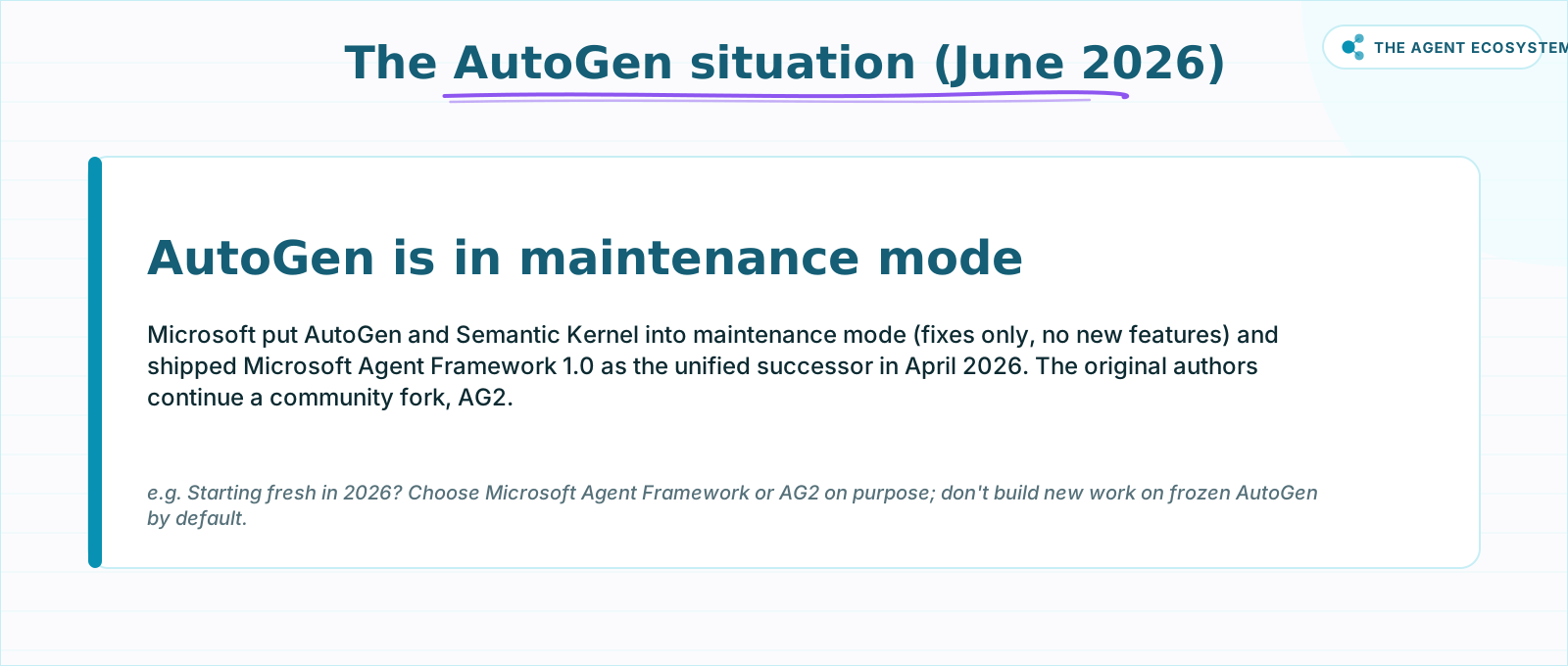 AutoGen still works, but it's frozen. The future is Microsoft Agent Framework (enterprise) or AG2 (community fork).
This is the fact that breaks the usual "AutoGen vs CrewAI" framing, because you would partly be choosing a frozen library. Microsoft put AutoGen and Semantic Kernel into maintenance mode, meaning bug and security fixes only, and released Microsoft Agent Framework 1.0 in April 2026 as the unified successor. It merges AutoGen's simple agent abstractions with Semantic Kernel's enterprise features and adds graph-based workflows with request and response pause points for human-in-the-loop.
The community split also creates a star-count trap: microsoft/autogen shows roughly 55,000 stars while the community fork ag2ai/ag2 shows around 4,000 as of mid-2026, and they are not the same project. The honest read: AutoGen still runs, but start new work on Microsoft Agent Framework if you are on the Microsoft and Azure stack, or AG2 if you want the community-governed continuation.
n8n: the no-code agent lane the listicles skip#
n8n is the no-code lane the framework roundups skip. Its AI Agent node gives you a tool-using, looping agent inside a visual workflow: attach a chat model, connect tools as sub-nodes, and add memory, with no Python and no dependency churn. For automation-shaped agents, it is the fastest path to a governed loop.
A large share of "agent" work is automation-shaped: a trigger fires, the model reasons, it calls a few tools, and it acts. n8n ships that with built-in connectors, a Max Iterations bound (default 10) so the loop cannot run away, Human Review on tool calls, and a Guardrails node. Since v1.82 every AI Agent node is a Tools Agent, and you can even call other agents as tools to build multi-agent orchestration without leaving the canvas. Wiring tools into the node is covered in give an n8n agent tools, and the self-hosted Community edition is zero platform cost.
A concrete shape: a support inbox triggers the workflow, the AI Agent node reads the message, decides whether to search a knowledge base, look up an order, or hand off to a human, and acts, all inside one canvas you can watch run. That visibility, plus built-in retries and guardrails, is why no-code wins for operational agents even when a code framework would be more flexible.
The honest read: n8n has less raw flexibility than LangGraph for exotic graph topologies, but for most builders it is the quickest route to a governed, tool-using agent. Just remember that an agent loop costs more than a single model call, as the agent-vs-chain breakdown shows, so reach for the loop only when the task needs it.
Which agent framework should you pick?#
Pick by how you build and what the work needs. If you can hardcode the path, skip frameworks entirely. No-code goes to n8n. In code, role-split work goes to CrewAI, durable or approval-gated work goes to LangGraph, and an all-Microsoft stack goes to Agent Framework. Do not start fresh on frozen AutoGen.
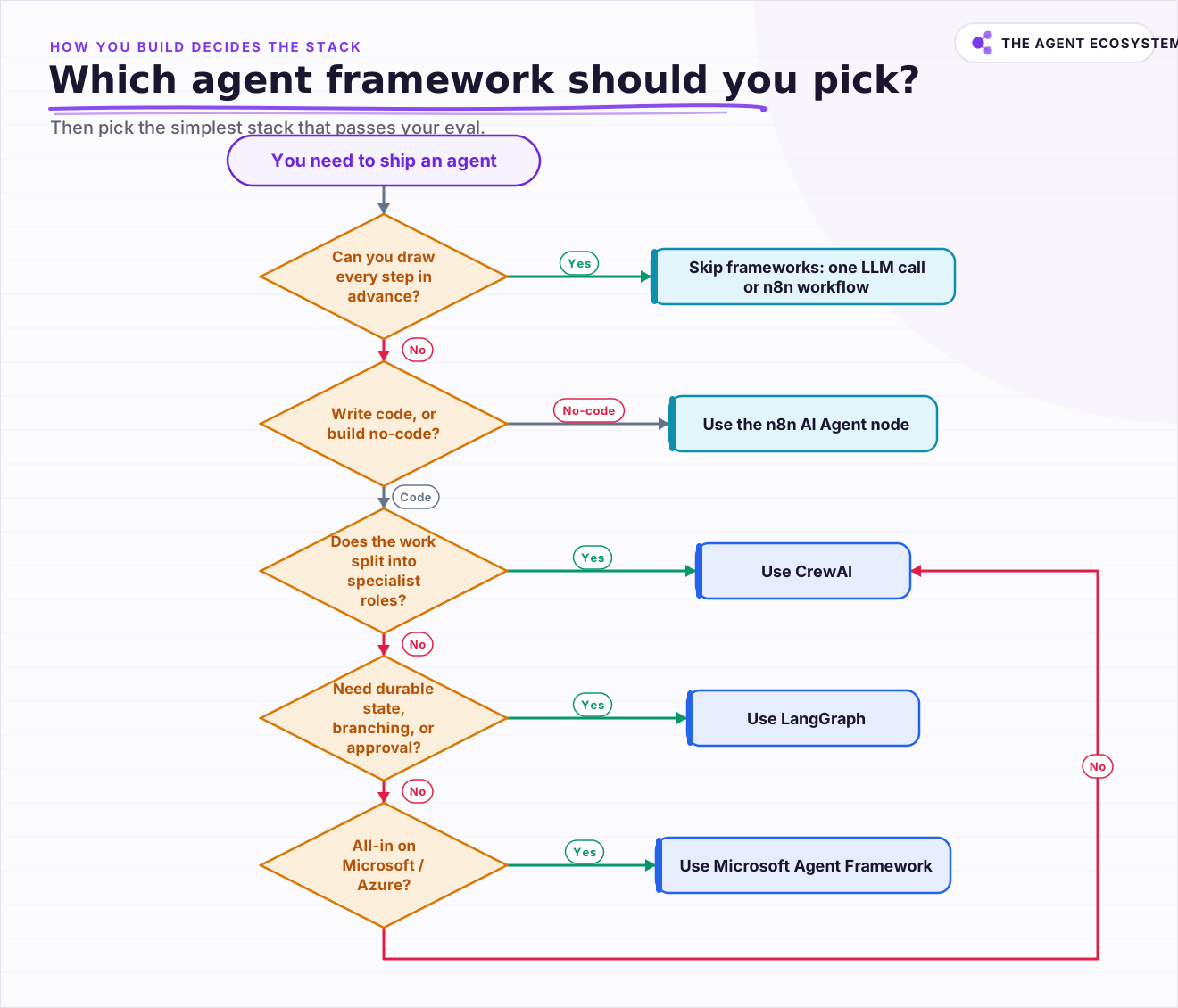 Pick by how you build and what the work needs, then choose the simplest stack that passes your eval.
The flowchart above is the short version; the honest counterpoint is knowing when to use nothing at all.
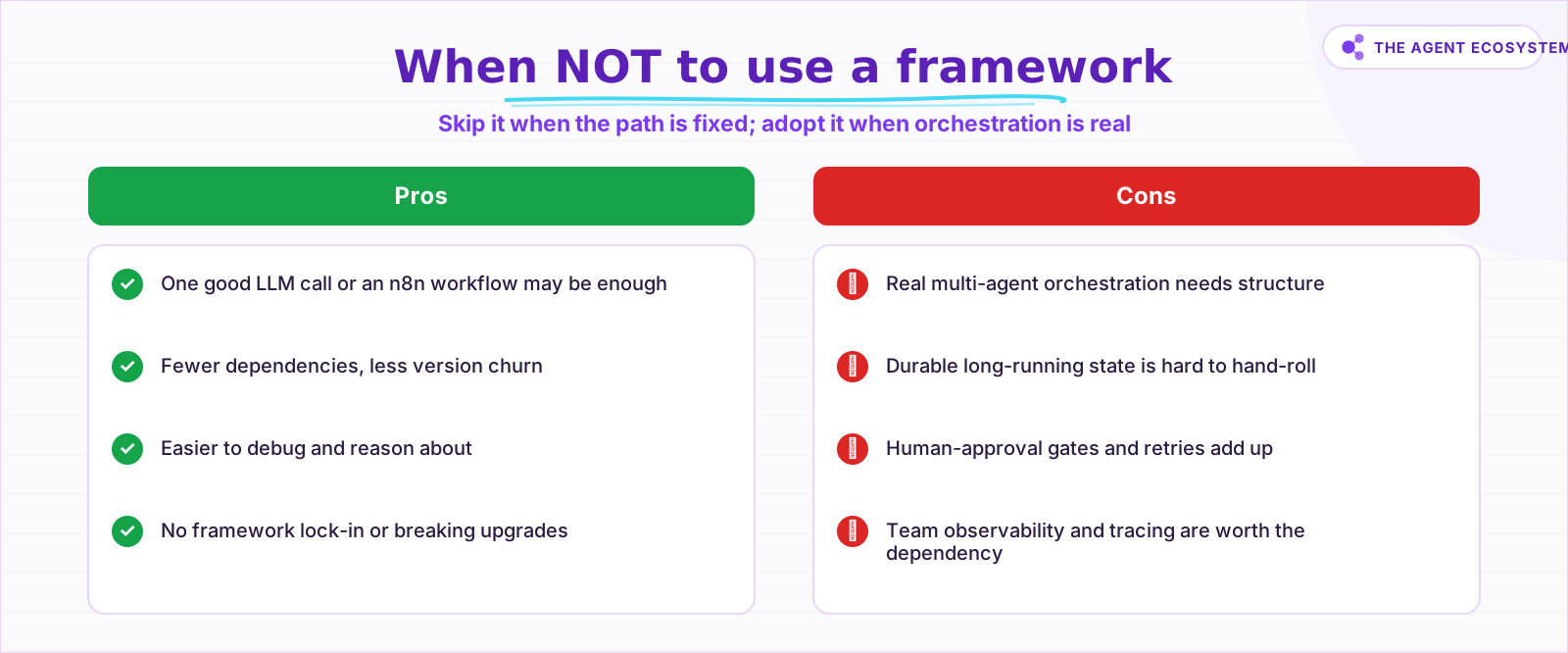 Anthropic's own advice: use the simplest thing that passes your eval. Often that's a workflow, not a framework.
If you can draw the steps in advance, a single well-tooled LLM call or an n8n workflow is simpler, cheaper, and easier to debug than any framework. Frameworks earn their keep on real multi-agent orchestration, durable long-running state, human-approval gates, and team-grade observability. If you want to feel the differences before committing, building the same agent in n8n, Make, and LangChain walks the same task across stacks.
The takeaway holds for every option here: the best choice is the smallest one that passes your eval and matches whether you build in code or no-code. Re-check each project's status before you commit, because in this space "active" and "maintenance mode" can swap within a year, and AutoGen just proved it.
Frequently asked questions
What is the best AI agent framework in 2026?
CrewAI vs LangGraph, which should I choose?
Is AutoGen still maintained in 2026?
Can I build AI agents without a code framework?
When should I not use an agent framework at all?
Sources
Primary references and vendor documentation used while drafting and reviewing this article.
- CrewAI on GitHub (Crews + Flows, standalone since v1.x, star count)
- CrewAI AMP enterprise control plane (managed deploy, governance, SSO, VPC)
- LangChain/LangGraph 1.0 GA (22 Oct 2025, durable execution, production users)
- Microsoft, migrate from AutoGen to Agent Framework (AutoGen maintenance mode)
- Microsoft Agent Framework overview (1.0 successor merging AutoGen + Semantic Kernel)
- AG2 community fork (original AutoGen authors, Apache-2.0)
- n8n AI Agent (Tools Agent) node (reasons + calls tools, Max Iterations default 10, agent-as-tool)
Written by

Muhammad Qasim Hammad is an AI agent and automation expert and the founder of Cart Gaze LLC (cartgaze.com). He builds product for the love of it: when an idea lands, a working prototype is usually running within hours, built with the same AI agents and automations he sells. He puts his own output at roughly 20× what it was before agents, and the Agentic OS behind this site is the working proof, documented in public with the tools he actually ran and what they really cost.
AI & Automation Services
Want a pipeline like this running in your business?
I'm Qasim — I design and ship AI agents and n8n automations for solo operators and small teams. Tell me what's eating your team's week, and I'll scope a fix.
Related reading
Semantic Kernel + AutoGen Merged: The 2026 Agent Framework Shift
Microsoft folded two of its biggest open-source agent projects, Semantic Kernel and AutoGen, into a single production SDK with version 1.0. Here is what the Microsoft Agent Framework bundles, where it sits against LangGraph, CrewAI, and OpenAI's Agents SDK, and how a small team

I Built the Same AI Agent in n8n, Make and LangChain: The Honest Difference
I built the exact same order-status AI agent in n8n, Make.com, and LangChain, then compared setup effort, cost model, portability, and who each platform actually suits.
What Is an AI Agent? A Plain-English Guide for Builders
An AI agent is a language model running in a loop that decides its own next action, not a chatbot and not a chain. Here is how the perceive-decide-act-observe loop works, how an agent differs from a chatbot, chain, and workflow, and a checklist for when you actually need one.
How to Build an AI Agent: The 80% That Survives Week Two
Most tutorials get you a working agent in ten minutes and skip what breaks it in week two. Sixteen lessons covering the loop, tool descriptions, memory, fallbacks, guardrails, evaluation, and the cost levers that decide your bill.
ReAct vs Plan-and-Execute: AI Agent Reasoning Patterns
ReAct and Plan-and-Execute get blurred into one fuzzy idea, but they are two different agent control loops. ReAct decides one step at a time after each result; Plan-and-Execute writes the whole plan up front. Here is the honest split, the trade-offs, and a decision map.
Everyone's Selling AI Agent Factories. You Just Need n8n.
HPE and NVIDIA's AI Factory, NVIDIA's Vera CPU and Agent Toolkit, and NAVER's coming platform are real enterprise agent infrastructure. For a small team, they are mostly noise. Here is where the heavy stack earns its keep, and why I would still default to n8n and one API.