A Real Citation Quotes the Source. Most AI Agents Just Name It.
The mechanism behind inline citations, why a correct citation can still be unfaithful, and how to check the difference.
AI-drafted, reviewed by Muhammad Qasim Hammad on August 31, 2026. See our AI disclosure.
Table of contents
- What does it mean for an agent to ground a claim in a source?
- What does a real inline citation actually look like?
- Why can a citation be correct but not faithful?
- Why is a confidently-wrong citation worse than no citation at all?
- How do you force a model to quote before it summarizes?
- How do you actually check whether a citation is faithful?
- Do citations eliminate hallucination?
- What should you build first?
Imagine a support agent answering a billing question two ways. Version one says: "According to our refund policy, you're covered." Version two says: "Our refund policy states, 'Refunds are issued within 10 business days of an approved return,' so you're covered." The first sentence names a source. The second shows you the exact words it read, which you can check against the real policy in about 10 seconds without leaving the chat. Source grounding is the practice of tying an agent's claim to a specific, quotable passage instead of a document name, and citation faithfulness is the separate, later check for whether that quoted passage actually supports the claim it is attached to.
What does it mean for an agent to ground a claim in a source?#
Grounding means an agent's claim is tied to a specific, checkable passage instead of the model's training memory. An ungrounded agent answers from probability: whatever sounds most likely given its training data. A grounded agent answers from evidence: a retrieved passage it can point back to, quote, and let you verify independently.
Retrieval-augmented generation is the most common way to supply that evidence, but grounding is the broader property. An agent can be grounded through a live database lookup, an API call, or a web search, and it can still fail to be grounded even with a RAG pipeline wired up, if nothing forces the model to actually use what it retrieved instead of falling back on what it already "knows." None of this requires an exotic architecture: a single tool call that returns a real record, with the model instructed to quote from what the tool returned rather than summarize from memory, already satisfies the grounding half of the problem before a single citation gets attached. For the wider set of reasons an agent invents facts in the first place, why AI agents hallucinate covers the general causes and fixes. This post stays narrowly on the citation itself: how a real one gets attached, and how you check that it is telling the truth.
What does a real inline citation actually look like?#
A real citation quotes the exact sentence or span it relies on, not just a document title or a link. Naming a source, "per the handbook," tells you where to look. Quoting a source, "Section 4.2: refunds are processed within 10 business days," tells you exactly what the agent read, in words you can check against the original.
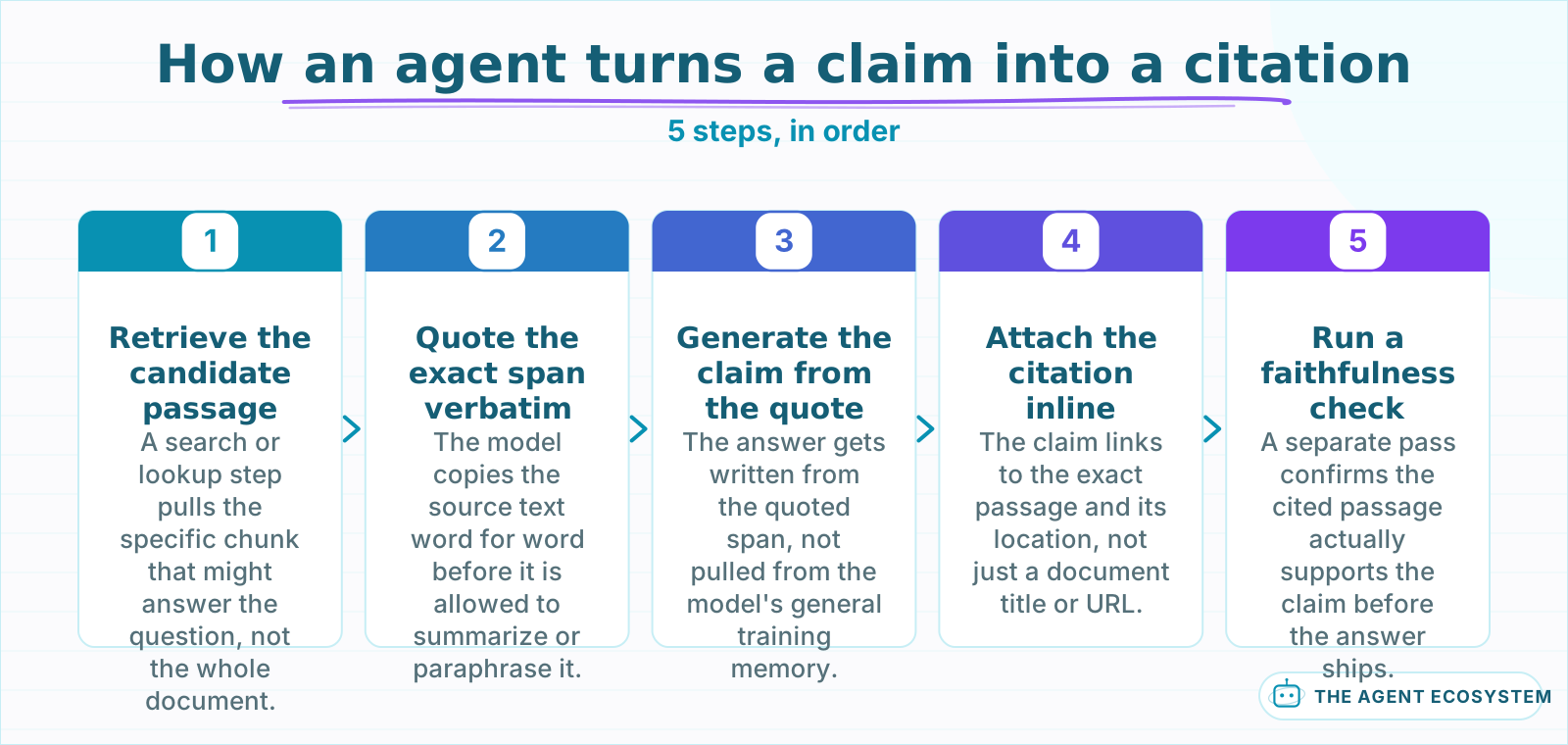 Quoting happens before generating, not after, so the claim has somewhere real to come from.
Three production systems show what this looks like in practice. Anthropic's Citations API chunks a source document into sentences and returns the specific quoted span behind every claim, along with a pointer to where it sits in the source, without requiring a separate embeddings step or vector database. Source Google's Gemini grounding tool returns a groundingChunks list, the actual source material, alongside groundingSupports, which maps individual spans of the generated text back to the specific chunk that backs them. Source Perplexity's Sonar models take a coarser approach: every answer ships with source URLs, and the Sonar Pro tier roughly doubles the citation count per answer compared with the base model. Source
The gap between these approaches is the gap between a footnote and a quote.
| Citation style | What it points to | How fast you can check it |
|---|---|---|
| URL or document name only | The whole source, no span | Slow: you re-read the document |
| Footnote with a page or section | A rough location | Medium: you scan a section |
| Inline quoted span | The exact sentence used | Fast: you compare 2 strings |
Span-level citation costs more engineering up front. It pays that cost back the first time someone actually checks one. None of the three vendor approaches above requires picking a side forever, either. A support agent can ship with URL-only citations for low-stakes answers and switch to span-level quoting the moment a claim touches billing, health, or anything a customer might screenshot and dispute.
Why can a citation be correct but not faithful?#
A citation can be technically correct, the cited document genuinely contains that fact, while still being unfaithful: the model already had the answer and found supporting text afterward instead of actually reasoning from it. Both failures look identical on the page. Only checking whether the quoted passage truly entails the claim tells them apart.
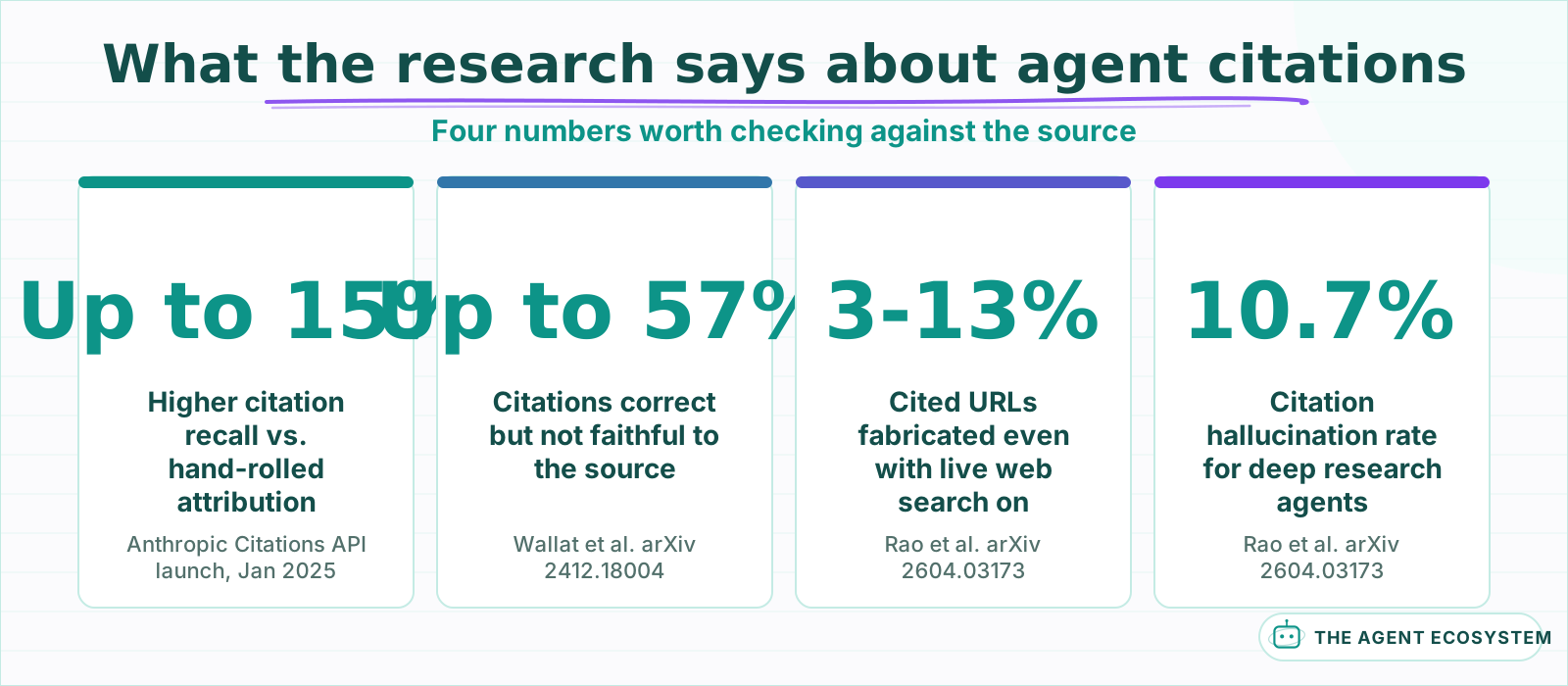 Every number here comes from the cited paper or vendor announcement, not a summary of a summary.
This happens because a language model is a fluent generator first and a retriever second. Asked to answer and cite in the same pass, it can produce a plausible-sounding claim from memory, then separately surface a passage that shares enough vocabulary to look supportive, without the two ever being causally connected. The December 2024 study behind the note above measured this directly and found up to 57% of citations in the RAG systems it tested were correct but not faithful, a pattern the researchers call post-rationalization. Source The uncomfortable part: post-rationalized citations pass every surface check. The link resolves, the document is real, and the passage does contain related words.
Why is a confidently-wrong citation worse than no citation at all?#
An answer with no citation at all invites doubt, so you check it. An answer with a citation attached looks verified, so you often do not. That gap in how much scrutiny each one earns is exactly why a fabricated or unfaithful citation causes more damage than an honest "I don't know" would have.
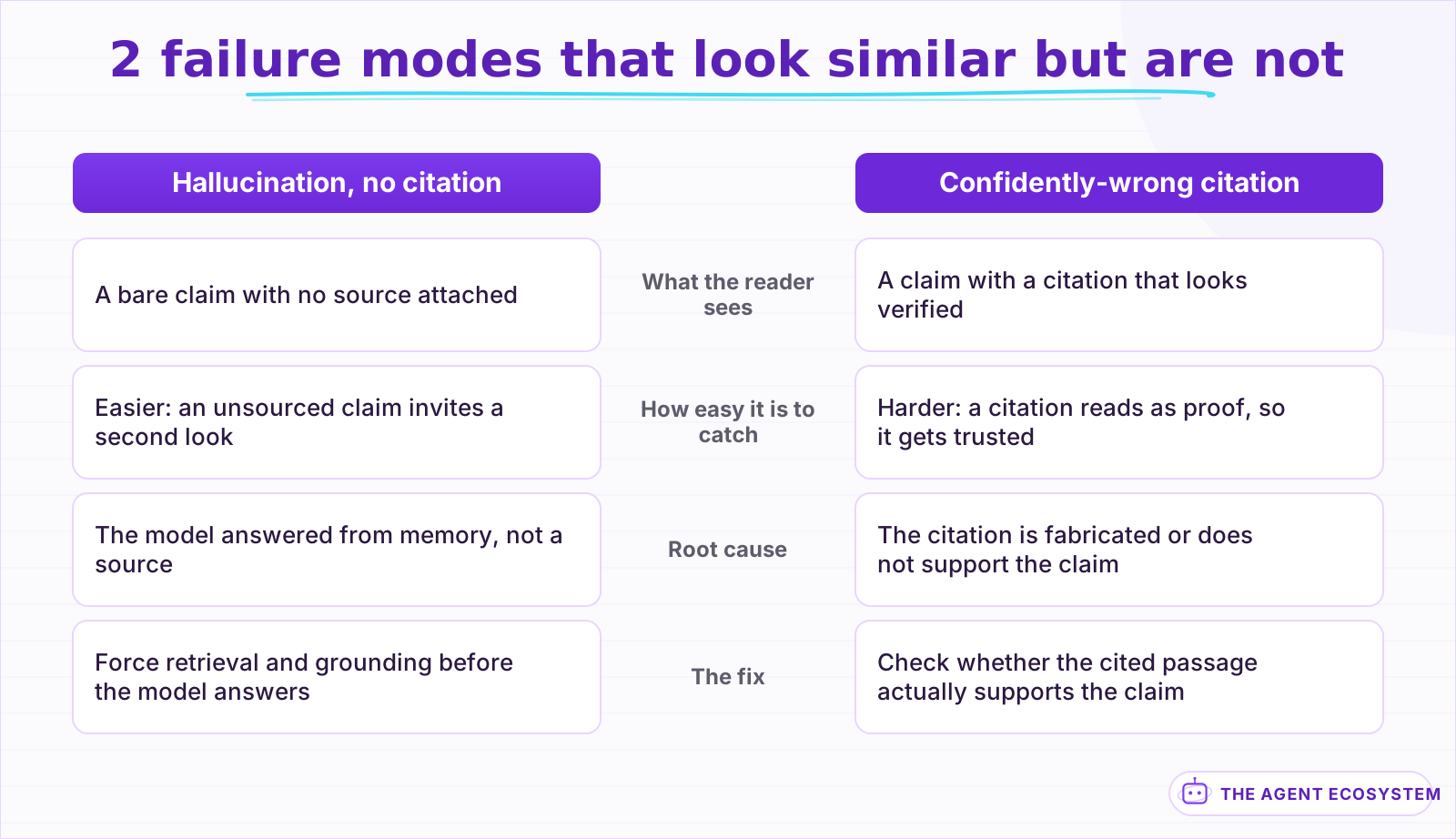 A bare claim invites doubt. A cited claim looks verified, which is exactly why the second failure mode does more damage.
Phantom citations are not rare or theoretical. A 2026 University of Pennsylvania study tested 10 commercial models and research agents against 2 large URL datasets and found 3% to 13% of cited URLs were fabricated even when the model had live web search turned on. Deep research agents specifically hit a 10.7% citation-hallucination rate, roughly double the 4.8% rate of simpler search-augmented chatbots. Source Every one of those fabricated citations was formatted exactly like the real ones next to it: same style, same confidence, no visible tell.
How do you force a model to quote before it summarizes?#
You make quoting a required step, not an optional courtesy. Ask the model to pull the exact sentences that support an answer before it writes the answer itself, then generate the response only from those quotes. Anthropic's own developer documentation recommends this specific technique for any document longer than 20,000 tokens.
The follow-up step matters as much as the first one. After the model drafts an answer, ask it to find a supporting quote for every claim it just made, and to delete any claim it cannot support. Anthropic documents this exact loop, extract quotes first, answer only from the quotes, then re-verify each claim against a quote, as a way to catch a claim that snuck in from training data instead of the source you actually gave it. Source The pattern holds whether you call a dedicated citations feature or build the check yourself in a plain prompt: retrieve, quote, generate from the quote, then verify the quote actually says what the claim says. Anthropic's own example applies this to a compliance review: extract the exact clauses relevant to a regulation first, then write the analysis only from those clauses, referencing each one by number. Swap "clauses" for "refund terms" or "API rate limits" and the same 2-step pattern covers most factual tasks an agent handles.
How do you actually check whether a citation is faithful?#
Faithfulness checking means opening the cited passage and asking one narrow question: does this exact text support the claim, or does it just sit near the same topic? You can run this by hand on a small sample, or automate it with a second model whose only job is comparing a claim against its cited passage.
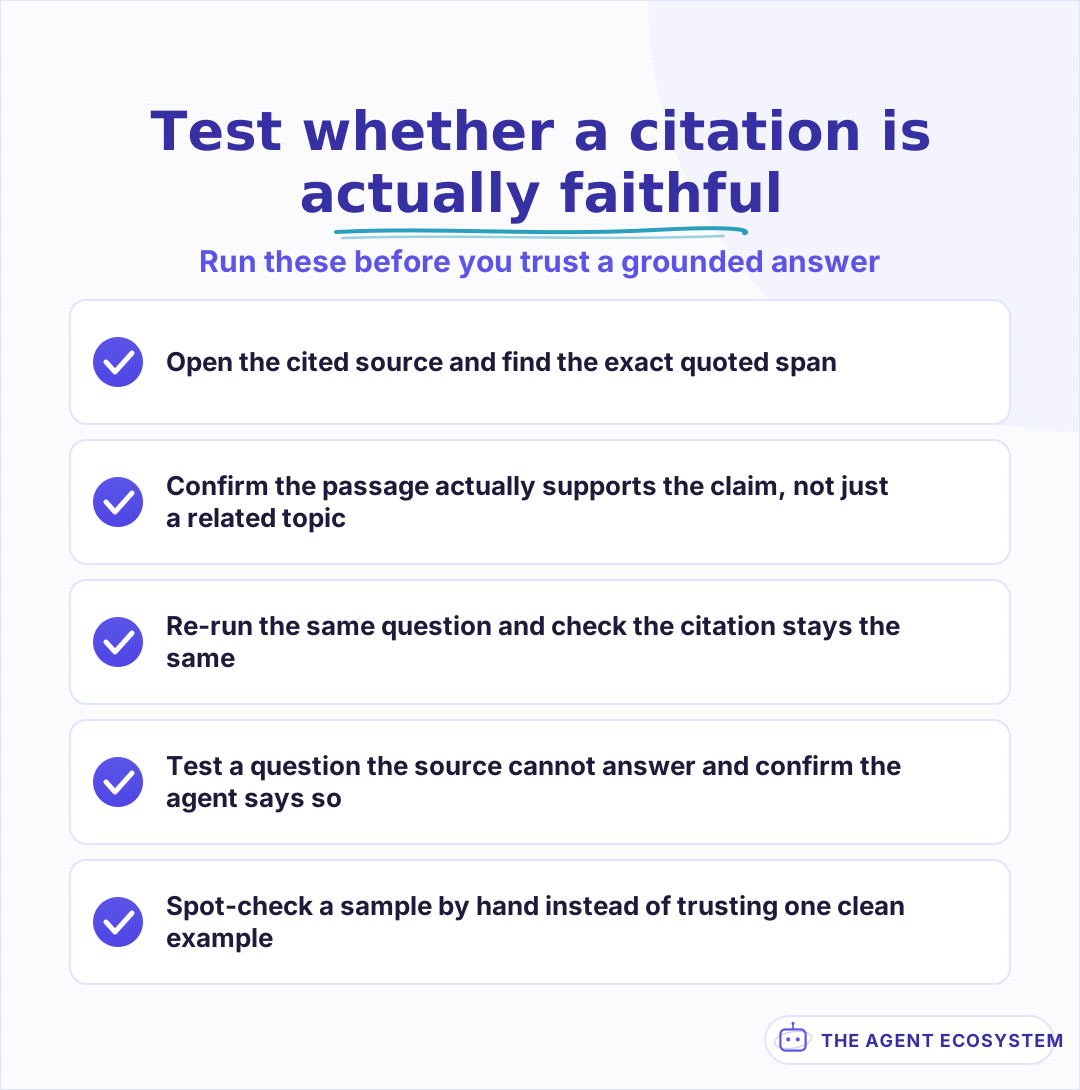 Each check is cheap enough to run by hand on a small sample before you trust an automated version.
That second-model setup is itself a judge, and it inherits every pitfall a judge carries: it can be lenient, inconsistent between runs, or biased toward citations that merely sound plausible. Our breakdown of LLM-as-a-judge pitfalls covers failure modes that apply just as much to a faithfulness checker as to any other automated grader: non-determinism at temperature 0, leniency, and self-preference bias. The passages a faithfulness check runs against are only as good as the retrieval step that produced them; if you are building the layer underneath this, contextual retrieval is what decides whether the right passage even reaches the candidate pool before any citation gets attached to it.
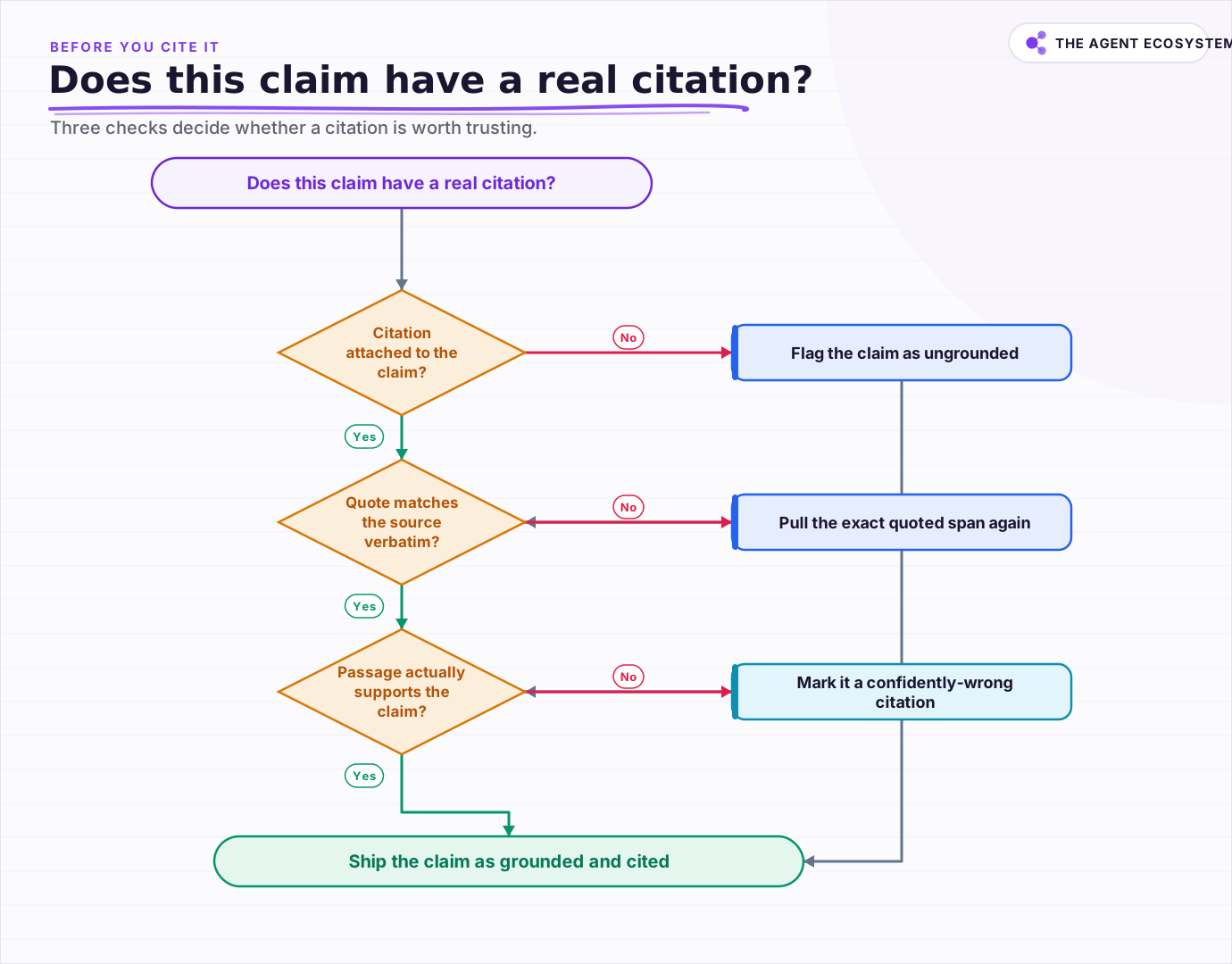 Three checks decide whether a citation is worth trusting: it exists, it quotes the source exactly, and the passage actually backs the claim.
Put the two together and you get a working answer to a simple question: does this specific claim have a real, faithful citation behind it, or does it just look like one does? At small scale, hand-checking works fine. Past a few dozen claims a day, check a fixed number of claims every week rather than a fixed percentage, so the check does not silently shrink as the agent gets busier.
Do citations eliminate hallucination?#
No. Citations reduce the rate of unsupported claims and make the ones that slip through easier to catch, but they do not eliminate hallucination, and a citation to a real, correctly quoted document does not guarantee the document itself is accurate. Grounding fixes where a claim came from, not whether the source was right.
A citation can pass every technical measure (real document, exact quote, faithful reasoning) and still be wrong, because the source itself was outdated, biased, or simply mistaken. Layering fixes helps: ground the claim in a real passage, quote it verbatim, and check the quote actually supports the claim. None of that substitutes for treating the source document as a claim of its own, one worth spot-checking rather than trusting by default just because an agent pointed at it. A citation should change how much you trust a claim, not whether you trust it completely. Treat a well-cited answer as a strong first draft with its homework shown, not a verdict that ends the conversation.
What should you build first?#
Start with the 2 cheapest wins: make the model quote the exact source span before it answers, and add one faithfulness check that opens the citation and confirms the passage actually supports the claim. Both are prompt-level changes you can ship this week, before you reach for a dedicated citations API or a second model as judge.
Neither step is glamorous, and neither is optional if the agent's answers are going to reach a customer, a regulator, or anyone else who might actually click the link. A citation is a promise that something specific backs the claim. Keep that promise checkable, and most of what makes citations trustworthy follows from there.
Frequently asked questions
What is the difference between grounding and RAG?
Can an AI agent cite sources without RAG?
What is citation faithfulness?
How do I know if an AI agent's citation is real?
Do citations eliminate AI hallucination?
Sources
Primary references and vendor documentation used while drafting and reviewing this article.
- Anthropic: Introducing Citations on the Anthropic API (Jan 2025)
- Anthropic Platform Docs: Reduce hallucinations (direct-quote grounding technique)
- Google: Grounding with Google Search, Gemini API docs
- Perplexity: Introducing the Sonar Pro API
- Wallat, Heuss, de Rijke, Anand: Correctness is not Faithfulness in RAG Attributions (Dec 2024)
- Rao, Wong, Callison-Burch: Detecting and Correcting Reference Hallucinations in Commercial LLMs and Deep Research Agents
Written by

Muhammad Qasim Hammad is an AI agent and automation expert and the founder of Cart Gaze LLC (cartgaze.com). He builds product for the love of it: when an idea lands, a working prototype is usually running within hours, built with the same AI agents and automations he sells. He puts his own output at roughly 20× what it was before agents, and the Agentic OS behind this site is the working proof, documented in public with the tools he actually ran and what they really cost.
AI & Automation Services
Want a pipeline like this running in your business?
I'm Qasim — I design and ship AI agents and n8n automations for solo operators and small teams. Tell me what's eating your team's week, and I'll scope a fix.
Related reading
Build an AI Research Assistant in n8n: Search, Read, Cite
You want a short answer with real, clickable links, not a confident paragraph the model invented. This is how to build an ai research assistant in n8n: capture a question, search the web, fetch and clean the top pages, and summarize with citations grounded only in that fetched

n8n AI Agent Hallucinations: How to Ground and Constrain Them
An n8n AI Agent that states a wrong fact or invents a tool result is hallucinating, filling a gap where it has no grounded answer. The fix is not a better model. It is giving the agent real data and constraining what it is allowed to say. Here is how, layered.
Giving AI Agents Web Access: Search Tools, Grounding, and Cost
A search tool turns post-cutoff questions from hallucination bait into retrievable facts, and it brings 3 problems with it: choosing sources, paying for pages that become tokens, and reading text that may be aimed at the model rather than the user. This is the wiring guide: the
How to Automate Customer Support with AI Without Losing People
The fastest way to damage a small business with AI is to put a bot in front of customers before it knows when to stop. Twelve lessons on triage before answers, grounding in your own documentation, escalation that carries context, and why deflection rate flatters you.
How to Build a RAG System That Retrieves the Right Thing
Most RAG systems fail at retrieval, not at the model. Twelve lessons on chunking for the question, hybrid search for exact strings, re-ranking, making it refuse, and measuring retrieval separately from generation.
Agentic RAG vs Classic RAG: When Should an Agent Drive Retrieval?
Classic RAG runs 1 fixed retrieval pass and hopes the chunks are right. Agentic RAG puts a model in charge of the search itself: rewriting queries, grading what came back, and retrying until the evidence covers the question. This is the mechanism behind the loop, the modeled 2