Agentic RAG vs Classic RAG: When Should an Agent Drive Retrieval?
What the agentic retrieval loop actually does, what it costs, and the questions that justify paying for it.
AI-drafted, reviewed by Muhammad Qasim Hammad on September 1, 2026. See our AI disclosure.
Table of contents
- What actually separates agentic RAG from classic RAG?
- What does the agentic retrieval loop actually do?
- When does classic RAG stop being enough?
- What does agentic RAG cost in latency and tokens?
- Which new failure modes does agentic RAG introduce?
- How do you decide which one to build?
- What should you build first?
Classic RAG answers every question the same way: embed the query, fetch the top chunks, paste them into the prompt, generate. That single pass is cheap, fast, and completely blind to whether the chunks it fetched actually answer the question. Agentic RAG replaces the fixed pipeline with a loop: a model looks at what retrieval returned, decides whether it is enough, rewrites or reroutes the search when it is not, and only generates an answer once the evidence actually covers the question.
What actually separates agentic RAG from classic RAG?#
Classic RAG is a fixed pipeline: one embedding lookup, one prompt, one answer, no matter what the question is. Agentic RAG puts a model in charge of retrieval itself, so the system can rewrite queries, pick between sources, run more searches, and judge whether the evidence is sufficient before answering.
The distinction is about who controls the retrieval step. In a classic pipeline, retrieval is plumbing: the developer decided at build time that every question gets 1 vector search against 1 index, top-k chunks, done. In an agentic pipeline, retrieval is a tool the model calls, and the model decides how many times to call it, with what query, against which source. If the first search comes back thin, the loop tries again instead of shipping a bad answer.
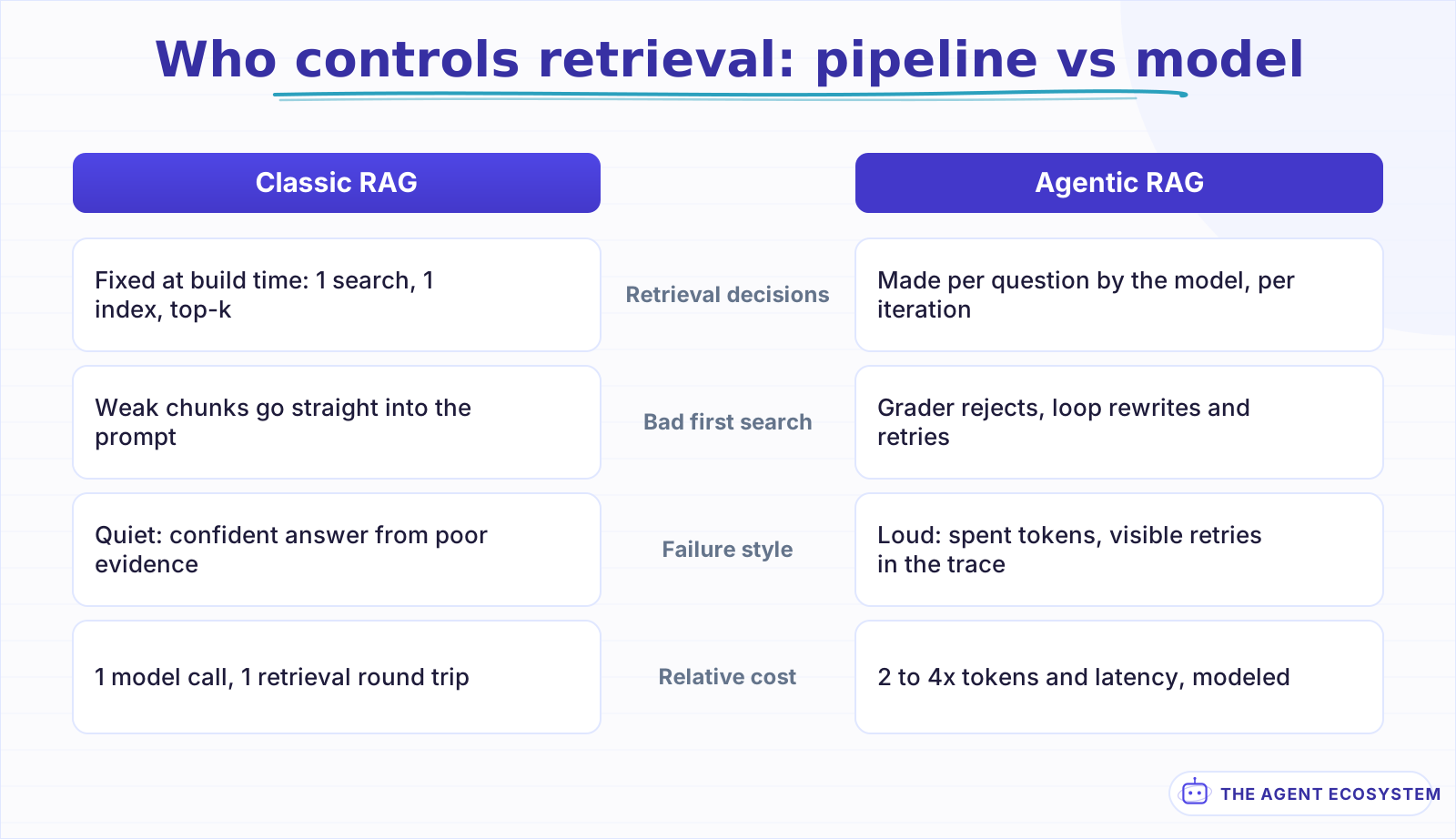 The architectures differ in one place: whether retrieval is plumbing decided at build time or a tool the model drives per question.
That control shift is also why the 2 approaches fail differently. Classic RAG fails quietly: weak chunks go into the prompt and a confident answer comes out anyway, which is exactly the pattern behind most RAG chatbots giving wrong answers. Agentic RAG fails loudly and expensively: the loop can spin, retry, and burn tokens before it ever produces anything. Neither failure mode is free. You are choosing which one you would rather debug.
What does the agentic retrieval loop actually do?#
The loop has 5 moves: plan what evidence the question needs, retrieve with a query the model wrote, grade what came back, decide whether to search again with a better query or a different source, and generate only when the graded evidence covers the question. Each cycle spends 1 more model call.
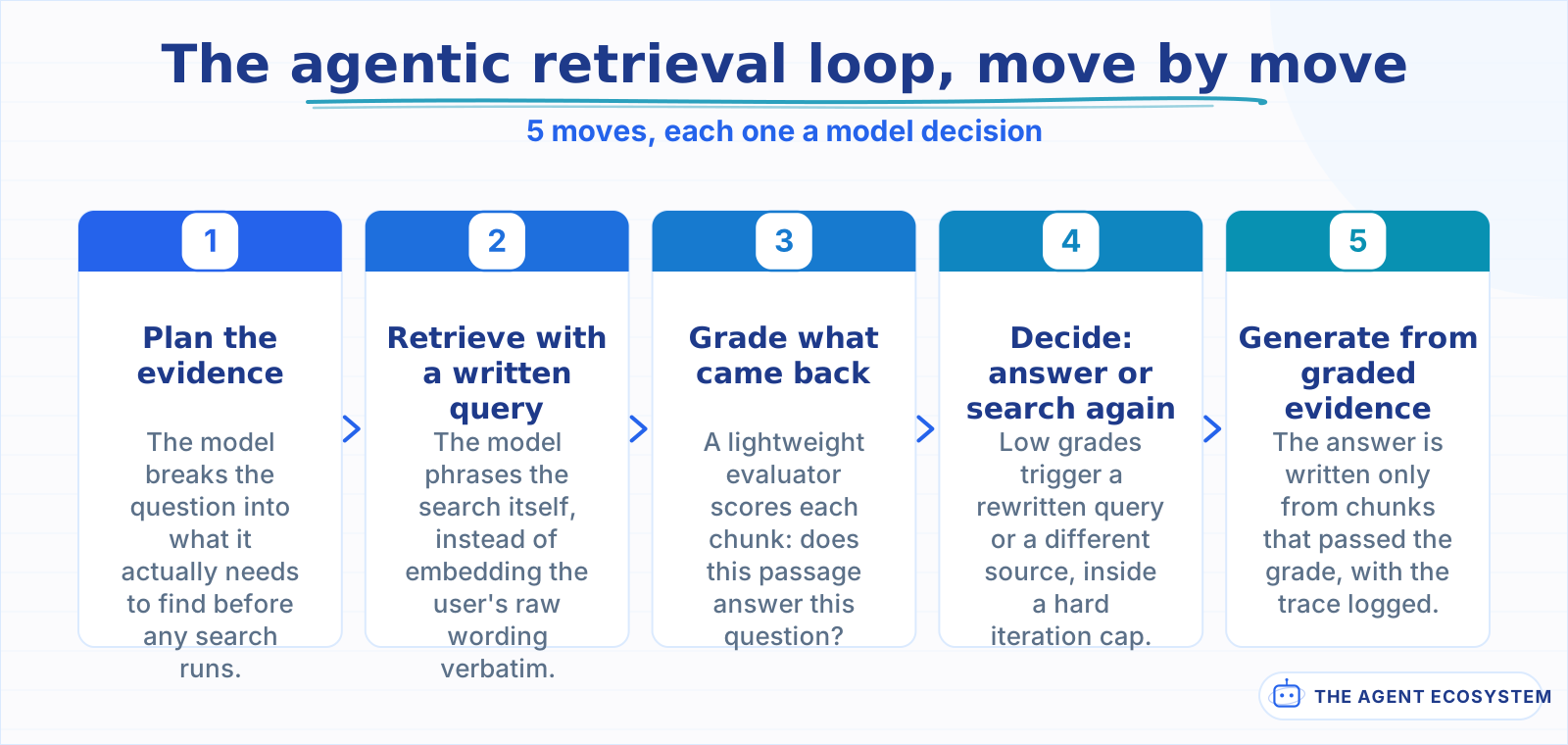 Generation waits until the grade says the evidence covers the question, which is the whole difference from a fixed pipeline.
Two of those moves exist in research form with names worth knowing. The grading step comes from Corrective RAG, which puts a lightweight retrieval evaluator between search and generation: it scores each retrieved document and, when everything scores poorly, triggers a fallback search instead of generating from bad context. Source The self-critique step comes from Self-RAG, where the model emits reflection tokens that mark whether a passage is relevant and whether the draft answer is actually supported by it. Source
The practical version you would build borrows selectively. A production loop usually keeps the grader and the query rewriter, caps iterations at 2 or 3, and drops the fancier reflection machinery. Query rewriting alone fixes a surprising share of retrieval misses because user phrasing and document phrasing rarely match, and the rewrite happens before any extra retrieval spend.
When does classic RAG stop being enough?#
Classic RAG struggles on 3 kinds of questions: multi-hop questions whose answer lives in 2 or more documents, ambiguous questions where the literal query embeds poorly, and cross-source questions where the right knowledge base depends on the question. A single fixed retrieval pass cannot adapt to any of those.
Multi-hop is the clearest case. "Which of our enterprise customers renewed after the pricing change?" needs the pricing-change date from one document and the renewal list from another, then a join between them. One embedding search returns chunks about pricing or chunks about renewals, but the pipeline has no mechanism to notice it needs both and go back for the second half.
Ambiguity is subtler. "What happened with the Anderson account?" embeds into a vague neighborhood of the vector space, and whatever lands in the top-k drives the answer. An agentic loop can ask the model to expand that query into 2 or 3 specific searches, which is the same trick that makes hybrid search with BM25 plus vectors outperform pure semantic retrieval on names and codes.
Cross-source questions are an organizational problem more than a technical one. When the answer might live in the product docs, the support tickets, or the CRM, something has to pick. Classic RAG makes that choice at build time by pointing at 1 index. An agentic router makes it per question.
What does agentic RAG cost in latency and tokens?#
Plan on 2 to 4 times the latency and token spend of a single-pass pipeline, because every extra loop iteration adds a model call plus a retrieval round trip. The modeled math below shows a 3-iteration agentic answer costing roughly 3.5 times a classic one at the same model price.
The arithmetic is straightforward and worth doing before you commit. Assume a classic pass sends 1,500 prompt tokens of chunks plus instructions and generates 300 tokens of answer. The agentic version below runs a planner call, 2 retrieval-and-grade cycles, and a final generation, each carrying context forward.
| Step | Classic RAG | Agentic RAG, 3 iterations (modeled) |
|---|---|---|
| Model calls | 1 | 4 |
| Prompt tokens | 1,500 | 5,600 |
| Output tokens | 300 | 750 |
| Retrieval round trips | 1 | 3 |
| Typical wall-clock | 2 to 4 seconds | 8 to 15 seconds |
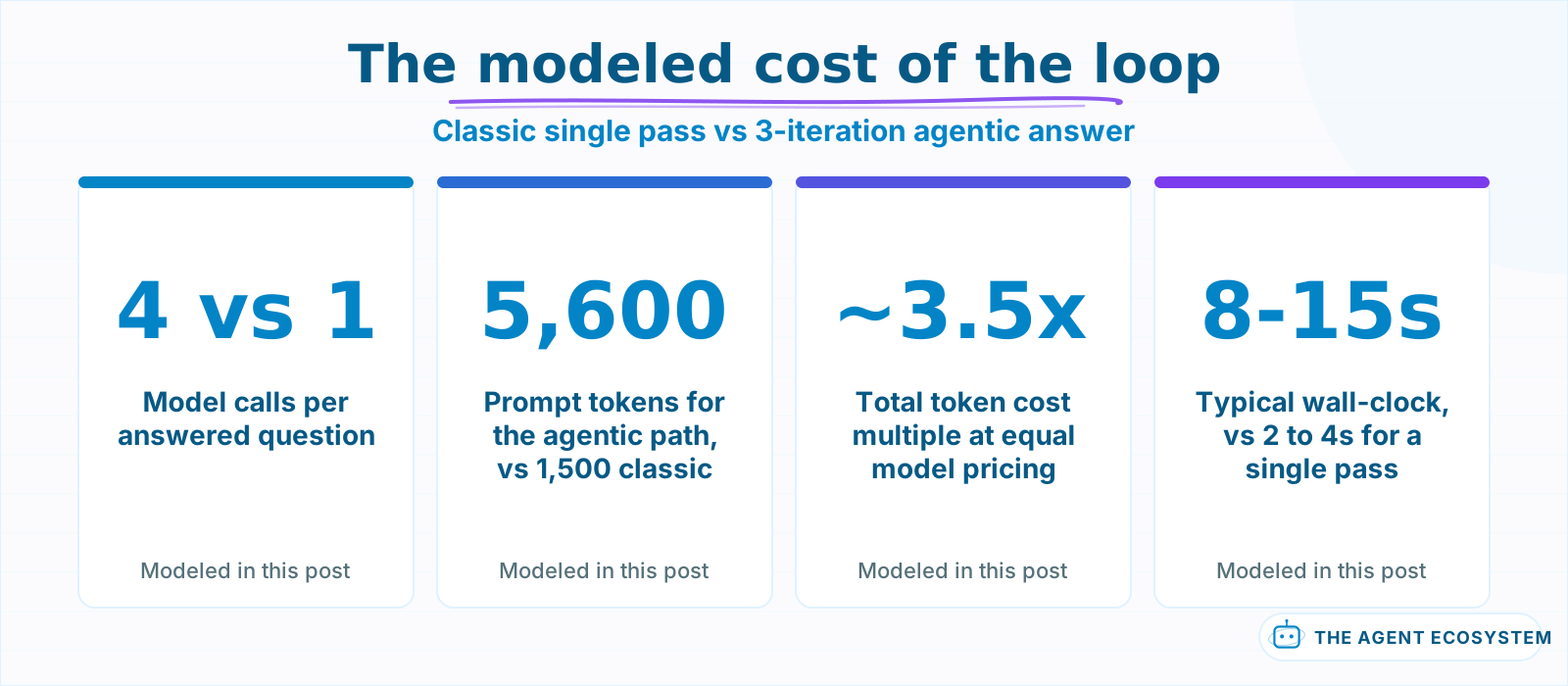 Modeled from the token arithmetic in this post, not a vendor benchmark. Your ratio depends on how often the loop iterates.
These are modeled figures, not benchmarks, and your ratio depends on how often the loop actually iterates. If 80% of questions resolve in 1 pass and only hard ones loop, the blended cost premium drops sharply, which is the strongest argument for making the loop conditional rather than default. The same token math you would use to estimate any LLM API cost applies here, just multiplied by the iteration count your logs actually show.
Which new failure modes does agentic RAG introduce?#
The loop that fixes retrieval failures creates new ones: search cycles that never terminate because the grader is never satisfied, budgets that compound when the agent keeps retrying, and self-confirmation, where the model accepts weak evidence because it already believes the answer from its training data.
The non-terminating loop is the one that costs real money. A grader prompted to demand thorough evidence will keep rejecting perfectly usable chunks on questions the corpus only partially covers, and each rejection buys another retrieval plus another grading call. Hard iteration caps are not optional. Neither is a budget ceiling per question, the same way you would cap any agent that can call tools in a loop.
Self-confirmation is quieter. When the model already holds an answer from pretraining, it can grade a mediocre chunk as sufficient because the chunk agrees with what it was going to say anyway. The grade looks like evidence evaluation but is really opinion matching. Keeping the grader prompt narrow helps: ask whether this passage answers this question, not whether the answer seems right.
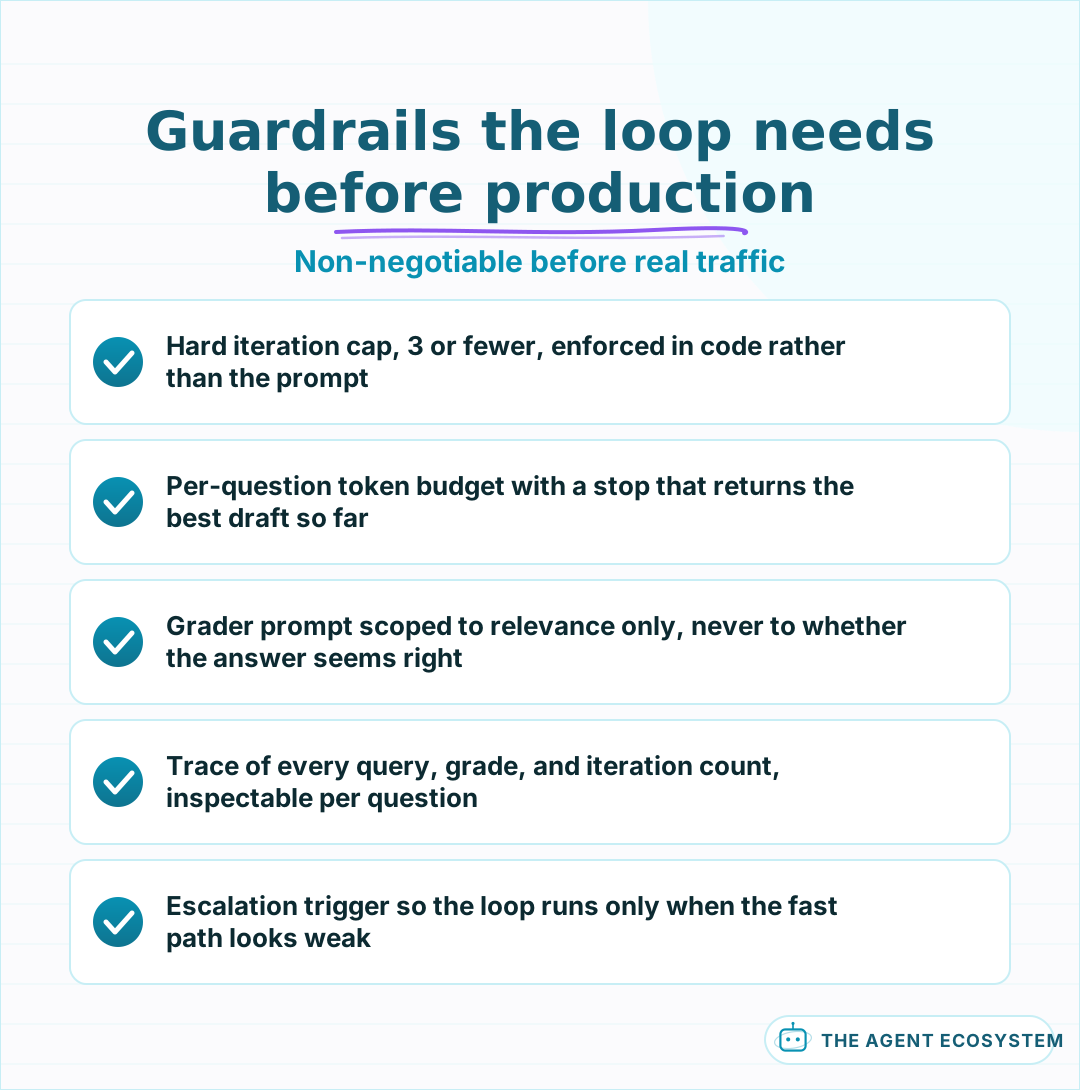 Each guardrail exists because a documented failure mode appears without it.
Observability is the difference between debugging this and guessing. A classic pipeline has 1 retrieval to inspect. An agentic one has a trace: queries tried, grades assigned, iterations spent. If you cannot see that trace per question, you cannot tell whether the loop is earning its cost, so wire up tracing for the agent before you scale it.
How do you decide which one to build?#
Start from the questions, not the architecture. If most queries are single-hop lookups against 1 corpus, classic RAG with good chunking wins on cost and latency. Reach for the agentic loop when multi-hop, ambiguous, or cross-source questions show up in your logs often enough to justify 2 to 4 times the spend.
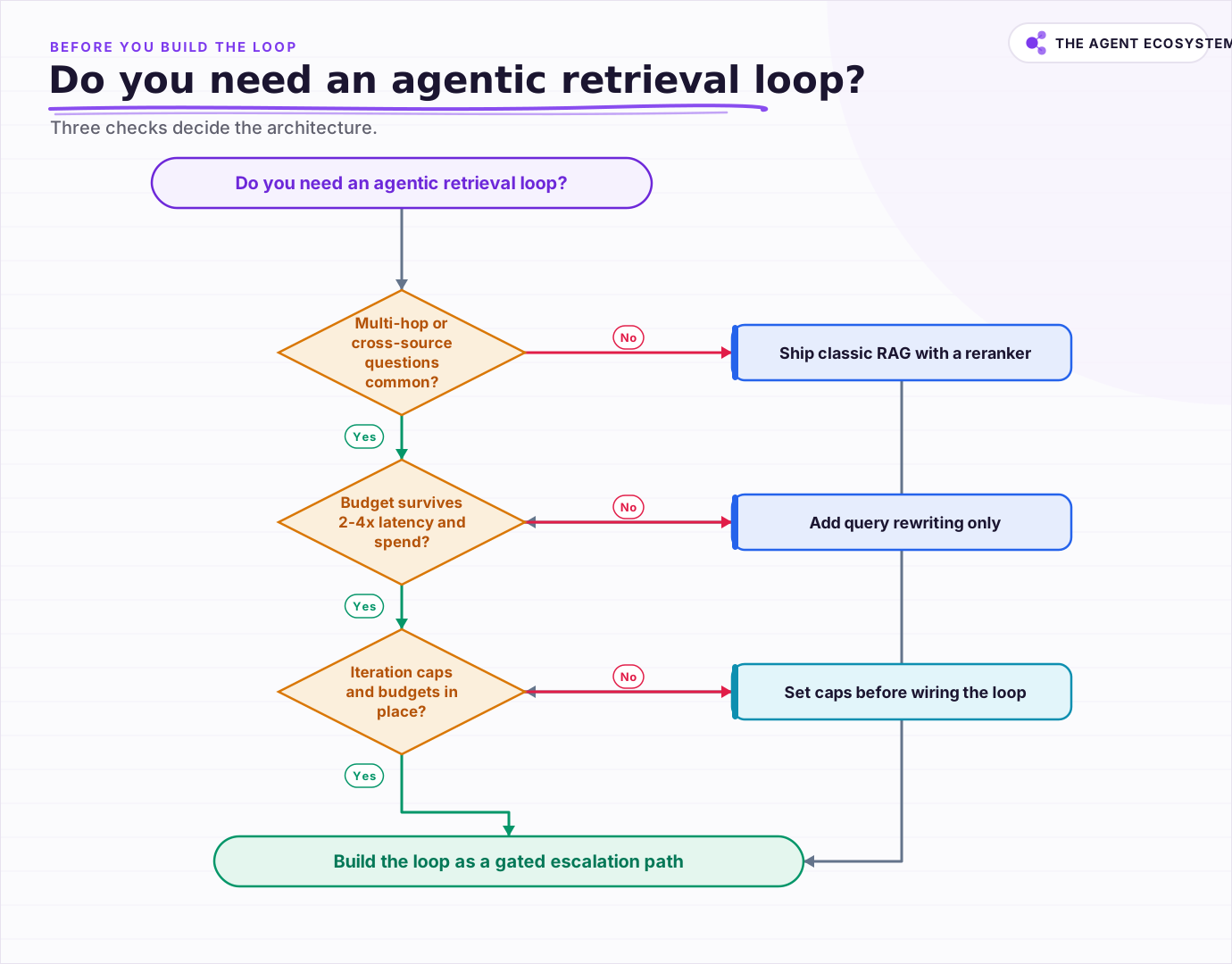 Three checks decide the architecture: whether your questions need the loop, whether the budget survives it, and whether the guardrails exist.
The decision is rarely all-or-nothing in practice. The most common production shape in 2026 is a hybrid: a classic pipeline as the fast path, plus an escalation trigger when the fast path looks weak, either because retrieval scores came back low or because the model flagged the question as multi-part. That gives you agentic behavior on the 10 to 20% of questions that need it while the bulk of traffic stays on the cheap path. Before adding any loop at all, confirm the basics are not the real problem: poor chunking strategy or a missing reranking step produces symptoms that look exactly like "we need agentic RAG" and costs far less to correct.
What should you build first?#
Ship classic RAG first, instrument it, and add agentic behaviors 1 at a time in order of payoff: query rewriting, then a retrieval grader with 1 retry, then source routing. Each step is a bounded upgrade you can measure against the logs, not a rewrite of the whole pipeline.
That ordering front-loads the cheap wins. Query rewriting costs 1 small model call and fixes phrasing mismatches. The grader-plus-retry pair converts silent failures into recovered answers on exactly the questions where retrieval came back thin. Source routing only matters once you genuinely have multiple corpora worth routing between. Measure each addition against retrieval metrics you already track, and stop adding machinery the moment the failure rate stops moving. An agentic loop is a tool for questions your pipeline demonstrably gets wrong, not a default posture for questions it already gets right.
Frequently asked questions
What is agentic RAG in simple terms?
Is agentic RAG always better than classic RAG?
How much more does agentic RAG cost?
What is the difference between agentic RAG and an AI agent with a search tool?
Do I need a framework to build agentic RAG?
Sources
Primary references and vendor documentation used while drafting and reviewing this article.
- Yao et al.: ReAct, Synergizing Reasoning and Acting in Language Models (2022)
- Asai et al.: Self-RAG, Learning to Retrieve, Generate, and Critique through Self-Reflection (2023)
- Yan et al.: Corrective Retrieval Augmented Generation (2024)
- Lewis et al.: Retrieval-Augmented Generation for Knowledge-Intensive NLP Tasks (2020)
Written by

Muhammad Qasim Hammad is an AI agent and automation expert and the founder of Cart Gaze LLC (cartgaze.com). He builds product for the love of it: when an idea lands, a working prototype is usually running within hours, built with the same AI agents and automations he sells. He puts his own output at roughly 20× what it was before agents, and the Agentic OS behind this site is the working proof, documented in public with the tools he actually ran and what they really cost.
AI & Automation Services
Want a pipeline like this running in your business?
I'm Qasim — I design and ship AI agents and n8n automations for solo operators and small teams. Tell me what's eating your team's week, and I'll scope a fix.
Related reading
How to Build a RAG System That Retrieves the Right Thing
Most RAG systems fail at retrieval, not at the model. Twelve lessons on chunking for the question, hybrid search for exact strings, re-ranking, making it refuse, and measuring retrieval separately from generation.

Long-Context vs RAG: When a 200K-1M Token Window Beats Chunking
Now that 1M-token windows ship at flat pricing, should you stuff the whole corpus in one prompt or build a retrieval pipeline? This breaks long context vs RAG into reproducible per-query cost math, the recall limits of big windows, and four variables that decide it.
Query Rewriting for RAG: Fix Retrieval at the Query Side
You tuned chunking, added a reranker, and swapped embeddings, but RAG still misses on short or conversational questions. The reason is often the query itself. Here is how query rewriting, multi-query, HyDE, and expansion fix retrieval at the query side, and how to measure
How to Build an AI Agent: The 80% That Survives Week Two
Most tutorials get you a working agent in ten minutes and skip what breaks it in week two. Sixteen lessons covering the loop, tool descriptions, memory, fallbacks, guardrails, evaluation, and the cost levers that decide your bill.
Graph RAG Knowledge Graph Retrieval: Two Questions Vector Search Cannot Answer
Graph retrieval builds an entity-and-relationship graph out of your documents and walks it at query time instead of ranking chunks by similarity. On a published benchmark it beat reranked vector search by 10.5 points on complex reasoning and 13.1 on contextual summarization, and
What Is an AI Agent? A Plain-English Guide for Builders
An AI agent is a language model running in a loop that decides its own next action, not a chatbot and not a chain. Here is how the perceive-decide-act-observe loop works, how an agent differs from a chatbot, chain, and workflow, and a checklist for when you actually need one.