LLM-as-a-Judge Pitfalls: Flaky Scores, Self-Preference, Grading on a Curve
The documented ways an LLM grader drifts from the truth, and the cheap tests that catch each one.
AI-drafted, reviewed by Muhammad Qasim Hammad on August 22, 2026. See our AI disclosure.
Table of contents
- What is LLM-as-a-judge, and why does it fail in predictable ways?
- Why do two runs of the same judge disagree with each other?
- Why does a judge favor its own model family's answers?
- Why do judges keep grading on a curve?
- What is overfitting to the judge, and why is it Goodhart's Law in disguise?
- How do you actually catch these pitfalls before they wreck a pipeline?
- Should you trust a single judge's score?
- What should you set up this week?
You wire an LLM judge into your eval pipeline, watch the pass rate climb, and ship with confidence. Then a real user hits a case where the answer is wrong in a way a careful person would catch in seconds, and your judge scored it a 9 out of 10 the whole time. LLM-as-judge pitfalls are the specific, documented ways an LLM grader drifts from the truth, and most of them are invisible until you go looking for them.
What is LLM-as-a-judge, and why does it fail in predictable ways?#
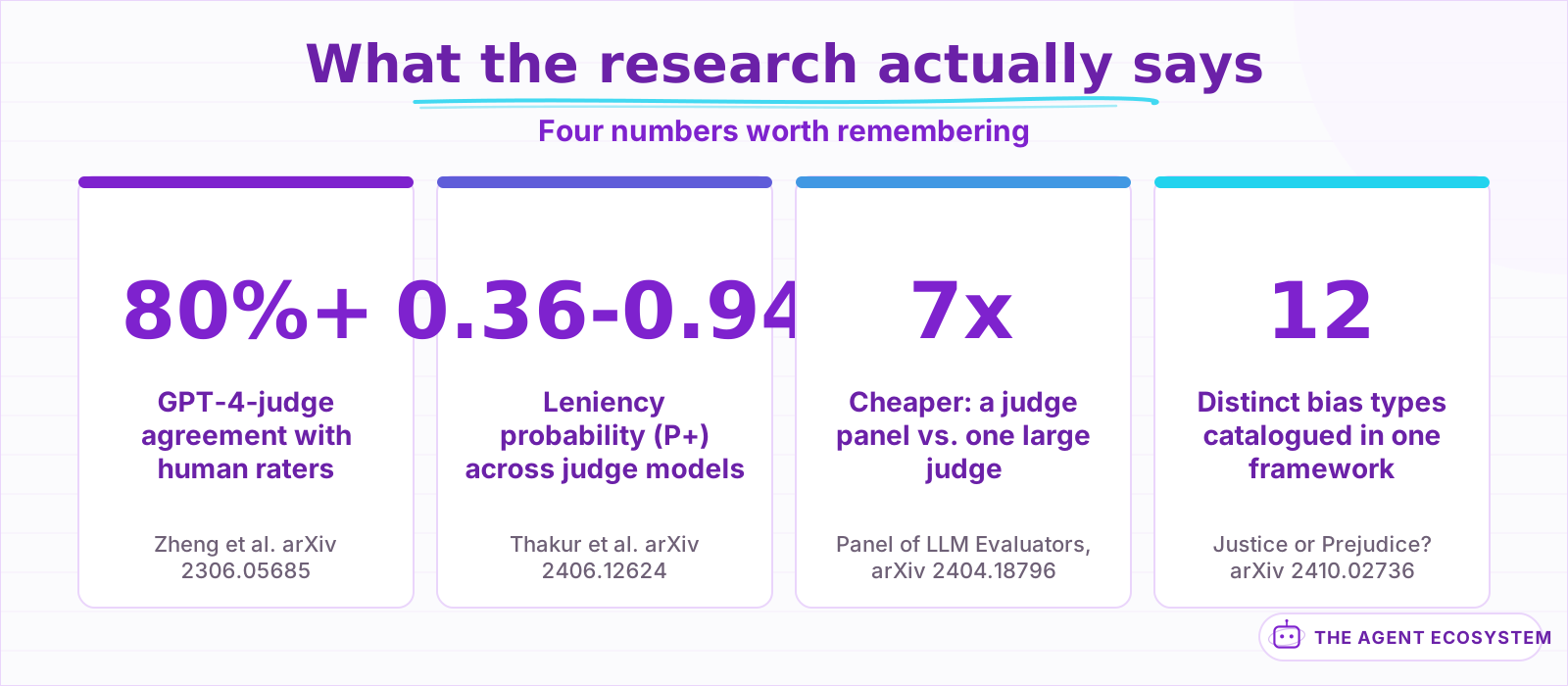
LLM-as-a-judge means using a language model to grade another model's output against a rubric or a reference answer, instead of paying a human reviewer for every case. The 2023 MT-Bench study found GPT-4 judges agree with human preferences over 80% of the time, but that number hides several repeatable failure patterns underneath it.
That agreement rate comes from Zheng et al.'s paper introducing MT-Bench and Chatbot Arena as benchmarks for LLM judges, and it named three biases that still show up in every later paper on the topic: position bias, where the order you present two answers changes the verdict; verbosity bias, where a judge favors the longer answer with quality held constant; and self-enhancement bias, where a judge favors output that resembles its own style. Source
If you already run evals in n8n, you have probably met one of these without naming it. Our guide to testing and evaluating AI agents in n8n covers the built-in Correctness and Helpfulness metrics, and both are LLM-as-judge under a different name, which means both inherit every pitfall below.
 Every number here is read directly from the cited paper, not a summary of a summary.
Six pitfalls turn up across the research often enough to be worth a standing reference. Use the table to jump straight to the one that is biting you right now.
| Pitfall | What it looks like | Fastest check |
|---|---|---|
| Position bias | The verdict flips when you swap which answer comes first | Re-run with the answer order reversed |
| Verbosity bias | The longer answer wins even when it is not more correct | Trim both answers to equal length and re-score |
| Self-preference bias | The judge favors output that reads like its own model family | Swap the judge model and compare scores |
| Leniency bias | The judge calls a borderline answer correct instead of failing it | Grade a sample yourself and compare |
| Non-determinism | The same case gets a different score on a second run | Re-run the identical case twice at temperature 0 |
| Overfitting to the judge | The system's judge score rises without real quality improving | Track a held-out human metric alongside the judge score |
Each row below gets its own section, roughly in the order it tends to surprise a small team running its first LLM-judge pipeline.
Why do two runs of the same judge disagree with each other?#
Non-determinism means the same input, the same model, and the same temperature setting can still produce a different score on a second run. A February 2026 study tested five judge models on real retrieval-augmented generation question-answer pairs and found meaningful score variability even at temperature 0, which is supposed to be the deterministic setting.
The study covered GPT-4o, GPT-4o-mini, Gemini 2.5 Flash, Claude Haiku 4.5, and Claude Sonnet 4.5, and found completeness scoring drifted the most of the metrics tested. Lowering the temperature stabilized GPT-4o and Gemini, but had inconsistent effects on the Claude models, so the fix is not as simple as setting temperature to 0 and moving on. This is a single, recent study rather than an established consensus, so treat the exact numbers as directional and worth re-checking as more work replicates it. Source
If you have not looked at how temperature and top-p actually shape an LLM's output, our temperature and top-p explainer covers the sampling mechanics this finding depends on. Treat non-determinism as a floor, not a rounding error: if your eval suite reports one score per case, you cannot tell a real regression from noise in the judge itself. Run every case at least twice before you trust a drop in the number.
Why does a judge favor its own model family's answers?#
Self-preference bias is a judge scoring an answer higher because it resembles text the judge model itself would generate, not because the answer is actually better. A 2024 NeurIPS workshop paper found GPT-4 shows a significant degree of this bias, and traced the mechanism to perplexity: judges rate familiar-sounding text higher, regardless of who wrote it.
Zheng et al. named this self-enhancement bias back in 2023; the 2024 paper gave it a sharper name and, more usefully, a way to measure it. That familiarity effect matters the moment you swap models for a comparison. Evaluate a Sonnet-generated answer with a Sonnet judge, then evaluate a GPT-generated answer with that same Sonnet judge, and the comparison is no longer fair by construction, because one output is more familiar to the grader than the other. Source
The practical fix is boring but it works: never let the model you are testing also be the model doing the grading, especially when the whole point of the eval is choosing between vendors. A neutral third model as judge costs you one extra API integration and removes an entire category of skewed comparison.
Why do judges keep grading on a curve?#
Leniency bias is a judge's tendency to score a borderline answer as correct rather than fail it, even when its own stated criteria are not fully met. A study testing 13 judge models found this leniency probability ranged from 0.36 to 0.94 depending on the model, meaning some judges pass questionable answers most of the time by default.
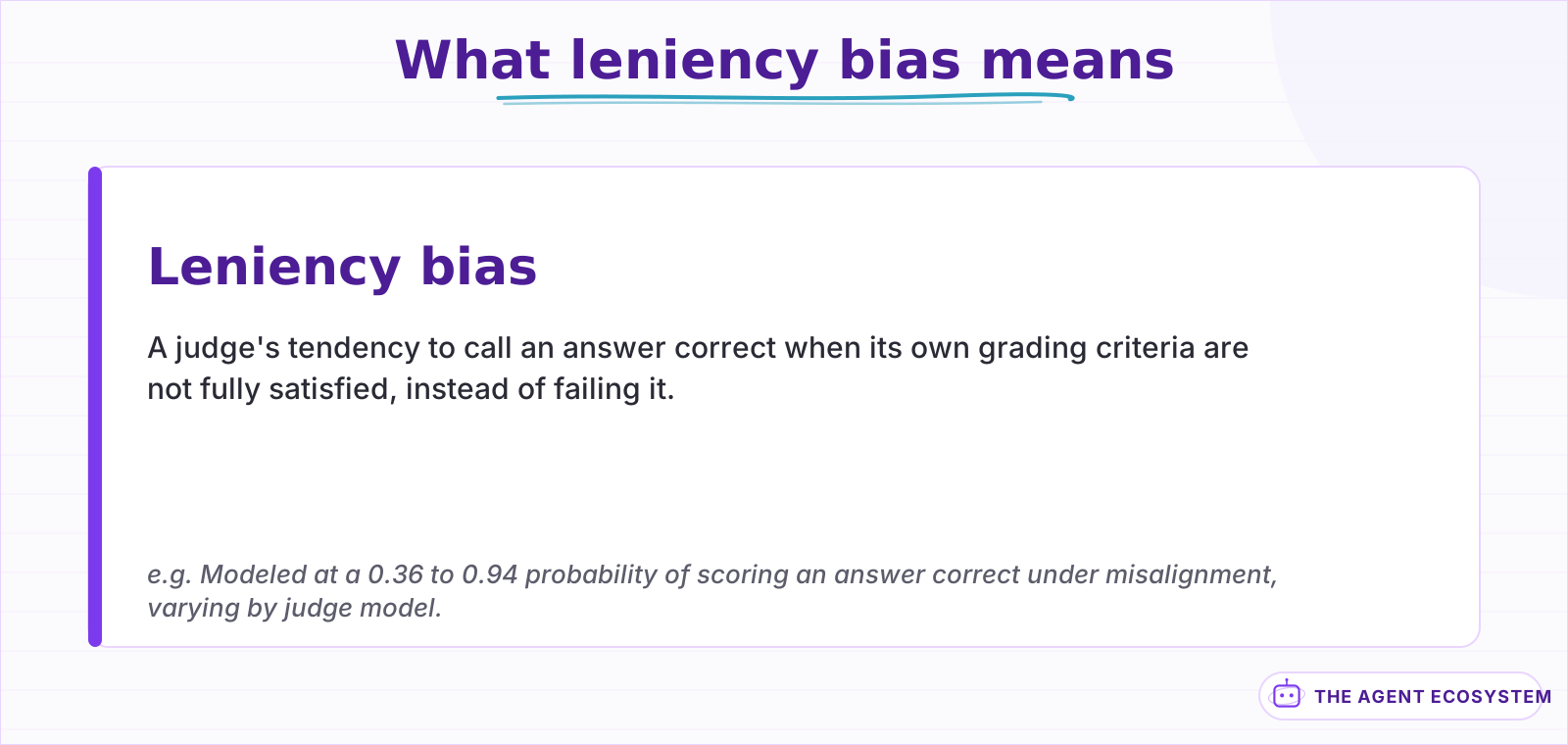 Leniency bias means a judge defaults toward calling an answer correct instead of failing a borderline one.
That same research tested how much rubric detail actually helps. Four grading-prompt variants, from a bare instruction to a full rubric with worked examples, showed only the strongest judge models got more aligned with more detail; weaker judges actually drifted further from human scores as the instructions got longer. That is a narrower and more useful finding than "too much context confuses a judge": it is specifically about how much grading instruction you hand the judge, not how long the thing being graded is. Source
The takeaway is not "write a longer rubric and move on." It is: test your rubric against a held-out human-graded set before you assume more instructions helped, because for a weaker or cheaper judge model, they might have quietly made scores less accurate instead of more.
What is overfitting to the judge, and why is it Goodhart's Law in disguise?#
Overfitting to the judge happens when you repeatedly tune a prompt or a model against your own LLM grader until the judge score climbs, while real quality for actual users stays flat. It is Goodhart's Law applied to evals: once a score becomes the optimization target, it stops measuring what you actually care about.
The channel is usually one of the biases above. A prompt tuned against judge feedback learns to produce longer answers because of verbosity bias, or answers that read like the judge's own house style because of self-preference bias, since those are the properties the judge happens to reward, not because the answers serve users any better. Every metric that becomes a target eventually gets gamed, on purpose or by accident, and an LLM judge is a metric like any other.
Guard against it the way you would guard against any proxy metric: keep a small, untouched human-graded set that you never train or prompt-tune against, and check it on a schedule. If the judge score keeps climbing while that held-out set stays flat or drops, you are optimizing for the grader, not the product it is supposed to stand in for.
How do you actually catch these pitfalls before they wreck a pipeline?#
You catch these pitfalls with a handful of concrete tests, not by reading about them once and trusting your setup forever. Swap answer order, strip both answers to equal length, reword the prompt neutrally, and re-run the identical case twice: if the score moves on either of these, you have found a live bias, not a stable measurement.
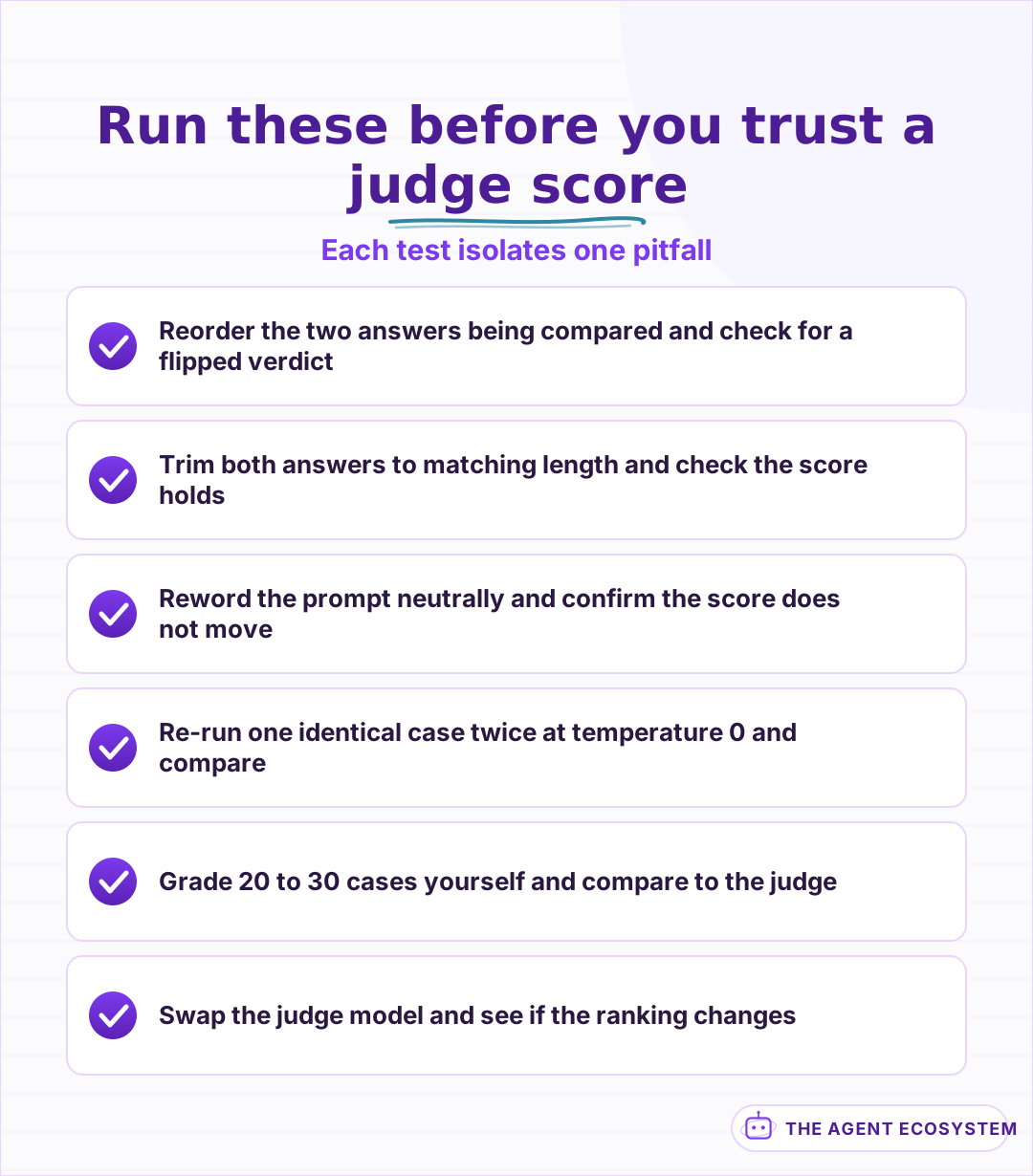 Six cheap tests that surface a live bias instead of a stable measurement.
Run the tests in roughly this order, since each is cheap and each isolates a different pitfall: reorder the two answers being compared and check for a flipped verdict, pad or trim both answers to matching length and check the score holds, swap in a different judge model and see if the ranking changes, and grade 20 to 30 cases yourself so you have a human baseline to calibrate against. None of this needs to be elaborate. A spreadsheet and an afternoon beats a judge score nobody has ever questioned.
Should you trust a single judge's score?#
A single judge is fine for quick iteration, where a wrong verdict costs you a re-run, not a bad decision. For anything higher stakes, a release gate, a vendor comparison, a customer-facing quality claim, pair the judge with a held-out human-graded sample, and consider a panel of several smaller judges instead of one large one.
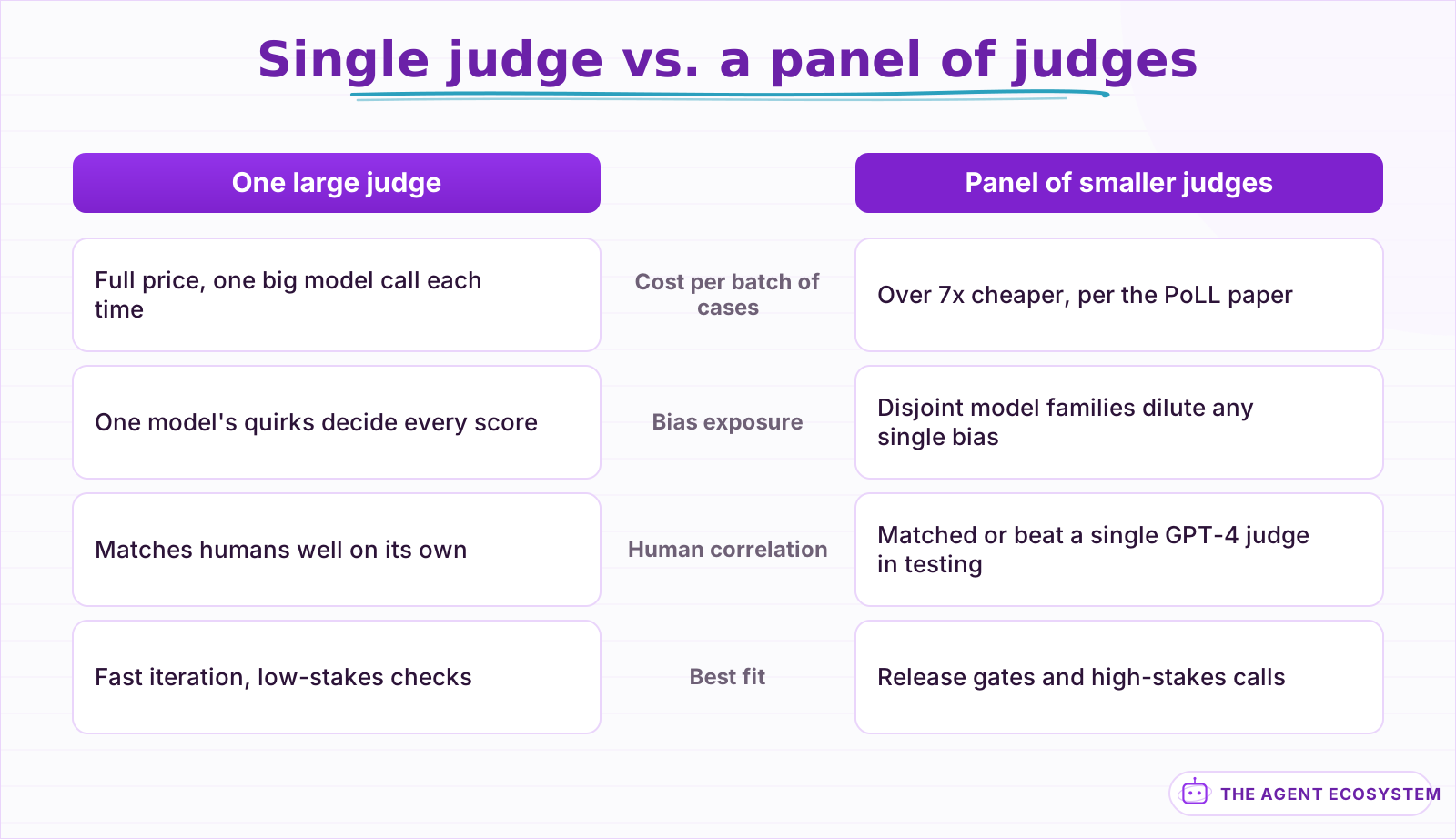 A panel of smaller, diverse judges matched or beat a single large judge at a fraction of the cost, per the PoLL study.
One study tested a panel of smaller, diverse judge models against a single large judge like GPT-4, across three judge settings and six datasets. The panel matched or beat the single judge on human correlation, showed less bias because its models came from different families, and ran at over 7x lower cost. Source
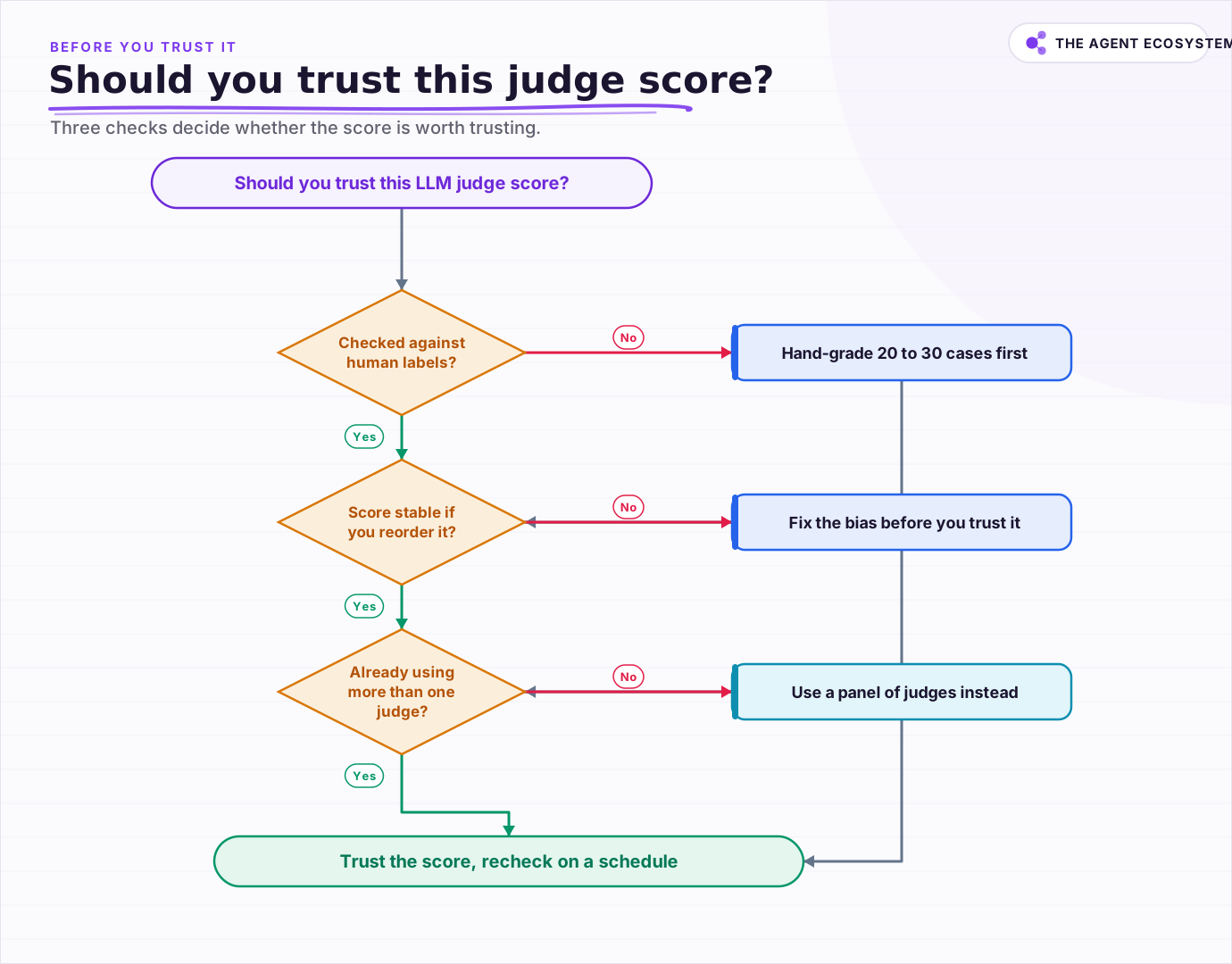 Three checks decide whether the score is worth trusting: calibration, stability under reordering, and single-judge risk.
Calibration is the step teams skip because it feels like extra work before the real work starts. Grade a sample against human labels before you trust any judge, single or panel, and re-check that calibration whenever you swap the judge model or the prompt it grades against. If your test cases are synthetic rather than pulled from real usage, our guide to synthetic data for AI agent evals covers how to keep that data honest enough to calibrate against in the first place.
What should you set up this week?#
This week, take your existing LLM-as-judge setup and run it through the four cheap tests: reorder answers, trim to equal length, swap the judge model, and re-run one case twice. If either test moves the score, you have found your first real bug, and fixing that is worth more than adding a fifth pitfall to worry about.
Then decide whether you need a single judge or a panel, based on what is actually at stake. A judge score that only gates your own iteration speed can stay simple. A judge score that decides what ships to a customer, or which vendor you pay for, earns the calibration pass and the panel.
If evals are new to your stack, start with testing and evaluating AI agents in n8n for the harness itself. Once a bad run makes it to production anyway, AI agent observability is the other half of the story: the trace that shows you what the judge never had a chance to catch.
Frequently asked questions
What is LLM-as-a-judge?
Are LLM judge scores deterministic?
What is self-preference bias in LLM judges?
What is leniency bias in LLM-as-a-judge?
Should I use one LLM judge or a panel of judges?
Sources
Primary references and vendor documentation used while drafting and reviewing this article.
- Zheng et al.: Judging LLM-as-a-Judge with MT-Bench and Chatbot Arena (NeurIPS 2023)
- Wataoka, Takahashi, Ri: Self-Preference Bias in LLM-as-a-Judge (NeurIPS 2024 workshop)
- Thakur et al.: Judging the Judges, Evaluating Alignment and Vulnerabilities in LLMs-as-Judges
- Same Input, Different Scores: A Multi-Model Study on the Inconsistency of LLM Judge (Feb 2026)
- Replacing Judges with Juries: Evaluating LLM Generations with a Panel of Diverse Models (PoLL)
- Justice or Prejudice? Quantifying Biases in LLM-as-a-Judge
Written by

Muhammad Qasim Hammad is an AI agent and automation expert and the founder of Cart Gaze LLC (cartgaze.com). He builds product for the love of it: when an idea lands, a working prototype is usually running within hours, built with the same AI agents and automations he sells. He puts his own output at roughly 20× what it was before agents, and the Agentic OS behind this site is the working proof, documented in public with the tools he actually ran and what they really cost.
AI & Automation Services
Want a pipeline like this running in your business?
I'm Qasim — I design and ship AI agents and n8n automations for solo operators and small teams. Tell me what's eating your team's week, and I'll scope a fix.
Related reading
How to Test and Evaluate n8n AI Agents: Accuracy, Mocks and Regression
An AI agent is non-deterministic, so 'it worked when I tried it' is not testing. Use n8n's built-in Evaluation feature, a golden test set, and the right scoring metrics to test n8n AI agents and prove a change made it better, not worse.

Choosing an LLM for Production: The Decisions That Stick
Every model comparison you read was written against someone else's task. Twelve lessons on building the evaluation that produces your answer, pricing the choice properly, and making it reversible before the model changes underneath you.
Synthetic Data for AI Agent Evals: Build the Set Before You Have Users
Real production traces are the best eval data you can get, and most teams do not have enough of them yet. Here is the concrete mechanism for generating a synthetic eval set from a handful of real examples, plus the honest failure modes: data that drifts from what real users do,
LLM Evaluation Without Ground Truth: What You Can Measure
You have 8,000 outputs, no labels, and no appetite for a labelling project. Reference-free evaluation is possible, and it does not measure what most people assume it measures.
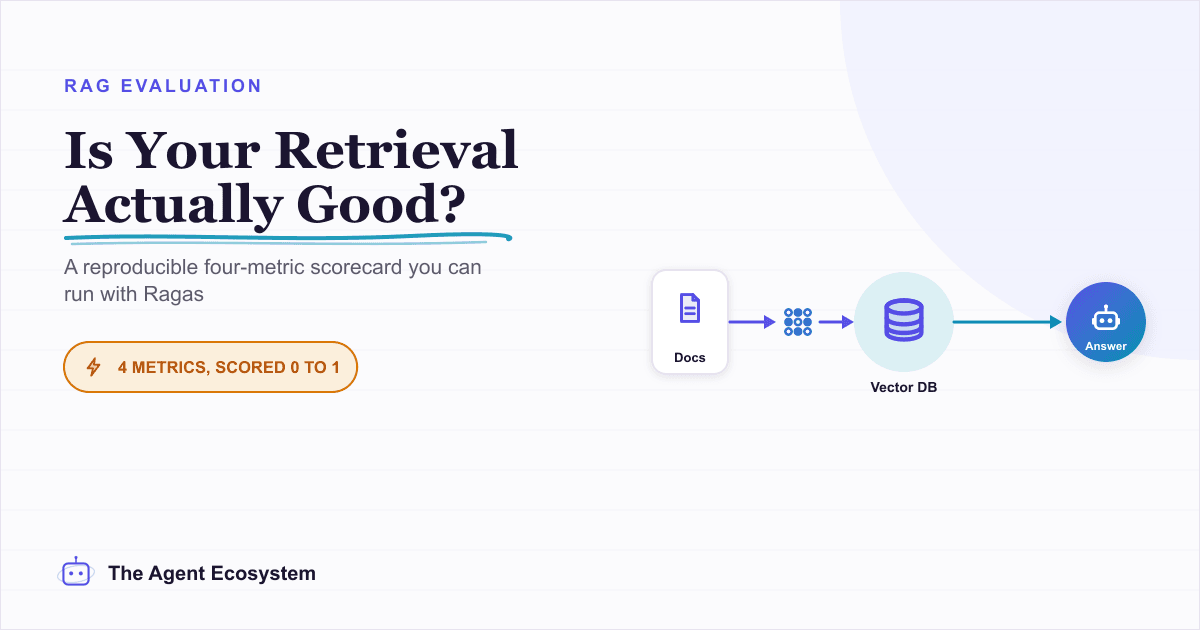
RAG Evaluation: How to Measure If Your Retrieval Is Actually Good
Your RAG pipeline feels okay, but no number says if retrieval is good. This is the reproducible scorecard: context precision and recall for retrieval, faithfulness and answer relevancy for generation, scored 0 to 1 with Ragas, plus which metric to read when an answer is wrong.
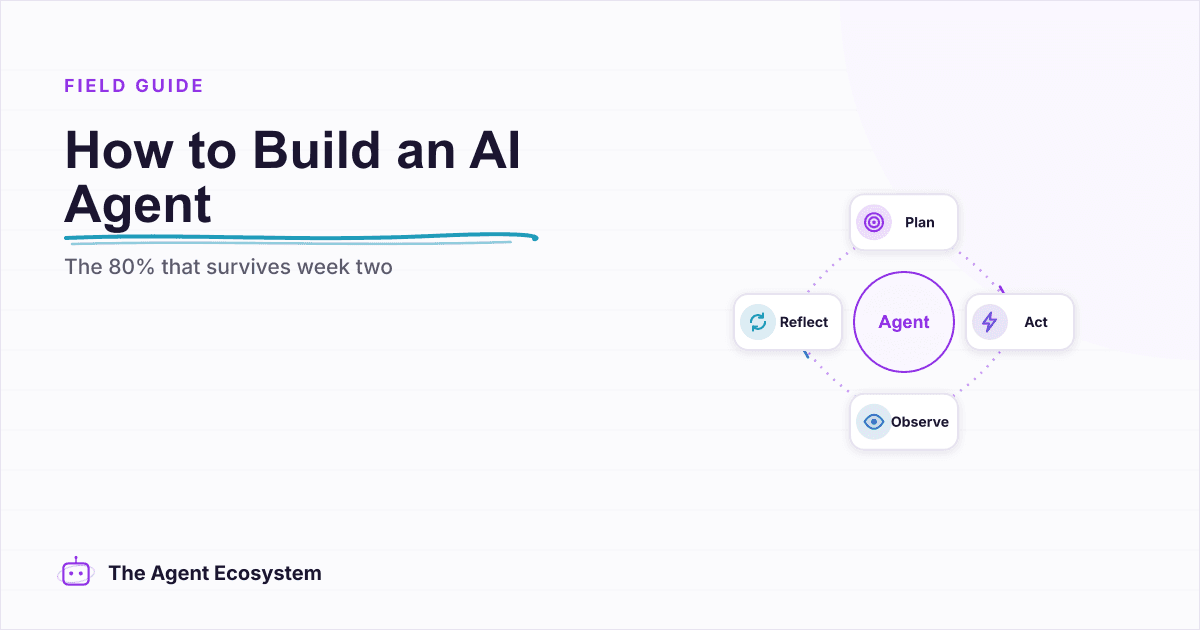
How to Build an AI Agent: The 80% That Survives Week Two
Most tutorials get you a working agent in ten minutes and skip what breaks it in week two. Sixteen lessons covering the loop, tool descriptions, memory, fallbacks, guardrails, evaluation, and the cost levers that decide your bill.