Why AI Pilots Fail to Reach Production, and What Works
The headline number measures one narrow funnel. The causes underneath it are ownership, a real metric, and a defined failure path.
AI-drafted, reviewed by Muhammad Qasim Hammad on September 9, 2026. See our AI disclosure.
Table of contents
A pilot that answered 40 questions correctly in a demo is not evidence of anything yet. It is a controlled test on data somebody picked. Why AI pilots fail to reach production is almost never the model. It is that production asks a different question, and nobody wrote that question down before the pilot began.
What does the 95 percent failure number actually measure?#
It measures one narrow funnel. The report behind the headline studied custom enterprise tools and found roughly 5 percent reached production with a measurable profit and loss impact inside 6 months. That is a strict bar on a small interview base, not a law of nature covering every pilot everywhere.
The methodology is worth knowing before you quote it in a planning meeting. The work rests on 52 executive interviews, a survey of 153 leaders, and a scan of about 300 public deployments. It was a preliminary paper rather than a peer reviewed study, and success was defined as deployment past the pilot stage with measurable indicators inside a 6 month window.
Three things follow from that. A pilot delivering efficiency gains that nobody converted into a headcount or cost line counts as a failure here. A pilot whose payback lands in month 14 counts as a failure. And the unit of analysis is an executive's recollection of whether it worked, not an audited financial result.
None of that makes the report useless. It makes the number a description of a measurement, not a prophecy. A separate Gartner poll of more than 3,400 organisations reached a directionally similar conclusion by a different route, predicting that over 40 percent of agentic AI projects will be cancelled by the end of 2027, and naming escalating cost, unclear business value and weak risk controls as the causes.
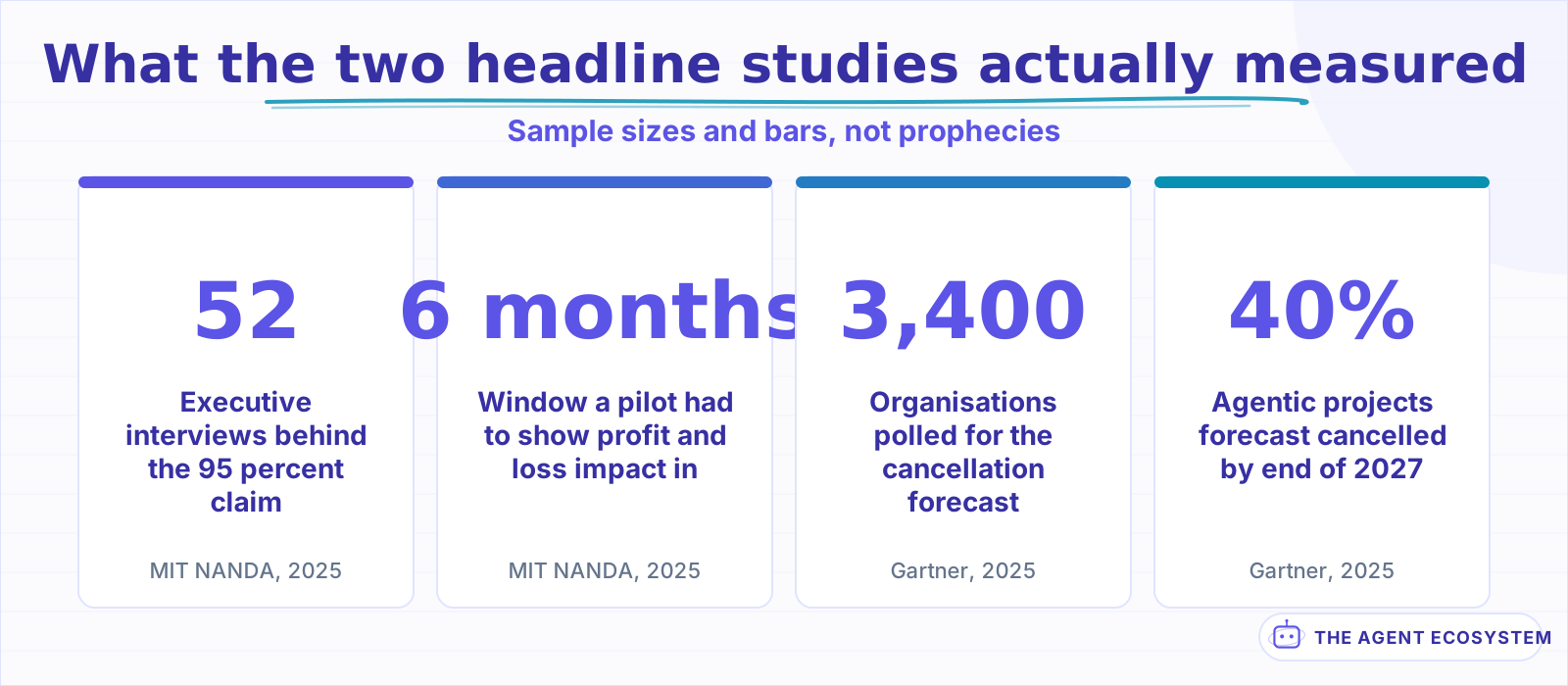 Two independent looks landing on cost and value rather than accuracy is the signal. The headline percentage is not.
Two independent looks landing on cost, value and control rather than on accuracy is the actual signal. Model quality is not what the failures have in common.
Why does a pilot that works in a demo stall before production?#
Because a pilot and a production system are measured against different things, and the pilot was never asked the harder question. A demo proves the model can produce the output. Production asks who owns it at 2am, what happens on the 3 percent it gets wrong, and whether anyone will pay for it every month.
The gap is structural rather than technical. A pilot runs on curated inputs, with the builder present, against no deadline, for an audience that wants it to succeed. Production runs on whatever arrives, with nobody watching, against a queue, for people who will route around it the first time it wastes their afternoon.
| Condition | In the pilot | In production |
|---|---|---|
| Inputs | Chosen examples | Whatever arrives, including malformed |
| Failure handling | The builder intervenes | An unowned queue, or silence |
| Cost | A rounding error | A recurring line somebody must approve |
| Success measure | It looked right | A number an owner is accountable for |
| Ongoing work | None assumed | Prompt drift, model changes, escalations |
Read that table as a list of the work a pilot deliberately defers. None of it is hidden or surprising. It just does not get scheduled, because the pilot succeeded and the deferred column never had a name or a budget attached to it.
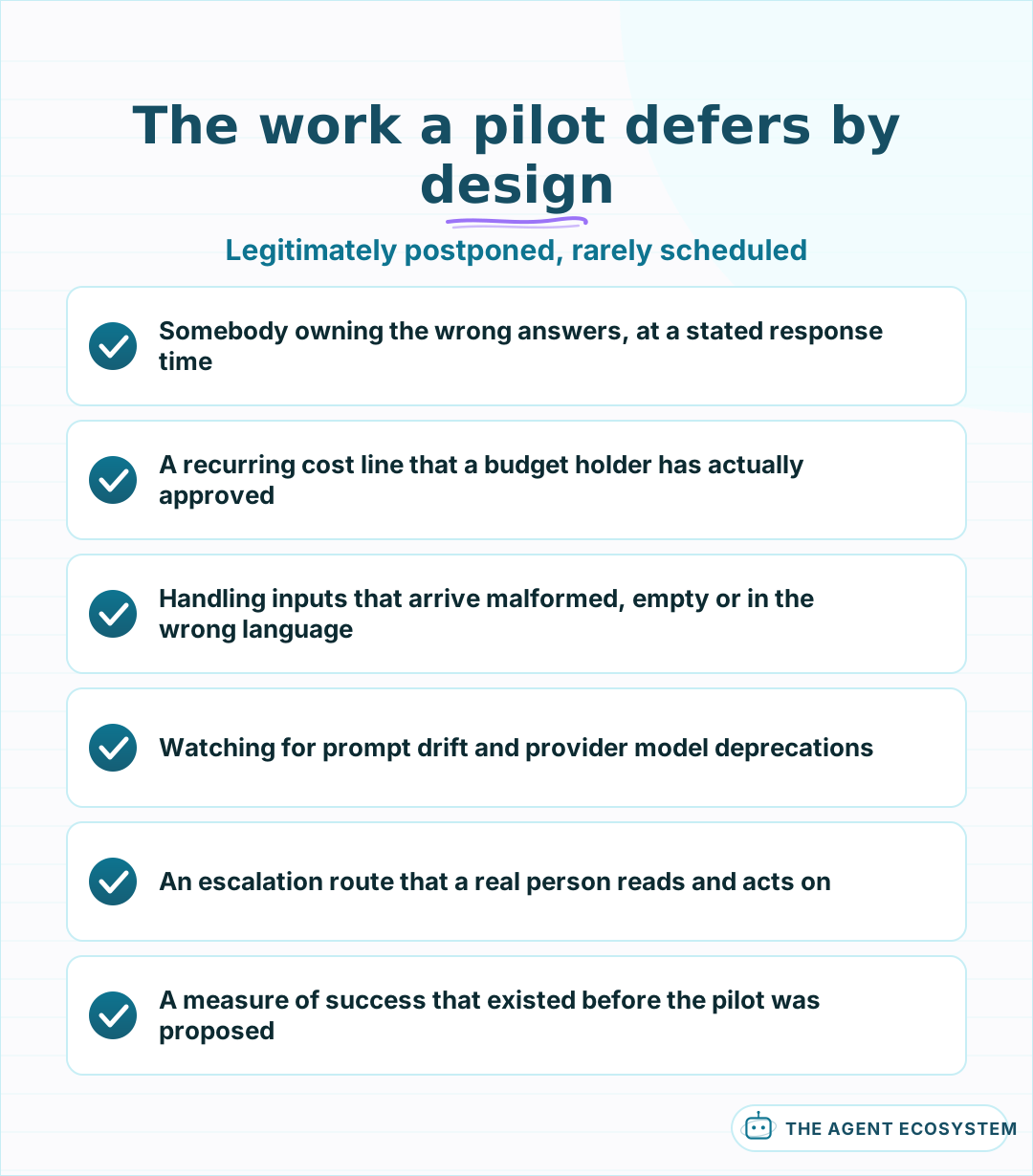 None of this is hidden. It simply never gets scheduled, because the pilot succeeded without it.
The specific trap is that the pilot's success is genuine. The system really did work under those conditions. That makes it very hard to argue for the 6 to 10 weeks of unglamorous work that the production version needs, because on the evidence available the thing already works.
What separates the pilots that ship from the ones that do not?#
An owner, a number, and a defined failure path. Pilots that reach production have a named person accountable for a metric that existed before the pilot started, and a written answer for what happens when the system is wrong. Pilots that stall usually have an enthusiastic builder and a slide.
The metric has to predate the pilot. A measure invented afterwards will be the one the pilot happens to do well on, and it will be chosen without anybody noticing they are doing it. Pick the number first, from the business, and accept that it may show the pilot did not move anything.
The failure path matters more than the accuracy rate. A system that is right 91 percent of the time and routes the rest to a person is deployable. A system that is right 97 percent of the time and fails silently on the rest is not, because nobody can tell which answers to trust. Deciding where a human takes over is production work, not polish.
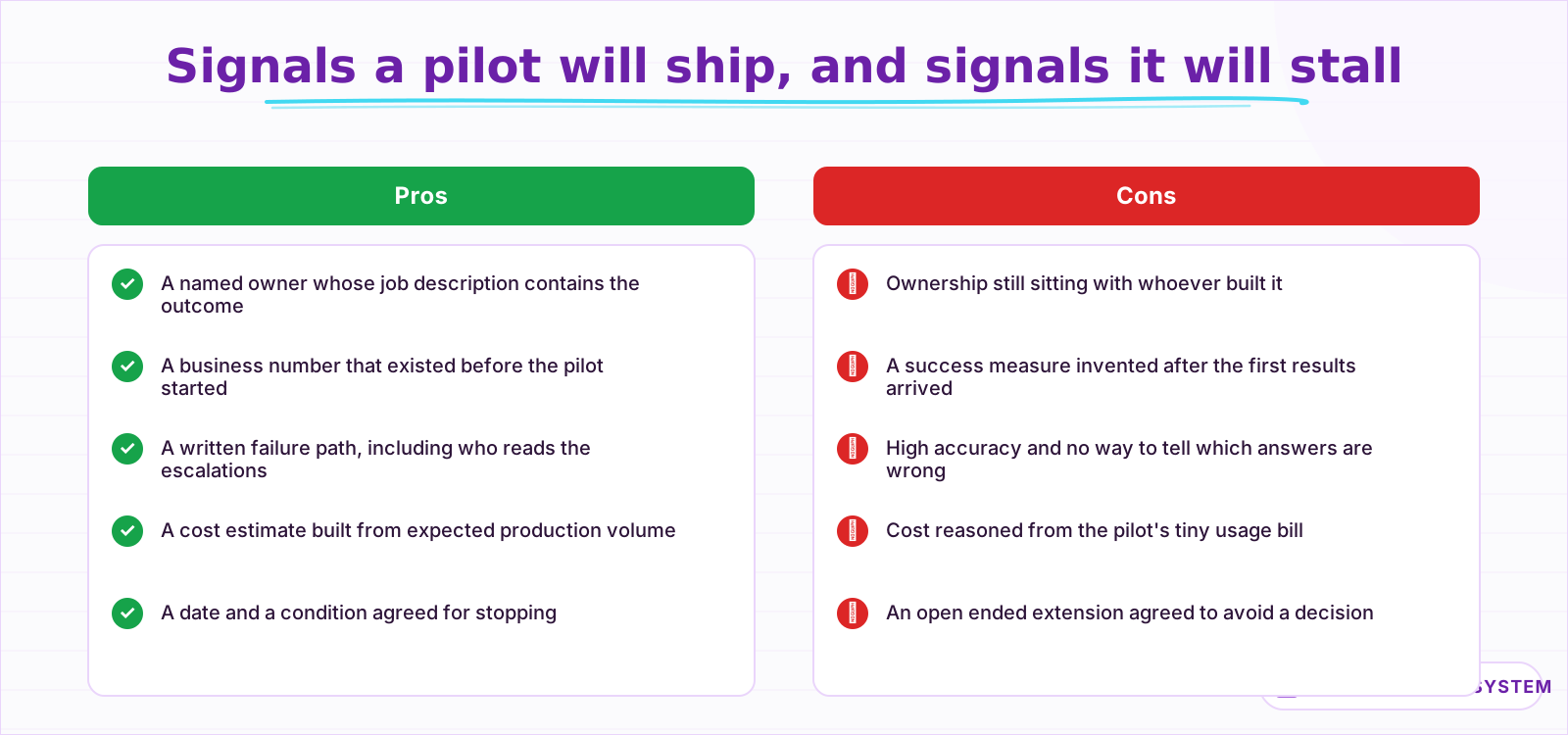 The left column is all organisational. Not one of these items is about the model.
Ownership is the part people skip. A pilot belongs to whoever built it, which is fine for 4 weeks and fatal after that. Production needs someone whose job description contains the outcome, because prompts drift, providers deprecate models, and inputs change shape without warning.
How do you tell early whether a pilot will make it?#
Ask four questions in week one and write down the answers. Who owns this when it is live, what number does it move, what happens on the cases it gets wrong, and what does a month of it cost. A pilot that cannot answer all four is a demo, and it is better to know that in week 1.
The questions are deliberately boring, and that is the point. Every one of them is answerable on day one without building anything, and every one of them is a common cause of cancellation in both the report and the Gartner poll. Asking them early costs an hour. Discovering them in month 5 costs the project.
Cost deserves a real estimate rather than a shrug. A pilot's usage bill is not informative because the volume is tiny, so the honest exercise is arithmetic on expected production volume rather than an extrapolation from the demo. Working through the token math before committing takes about 20 minutes and regularly changes the decision.
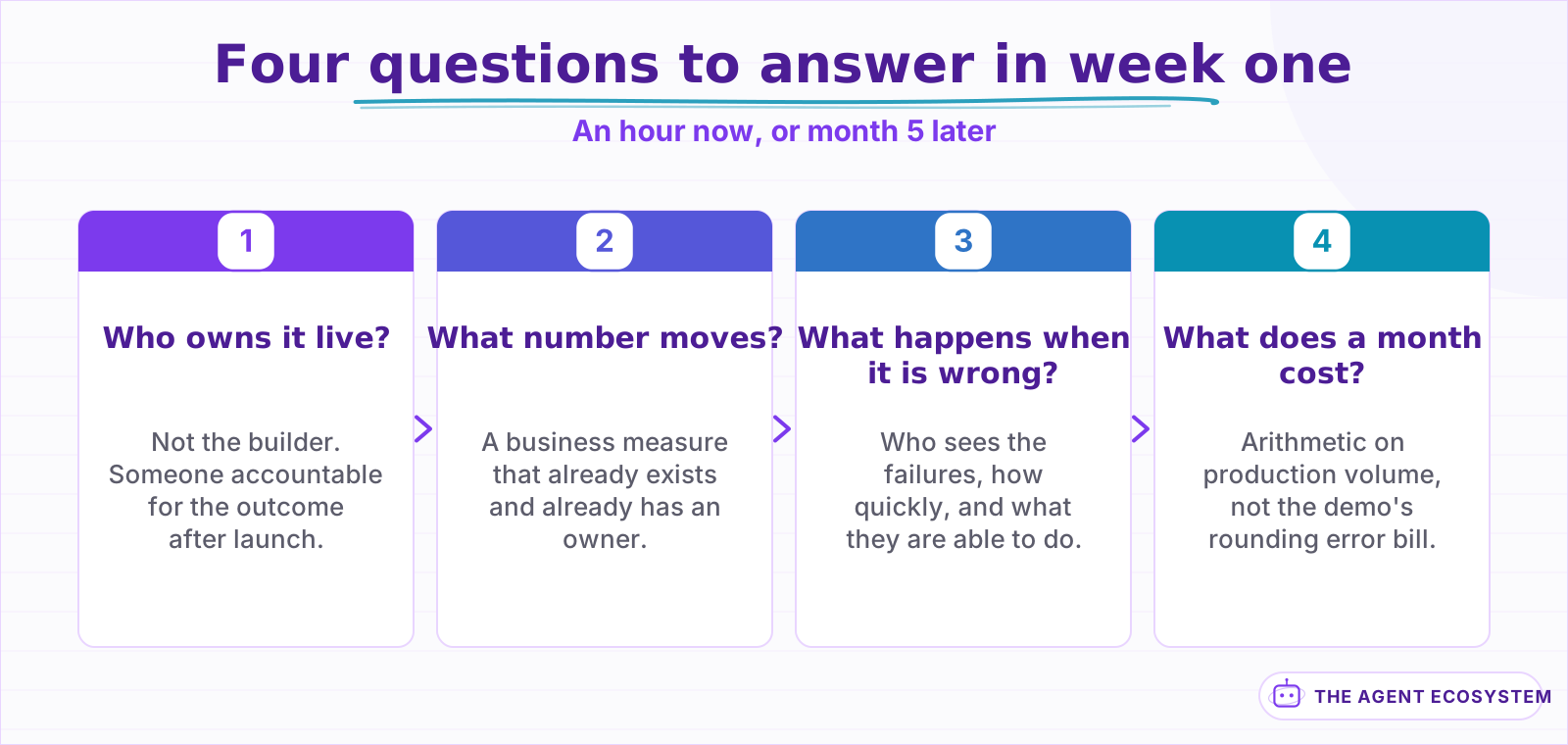 Every one is answerable on day 1 without building anything. Each is a common cause of cancellation.
When should you kill a pilot instead of extending it?#
When it cannot answer the ownership question after a fair attempt, when the number it moves turns out to be one nobody is accountable for, or when the honest cost estimate exceeds the value of the work it replaces. Extending a pilot to avoid that conclusion is the most expensive option available.
Extension is the default because it is socially easy. Nobody has to say the project failed, the team stays busy, and the decision moves to next quarter. This is how a pilot consumes 9 months and produces nothing except a maintained demo that a small number of people occasionally show to visitors.
The cleanest kill criterion is a date plus a condition set in advance. Decide in week 1 what has to be true by week 8, and agree that if it is not true the work stops. A pilot cancelled on a pre agreed condition is a cheap experiment that returned a real answer. The same pilot cancelled in month 9 is a failure, and it is the identical result arriving later at higher cost.
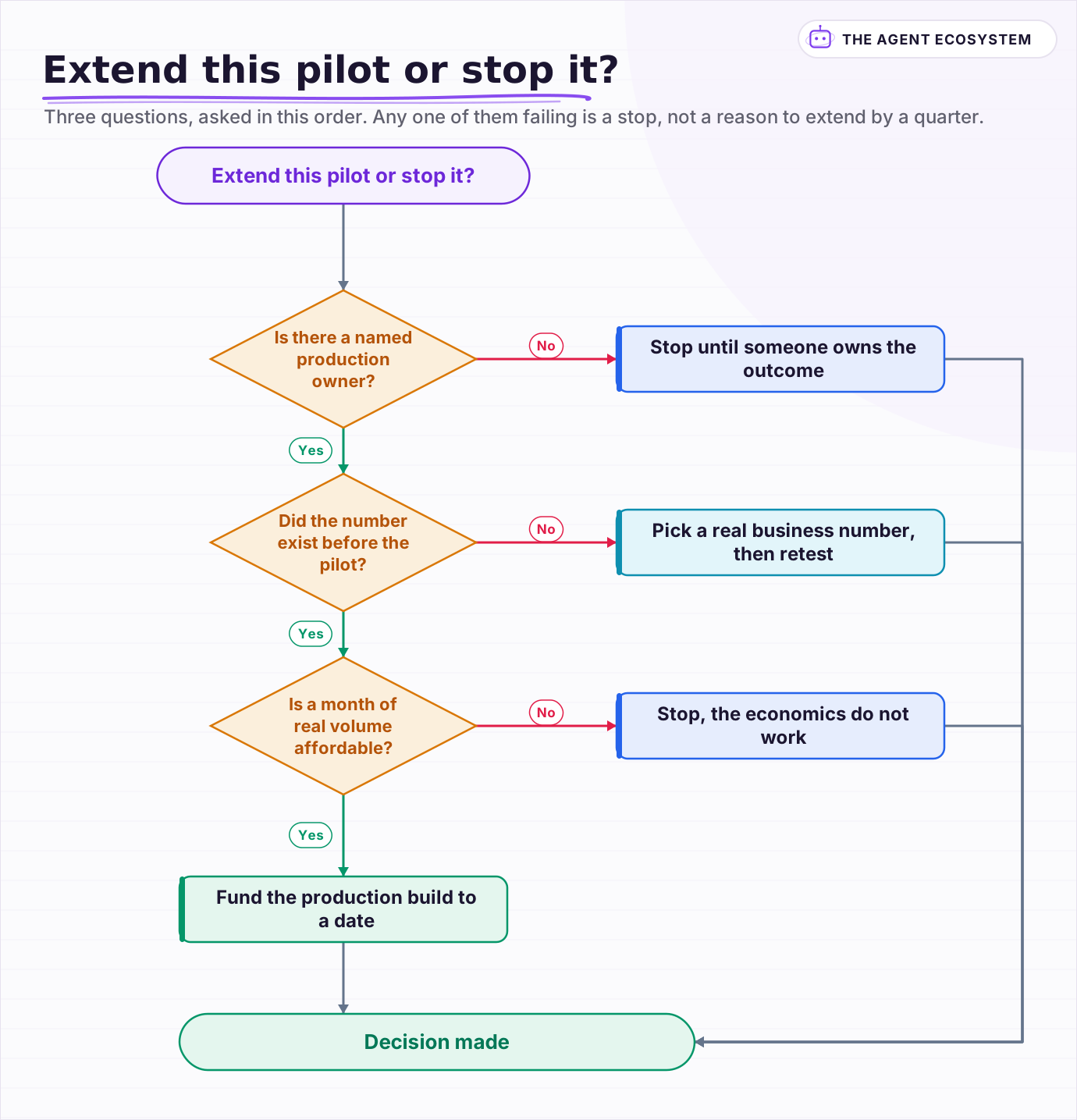 Three questions, asked in this order. Any one of them failing is a stop, not a reason to extend by a quarter.
Worth separating from all of this: a pilot proving the approach does not work is a good outcome, not a wasted quarter. It cost a few weeks and removed an option that would otherwise keep resurfacing. The waste is not in pilots that fail. It is in pilots that are neither killed nor shipped, which is where most of the 40 percent in the Gartner forecast will end up.
Frequently asked questions
Is it true that 95 percent of AI pilots fail?
What is the most common reason an AI pilot does not reach production?
Should the success metric be chosen before or after the pilot?
Does a higher accuracy rate make a pilot more deployable?
When should you cancel an AI pilot?
Sources
Primary references and vendor documentation used while drafting and reviewing this article.
Written by

Muhammad Qasim Hammad is an AI agent and automation expert and the founder of Cart Gaze LLC (cartgaze.com). He builds product for the love of it: when an idea lands, a working prototype is usually running within hours, built with the same AI agents and automations he sells. He puts his own output at roughly 20× what it was before agents, and the Agentic OS behind this site is the working proof, documented in public with the tools he actually ran and what they really cost.
AI & Automation Services
Want a pipeline like this running in your business?
I'm Qasim — I design and ship AI agents and n8n automations for solo operators and small teams. Tell me what's eating your team's week, and I'll scope a fix.
Related reading
AI Automation ROI: How to Tell If It Actually Paid Off
Almost every AI automation ROI claim is unfalsifiable. Twelve lessons on the four cost meters people miss, why time saved is the weakest number you have, computing payback instead of a percentage, and deciding the kill threshold before you need it.

Choosing an LLM for Production: The Decisions That Stick
Every model comparison you read was written against someone else's task. Twelve lessons on building the evaluation that produces your answer, pricing the choice properly, and making it reversible before the model changes underneath you.
AI Agent Error Budget: Pick a Failure Rate You Can Ship
Nobody ships an agent that is right every time, so the only honest question is how often it may be wrong. The version borrowed straight from web reliability breaks on the first day.
AI Automation Maintenance Cost: What Nobody Budgets For
The build estimate was 3 weeks and it was roughly right. The maintenance is the part nobody quoted, and it is predicted by a number you can count before committing.
How to Test and Evaluate n8n AI Agents: Accuracy, Mocks and Regression
An AI agent is non-deterministic, so 'it worked when I tried it' is not testing. Use n8n's built-in Evaluation feature, a golden test set, and the right scoring metrics to test n8n AI agents and prove a change made it better, not worse.
How to Build an AI Agent: The 80% That Survives Week Two
Most tutorials get you a working agent in ten minutes and skip what breaks it in week two. Sixteen lessons covering the loop, tool descriptions, memory, fallbacks, guardrails, evaluation, and the cost levers that decide your bill.