AI Automation Maintenance Cost: What Nobody Budgets For
It does not scale with how clever the build was. It scales with how many things can change underneath it without asking you.
AI-drafted, reviewed by Muhammad Qasim Hammad on September 23, 2026. See our AI disclosure.
Table of contents
The build estimate was 3 weeks and it was roughly right. The AI automation maintenance cost is the part nobody quoted, and it does not scale with how clever the automation was. It scales with how many things can change underneath it without asking your permission, which is a number you can count before you commit to anything.
What actually generates the ongoing work?#
External change, almost entirely. An automation sitting between a document source, a model provider and a destination system inherits the release schedule of all three. None of them will consult you, most changes arrive without a notice you read, and each one costs a diagnosis even when the fix is small.
You will see a figure quoted that maintenance is 50 to 80 percent of a system's lifetime cost. Treat it as folklore rather than evidence. It is attributed variously to IEEE, IBM, Gartner and Standish, the ranges disagree, and the underlying studies are hard to inspect. The direction is probably right and the precision is not.
A count you can actually perform is more useful than a percentage you cannot verify. List every external thing your automation depends on, then ask how often each changed in the last 12 months. That number, not the line count, predicts how much of somebody's year this consumes.
| Change surface | Typical cadence | What breaks |
|---|---|---|
| Model version or deprecation | Provider's schedule | Output shape, tone, refusal rate |
| Third party API | A few times a year | Auth, fields, rate limits |
| Upstream document or export format | Whenever they redesign | Parsing, extraction accuracy |
| Internal schema the output writes to | Your own releases | Silent field mismatches |
| Prompt behaviour under new data | Continuous | Accuracy drifts, nobody notices |
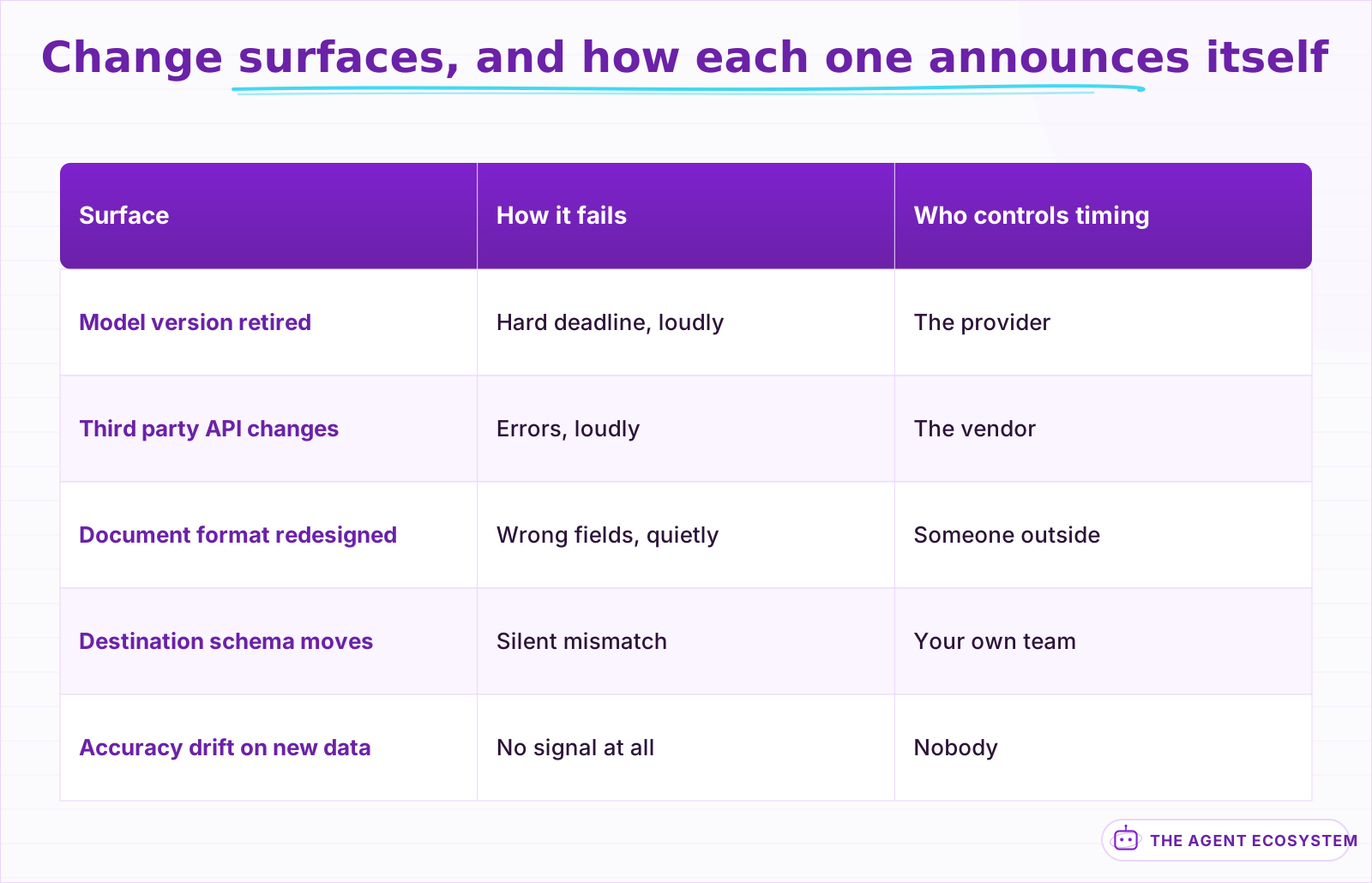 Four of these open a ticket on their own. The fifth produces slightly worse output for months.
The last row is the one that has no ticket attached. Every other surface fails loudly enough that somebody opens an incident. Accuracy drift produces a slightly worse output for months, and only a sample or a complaint reveals it.
How is this different from maintaining ordinary software?#
Ordinary software fails deterministically and stays fixed. A parser that breaks on a new format breaks every time, gets a ticket, gets repaired, and stays repaired. An AI step degrades partially, on a subset of inputs, and passes every test you wrote because the tests were written against last quarter's data.
Two differences do most of the damage. Model providers deprecate versions on their own timetable, so a working automation acquires a hard deadline it did not choose. And identical code produces different output as the underlying model changes, which is a category of regression that traditional testing was never designed to catch.
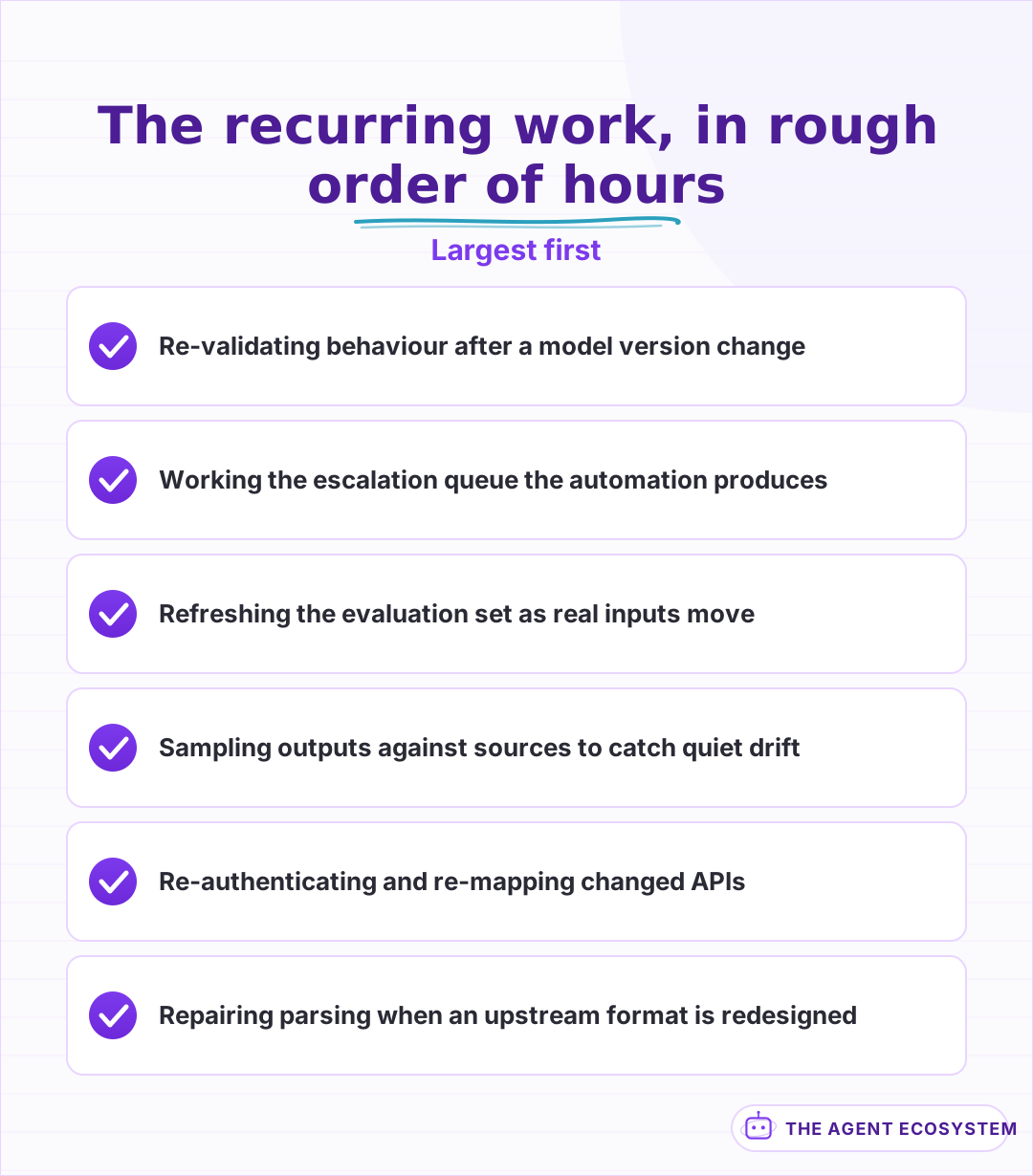 Only the last item resembles conventional maintenance, and it is usually the smallest of them.
A worked example makes the shape concrete. An extraction step reads supplier invoices and writes 6 fields into a finance system. It runs for 7 months untouched. Then one supplier changes its invoice template, the model starts reading the tax line as the total on that supplier only, and the finance system accepts it because the number is well formed and in range. Nothing alerts. The error surfaces when somebody reconciles a quarter.
Notice what would have caught it. Not a unit test, because the code is unchanged and correct. Not an uptime check, because the automation ran successfully every time. Only a sample of outputs compared against source documents, or a downstream reconciliation, finds this class of problem, and both are recurring work rather than one time work.
There is a third difference, quieter than the others. Nobody owns an automation that works. It was built by whoever had the idea, it ran fine for 5 months, and the person who understands it has changed teams by the time it needs attention. That is a maintenance cost even though it appears on no budget line.
What does the recurring work actually consist of?#
Four things, in rough order of how much time they take. Re-validating after model or API changes, handling the escalation queue, keeping the evaluation set current, and repairing integrations. Only the last resembles conventional maintenance, and it is usually the smallest of the four.
Re-validation is the item people forget to staff. When a provider retires a version you are not choosing whether to move, only when, and moving means re-running your evaluations, comparing behaviour and accepting a small behavioural difference you did not ask for. That is engineer days, not minutes, and it arrives on somebody else's schedule.
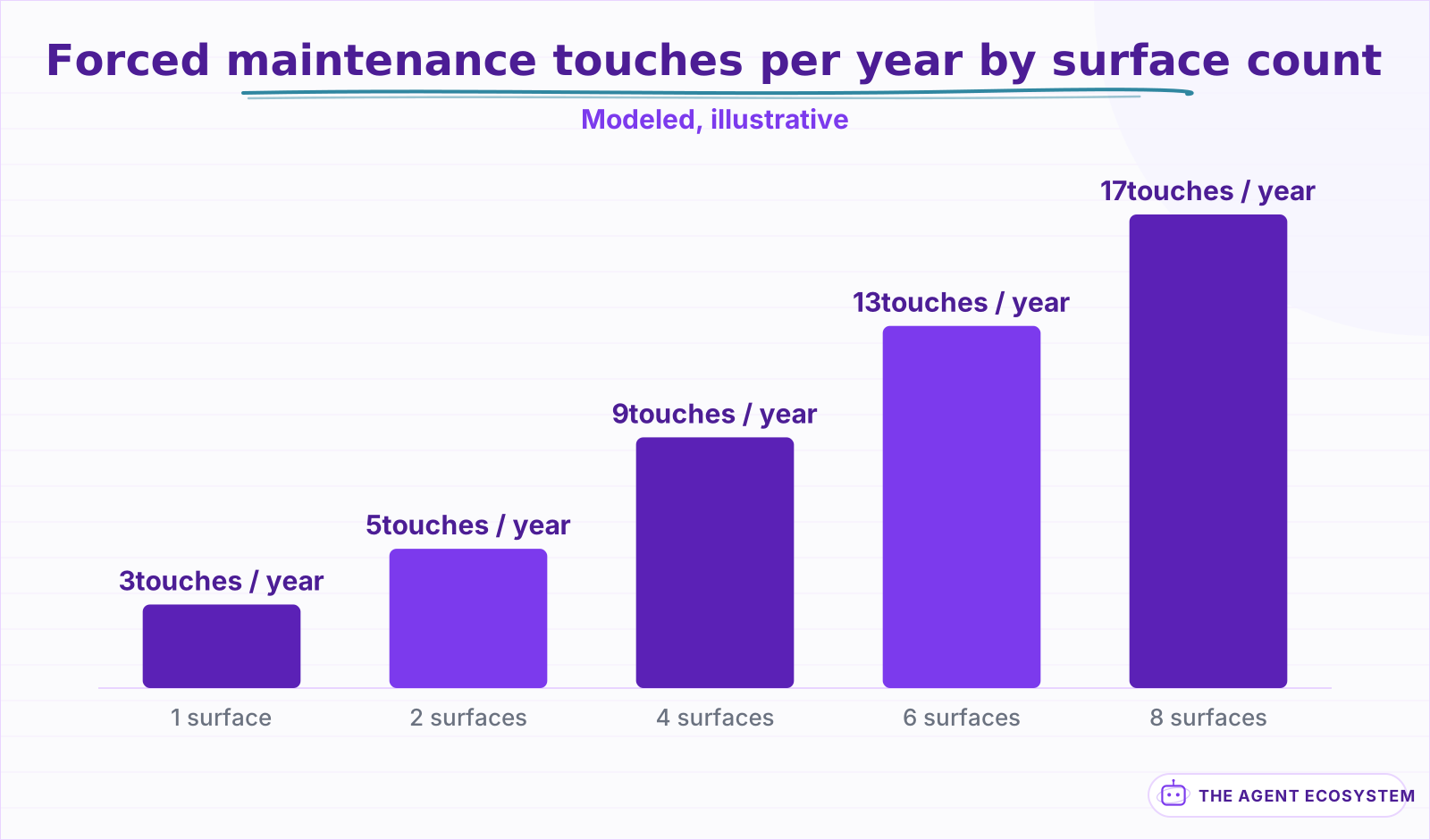 Modeled at about 2 changes per surface per year plus one re-validation. Substitute your own observed cadence.
The escalation queue is a real running cost and it belongs in the estimate. An automation handling 90 percent of cases sends 10 percent to a person, and that person's time is part of what the automation costs. Leaving it out makes the business case look better than it is by exactly the amount that matters.
How do you estimate it before committing?#
Multiply change surfaces by observed cadence, add a fixed allowance for the escalation queue, and add one re-validation cycle per model provider per year. That produces a number of engineer days rather than a percentage, and the inputs are things you can check today instead of things you would have to believe.
Do it per surface rather than as one lump. A model provider you have to follow is roughly one re-validation cycle a year. An API that changed twice last year will change about twice again. A document format controlled by somebody outside your company is unpredictable and deserves a deliberately pessimistic allowance rather than an average. Adding those gives a defensible total that survives being questioned.
Being wrong in the right direction is cheap here. An automation budgeted for 12 maintenance days a year that needs 6 is a pleasant surprise. One budgeted for zero that needs 12 gets abandoned mid year, usually still running, usually still wrong. Estimating the running cost covers the token side; this is the human side of the same question.
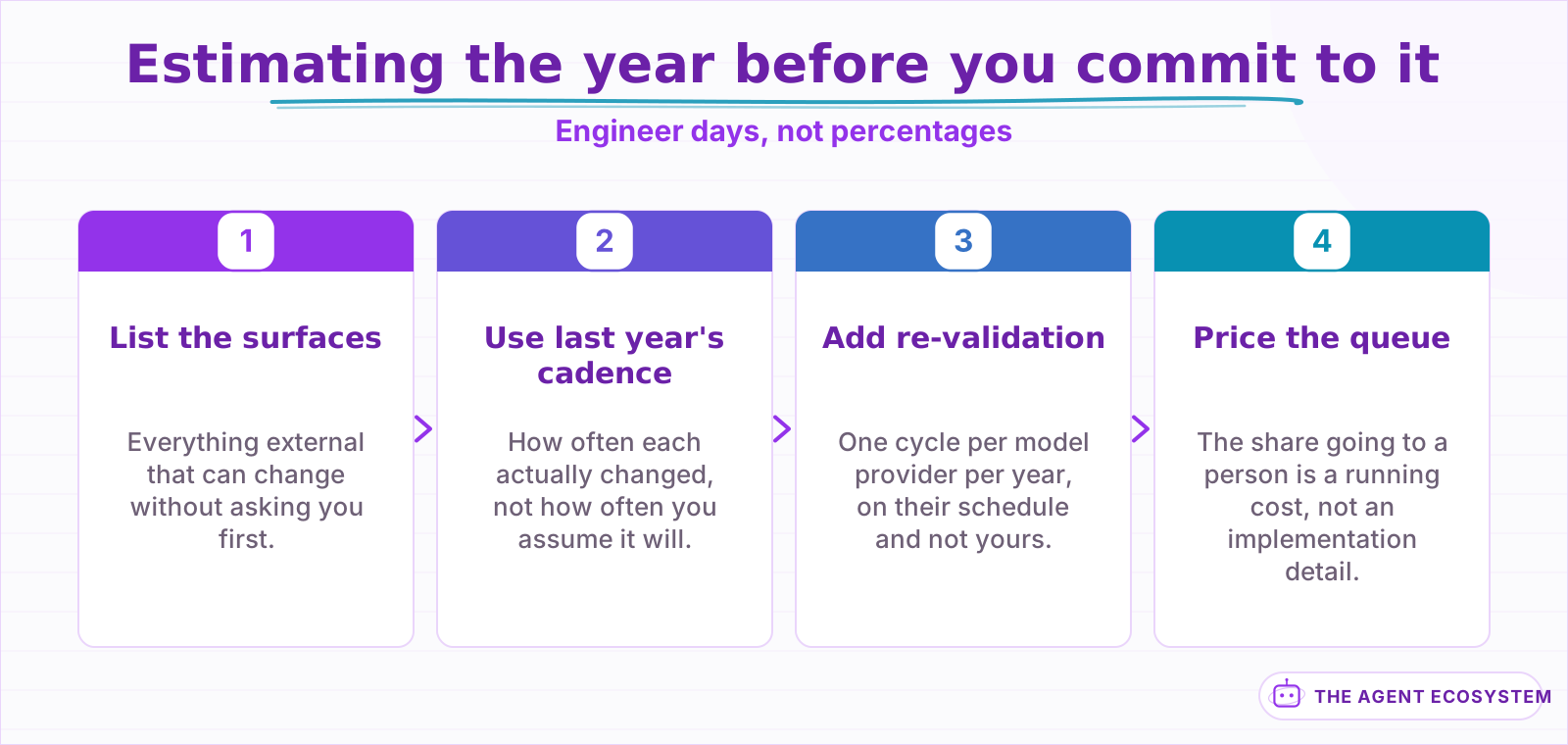 Every input is checkable today. That is the whole advantage over quoting a percentage.
When is an automation no longer worth maintaining?#
When the maintenance cost exceeds the manual work it replaces, which happens more often than anyone admits. An automation saving 2 hours a week saves about 100 hours a year, and if it consumes 15 engineer days plus an escalation queue, the arithmetic has quietly inverted and nobody has redone it since the launch.
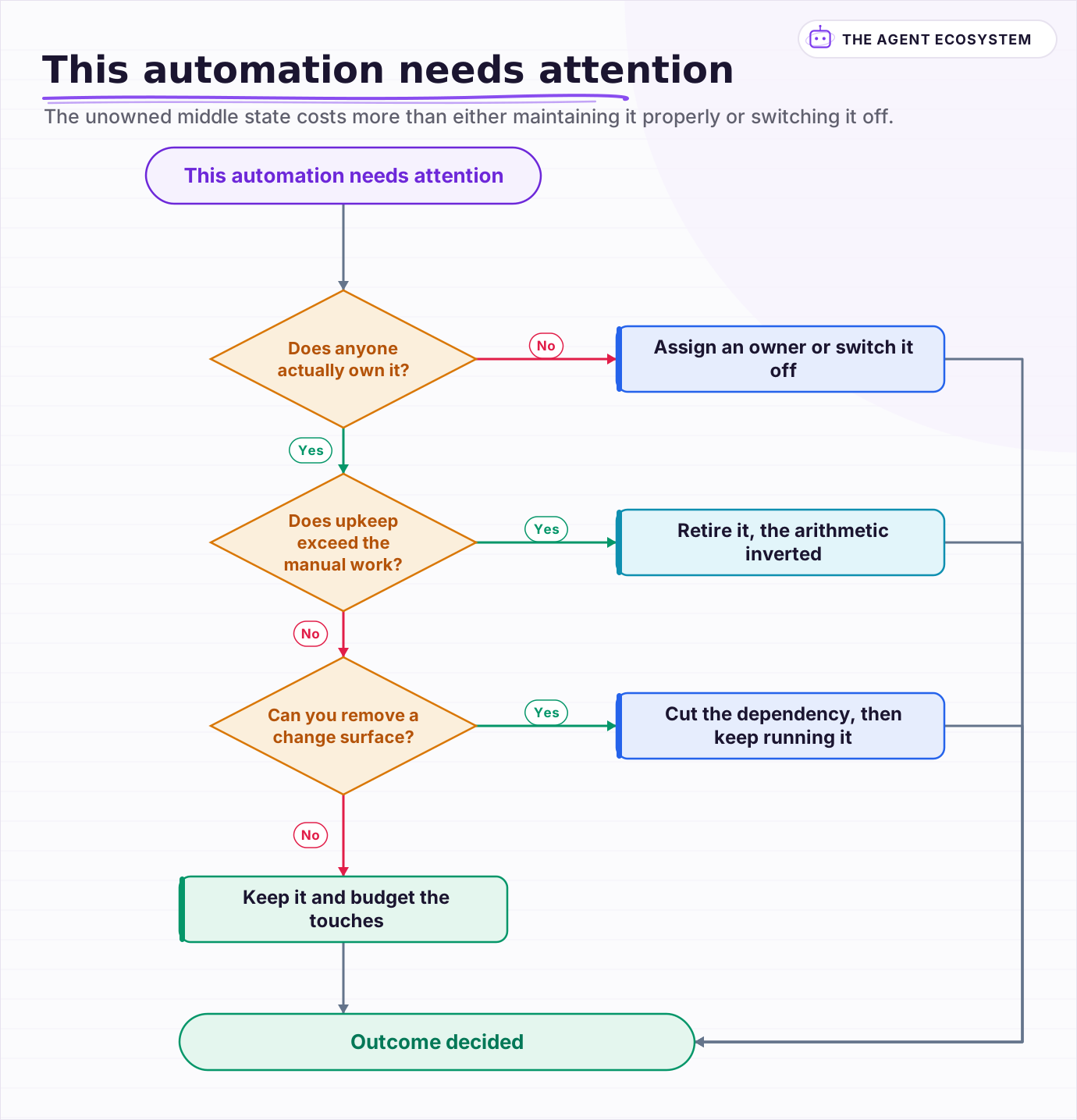 The unowned middle state costs more than either maintaining it properly or switching it off.
Retiring one is a legitimate outcome and it should be as unremarkable as building it. The failure mode is the middle state, where an automation nobody maintains keeps running, keeps producing output people half trust, and keeps consuming the queue. That costs more than either shipping it properly or turning it off.
Frequently asked questions
What drives maintenance cost for an AI automation?
Is it true that maintenance is 60 to 80 percent of software cost?
Why do AI automations degrade differently from normal software?
How do I estimate maintenance before building?
When should we retire an AI automation?
Written by

Muhammad Qasim Hammad is an AI agent and automation expert and the founder of Cart Gaze LLC (cartgaze.com). He builds product for the love of it: when an idea lands, a working prototype is usually running within hours, built with the same AI agents and automations he sells. He puts his own output at roughly 20× what it was before agents, and the Agentic OS behind this site is the working proof, documented in public with the tools he actually ran and what they really cost.
AI & Automation Services
Want a pipeline like this running in your business?
I'm Qasim — I design and ship AI agents and n8n automations for solo operators and small teams. Tell me what's eating your team's week, and I'll scope a fix.
Related reading
AI Automation ROI: How to Tell If It Actually Paid Off
Almost every AI automation ROI claim is unfalsifiable. Twelve lessons on the four cost meters people miss, why time saved is the weakest number you have, computing payback instead of a percentage, and deciding the kill threshold before you need it.

AI Agent Cost Per Resolved Ticket: The Honest Version
The dashboard says the bot handled 4,000 conversations last month and cost very little. Cost per resolved ticket is a different number, usually several times larger.
Why AI Pilots Fail to Reach Production, and What Works
A pilot that answered 40 questions correctly in a demo is not evidence of anything yet. It is a controlled test on data somebody picked, and production asks a different question entirely.
AI Automation for Solopreneurs: What to Build First
You do not have an automation problem, you have a which-of-these-forty-things problem. Thirteen lessons on picking the first job, counting the baseline, building three automations that survive, and knowing when to stop.
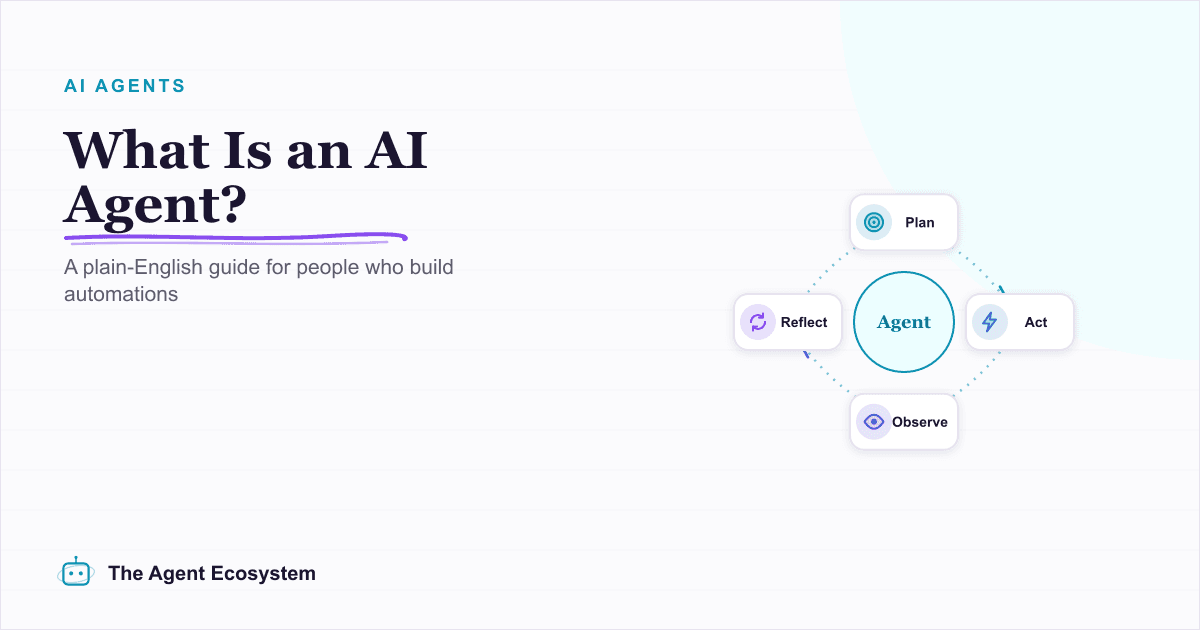
What Is an AI Agent? A Plain-English Guide for Builders
An AI agent is a language model running in a loop that decides its own next action, not a chatbot and not a chain. Here is how the perceive-decide-act-observe loop works, how an agent differs from a chatbot, chain, and workflow, and a checklist for when you actually need one.
AI Labs Are Racing to IPO: What It Means If You Build on Them
Crusoe is reportedly in talks for a big new round, Anthropic hired IPO counsel, and Sonnet 5 shipped as the company races toward a blockbuster IPO. Infra megarounds and public markets mean commercial pressure on the exact APIs your automations depend on. Here is my take on