AI Agent Error Budget: Pick a Failure Rate You Can Ship
One percentage cannot describe an agent. Split the budget into loud failures and silent ones, and attach a consequence before you need it.
AI-drafted, reviewed by Muhammad Qasim Hammad on September 18, 2026. See our AI disclosure.
Table of contents
Nobody ships an agent that is right every time, so the only honest question is how often it may be wrong and what happens when it exceeds that. An AI agent error budget turns that from an argument into a number, but the version borrowed straight from web reliability breaks on the first day. It breaks because agent failures are not interchangeable.
What is an error budget, and why borrow it here?#
It is the allowance for failure implied by a reliability target. Google's practice defines it as 1 minus the SLO, so a 99.9 percent service carries a 0.1 percent budget, and when that budget is spent the team freezes changes except urgent fixes until it is earned back or the period resets.
The reason it transfers to agents is that it kills the two useless positions in every launch argument. One side wants the agent to be right every time, which prices nothing and ships nothing. The other says it is good enough, which measures nothing. A budget forces both into a number that can be checked next month.
What transfers less well is the assumption underneath it. Availability is roughly binary: the request served or it did not. An agent has at least 5 distinct ways to fail, they are not equally bad, and a single percentage treats them as though they are.
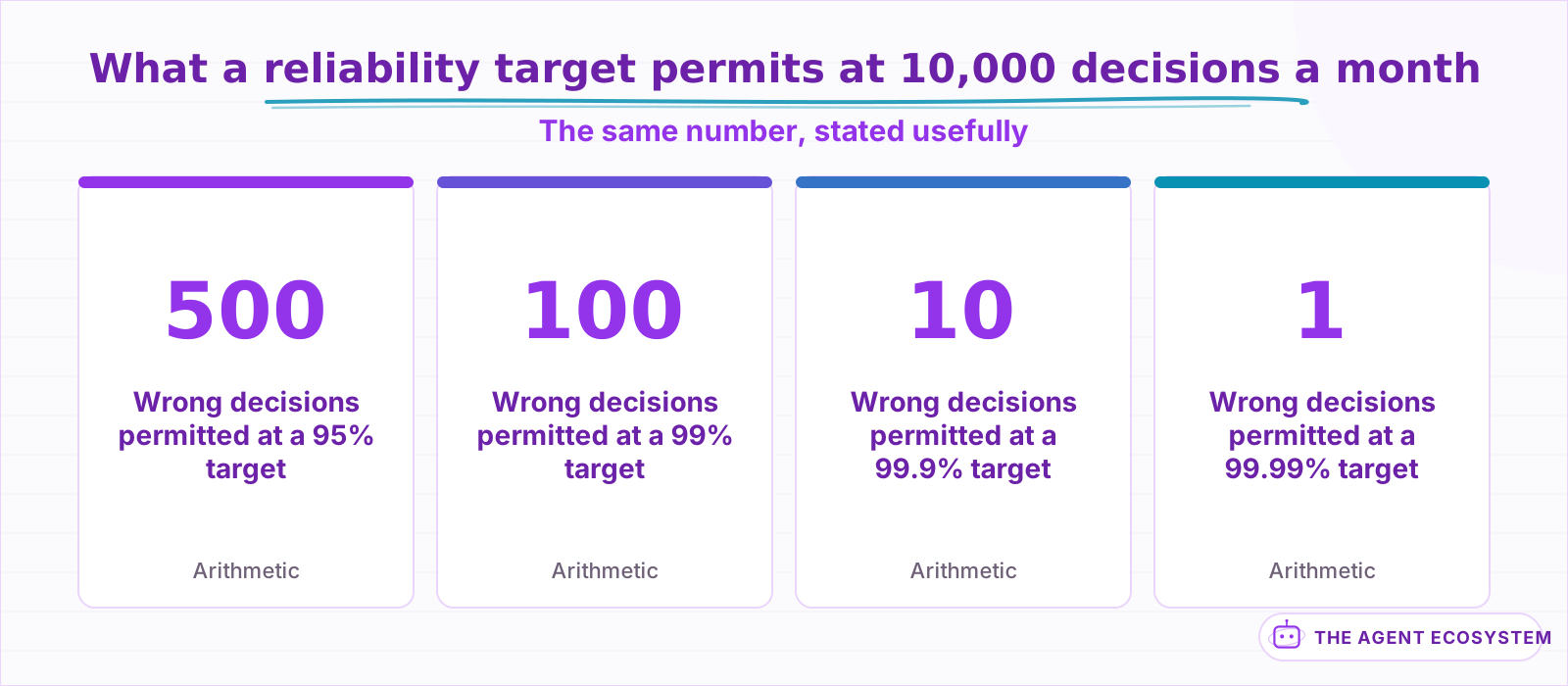 Exact arithmetic, not an estimate. Percentages hide the count, and the count is what the argument is really about.
The arithmetic is worth doing out loud once, because percentages hide scale. At 10,000 decisions a month, a 99 percent target permits 100 wrong ones. That is 100 real customers, and whether that is fine depends entirely on which 100 and how loudly they failed.
Why is a single accuracy number the wrong target?#
Because two agents with identical accuracy can have completely different costs. One refuses 4 percent of the time and the user retries. The other answers 4 percent of the time with a confident wrong number that a person acts on. The metric is the same and only one of them belongs in production.
The distinction that actually matters is whether a failure is loud or silent. A loud failure announces itself: a timeout, a refusal, an error, an escalation. Someone knows immediately and the cost is usually inconvenience. A silent failure looks exactly like a success and is discovered later, by a customer, or never.
| Failure mode | Loud or silent | Typical cost |
|---|---|---|
| Timeout or provider error | Loud | A retry, seconds of delay |
| Explicit refusal | Loud | User tries another route |
| Escalation to a person | Loud | Human minutes, working as designed |
| Malformed output caught downstream | Loud | A failed job, easy to spot |
| Confident wrong answer | Silent | Acted on, found late, costs trust |
Budget these separately. A generous allowance for loud failures and a very tight one for silent failures describes what you actually want, and a single blended accuracy figure cannot express it.
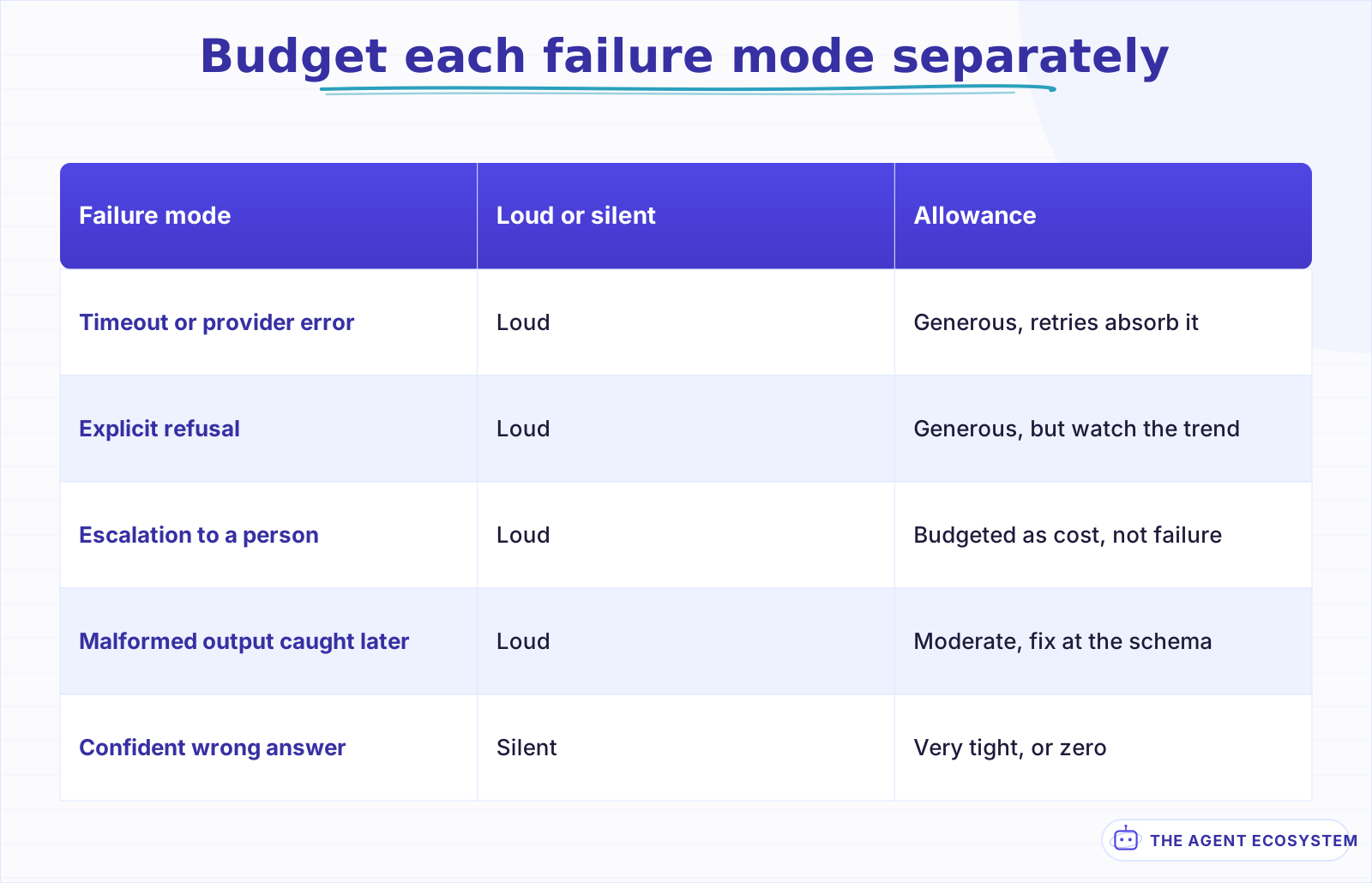 The last row is the one worth spending real effort on. The rows above it are mostly inconvenience.
This also changes what counts as an improvement. Converting a silent failure into a loud one is progress even when accuracy is unchanged, because a confident wrong answer became a refusal a person can see. Most practical agent hardening is exactly that trade.
What has to exist before you can measure it?#
A per decision record and a definition of wrong that does not require a human to adjudicate every case. Without the first you cannot count anything. Without the second you can count only what somebody complained about, which undercounts silent failures by a wide and unknowable margin.
The cheapest usable signal is downstream correction. If a later step, a reviewer or the customer changed the agent's output, treat that as a failure without asking anyone to grade it. It is imperfect and it is available today, which beats a labelling project that never starts.
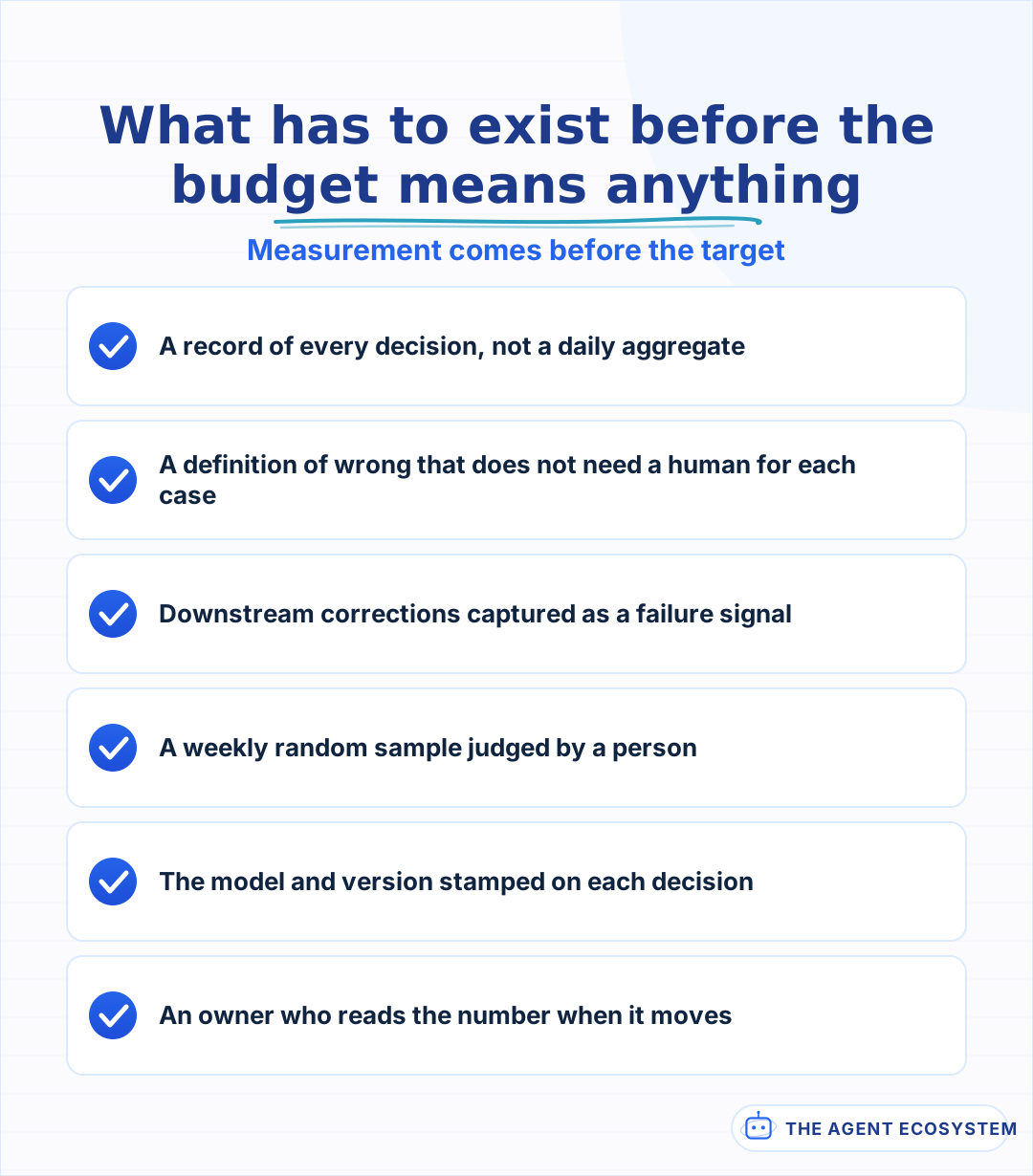 Without the first two rows the budget measures complaints, which undercounts silent failures by an unknowable margin.
Sampling covers the rest. Pull 50 decisions a week at random, have a person judge them, and use that to estimate the silent failure rate the corrections never surface. It is a small standing cost and it is the only thing that catches an agent quietly getting worse after a model update.
How do you set the number without guessing?#
Work backwards from the thing the agent replaced. If the process it automated was already wrong some of the time, that rate is your reference point, and matching it is a defensible target. Beating it is a business case. Being told to reach 100 percent is a request nobody made of the humans doing it before.
Then split the budget by mode rather than assigning one figure. Give loud failures room, because they are recoverable and the alternative is an agent so cautious it escalates everything. Keep the silent budget small enough that spending it triggers a real response rather than a shrug.
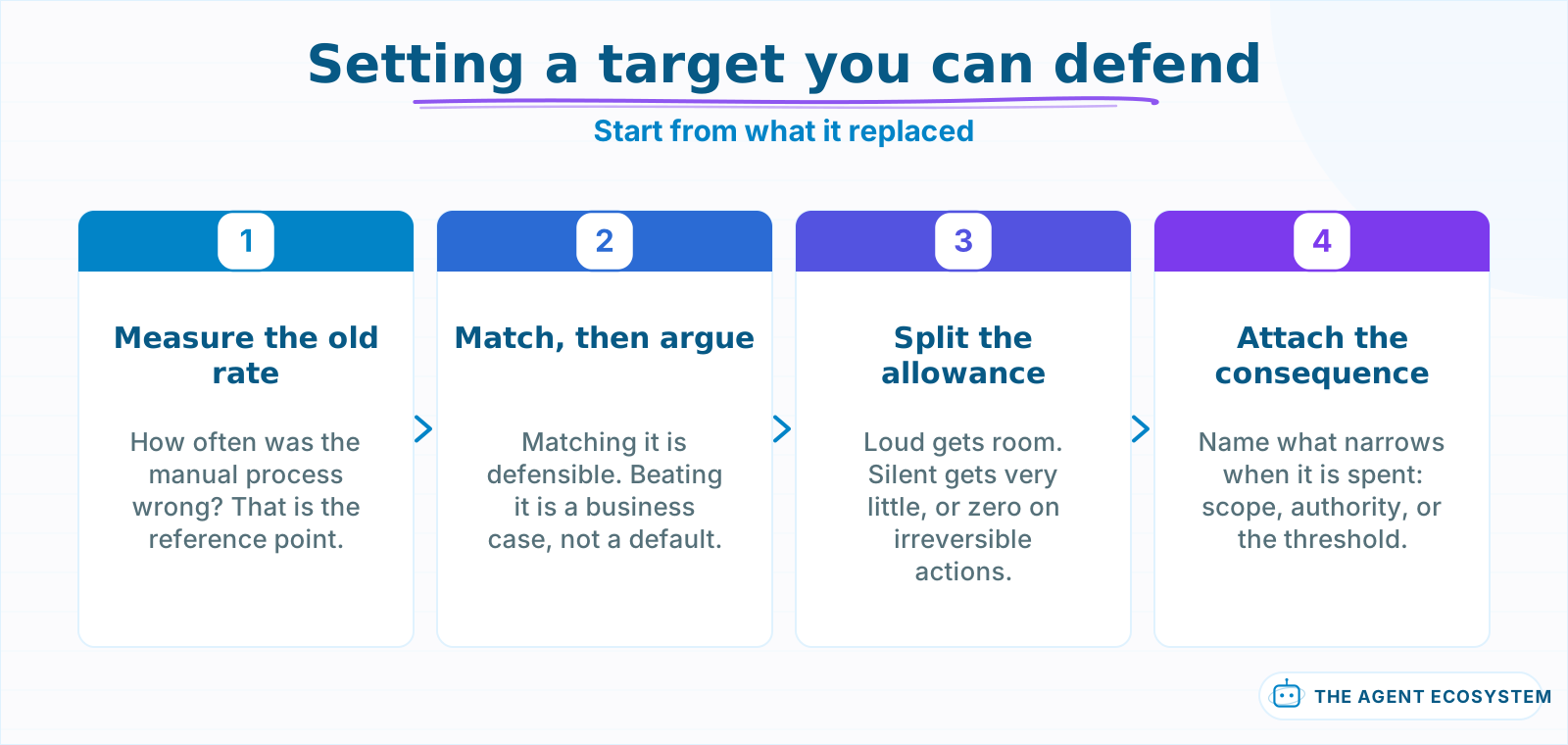 Step 1 removes the argument about perfection. Nobody asked the previous process to be right every time.
What happens when the budget is spent?#
Whatever you agreed in advance, which is the entire point. In the original practice the team freezes changes except urgent fixes addressing the cause, until the budget is earned back or the period resets. For agents the equivalent lever is usually authority rather than deploys.
Narrowing authority is the fastest response available. An agent that was acting alone starts proposing instead, or its scope shrinks to the categories it handles well, or a confidence threshold routes more cases to people. All three reduce the damage rate immediately without waiting for a fix.
The failure of the whole mechanism is agreeing the number and then not agreeing the consequence. A budget with no attached action is a metric on a dashboard, and it will be exceeded quietly for a quarter before anybody raises it. Write the consequence down next to the number, on the same day.
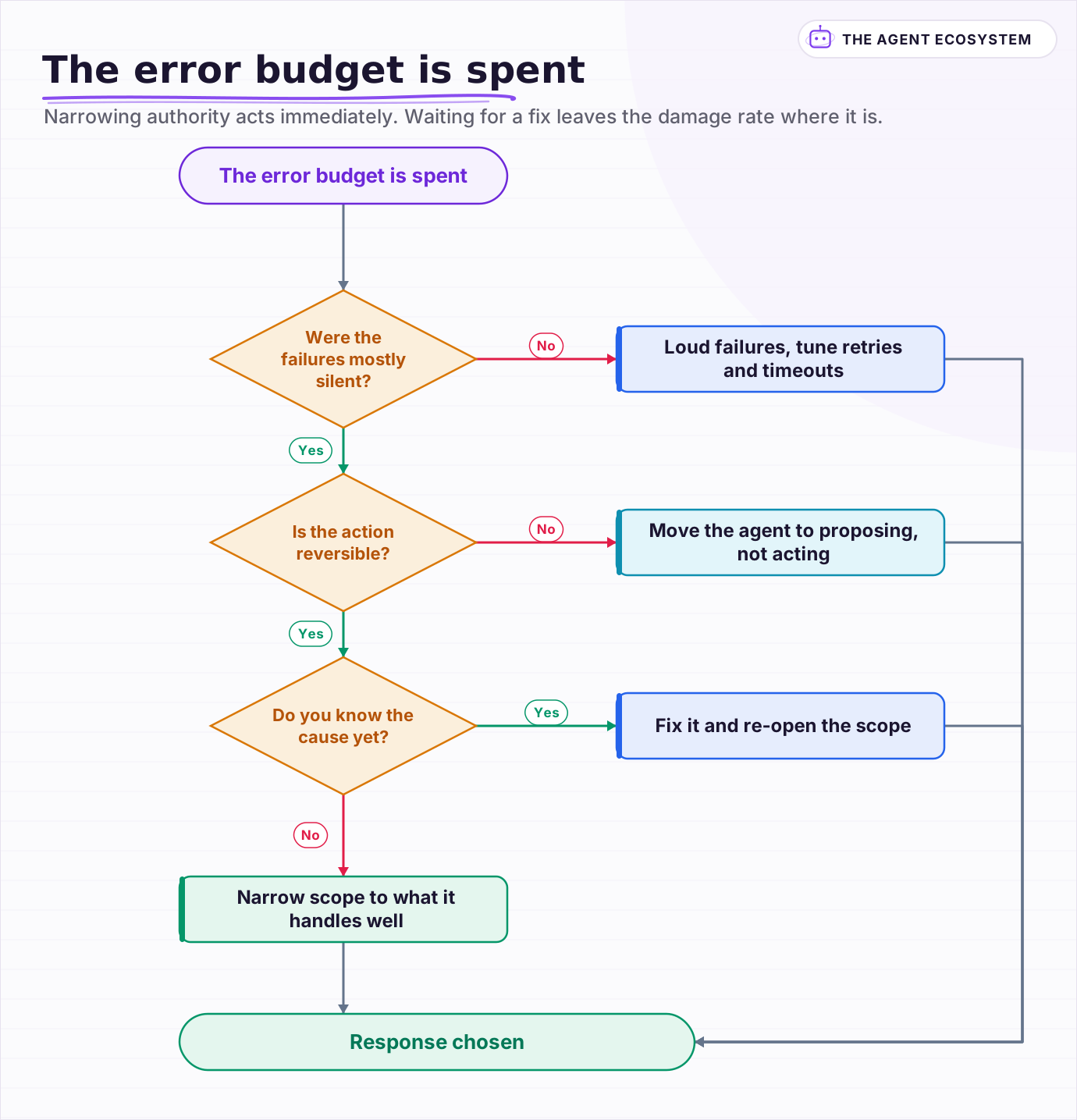 Narrowing authority acts immediately. Waiting for a fix leaves the damage rate where it is.
When should the silent budget be zero?#
When a single wrong action cannot be undone or is not recoverable at any acceptable cost. Irreversible payments, deletions, external communications sent on your behalf, and anything with a regulatory consequence belong here. For these the answer is not a tighter budget, it is a person in the path.
A zero budget is a design instruction rather than a target. It means the agent may prepare the action but not commit it, and deciding what an agent may do alone is the mechanism. Everything else can carry a real number, and most things should.
Frequently asked questions
What is an error budget for an AI agent?
Why is a single accuracy target not enough?
What is the difference between a loud and a silent failure?
How do I detect silent failures without labelling everything?
What should happen when the error budget is exhausted?
Sources
Primary references and vendor documentation used while drafting and reviewing this article.
Written by

Muhammad Qasim Hammad is an AI agent and automation expert and the founder of Cart Gaze LLC (cartgaze.com). He builds product for the love of it: when an idea lands, a working prototype is usually running within hours, built with the same AI agents and automations he sells. He puts his own output at roughly 20× what it was before agents, and the Agentic OS behind this site is the working proof, documented in public with the tools he actually ran and what they really cost.
AI & Automation Services
Want a pipeline like this running in your business?
I'm Qasim — I design and ship AI agents and n8n automations for solo operators and small teams. Tell me what's eating your team's week, and I'll scope a fix.
Related reading
How to Build an AI Agent: The 80% That Survives Week Two
Most tutorials get you a working agent in ten minutes and skip what breaks it in week two. Sixteen lessons covering the loop, tool descriptions, memory, fallbacks, guardrails, evaluation, and the cost levers that decide your bill.

Why AI Pilots Fail to Reach Production, and What Works
A pilot that answered 40 questions correctly in a demo is not evidence of anything yet. It is a controlled test on data somebody picked, and production asks a different question entirely.
Multi-Model Fallback in n8n: Stay Up When Claude Is Down or Over Budget
The model call is the least reliable step in your n8n workflow. Build a multi model fallback ladder (primary, cheaper, local, human) plus a budget guard so a 429, a 529 overload, or a blown budget degrades gracefully instead of killing the run.
Who Is Liable When an AI Agent Makes a Mistake in 2026?
An agent you deployed emailed a customer the wrong refund amount. The answer is always a person or a company, never the software, and which one is decided long before the incident.
Text-to-SQL AI Agents: Plain-English Database Queries You Can Trust
A text-to-SQL agent turns 'how many customers churned?' into a real query against a real database. The models are good enough to try this in 2026, but accuracy is mostly a schema problem and safety is entirely a database problem. This is the loop that makes generation reliable,
Coding Agents Have 4 Autonomy Levels. Most Teams Never Leave Level 2.
The tool you pick is not what decides the risk, the autonomy level is. This is a tool-agnostic, 4-level framework for how much a coding agent should actually be allowed to do, from a diff that waits for your approval to a merge and deploy with no human step at all, grounded in