PII Redaction in LLM Pipelines: Strip the Names, Keep the Meaning
Where personal data leaks in a prompt pipeline, the pseudonymization pattern that preserves context, and the boundary that enforces it.
AI-drafted, reviewed by Muhammad Qasim Hammad on September 3, 2026. See our AI disclosure.
Table of contents
- Why does PII in prompts become a bigger problem than PII in databases?
- What counts as PII in an LLM pipeline?
- Where in the pipeline should redaction happen?
- How do you redact without destroying the model's context?
- What does a detection stack actually look like?
- How do you decide what reaches the model at all?
- What should you build first?
A support ticket says: "Hi, I'm Sarah Chen, sarah.chen@fernandframe.shop, card ending 4242, and my order never arrived." Pipe that into a summarization prompt and the personal data now exists in your prompt log, your tracing tool, the provider's systems, and the eval set someone exports next quarter. PII redaction in an LLM pipeline means stripping or replacing personal data before it leaves your boundary, in a way that keeps the text useful to the model and, when needed, restores the real values in the response.
Why does PII in prompts become a bigger problem than PII in databases?#
A database row lives in 1 place with access controls you designed. A prompt gets copied: into provider logs, your observability traces, cached responses, eval datasets, and screenshots in bug reports. Each copy is a new system holding personal data, usually with weaker controls than the original.
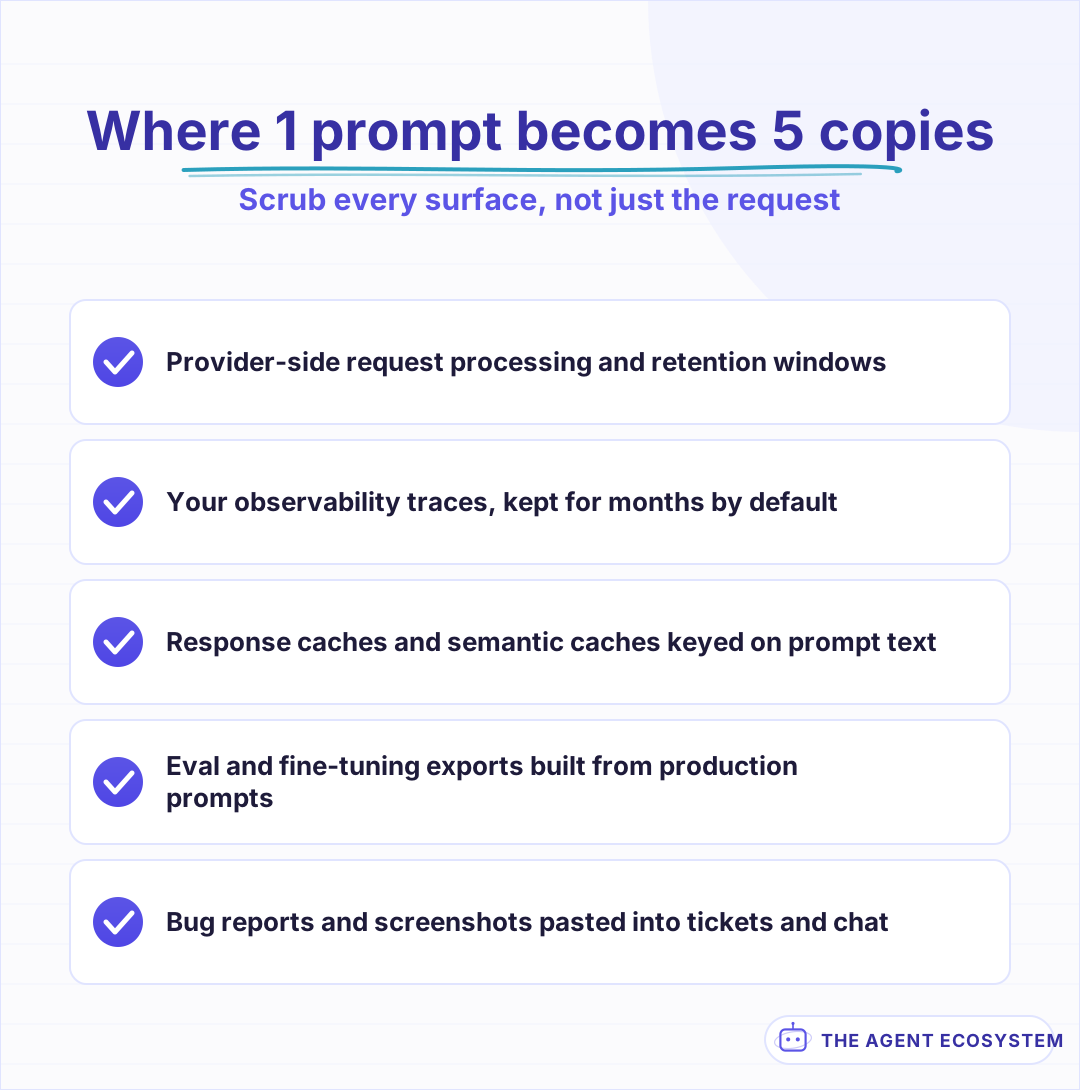 Each copy is a separate system holding personal data, and most of them were never designed as data stores.
The copies are the point. Your database has row-level permissions and an audit trail; your tracing tool has whoever-has-the-dashboard access, and the JSON export of last month's "interesting failures" has none at all. The traces you rightly collect for debugging agents are one of the fastest-growing PII stores in most companies, precisely because nobody thinks of them as a data store.
Data-protection law pushes the same direction from the compliance side. GDPR's data-minimization principle says personal data should be limited to what the purpose requires, and a summarization task rarely requires a real email address to summarize a complaint. Source Minimization at the prompt boundary is the technical shape of that legal sentence.
What counts as PII in an LLM pipeline?#
Start from the regulated lists and extend for context: direct identifiers like names, emails, phone numbers, and account IDs; quasi-identifiers like dates, locations, and job titles that combine to identify someone; and domain secrets like card numbers or health details that carry their own rules.
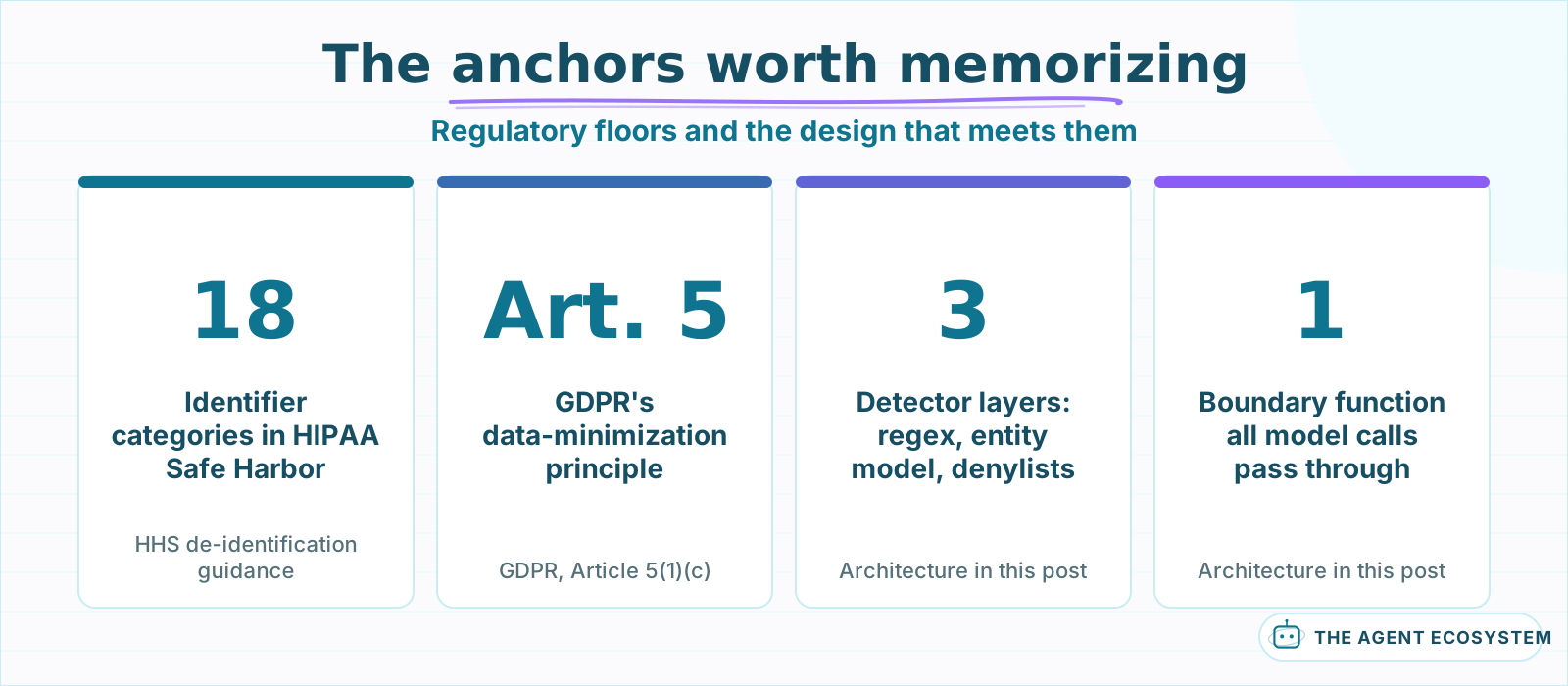 Two are published regulatory anchors; the architecture numbers describe the design in this post.
The quasi-identifier bucket is the one detection tools underweight. "The VP of engineering at a 40-person fintech in Lahore" contains no name and identifies a person anyway. No regex catches that; it takes either an entity model tuned for your domain or a policy decision that certain fields, like free-text "about" sections, get summarized in aggregate rather than passed through raw.
Your own synthetic identifiers belong on the list too. Account numbers, ticket IDs, and internal user IDs look harmless because they mean nothing outside your systems, but they join trivially back to a person by anyone who has, or later gets, access to those systems. Treat them like phone numbers: pseudonymize on the way out, and keep the mapping at home.
Where in the pipeline should redaction happen?#
Redact at the last point you control before data leaves: a boundary function that every model call passes through. Detection earlier is fine, but enforcement belongs at the choke point, and the same boundary owns re-hydration of the response and scrubbing of whatever your logs record.
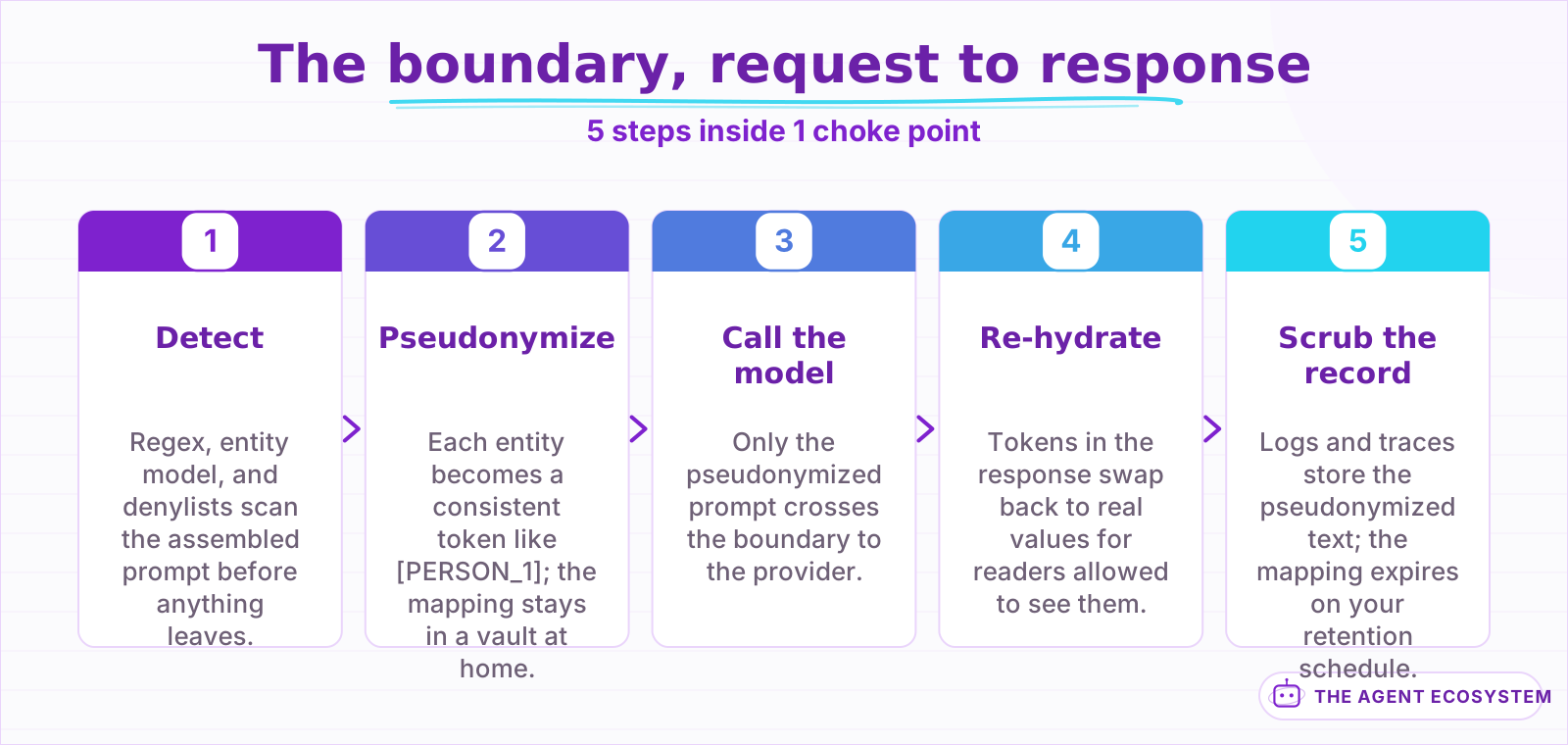 One choke point owns the whole lifecycle, so coverage is verifiable in one place instead of thirty handlers.
A single choke point beats per-feature redaction for the same reason input validation lives in middleware and not in 30 handlers: coverage you can verify in 1 place. New features inherit the protection automatically, and there is exactly 1 function to test, audit, and tighten. This is the same boundary thinking behind prompt injection defense: controls placed where the data crosses trust lines, not sprinkled where developers remember them.
Two more surfaces need the same treatment and usually get forgotten. RAG indexes ingest documents wholesale, so PII in source documents becomes PII in retrieved chunks pasted into future prompts; run the detector at ingest, not just at query time. And if prompts feed an eval or fine-tuning set later, the scrubbing has to happen before the export, because after it, copies multiply beyond recall. Teams handling genuinely sensitive corpora sometimes skip the boundary problem entirely by keeping inference local, which is the privacy argument for a fully local RAG setup.
How do you redact without destroying the model's context?#
Replace, do not erase. Swapping "Sarah Chen" for [PERSON_1] everywhere it appears keeps coreference intact, so the model still knows the 2 mentions are the same person. Blunt masking to [REDACTED] destroys that thread, and answers about who did what degrade with it.
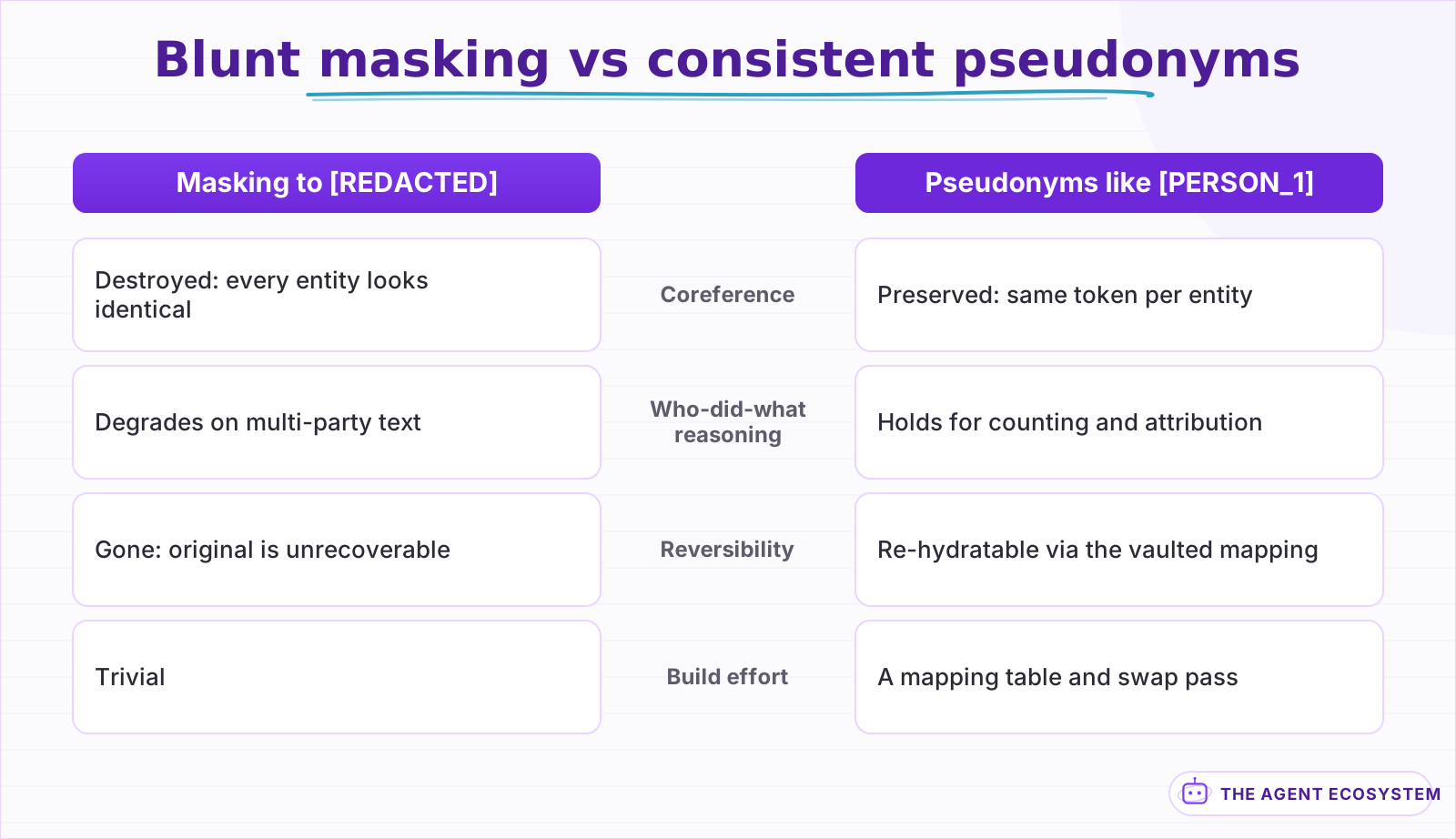 The model does not need real names. It needs to know that 2 mentions are the same person.
Consistent pseudonyms preserve almost everything the model needs. "PERSON_1 emailed twice about ORDER_7, then PERSON_2 escalated" supports the same reasoning as the real text: counting, sequencing, attribution, tone. What the model loses is world knowledge attached to real names, which matters for public figures and almost never for customers.
Re-hydration closes the loop when the output goes back to a human who is allowed to see the real values. The boundary keeps a per-request mapping, replaces tokens with the original values in the response, and discards or vault-stores the mapping according to your retention rules. The mapping store itself is now sensitive, which is fine: it is 1 small, encrypted, access-controlled table inside your perimeter, exactly where personal data belongs, instead of scattered across every log line.
What does a detection stack actually look like?#
Layer 3 detectors: regex for the fixed formats like emails, phones, and card numbers with a Luhn check, a named-entity model for names, addresses, and organizations, and denylists for your own account and ticket ID patterns. Open-source toolkits like Microsoft Presidio bundle exactly this stack.
| Detector layer | Catches reliably | Tends to miss |
|---|---|---|
| Regex + checksums | Emails, phones, cards, IBANs, national ID formats | Anything unstructured |
| Named-entity model | Names, addresses, organizations in prose | Rare names, misspellings, transliterations |
| Custom denylists | Your account IDs, ticket refs, internal codes | Everything you forgot to list |
Presidio is the sensible default starting point: analyzer plus anonymizer, configurable recognizers per entity type, and it runs inside your infrastructure so the detection step is not itself a data leak. Source Whatever you choose, measure both directions on a labeled sample of your real traffic: false negatives are leaks, and false positives silently mangle text before extraction or summarization, which then reads like a model failure. The same discipline applies when the pipeline feeds document extraction workflows: a detector that eats invoice numbers ruins the output while looking like safety.
How do you decide what reaches the model at all?#
Run every field through 3 questions before it enters a prompt: does the task need it, can a pseudonym carry the meaning instead, and would you accept this value appearing in a provider log. Any field that fails the first question simply gets dropped, which redacts better than any detector.
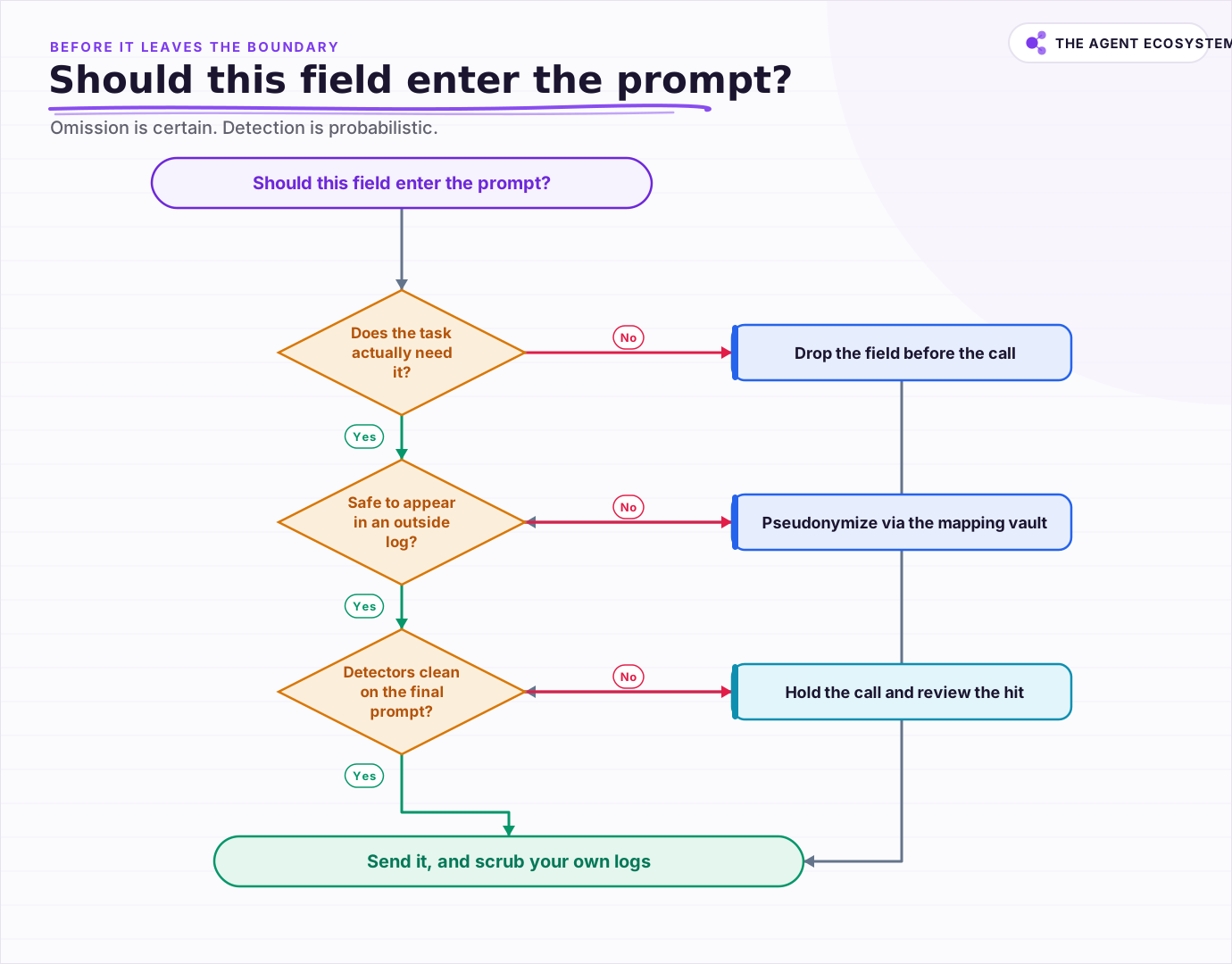 Omission is certain and detection is probabilistic, which is why the first check is whether the field belongs in the prompt at all.
Dropping fields outperforms detecting them because detection is probabilistic and omission is certain. A summarization task needs the complaint text, not the email address; a routing task needs the category signals, not the card number. Most prompts in most pipelines are assembled from structured fields you control, which means the biggest wins come from prompt construction, not from scanning free text after the fact. Scan what must flow; drop what must not.
What should you build first?#
Start with the boundary function and 3 regex detectors: emails, phone numbers, and card numbers. That covers the highest-volume leaks in a day of work. Add entity detection for names next, then pseudonym mapping with re-hydration, and only then worry about the long tail of quasi-identifiers.
The order is deliberate: each step is shippable alone and none blocks the next. A boundary with 3 regexes is dramatically better than a plan for a perfect system, and the seeded-ticket test from the field note gives you a number to improve week over week. Privacy work in LLM pipelines fails by being postponed until "after launch," which is precisely when the logs are already full. Put the choke point in now, however simple, and tighten it in place.
Frequently asked questions
Should I redact PII before sending prompts to an LLM API?
Does redaction hurt LLM output quality?
What tools detect PII in text?
What is re-hydration in PII redaction?
Do I need to redact data going into a RAG index?
Sources
Primary references and vendor documentation used while drafting and reviewing this article.
Written by

Muhammad Qasim Hammad is an AI agent and automation expert and the founder of Cart Gaze LLC (cartgaze.com). He builds product for the love of it: when an idea lands, a working prototype is usually running within hours, built with the same AI agents and automations he sells. He puts his own output at roughly 20× what it was before agents, and the Agentic OS behind this site is the working proof, documented in public with the tools he actually ran and what they really cost.
AI & Automation Services
Want a pipeline like this running in your business?
I'm Qasim — I design and ship AI agents and n8n automations for solo operators and small teams. Tell me what's eating your team's week, and I'll scope a fix.
Related reading
Data Privacy for AI Tools: The Decisions to Make First
Most small businesses decide what data may reach their AI tools retroactively, when a client asks. Eleven lessons on the inventory, the three data tiers, what zero retention actually covers, and why the model is rarely the leak.

AI Agent Audit Log Requirements: What to Record and Why
Somebody asks what your agent did on 14 March for one specific customer. Most teams find out the answer is no on the day the question is asked, not the day the log was designed.
Stop Prompt Injection in n8n AI Agents: Practical Defenses
Your n8n agent reads emails, scraped pages, and RAG chunks nobody on your side wrote, and a planted instruction can hijack it. Here is the layered prompt injection defense, mapped to OWASP LLM01 and to nodes you can actually toggle.
AI Agent Guardrails: Stop Your n8n Agent From Going Off the Rails
An AI agent is a language model with hands. Without guardrails it can follow a malicious instruction, leak data, loop until your bill spikes, or return output the next node cannot parse. This guide maps the five ways an n8n agent breaks to the exact control that stops each.
Prompt Versioning and Management: Treat Prompts Like the Code They Are
Someone improves a prompt on Tuesday and the pipeline mislabels documents by Thursday, with no diff, no test run, and no way to connect the 2 events. The fix is 3 disciplines applied to text: version the bundle (template, examples, tool descriptions, model ID, parameters), run
Cut Your AI API Bill: 7 Levers That Actually Work
To reduce AI API costs you need levers that change the bill by a verifiable mechanism, not vague advice. This hub names all seven, right-size the model, prompt caching, the Batch API, routing and fallback, local versus API, token discipline, and RAG over long-context, with a