How to Evaluate a New Model Release for Your Own Work
Releases arrive weekly, so this is a throughput problem. A two-hour triage you actually run beats a proper evaluation you skip.
AI-drafted, reviewed by Muhammad Qasim Hammad on November 10, 2026. See our AI disclosure.
Table of contents
Nine dated model releases landed across 5 calendar days in the first week of August 2026. Knowing how to evaluate a new model release is now a throughput problem, not a research problem, and treating each one as a project is how teams end up evaluating none of them. You need a cheap repeatable triage, run often.
Why not evaluate every release properly?#
Because a proper evaluation costs days and releases arrive weekly, so the honest options are a shallow process you actually run or a deep one you skip. Teams that insist on the second end up making switching decisions from release notes and vibes, which is strictly worse than a rough measurement.
The reframe that helps is treating this as triage rather than assessment. A triage does not tell you which model is best. It tells you whether this release plausibly changes anything for your workload, which is a much cheaper question and the only one you need answered most weeks.
There is a scheduling version of the same idea. Batch the triage rather than reacting to each announcement: one afternoon every 2 weeks covering whatever landed is far more sustainable than an interrupt each time a launch trends, and it costs the same total time while protecting the rest of the fortnight.
Most releases will not change anything for you, and that is the expected outcome rather than a disappointing one. A process that returns no most of the time, quickly, is doing its job.
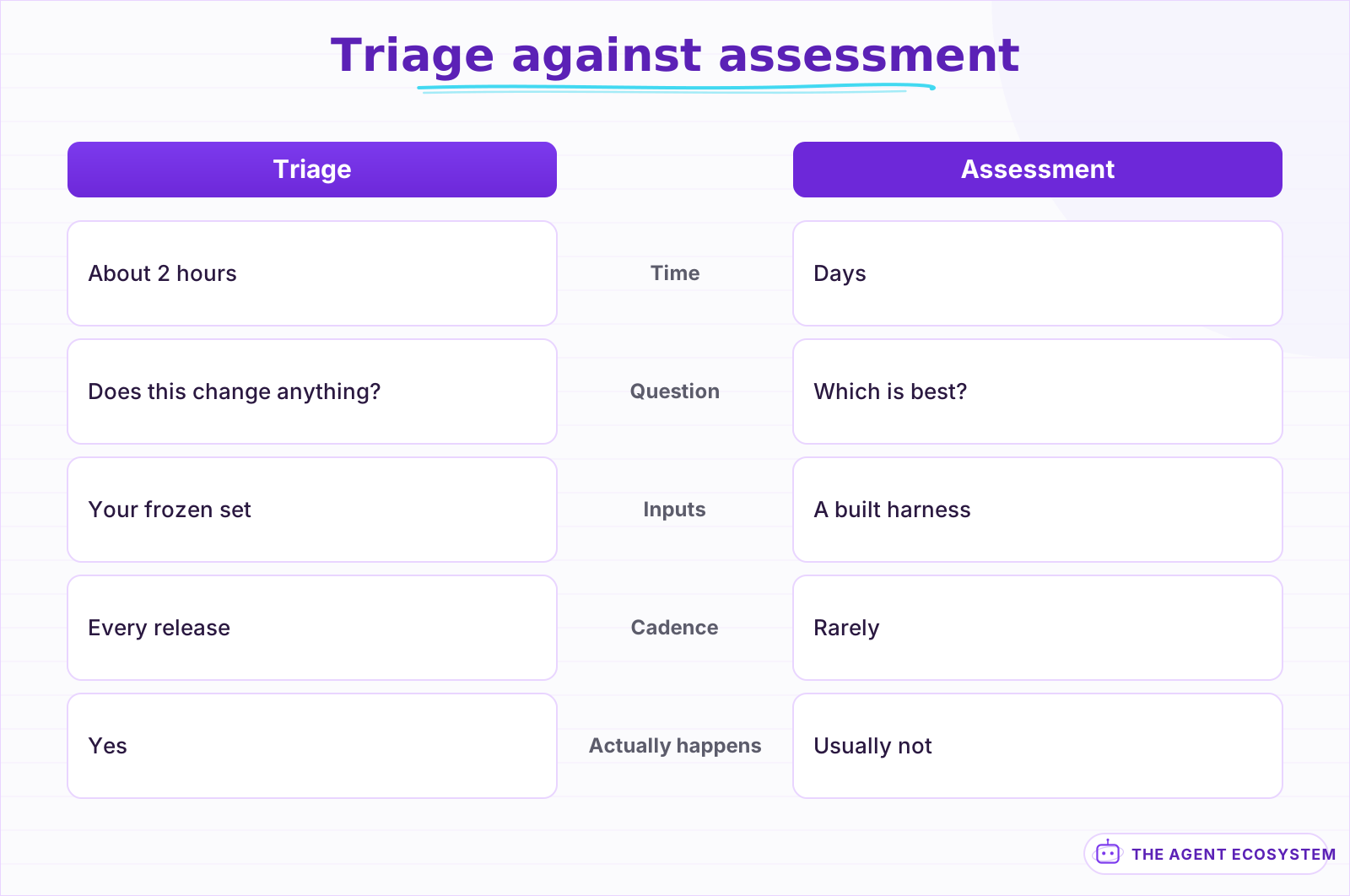 One of these gets run every fortnight. The other gets scheduled and then postponed indefinitely.
What does a two-hour triage look like?#
A frozen set of your own inputs, run through the new model against your current one, scored by whatever check you already have. No new harness, no labelling project, no benchmark. If it takes longer than an afternoon the process will not survive contact with a busy week.
The frozen set is the part worth investing in once. Two hundred real inputs, chosen to include the awkward ones, stored somewhere stable, is the asset that makes every future triage cheap. Assembling it is a half-day that pays for itself by the third release.
| Step | Time | Output |
|---|---|---|
| Run the frozen set through both | 30 minutes | Two sets of outputs |
| Apply your existing checks | 15 minutes | Pass rates, side by side |
| Compare cost and latency | 15 minutes | Per-call deltas |
| Eyeball 20 differing cases | 45 minutes | Whether differences matter |
| Write 3 lines and stop | 15 minutes | A decision, or a no |
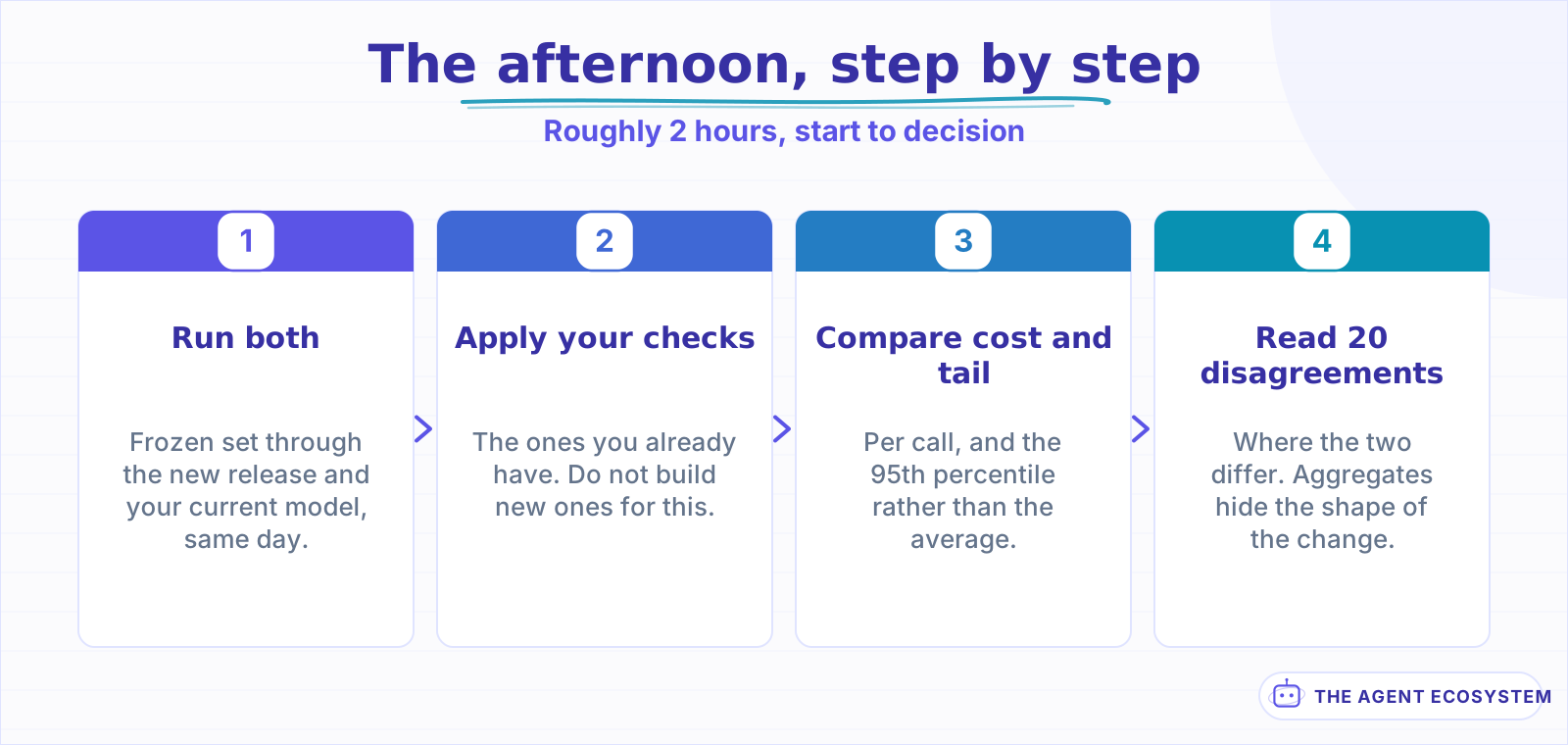 Step 4 is the one that gets cut under time pressure, and it is where the actual information lives.
The eyeball step is the one people cut and the one that carries the information. Aggregate pass rates hide the shape of a change, and 20 cases where the two models disagree tell you more about the difference than any summary statistic will.
What should you actually measure?#
Pass rate on your checks, cost per call, latency at the tail, and format stability. Those four cover almost every reason you would switch or refuse to, and all four come from the same run, so measuring them costs nothing extra once the set is going through.
Format stability deserves naming separately because it is where migrations actually break. A model that is better on quality and slightly less reliable at producing the exact structure you parse will generate retries, and the retries eat the improvement while making the system feel worse.
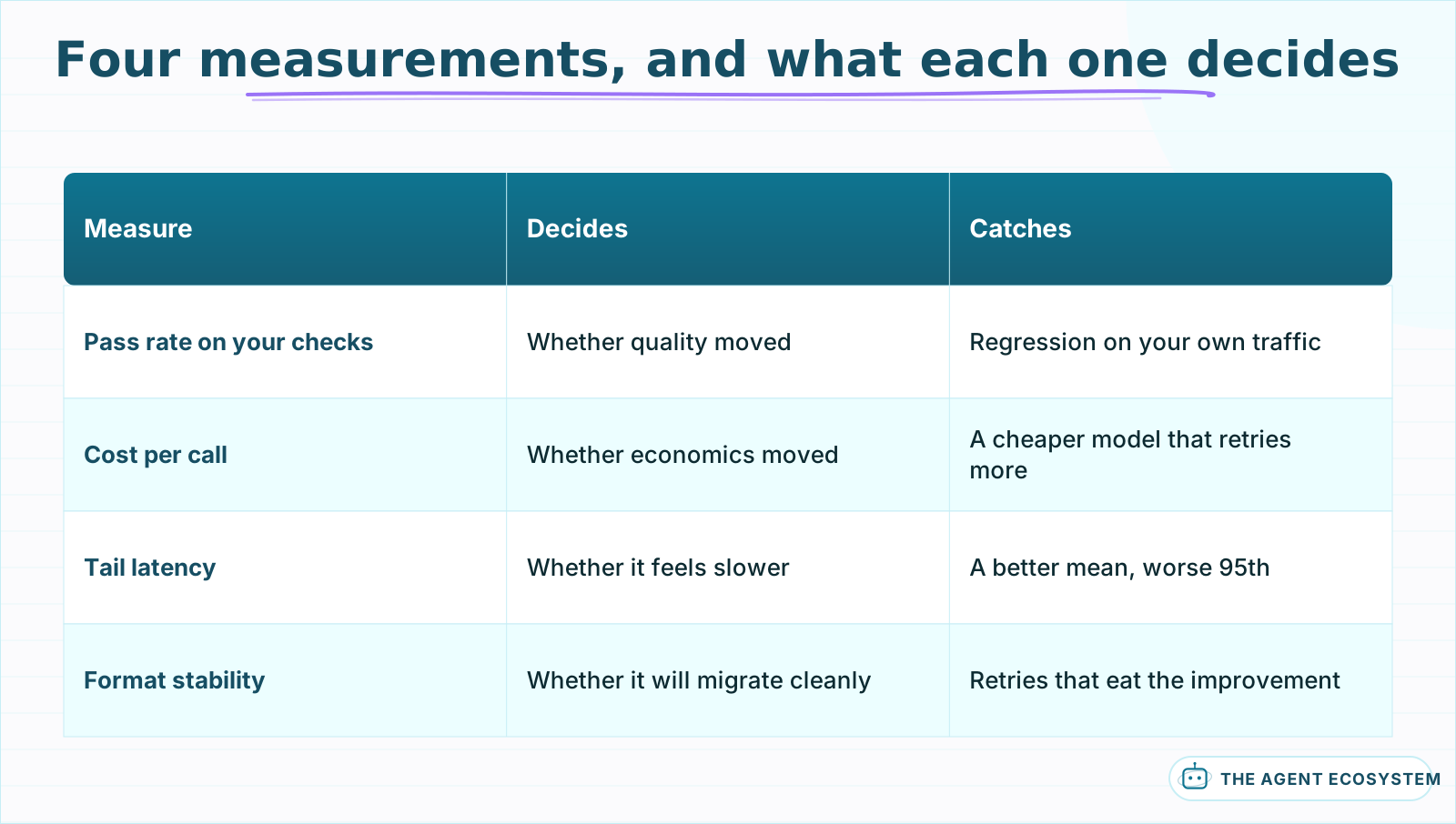 Format stability is the row that decides migrations, and the one nobody puts on the list unprompted.
Tail latency rather than the average, specifically. A model with a better mean and a worse 95th percentile will feel slower to the people who notice, because nobody experiences an average. If a person waits on the output, the tail is the number that describes their experience.
Resist adding new metrics. The temptation at this point is to build a proper evaluation suite, and the suite becomes the project that replaces the triage. Four numbers, from your own traffic, compared against last week's model, is the whole method.
When is switching worth the migration cost?#
When the improvement is larger than the disruption, which is a lower bar than it sounds for a drop-in change and a much higher one when prompts need rework. A switch that requires re-tuning prompts is not a model change, it is a project, and it should be sized as one.
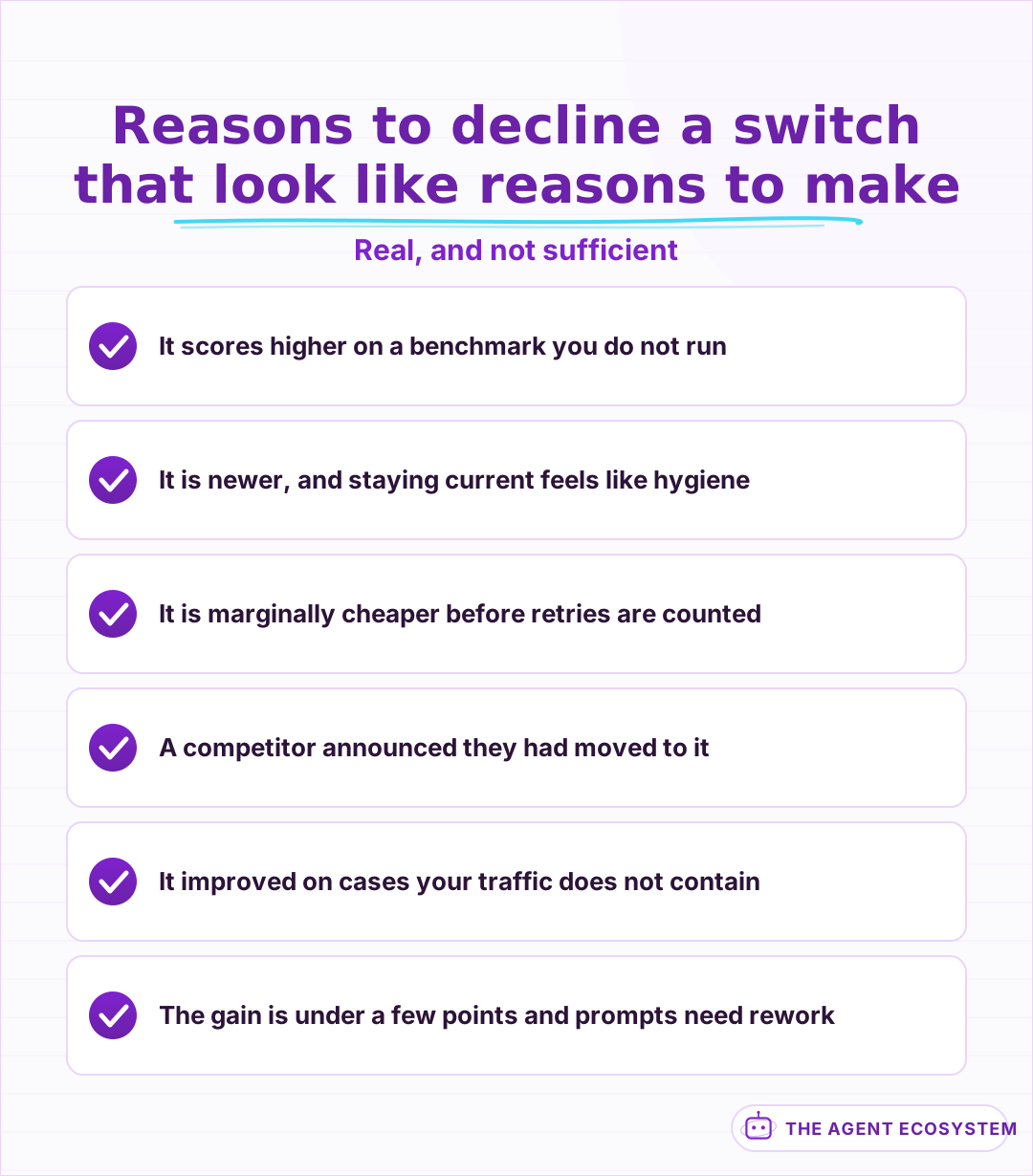 Each of these is a real observation. None of them is on its own a reason to spend a migration.
A useful rule of thumb: if the triage shows an improvement under about 5 percentage points on your pass rate, and the switch costs any prompt rework at all, it is usually not worth doing this week. Small gains are real and they are rarely worth spending the team's attention against, and the next release is 2 weeks away.
Keep the previous version reachable through the transition. A newer model that looks better on 200 inputs can still surprise you on the long tail of real traffic, and the ability to revert quickly is worth more than the confidence of a clean triage result.
What about the releases you skip?#
Log the decision in one line and move on. Three lines per release, kept in one file, becomes a record of why you are on the model you are on, which is the question somebody asks 6 months later when nobody remembers.
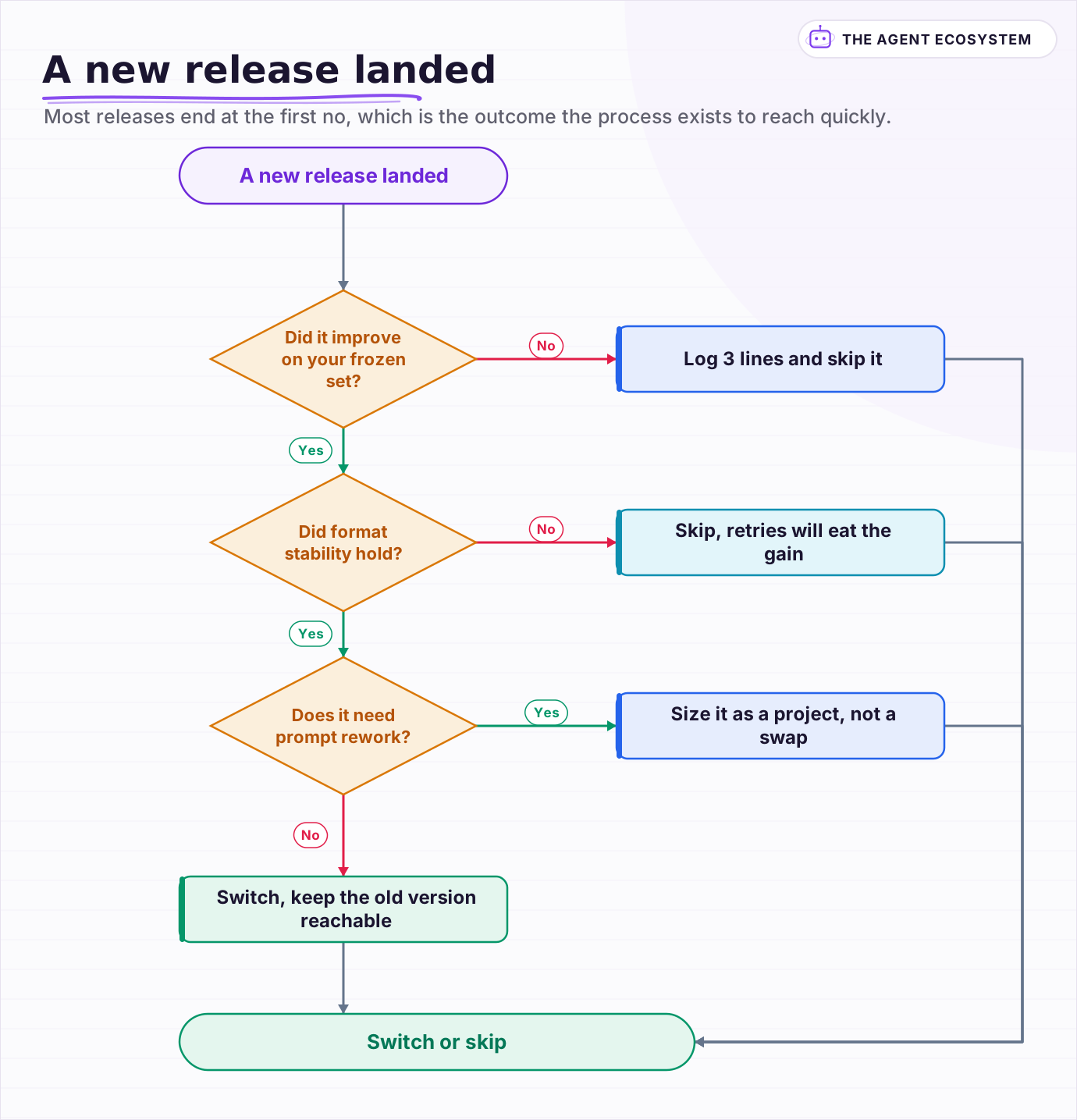 Most releases end at the first no, which is the outcome the process exists to reach quickly.
That log also stops the same argument recurring. A release you assessed and declined is settled until something changes, and without the note it gets re-litigated every time somebody reads an announcement. Reading the announcement itself sceptically is the upstream half of this, and it decides which releases are even worth the afternoon.
Frequently asked questions
How do I evaluate a new model release quickly?
What is a frozen input set and why does it matter?
What should I measure?
When is a switch worth the migration cost?
What should I do about releases I decide to skip?
Written by

Muhammad Qasim Hammad is an AI agent and automation expert and the founder of Cart Gaze LLC (cartgaze.com). He builds product for the love of it: when an idea lands, a working prototype is usually running within hours, built with the same AI agents and automations he sells. He puts his own output at roughly 20× what it was before agents, and the Agentic OS behind this site is the working proof, documented in public with the tools he actually ran and what they really cost.
AI & Automation Services
Want a pipeline like this running in your business?
I'm Qasim — I design and ship AI agents and n8n automations for solo operators and small teams. Tell me what's eating your team's week, and I'll scope a fix.
Related reading
Choosing an LLM for Production: The Decisions That Stick
Every model comparison you read was written against someone else's task. Twelve lessons on building the evaluation that produces your answer, pricing the choice properly, and making it reversible before the model changes underneath you.

How to Evaluate AI Agents: Building a Test Set You Can Trust
Most teams learn their agent got worse from a customer, not a test. Eleven lessons on building the small suite that would have caught it: real cases, per-case scoring, step checks, and the four ways an eval set starts lying to you.
4 Signals Decide Whether a Pipeline Step Needs a Frontier Model
Most agent pipelines run every step on the same frontier model out of habit, not need. This is the decision framework for picking a small model per step instead of per pipeline: whether the output space is narrow, whether the task needs multi-hop reasoning, whether you can

Frontier Model Claims: Evaluation and Verification Rules
A lab says its system resolved ten open problems in mathematics. Most capability announcements fail at the first question, because there is no artifact to inspect.
The OpenAI-Compatible API: Swap Models Without a Rewrite
A new frontier model lands every week, and rewriting your integration each time is a losing game. Because most providers now speak the OpenAI API format, swapping a model is usually a base-URL and key change. Here is the portability pattern, and where it breaks.

Claude Fable 5: Anthropic's Mythos-Class Model, Explained
Anthropic's Claude Fable 5 shipped on June 9, 2026 topping the coding benchmarks it publishes and priced near twice Opus 4.8. Here is an honest read on the reported numbers, the real trade-off, and who should pay the premium.