Frontier Model Claims: Evaluation and Verification Rules
The question is never whether a claim is true. It is which parts are machine-checked, which are attested by people, and which remain open.
AI-drafted, reviewed by Muhammad Qasim Hammad on November 8, 2026. See our AI disclosure.

Table of contents
A lab says its system resolved 10 open problems in mathematics and theoretical computer science. Frontier model evaluation claims live or die on verification, and the useful question is never whether the claim is true. It is which parts are machine-checkable, which are attested by people, and which are still genuinely open.
What separates a checkable claim from a press release?#
An artifact somebody outside the lab can examine. A benchmark score is a number produced by the claimant on their own infrastructure, and nothing about it can be independently confirmed. A published proof, a released dataset or a reproducible transcript can be.
The mathematics case is instructive because it goes further than most. The arguments were produced by the model, researchers prepared the manuscripts, and the logical correctness of the proofs was checked in Lean, which is a proof assistant rather than a human reviewer. That last step is the part worth noticing.
Machine-checked correctness changes the conversation. It removes the question of whether the reasoning holds, which is usually where scepticism concentrates, and moves the remaining doubt to different questions entirely: whether the results are novel, whether they matter, and how much a person contributed along the way.
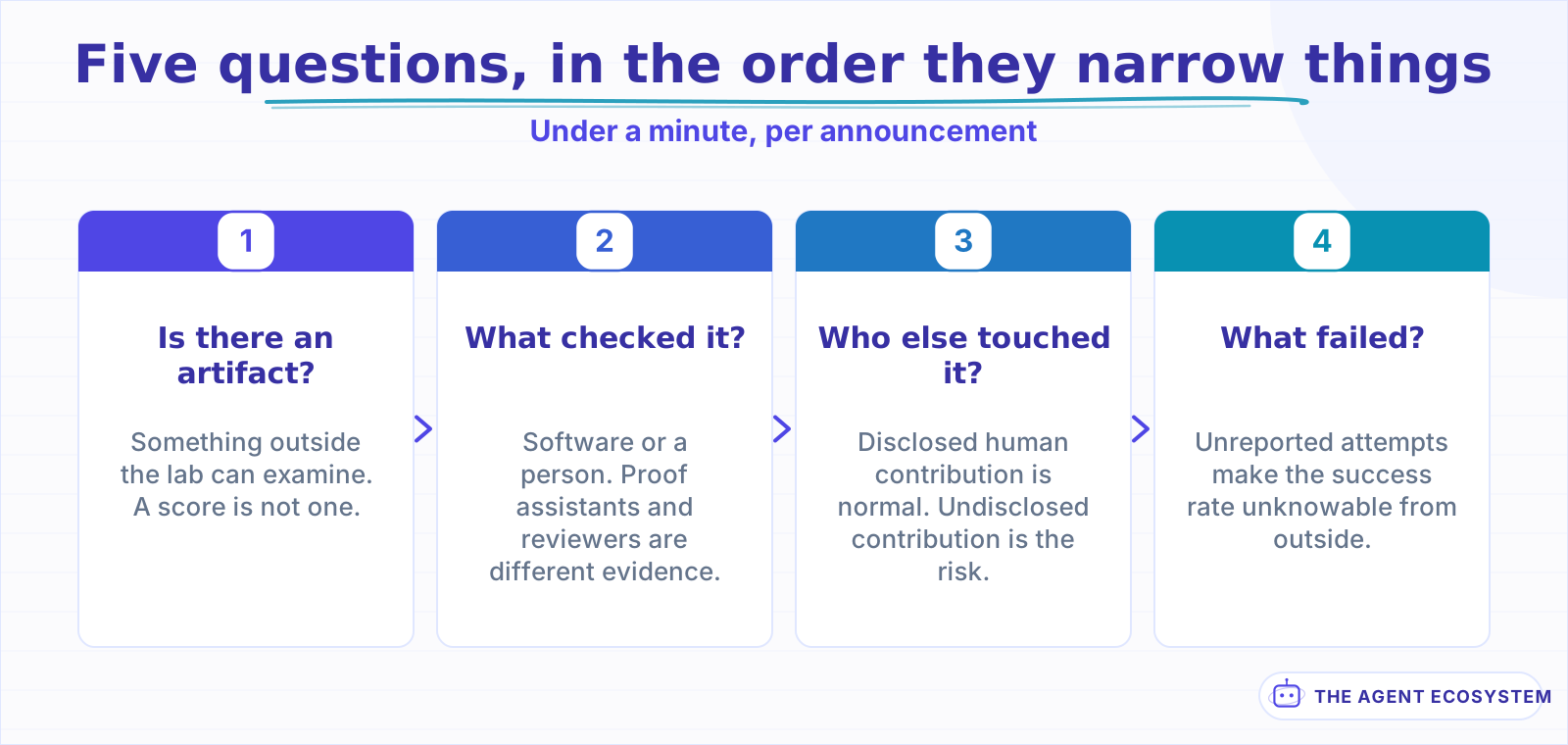 Most announcements stop at step 1 with nothing to inspect, which settles the matter quickly.
The specific results give the claim texture that a score never has. Constructing a non-sofic group, disproving a rigidity conjecture, settling several problems posed by Erdős: these are nameable objects that specialists can argue about. A benchmark percentage offers nothing to argue with, which is why arguments about benchmarks are always about the benchmark.
Very few announcements offer anything comparable. A model that scores well on a reasoning benchmark provides a number, a methodology paragraph and a request for trust, and there is no equivalent of Lean sitting behind it.
Which questions actually remain open?#
Novelty, significance and selection. Whether each result is genuinely new, whether it matters to the field, and how many attempts produced nothing and were never published. The lab itself was clear that the first two are for mathematicians to assess rather than for the announcement to assert.
The selection question is the one that structurally cannot be answered from outside. The 10 published results are the successes; the failures are invisible by default. One of the researchers involved noted directly that other major problems had been attempted without success, which is a more useful disclosure than most releases contain.
| Question | Who can answer it | Status in this case |
|---|---|---|
| Is the reasoning valid? | A proof assistant | Machine-checked |
| Did a model produce it? | The lab | Attested, papers prepared by people |
| Is it novel? | The field | Still being assessed |
| Does it matter? | The field | Still being assessed |
| What failed? | Only the lab | Partially disclosed |
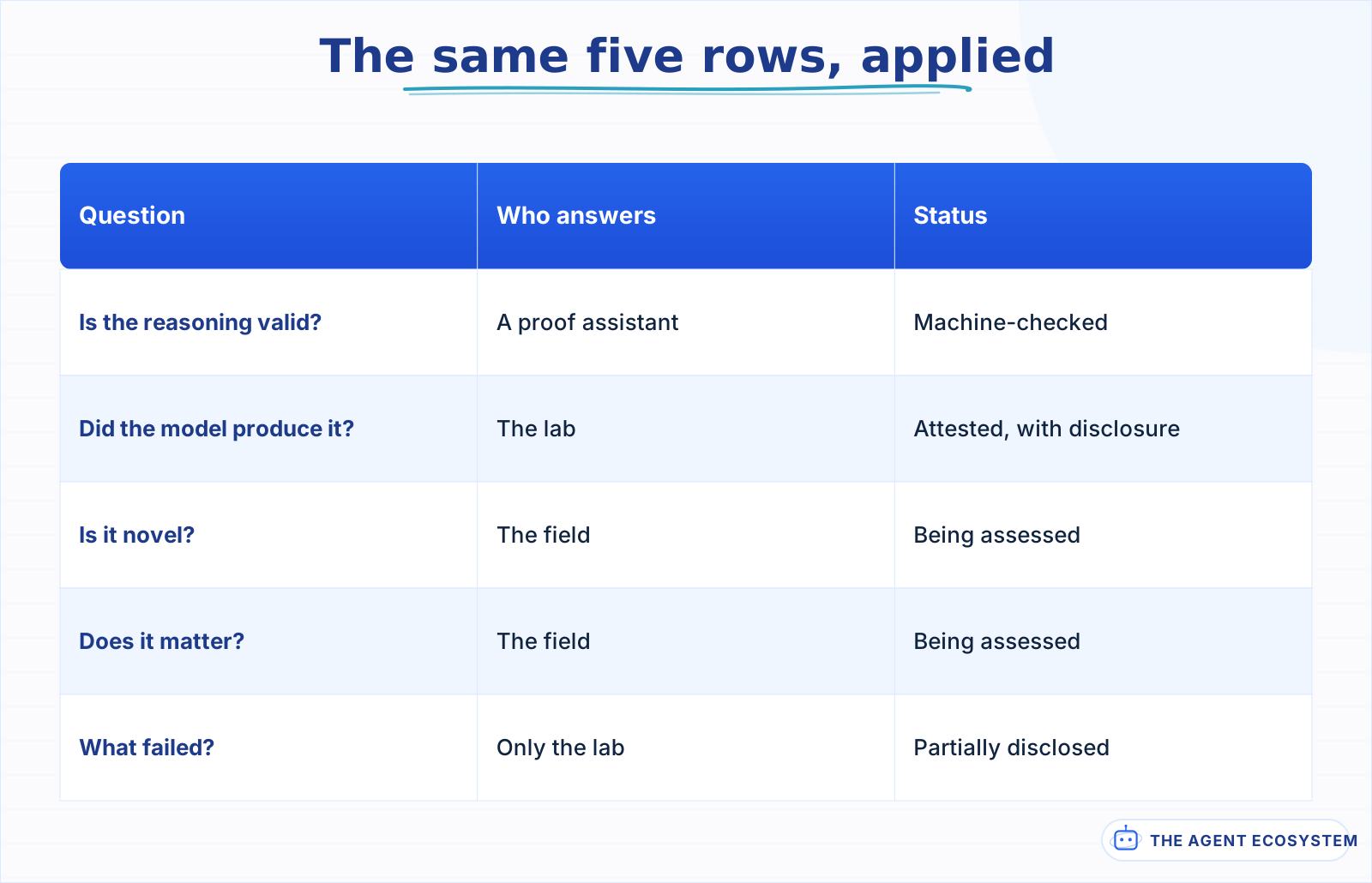 Two rows are settled, two are with the field, and one can only ever be answered by the lab.
Read that table as a template rather than a verdict. It is the same set of questions for any capability claim, and the value is in noticing which rows an announcement leaves blank.
Why is human involvement not automatically a problem?#
Because the useful claim is rarely that a system worked unaided. Researchers preparing manuscripts and formalising proofs is normal scientific labour, and disclosing it is a mark of a careful announcement rather than a hedge. The failure mode is not human help, it is undisclosed human help.
The distinction that matters is between contribution and repair. A person tidying prose around an argument the model produced leaves the claim intact. A person supplying the key step and reporting the result as the model's does not, and the only defence against the second is a lab that says which happened.
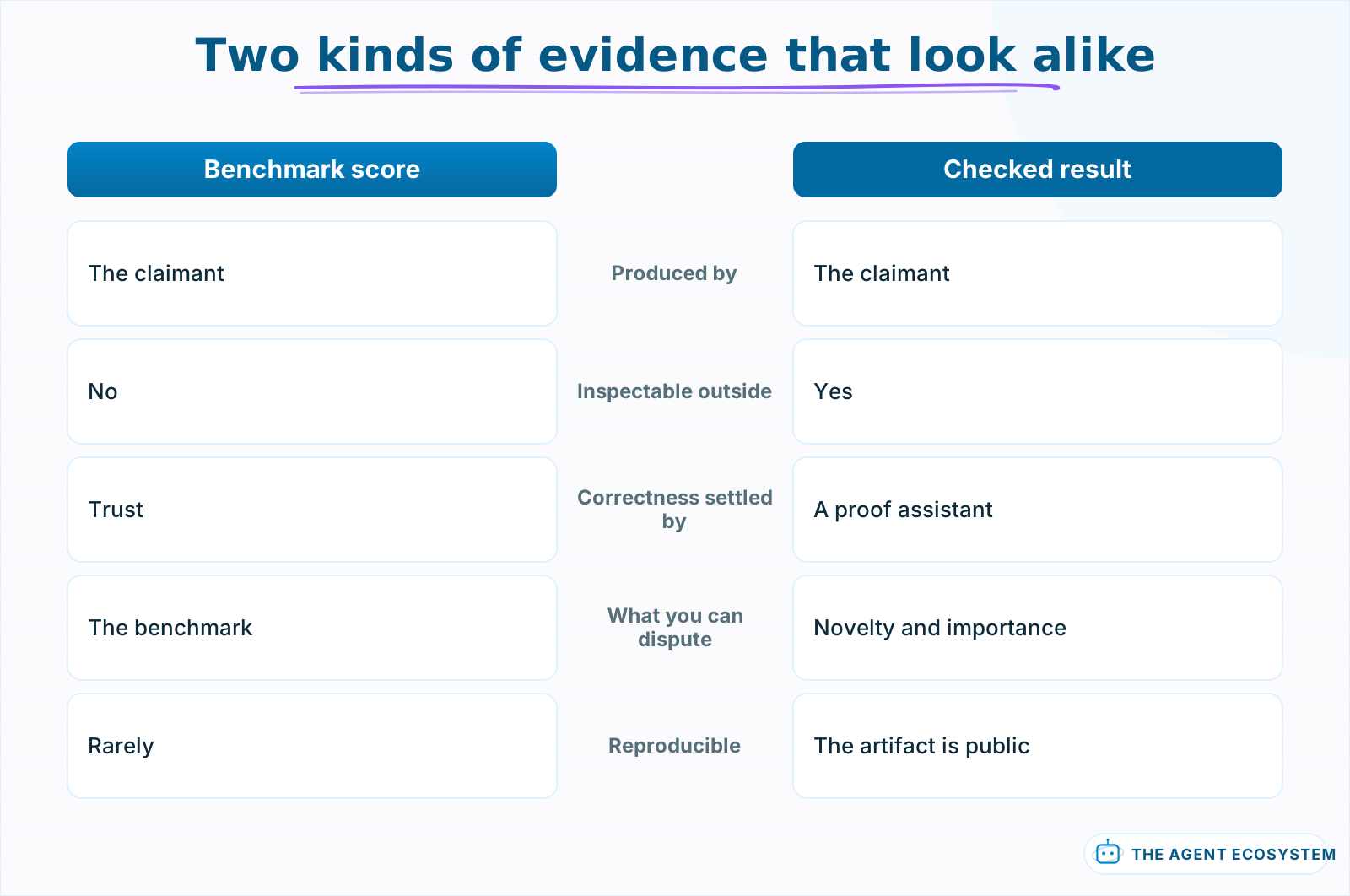 Arguments about benchmarks are always about the benchmark, because there is nothing else to argue with.
There is also a reasonable objection to the framing rather than the facts. A model trained on everything mathematicians have written, built by mathematicians, drawing on over 100 years of accumulated theory, is not an outsider solving problems from nothing. That does not diminish the result and it does change what the result is evidence of.
What does a claim like this change for you?#
Usually less than the headline implies, and that is not cynicism. Research-stage systems demonstrating capability at the frontier tell you where the field is heading, not what is available in an API next week, and the gap between those two is where most planning errors happen.
There are 3 distinct kinds of evidence tangled in most announcements, and separating them is most of the work: what software verified, what a person asserted, and what the reader inferred. Only the 1st of those three survives contact with someone who disagrees with you.
The reported cost is a useful anchor here. The tokens required to find these solutions were put at roughly $2,000 at then-current rates for the lab's top tier, which is remarkable for original mathematics and irrelevant to a support workflow costing a fraction of 1 cent per call. A capability that costs that per result is not the same product as an endpoint you call.
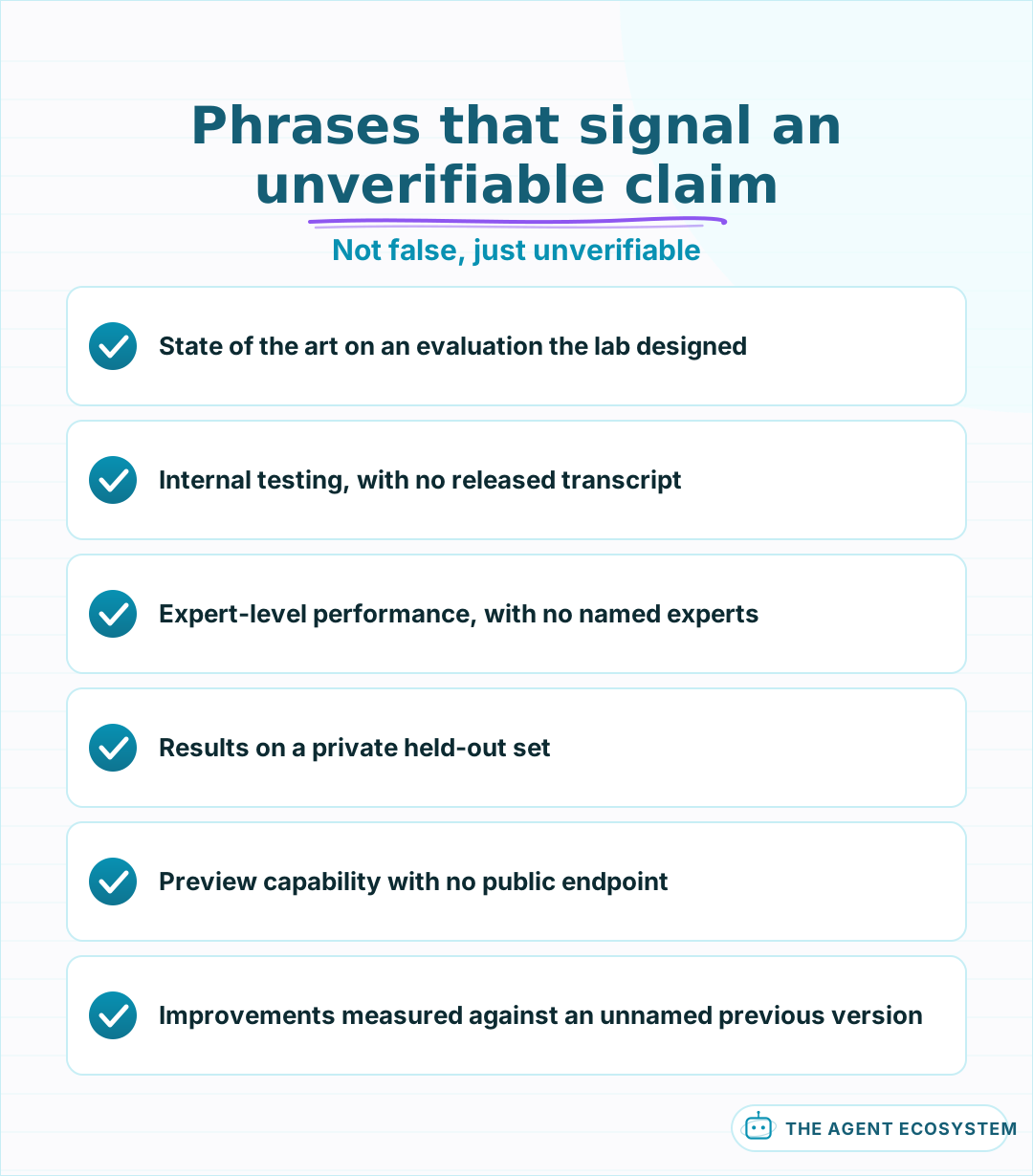 None of these mean the claim is false. Each means you cannot establish it from outside.
The other reason to discount the headline is that research-stage systems are frequently not the same artifact as the product that eventually ships under a related name. Capability demonstrated by an internal configuration, with generous compute and researchers in the loop, is an upper bound rather than a specification.
Treat these as directional evidence. They shift how confident you should be that a class of problem becomes tractable, which is a real input to a roadmap on a horizon of quarters rather than sprints.
How should you read the next one?#
By running the same 5 questions and noticing the blanks. An announcement that names its verification method, discloses human contribution and mentions its failures is doing something different from one that reports a benchmark, and the difference is visible in under 60 seconds.
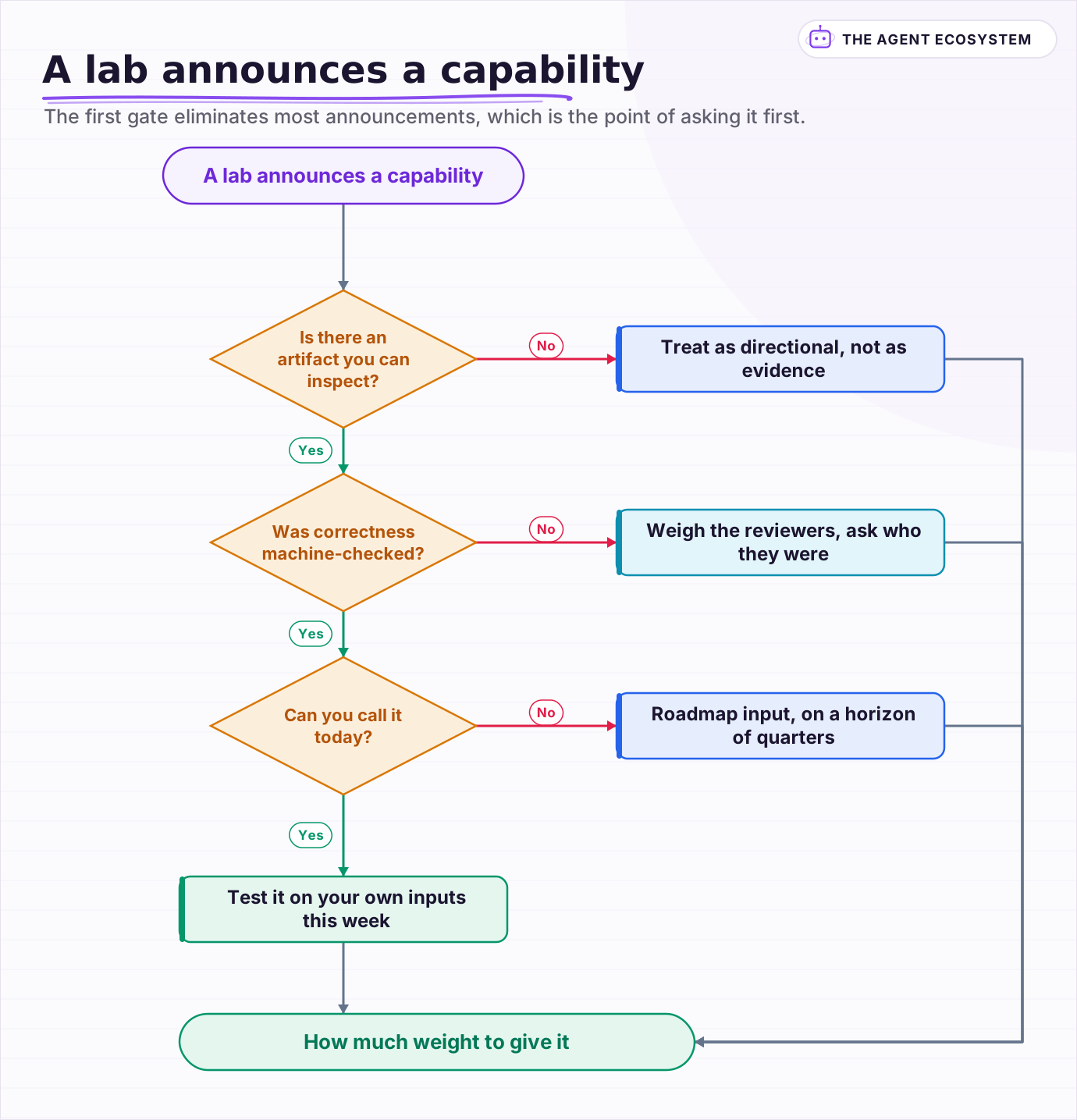 The first gate eliminates most announcements, which is the point of asking it first.
The habit worth building is separating what is proven from what is claimed from what is implied, because the third category is where announcements do most of their work. Evaluating without a ground truth to check against is the same discipline applied to your own systems, where nobody is writing the press release and the blanks are yours to fill.
Frequently asked questions
How do I tell a verified capability claim from marketing?
What made the 2026 mathematics results different?
Does human involvement invalidate a model's result?
Why can't you assess selection effects from outside?
Should a research capability claim change my roadmap?
Sources
Primary references and vendor documentation used while drafting and reviewing this article.
Written by

Muhammad Qasim Hammad is an AI agent and automation expert and the founder of Cart Gaze LLC (cartgaze.com). He builds product for the love of it: when an idea lands, a working prototype is usually running within hours, built with the same AI agents and automations he sells. He puts his own output at roughly 20× what it was before agents, and the Agentic OS behind this site is the working proof, documented in public with the tools he actually ran and what they really cost.
AI & Automation Services
Want a pipeline like this running in your business?
I'm Qasim — I design and ship AI agents and n8n automations for solo operators and small teams. Tell me what's eating your team's week, and I'll scope a fix.
Related reading
LLM Evaluation Without Ground Truth: What You Can Measure
You have 8,000 outputs, no labels, and no appetite for a labelling project. Reference-free evaluation is possible, and it does not measure what most people assume it measures.

How to Evaluate a New Model Release for Your Own Work
Nine dated model releases landed across 5 days in one week. Treating each as a project is how teams end up evaluating none of them.
DeepSeek V4 Is '8 Months Behind' the Frontier. That's Fine.
An official US evaluation says DeepSeek V4 Pro lags the frontier by about eight months. It gets quoted as a verdict. My take: for most real coding and automation work, an open-weight model that is eight months behind at a fraction of the price is not a compromise, it is the
Fable 5 vs GLM 5.2 vs GPT-5.6: The 2026 Frontier Landscape
Three frontier models landed in June 2026: Claude Fable 5, Z.ai's open-weight GLM-5.2, and OpenAI's limited-preview GPT-5.6. The numbers do not all measure the same thing, so here is an honest, dated comparison on coding score, price, and openness.
Why AI Pilots Fail to Reach Production, and What Works
A pilot that answered 40 questions correctly in a demo is not evidence of anything yet. It is a controlled test on data somebody picked, and production asks a different question entirely.

The Government Wants 30 Days With Frontier Models: My Take
A June 2, 2026 US executive order invites frontier-model developers to voluntarily hand the government up to 30 days of pre-release access for security review. It is not a license mandate, but paired with GPT-5.6's gated launch it hints at a world where builders get the best