Does a Chatbot Have to Say It Is AI? Yes, Since August
Article 50 applied from 2 August 2026. Three separate duties sit inside one sentence, and teams routinely conflate them.
Updated November 5, 2026 — Corrected who owes the chat disclosure and the fine cap for SMEs.
AI-drafted, reviewed by Muhammad Qasim Hammad on November 2, 2026. See our AI disclosure.
Table of contents
For years the answer was a matter of taste. Since 2 August 2026 it is a legal duty in the EU: does a chatbot have to say it is AI, and the answer is yes, unless it is already obvious to a reasonable person. The rule is short, the exemption is narrower than teams hope, and the deadline has already passed.
What exactly does the rule require?#
That people are told when they are dealing with a machine. The Commission's own wording is that chatbots and other interactive AI systems have to tell users they are dealing with AI rather than a human. Deepfakes must be labelled, and AI-generated or altered content must carry machine-readable marks so it can be detected.
Three separate duties sit inside that sentence and teams routinely conflate them. Disclosing that the interaction is with a machine is one. Labelling deepfakes and public-interest text so a person can see it is another. Embedding a machine-readable mark so software can detect it later is a third, and it is the one nobody has built.
The disclosure duty is the cheapest of the three and the one most likely to be missed, because it feels like a design decision rather than a compliance one. A support widget that opens with a friendly first name and no indication it is automated is precisely the pattern the rule addresses.
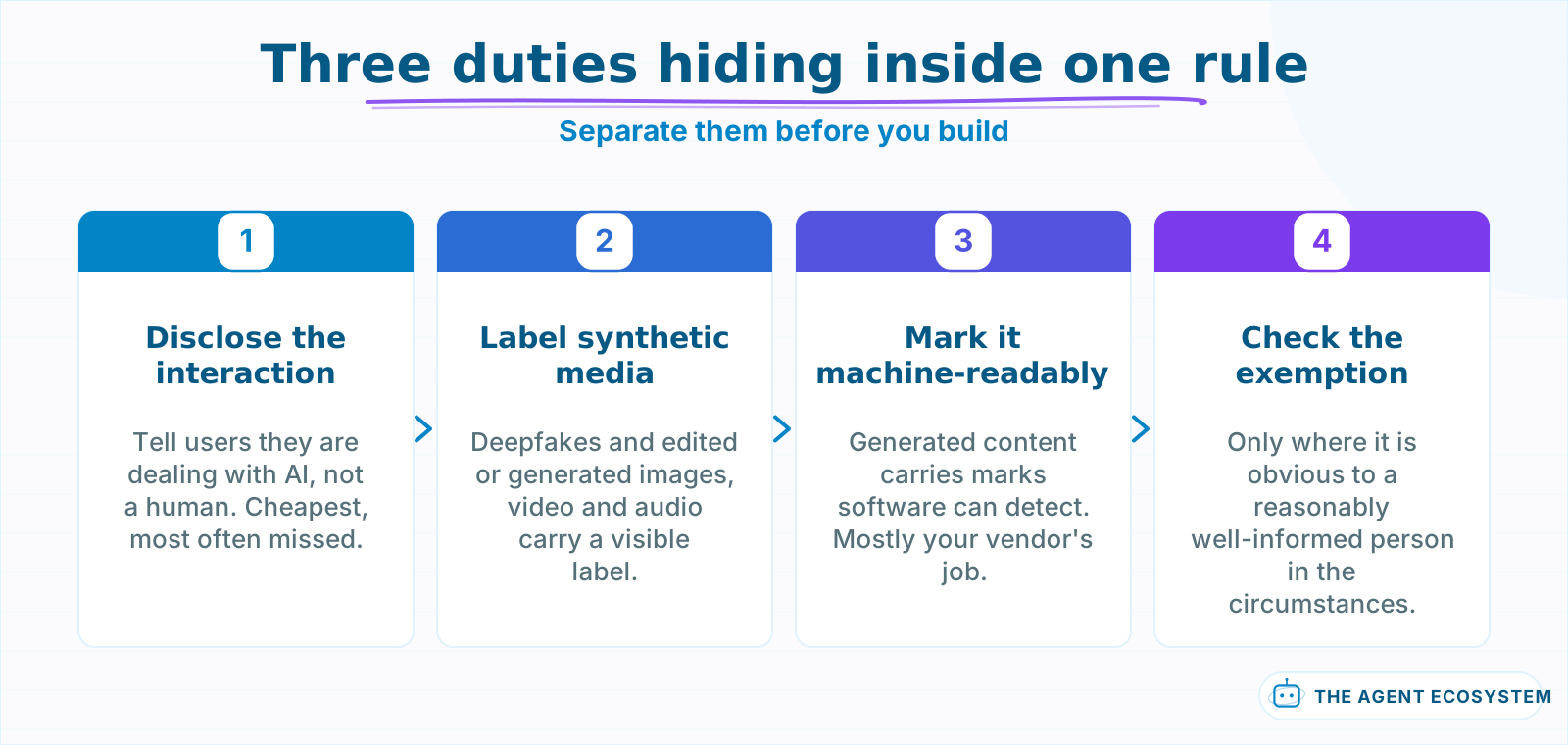 Teams read this as one requirement and build one thing. It is three, landing on different parties. Visible labels apply to deepfakes and public-interest text, not all generated media.
The exemption is for cases where it is obvious to a reasonably well-informed person, given the circumstances. That is narrower than "our users know". A returning power user may know; a first-time visitor arriving from a search result does not, and the standard is written around the second person.
Who carries the obligation, you or your model vendor?#
Both, for different things, and the split turns on roles. The chat disclosure sits with the provider of the interactive system, which is you if you run your own agent under your brand, or the vendor if you installed its widget. Machine-readable marking sits with the generative system's provider.
That means you cannot fully delegate this. Your vendor marking its output does not disclose to your users that your widget is automated, and your disclosure banner does not put a detectable mark in an image the model produced. The two duties travel separately and both have to land.
| Duty | Who it lands on | What it looks like in practice |
|---|---|---|
| Tell users they are talking to AI | The interactive system's provider | Clear, at the latest at first interaction |
| Label deepfakes and public-interest text | The deployer | A visible label a person can read |
| Machine-readable marking | The generative system's provider | Embedded, survives normal handling |
| Keep it obvious on re-entry | Good practice, not a stated duty | Not just on first load |
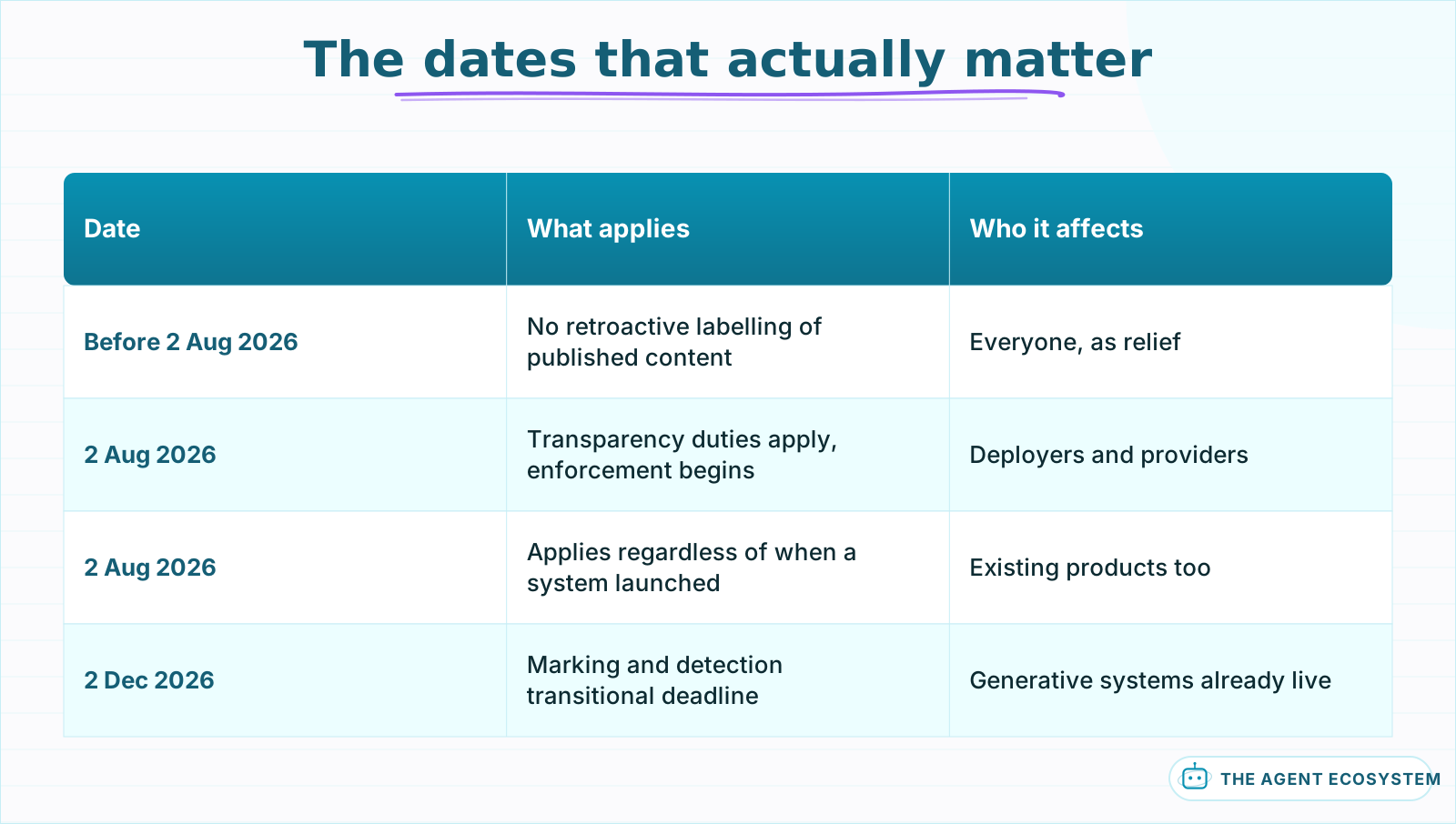 Only one row is a future deadline. Everything else already applied on the day enforcement began.
If you run your own agent on a model API, you are usually both its provider and its deployer, so the disclosure is yours. The marking duty can reach you too, because Article 50(2) covers systems that generate text, so ask your vendor what it already marks. That dependency belongs in your vendor assessment, because you cannot inspect it after the fact from the output alone.
What counts as adequate disclosure?#
Something the user sees before they act on the answer, in language they will read. A line in a privacy policy is not disclosure, and neither is a tooltip behind an icon. The test is practical rather than formal: would a first-time visitor understand, at the moment of the first exchange, that a machine is answering.
Placement does most of the work. A short line in the opening message and a persistent label on the interface covers the ordinary case, and it costs an afternoon. Teams tend to over-engineer this into a consent flow, which is a different regime and not what Article 50 asks for.
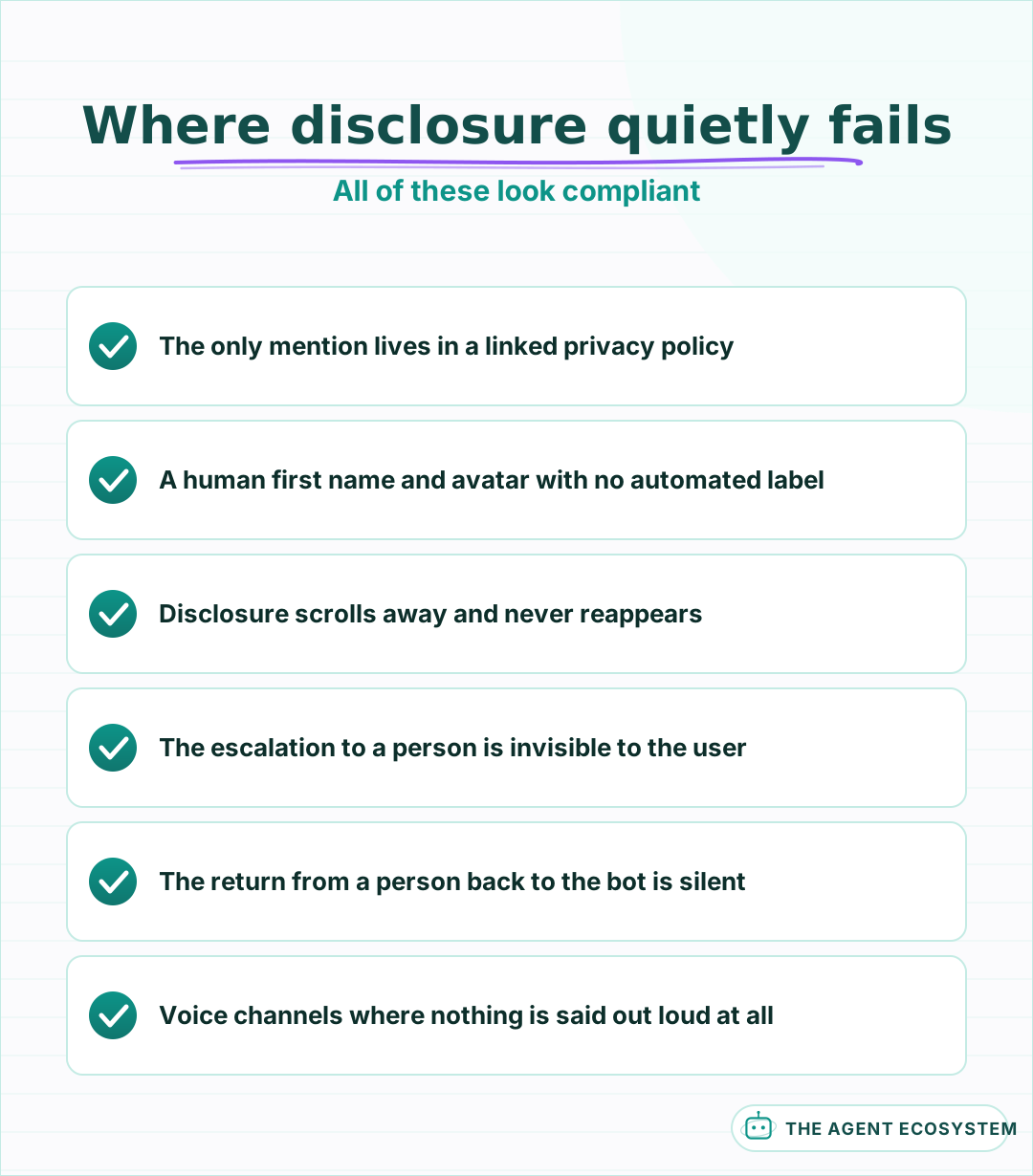 Each of these is a real interface pattern, and each puts the disclosure somewhere the user will not read it.
One thing genuinely is a judgement call: how persistent the label must be. The duty is that the person is informed, not that a banner is on screen at every instant, so a clear opening statement plus a standing label on the interface is a defensible reading. A single line that scrolls away after 20 messages is a weaker one, and it costs nothing to avoid.
Watch the handover case specifically. A widget that starts automated and escalates to a person needs the transition to be visible in both directions, because a user who believes they reached a human and is then returned to the bot has been misled by the interface rather than by any single message.
What about the content the bot produces?#
Different rule, different deadline. Content generated before 2 August 2026 does not need retroactive marking, though public-interest text published on or after that date must be labelled. For generative systems already on the market, a transitional period runs to 2 December 2026 for the marking and detection obligation, which is the only real breathing room.
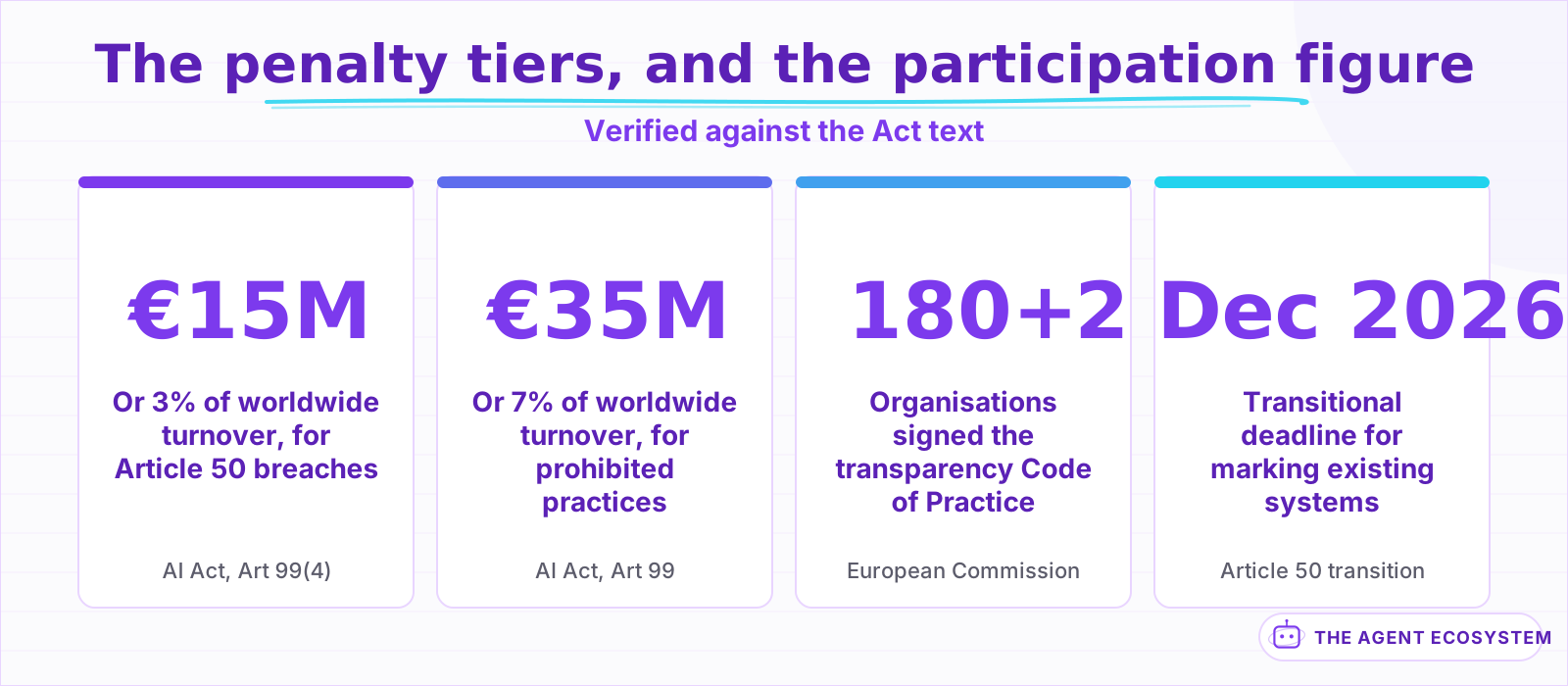 These are maxima, not expected outcomes, and for an SME each one is the lower of the two figures.
The machine-readable part is the one with genuine engineering in it, and it is largely not yours to solve. Over 180 organisations had signed the Code of Practice on transparency of AI-generated content by the enforcement date, which is the mechanism through which most of this will actually be implemented.
What happens if you do not?#
Administrative fines, in the Act's middle tier. A breach of the Article 50 transparency duties can reach €15,000,000 or 3% of total worldwide annual turnover, whichever is higher, or whichever is lower for an SME. That is the same ceiling as the general-purpose model provider tier, and below the €35,000,000 or 7% reserved for prohibited practices.
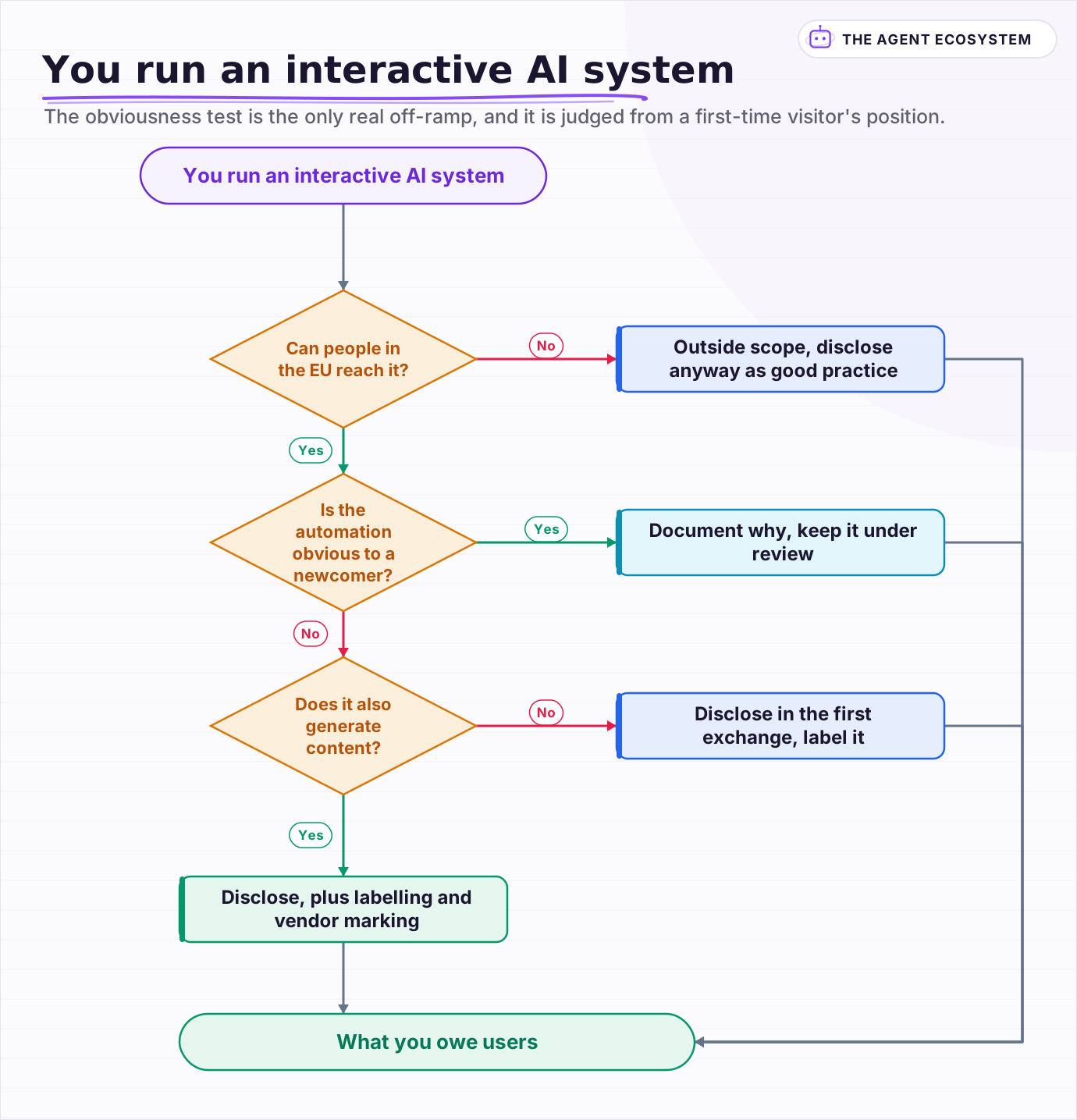 The obviousness test is the only real off-ramp, and it is judged from a first-time visitor's position.
Those ceilings are maxima rather than expectations. For a larger company the cap is whichever figure is higher. For an SME, Article 99(6) makes it whichever is lower, so a business with €2,000,000 in turnover has a modeled ceiling of €60,000 here, not €15,000,000. Article 99(7) also has the authority weigh the breach's gravity and duration and the operator's size.
The realistic near-term risk for a small team is not a headline fine. It is that disclosure is trivially checkable from the outside, unlike almost every other obligation in the Act, so a complaint costs a regulator nothing to verify. Who carries responsibility when an agent gets it wrong is the broader version of that question, and the pre-August primer covers the risk tiers this sits inside.
Frequently asked questions
Does a chatbot legally have to disclose that it is AI?
Who is responsible, us or our model vendor?
What counts as adequate disclosure?
Do we have to label content we generated before August?
What are the penalties for getting this wrong?
Sources
Primary references and vendor documentation used while drafting and reviewing this article.
- European Commission: Commission starts enforcing AI Act rules and new transparency requirements on 2 August
- EU AI Act, Article 99: Penalties
- Cooley: EU AI Act transparency obligations take effect 2 August 2026
- EUR-Lex: Consolidated EU AI Act, version of 27 July 2026
- European Commission: Guidelines on Article 50 transparency obligations, C(2026) 5054
Written by

Muhammad Qasim Hammad is an AI agent and automation expert and the founder of Cart Gaze LLC (cartgaze.com). He builds product for the love of it: when an idea lands, a working prototype is usually running within hours, built with the same AI agents and automations he sells. He puts his own output at roughly 20× what it was before agents, and the Agentic OS behind this site is the working proof, documented in public with the tools he actually ran and what they really cost.
AI & Automation Services
Want a pipeline like this running in your business?
I'm Qasim — I design and ship AI agents and n8n automations for solo operators and small teams. Tell me what's eating your team's week, and I'll scope a fix.
Related reading
AI Generated Content Labeling Requirement: Who It Binds
Two labeling regimes took effect on the same day, and that was not a coincidence. One of them has a size threshold and the other does not, which inverts the usual assumption.

The AI Code of Practice: Voluntary Commitments, Explained
Two documents share almost the same name and do entirely different jobs. Reading them as one set of commitments is the fastest way to answer the wrong question.
The EU AI Act Reaches Agents on August 2: A Builder Primer
EU AI Act transparency duties and enforcement started on 2 August 2026, while high-risk rules moved to December 2027 and August 2028. This is a dated, non-legal primer on what that means for a small team shipping agents.
EU AI Act Fines for Providers: Who Actually Gets Asked
The headline numbers travelled further than the detail. Almost none of that ceiling is aimed at the people quoting it nervously, and the first contact is a question.
Who Is Liable When an AI Agent Makes a Mistake in 2026?
An agent you deployed emailed a customer the wrong refund amount. The answer is always a person or a company, never the software, and which one is decided long before the incident.
AI Vendor Due Diligence: Questions Worth Asking First
Most AI vendor evaluations test the demo and skip the contract. The questions that matter are the ones whose answers you cannot discover later.