AI Generated Content Labeling Requirement: Who It Binds
Two regimes took effect on 2 August 2026. One has a million-user threshold and the other has none, which inverts who is actually caught.
Updated November 5, 2026 — Corrected who the EU marking duty binds and the fine cap for SMEs.
AI-drafted, reviewed by Muhammad Qasim Hammad on November 3, 2026. See our AI disclosure.
Table of contents
Two labeling regimes took effect on the same day, and that was not a coincidence. The AI generated content labeling requirement now runs on both sides of the Atlantic from 2 August 2026, but one of them has a size threshold and the other does not. Which means the smaller you are, the more likely only the European rule reaches you.
What do the rules actually require?#
Marks a machine can read, and in California a tool the public can use. The EU requires providers of generative systems to mark output so software can detect it, and deployers to label deepfakes visibly. California requires covered providers to offer a free AI-detection tool plus visible and embedded disclosures.
Two kinds of disclosure are in play and the vocabulary differs by regime. A manifest disclosure is the visible one, a label a person can see on the content. A latent disclosure is embedded in the file itself, invisible to a reader and detectable by software, and it is the part with real engineering behind it.
The visible half is a product decision you can make this afternoon. The embedded half depends on what your generation stack actually supports, which for most teams means what their model vendor emits, since you are not going to write a provenance implementation yourself.
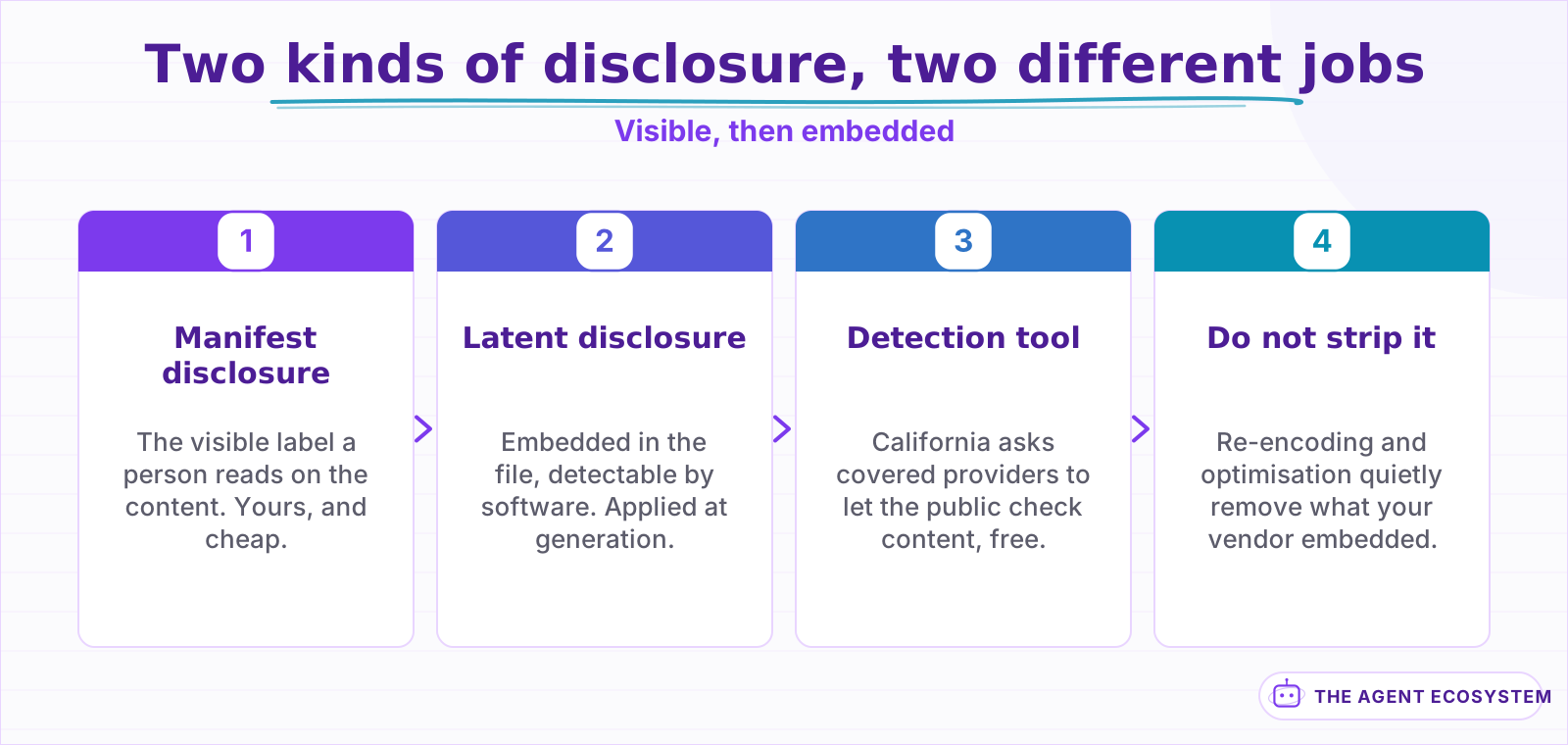 One is a product decision you own. The other arrives from your vendor and can be destroyed downstream.
There is a third obligation people miss because it is phrased as an exception. Content generated and published before 2 August 2026 does not need retroactive labelling under the Commission's Article 50 guidelines, so the duty is prospective. That is genuine relief for anyone sitting on an archive of generated assets, and it means the work is bounded by what you publish from here.
California's framing is worth noting because it goes further than marking. Requiring a free public detection tool puts an obligation on the provider to let anybody check content against their system, which is a different kind of commitment from embedding a mark and hoping someone reads it.
Why did both land on the same date?#
Because California moved. The AI Transparency Act was originally due to take effect on 1 January 2026, and AB 853, signed on 13 October 2025, pushed it to 2 August 2026 to line up with the European provenance timeline. The alignment was deliberate rather than coincidental.
That matters for planning more than it sounds. A single 2 August date means one engineering effort can satisfy both regimes if the provenance approach is chosen sensibly, and it means the vendors you depend on were building to one deadline rather than two. It also means nobody gets a staggered runway.
| EU, Article 50 | California, SB 942 | |
|---|---|---|
| Operative from | 2 August 2026 | 2 August 2026 |
| Size threshold | None | Over 1,000,000 monthly users |
| Visible labelling | Deepfakes and public-interest text | Manifest disclosure on covered content |
| Embedded marking | Machine-readable marks | Latent disclosure where feasible |
| Public detection tool | Not required | Required, and free |
| Penalty shape | Up to €15,000,000 or 3% turnover, whichever is lower for an SME | $5,000 per violation, per day |
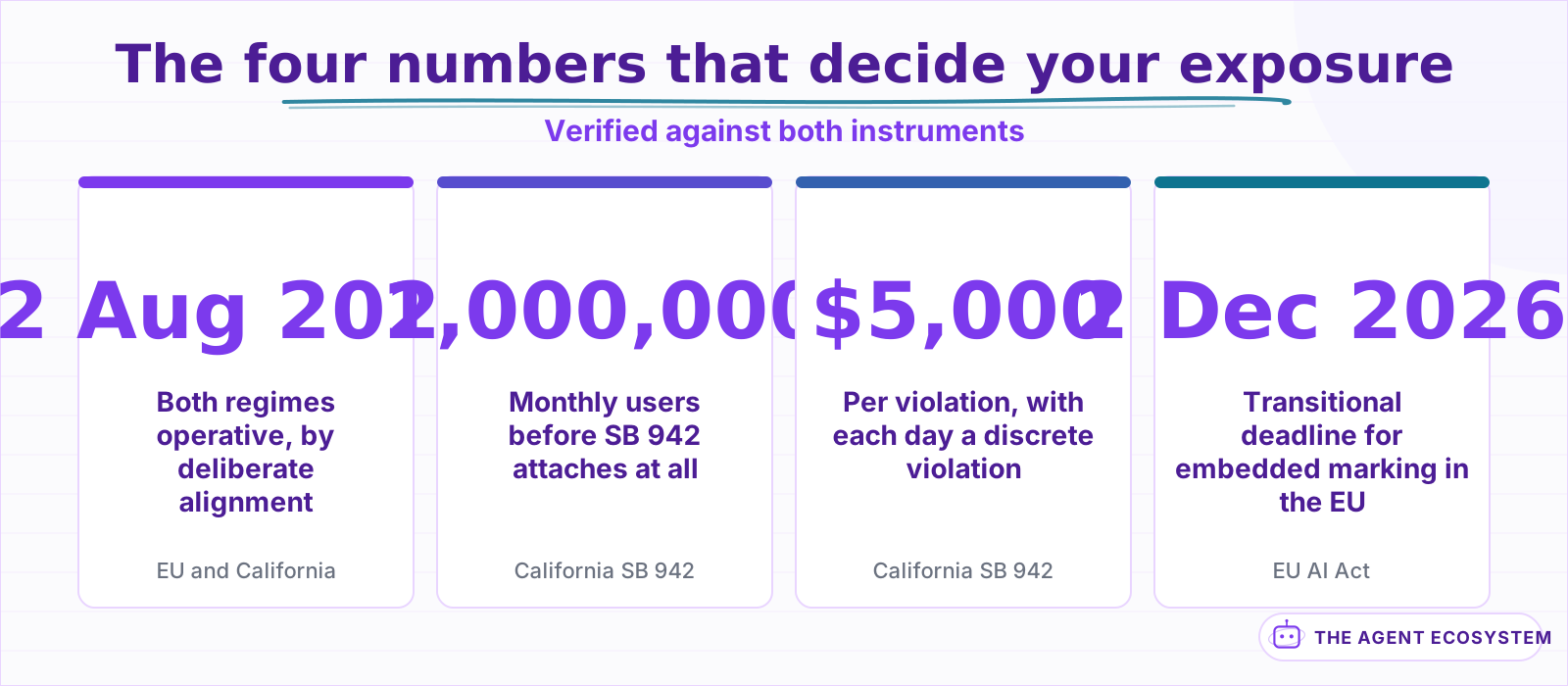 The threshold is the one that surprises people: it excludes small teams from California and not from the EU.
Read the threshold row twice, because it inverts the usual assumption. A team with 20,000 users is outside SB 942 entirely. Article 50 has no size threshold, so the European duty for the team's role still applies: marking if it provides a generative system, deepfake and public-interest labels if it deploys one. The rule that most builders assume is the distant one is the one that actually reaches them.
Does the California law apply to you?#
Only above a million. Covered providers are those that create or produce a generative AI system with over 1,000,000 monthly visitors or users that is publicly accessible in California. Below that line the Act's obligations do not attach, and most teams building products on someone else's model are comfortably below it.
The word doing the work is provider. SB 942 targets whoever produces the generative system, not everyone who uses one. If you are calling a vendor's API, the detection-tool obligation is theirs rather than yours, which is a different position from Article 50, where a deployer has labelling duties of its own for deepfakes and public-interest text, while the marking duty itself binds providers of generative systems.
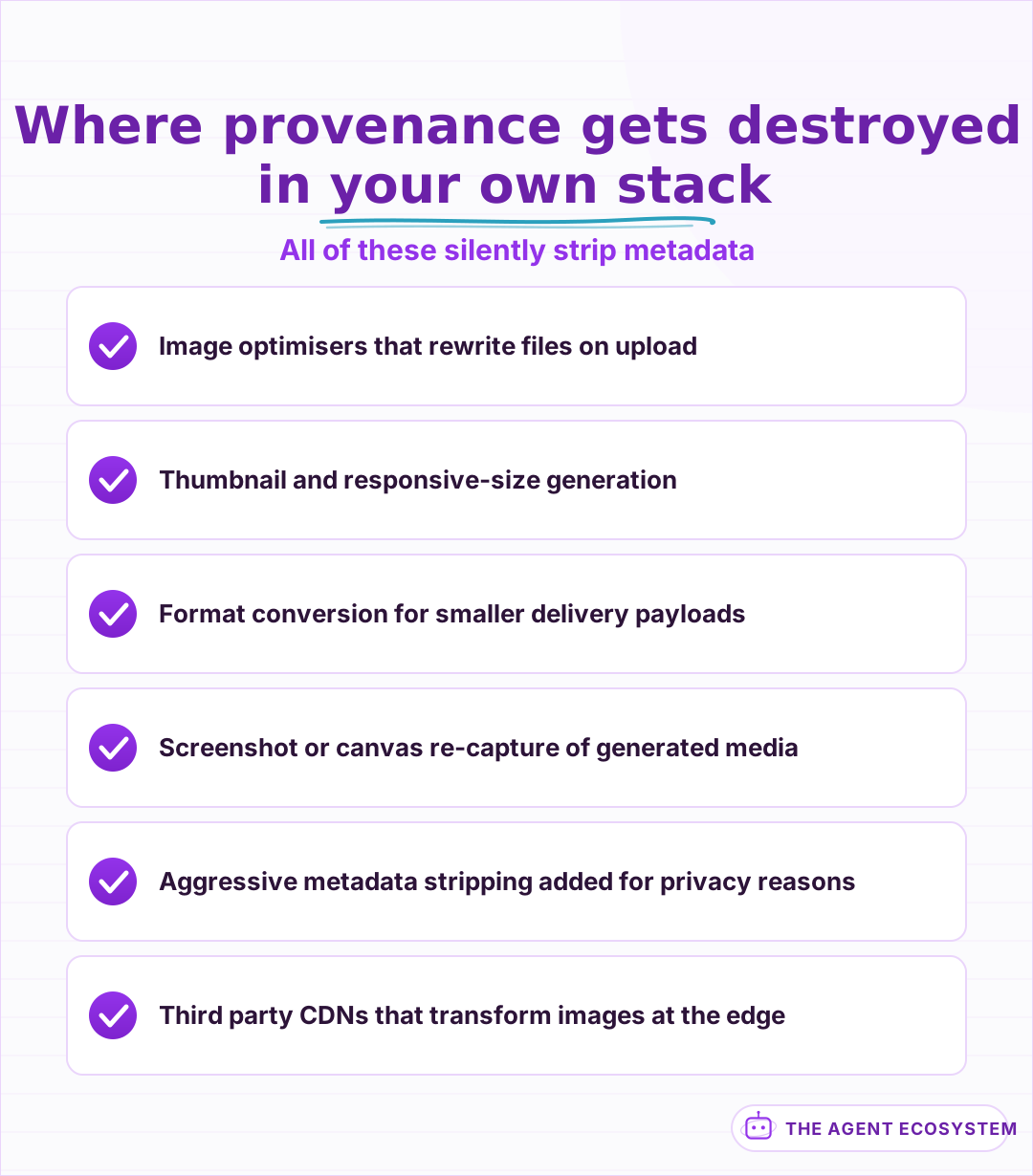 Every item here happens after your vendor did its job correctly, and inside infrastructure you control.
Being outside SB 942 is not a reason to skip provenance. Crossing a million users is a growth outcome you would welcome, and retrofitting marks onto a generation pipeline after the fact is considerably harder than building it in while the volume is small.
What is a latent disclosure and can you actually do it?#
An embedded, machine-detectable mark that travels with the file rather than sitting next to it. California requires it where technically feasible, which is an unusually honest piece of drafting, because for a lot of content types it genuinely is not yet feasible and the standard bodies are still catching up.
Almost none of this is yours to implement. If you generate images or audio through a vendor, the provenance is applied at generation, and your job is to establish what your vendor emits and to avoid stripping it downstream. Pipelines that re-encode, resize or optimise media routinely destroy embedded metadata without anyone noticing.
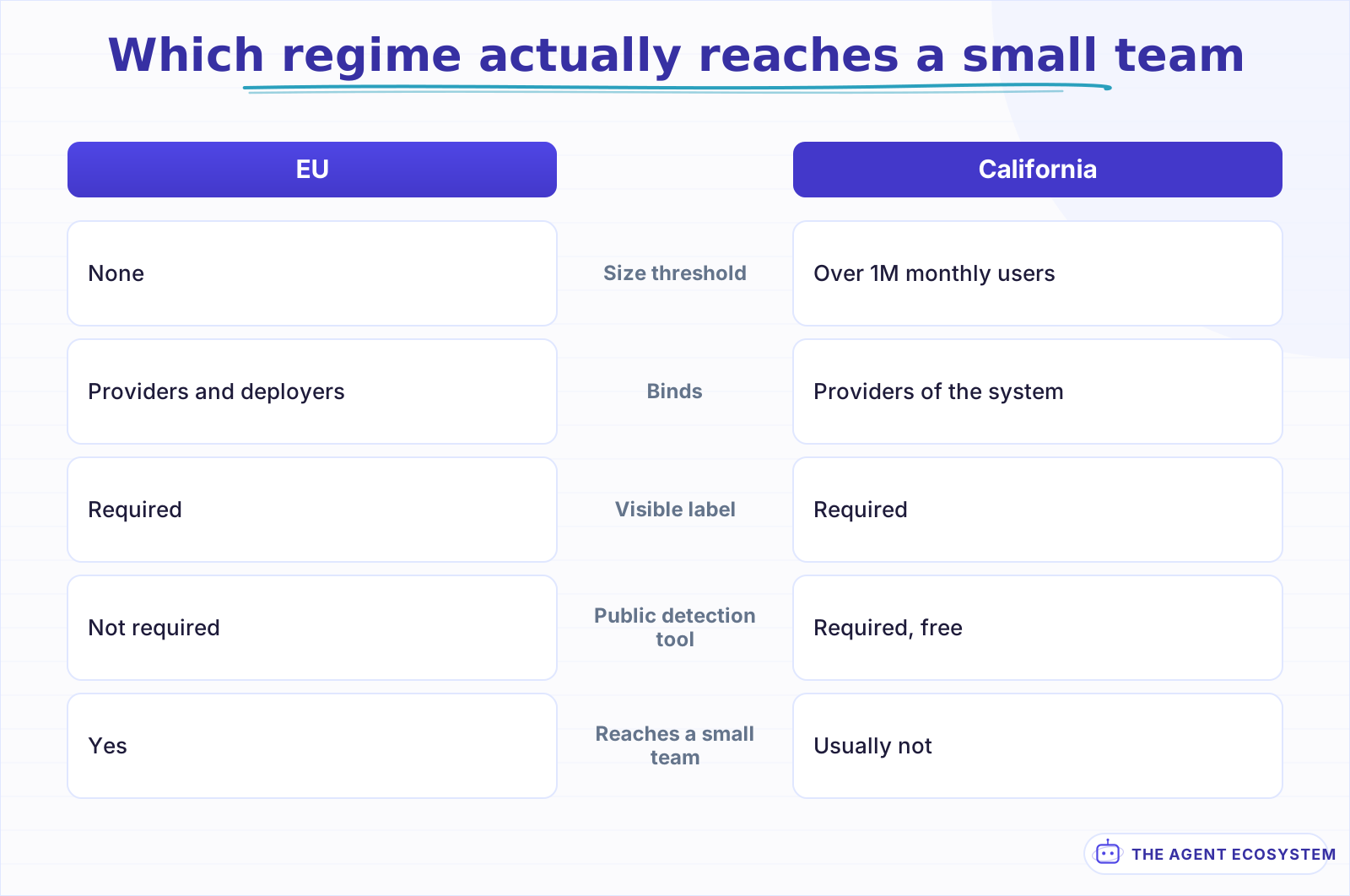 The row that matters is the threshold. Below a million users only one of these columns applies to you.
That last failure is the one to check first, because it converts a compliant vendor output into a non-compliant published asset entirely inside your own infrastructure. An image optimiser that rewrites files on upload will happily discard whatever provenance arrived with them.
What should you do before December?#
Add the visible label now and use the remaining time on the embedded half. The European marking and detection obligation has a limited transitional period to 2 December 2026 for generative systems already on the market, and that is the only deferred piece in either regime.
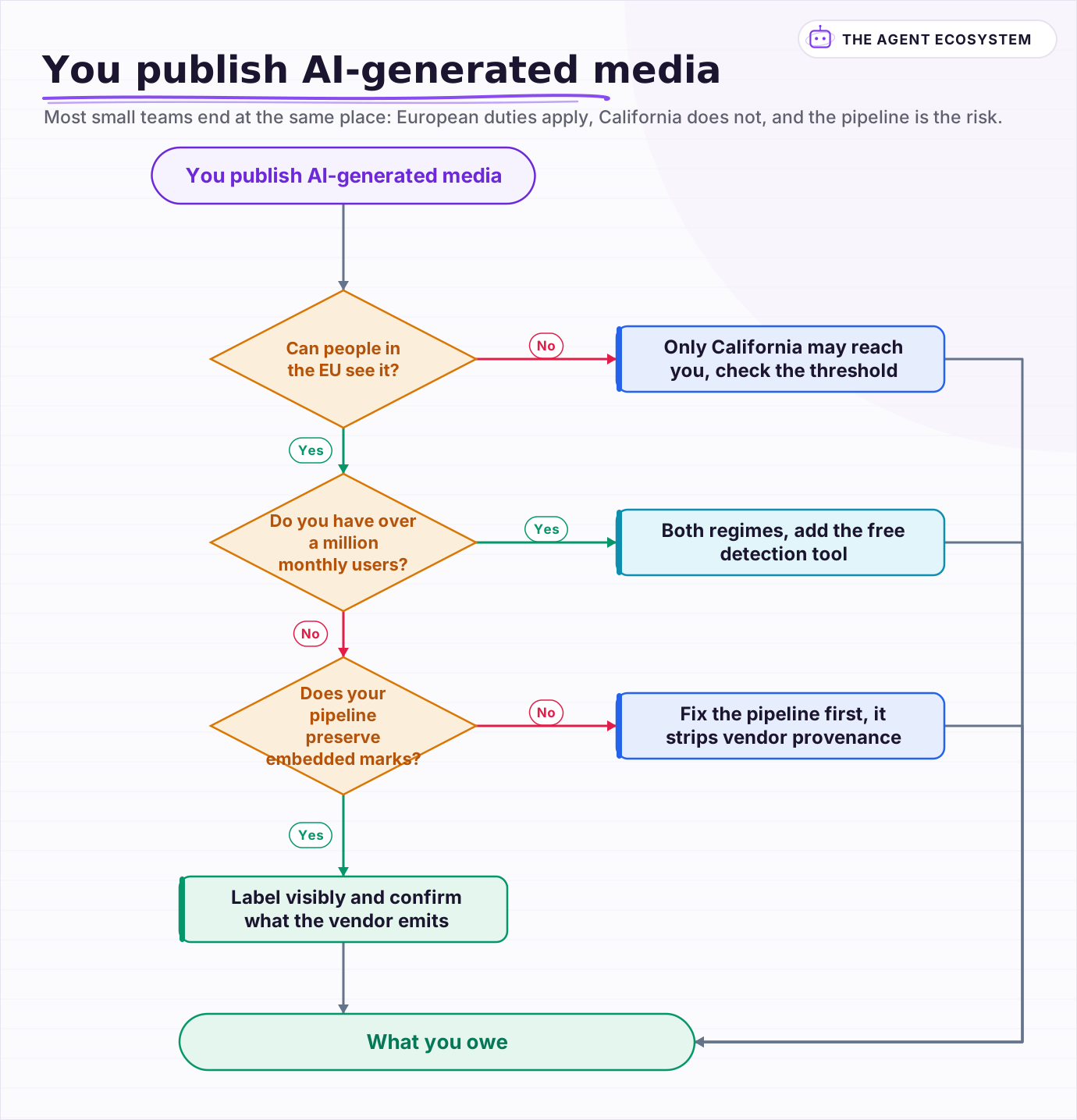 Most small teams end at the same place: European duties apply, California does not, and the pipeline is the risk.
One planning caveat: the transitional period covers marking and detection, not the visible label and not the interaction disclosure. Reading it as a general extension is the mistake that will cost somebody a scramble in late November. Everything except embedded marking on already-live generative systems applied on 2 August.
Sequence it by cost. The visible disclosure is an afternoon, the vendor question is an email, and the pipeline audit is a morning spent checking whether your own processing strips what arrives. None of that requires a provenance implementation, and together it covers most of what either regime asks a small team to do. Whether your chatbot must announce itself is the interaction half of the same package.
Frequently asked questions
What does the AI generated content labeling requirement actually demand?
Does California's SB 942 apply to my company?
Why did the EU and California rules start on the same day?
What is the difference between manifest and latent disclosure?
Do we have to label content we published before August?
Sources
Primary references and vendor documentation used while drafting and reviewing this article.
- Jones Day: California Enacts AI Transparency Law Requiring Disclosures for AI Content
- European Commission: Commission starts enforcing AI Act rules and new transparency requirements on 2 August
- EUR-Lex: Consolidated EU AI Act, version of 27 July 2026
- European Commission: Guidelines on Article 50 transparency obligations, C(2026) 5054
Written by

Muhammad Qasim Hammad is an AI agent and automation expert and the founder of Cart Gaze LLC (cartgaze.com). He builds product for the love of it: when an idea lands, a working prototype is usually running within hours, built with the same AI agents and automations he sells. He puts his own output at roughly 20× what it was before agents, and the Agentic OS behind this site is the working proof, documented in public with the tools he actually ran and what they really cost.
AI & Automation Services
Want a pipeline like this running in your business?
I'm Qasim — I design and ship AI agents and n8n automations for solo operators and small teams. Tell me what's eating your team's week, and I'll scope a fix.
Related reading
Does a Chatbot Have to Say It Is AI? Yes, Since August
For years the answer was a matter of taste. Since 2 August 2026 it is a legal duty in the EU, the exemption is narrower than teams hope, and the deadline has already passed.

The AI Code of Practice: Voluntary Commitments, Explained
Two documents share almost the same name and do entirely different jobs. Reading them as one set of commitments is the fastest way to answer the wrong question.

The EU AI Act Reaches Agents on August 2: A Builder Primer
EU AI Act transparency duties and enforcement started on 2 August 2026, while high-risk rules moved to December 2027 and August 2028. This is a dated, non-legal primer on what that means for a small team shipping agents.
Who Is Liable When an AI Agent Makes a Mistake in 2026?
An agent you deployed emailed a customer the wrong refund amount. The answer is always a person or a company, never the software, and which one is decided long before the incident.
EU AI Act Fines for Providers: Who Actually Gets Asked
The headline numbers travelled further than the detail. Almost none of that ceiling is aimed at the people quoting it nervously, and the first contact is a question.
AI Vendor Due Diligence: Questions Worth Asking First
Most AI vendor evaluations test the demo and skip the contract. The questions that matter are the ones whose answers you cannot discover later.