EU AI Act Fines for Providers: Who Actually Gets Asked
Three enforcers, tiered ceilings, and one first contact that is a question rather than a penalty.
AI-drafted, reviewed by Muhammad Qasim Hammad on November 7, 2026. See our AI disclosure.
Table of contents
The headline numbers are large enough to have travelled further than the detail. EU AI Act fines for providers reach €35,000,000 or 7% of worldwide turnover, and almost none of that ceiling is aimed at the people quoting it nervously. The tiers, the enforcer and the first thing that will actually land are three separate questions.
Who actually enforces this?#
Three bodies, split by what they oversee. The AI Office handles general-purpose models and certain systems on very large platforms. National competent authorities enforce the rules for everything else, which is most systems. The European Data Protection Supervisor covers AI used by EU institutions themselves.
That split is the fact most worth internalising, because it decides who you would ever hear from. If you build a product on somebody else's model, the AI Office's powers point at your vendor rather than at you, and your counterparty is a national market surveillance authority in whichever member state is relevant.
It also explains why enforcement will feel uneven for a while. One central body with a clear remit over a small number of model providers is a different machine from twenty-seven national authorities covering every deployed system, and the second machine is the one most companies sit under.
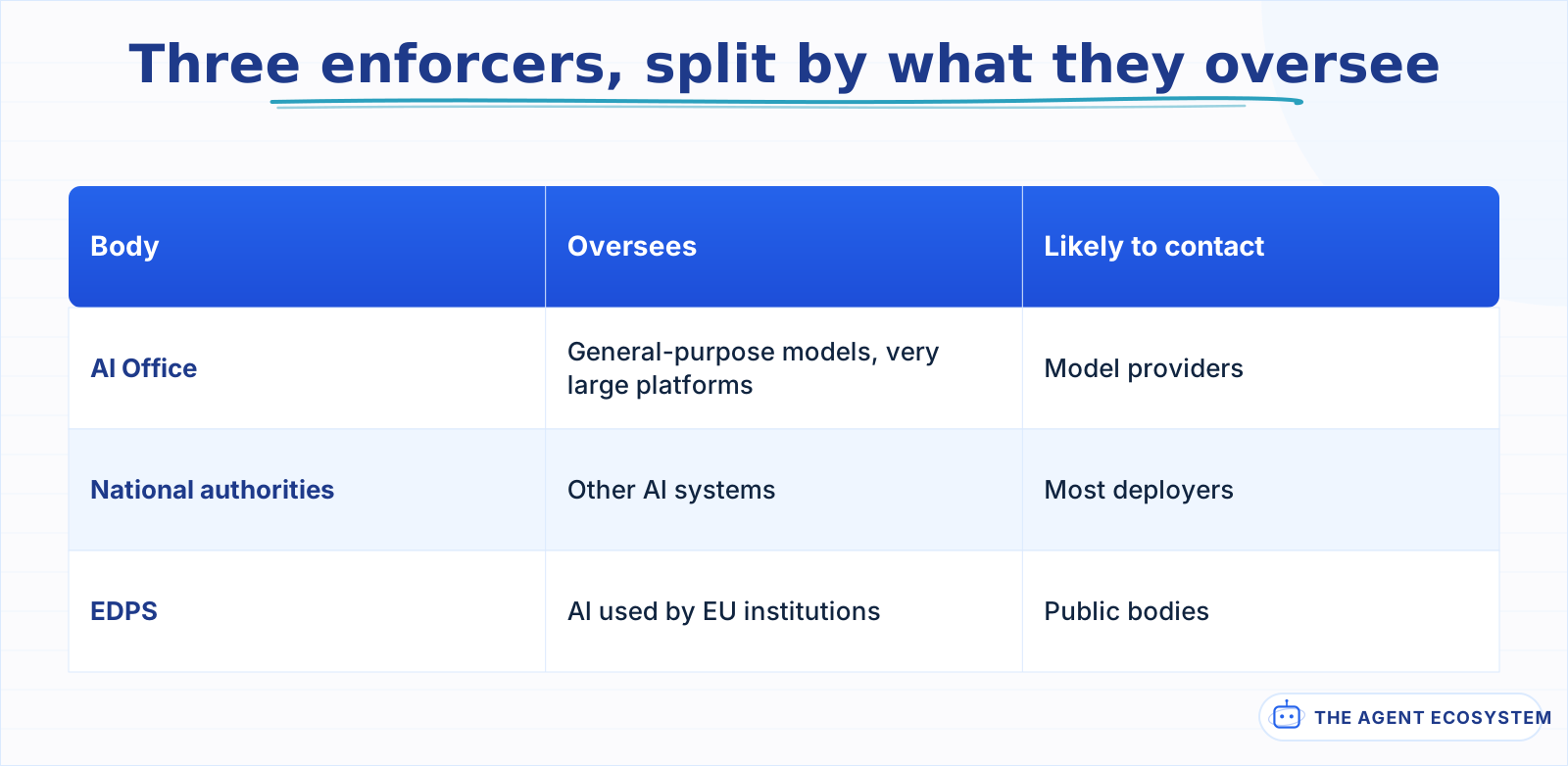 Most products sit in the middle row, which is the machine with twenty-seven implementations rather than one.
Nothing about that reduces the obligations. It changes who asks, how quickly, and what the first contact looks like, which is the part that actually shapes what you should prepare.
What can the AI Office do to a model provider?#
More than fine them, and the non-financial powers are the ones with teeth. It can send requests for information to verify compliance, conduct model evaluations and request the access needed to run them, and require a provider to take measures, including restricting a model's public availability.
That last power deserves attention from everyone downstream, not just from providers. A measure restricting the availability of a model is a supply event for every product built on it, and it arrives on a regulatory timetable rather than a commercial one. Nobody's vendor risk register has a row for it yet.
There is also a quieter trap in the information power. Fines are possible for incorrect or misleading responses to a request, which means a rushed or over-confident answer creates exposure of its own, separate from whatever the original question was about.
| Power | Aimed at | Downstream effect on you |
|---|---|---|
| Requests for information | Model providers | Your vendor's answers describe your stack |
| Model evaluations and access | Model providers | Possible behaviour or availability changes |
| Requiring corrective measures | Model providers | Features can be restricted at short notice |
| Restricting public availability | Model providers | A supply event with no commercial notice |
| Fines | Model providers | Your vendor's exposure, up to €15,000,000 or 3% |
Do the headline fines actually apply to you?#
The largest tier almost certainly does not. €35,000,000 or 7% of total worldwide annual turnover is reserved for prohibited practices, which are a defined and narrow set of uses that most products never come near. Quoting that figure in a planning meeting about a support chatbot is a category error.
The tier that plausibly reaches an ordinary product is €15,000,000 or 3% of worldwide turnover. Article 99 applies it to the transparency duties and, once they start, to the duties of high-risk providers and deployers. Article 101 sets the same figures for general-purpose model providers. AI literacy has no tier of its own in Article 99, so national rules set any penalty.
Size decides which figure is your ceiling. A larger company faces whichever is higher. Article 99(6) flips that for SMEs, including start-ups, to whichever is lower, on every Article 99 tier. Article 99(6a) gives small mid-caps the same rule, except on prohibited practices. Article 101 has no such rule, so a small model provider gets no relief on the cap.
| Rule | Covers | Larger company | SME |
|---|---|---|---|
| Article 99(3) | Prohibited practices | Up to €35,000,000 or 7%, whichever is higher | Whichever is lower |
| Article 99(4) | Operator duties, including Article 50 transparency | Up to €15,000,000 or 3%, whichever is higher | Whichever is lower |
| Article 99(5) | Incorrect, incomplete or misleading information to authorities | Up to €7,500,000 or 1%, whichever is higher | Whichever is lower |
| Article 101 | General-purpose model providers | Up to €15,000,000 or 3%, whichever is higher | Same, no lower-of rule |
Modeled: a business with €2,000,000 in turnover has a ceiling of €60,000 on the €15,000,000 tier and €140,000 for a prohibited practice. Those are maximums, not likely fines.
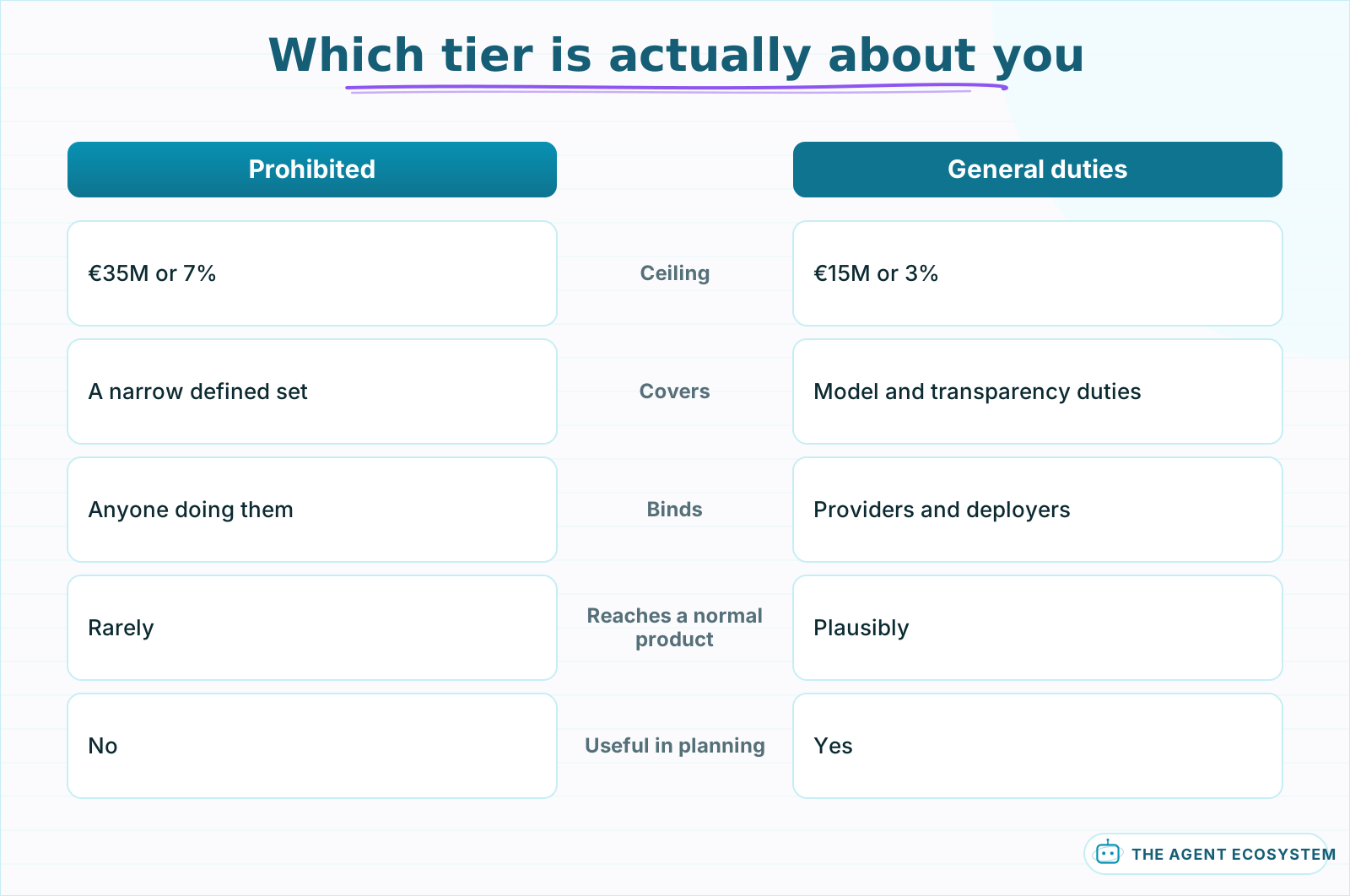 Headline figures. For an SME each ceiling is the lower of the two, and only one of these columns describes an ordinary product.
Worth separating two things that share the €15,000,000 and 3% figure. The general-purpose model obligations sit in one article and the transparency duties in another, and they reach different parties. The first binds model providers. The second splits by role under Article 50: the provider of a system owes the notice that people are talking to an AI and, for generators, machine-readable marking, while the deployer owes the notices and labels for emotion recognition, deepfakes and public-interest text. Wire an agent to a model API and run it under your own brand, and you are that system's provider. The ceiling being identical hides the fact that only one of them is likely to be about you.
Ceilings are also not expectations. They are maxima, and Article 99(7) has the authority weigh the nature, gravity and duration of the breach and the operator's size, turnover and market share. Planning against the ceiling is as unhelpful as ignoring the regime entirely.
What reaches a small team first?#
A question, not a penalty. The realistic first contact is an information request or a complaint routed through a national authority, and the thing that determines how that goes is whether you can answer promptly and accurately about what your system does, what it was told, and what you disclosed to users.
That is a documentation problem rather than a legal one, and it is the same documentation that serves every other purpose. Which model version served a request, what the user was shown, what the system was instructed to do, and who reviewed the output.
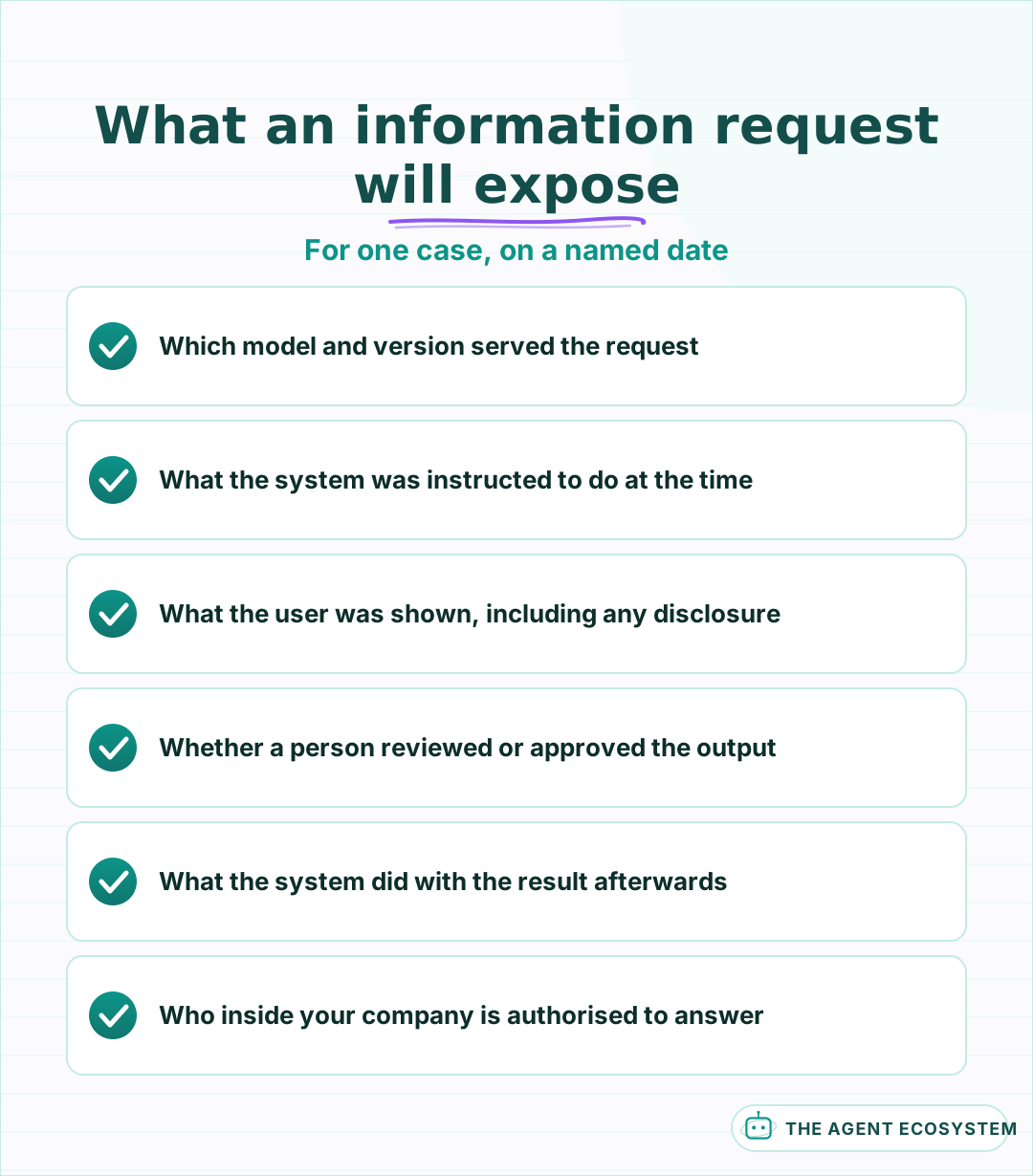 None of this can be assembled inside a response window. It is either already there or it is not.
Speed is the part people underestimate. An information request arrives with a deadline attached, and the work of reconstructing what a system did months ago is not work you can compress into the response window. Teams that can answer in an afternoon built that capability long before anyone asked. Accuracy matters as much, because Article 99(5) puts a fine on incorrect, incomplete or misleading information given to a national authority.
The second thing that reaches you is your vendor's compliance work, arriving as product change. Model evaluations and corrective measures land upstream and surface downstream as altered behaviour, deprecated endpoints or restricted features, on a schedule nobody consulted you about.
What is still to come?#
More of the framework, on three dates. New prohibitions and the end of a marking grace period arrive on 2 December 2026, high-risk rules for uses such as hiring on 2 December 2027, and rules for AI in regulated products on 2 August 2028. Treating August as the end of the work means scrambling again later.
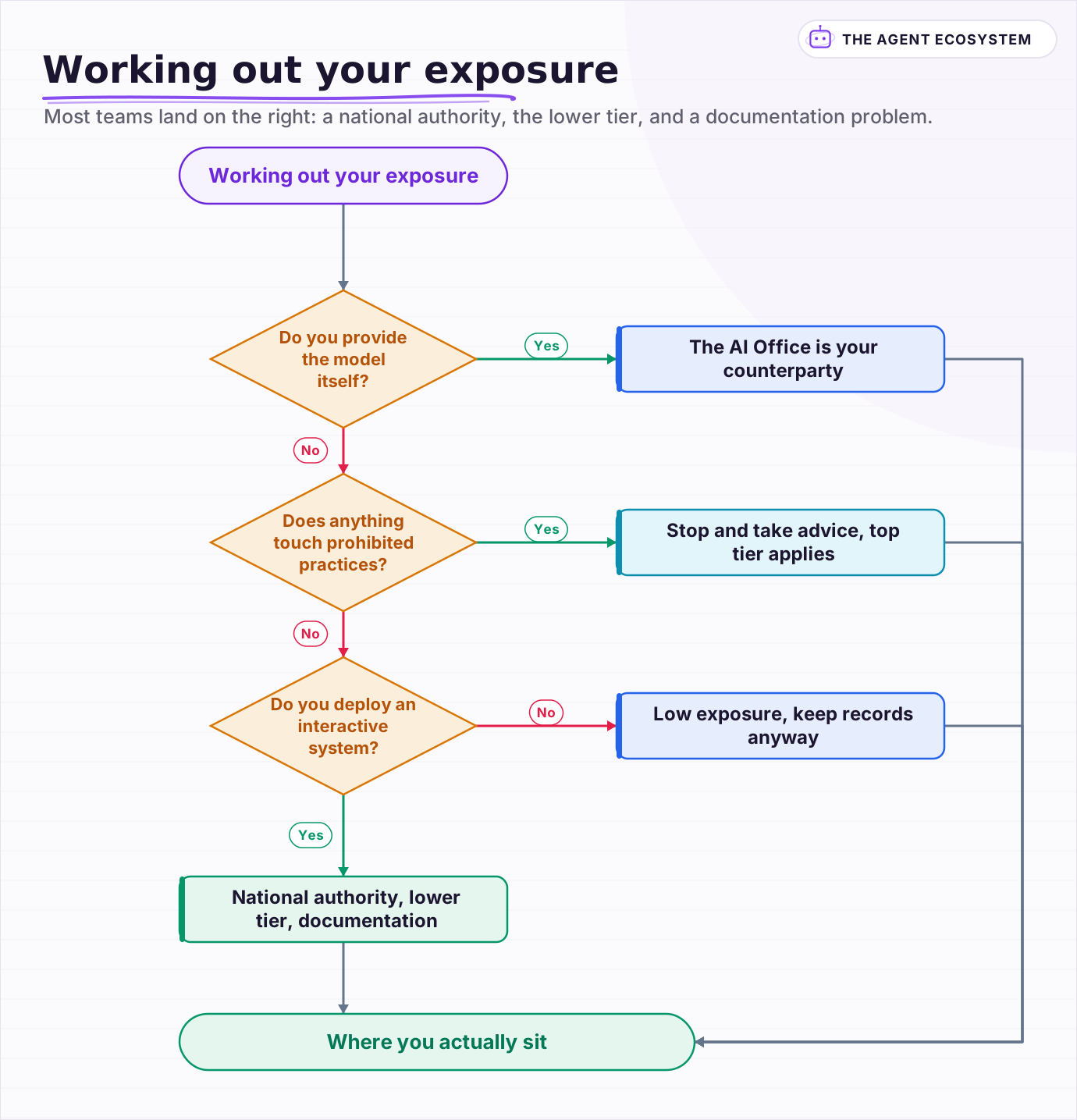 Most teams land on the right: a national authority, the lower tier, and a documentation problem.
The practical stance is unglamorous. Know which authority covers you, keep records that answer a question about one specific case, and treat your model vendor's regulatory exposure as a supply risk in your own planning. What a defensible record looks like covers the documentation half, and who carries responsibility when an agent errs covers the liability half.
Frequently asked questions
Who enforces the EU AI Act?
Do the €35 million fines apply to ordinary AI products?
What powers does the AI Office actually have?
What will a regulator ask us first?
Is the regime finished now that August has passed?
Sources
Primary references and vendor documentation used while drafting and reviewing this article.
Written by

Muhammad Qasim Hammad is an AI agent and automation expert and the founder of Cart Gaze LLC (cartgaze.com). He builds product for the love of it: when an idea lands, a working prototype is usually running within hours, built with the same AI agents and automations he sells. He puts his own output at roughly 20× what it was before agents, and the Agentic OS behind this site is the working proof, documented in public with the tools he actually ran and what they really cost.
AI & Automation Services
Want a pipeline like this running in your business?
I'm Qasim — I design and ship AI agents and n8n automations for solo operators and small teams. Tell me what's eating your team's week, and I'll scope a fix.
Related reading
Does a Chatbot Have to Say It Is AI? Yes, Since August
For years the answer was a matter of taste. Since 2 August 2026 it is a legal duty in the EU, the exemption is narrower than teams hope, and the deadline has already passed.

AI Vendor Due Diligence: Questions Worth Asking First
Most AI vendor evaluations test the demo and skip the contract. The questions that matter are the ones whose answers you cannot discover later.
Who Is Liable When an AI Agent Makes a Mistake in 2026?
An agent you deployed emailed a customer the wrong refund amount. The answer is always a person or a company, never the software, and which one is decided long before the incident.
The EU AI Act Reaches Agents on August 2: A Builder Primer
EU AI Act transparency duties and enforcement started on 2 August 2026, while high-risk rules moved to December 2027 and August 2028. This is a dated, non-legal primer on what that means for a small team shipping agents.
The AI Code of Practice: Voluntary Commitments, Explained
Two documents share almost the same name and do entirely different jobs. Reading them as one set of commitments is the fastest way to answer the wrong question.
Data Privacy for AI Tools: The Decisions to Make First
Most small businesses decide what data may reach their AI tools retroactively, when a client asks. Eleven lessons on the inventory, the three data tiers, what zero retention actually covers, and why the model is rarely the leak.