The AI Code of Practice: Voluntary Commitments, Explained
Two documents share almost the same name and govern different articles. Only one of them is likely to be about you.
AI-drafted, reviewed by Muhammad Qasim Hammad on November 6, 2026. See our AI disclosure.
Table of contents
Two documents share almost the same name and do entirely different jobs. Reading an AI Code of Practice as a single set of voluntary commitments is the fastest way to answer a question about the wrong one. One governs marking generated content. The other governs general-purpose model providers, and most teams are only affected by the first.
Which Code is which?#
The transparency Code, released by the European AI Office on 10 June 2026, sits beneath Article 50 and concerns marking and labelling AI-generated content. The GPAI Code, published a year earlier in July 2025, sits beneath Articles 53 and 55 and concerns transparency, copyright and safety for general-purpose model providers.
The scope difference decides which one you should read. If you deploy a generative system or publish generated media, the transparency Code describes your world. If you train and release foundation models, the GPAI Code does, and you already know it.
The naming collision is not accidental so much as unavoidable: both are codes of practice under the same Act, produced by the same institution, about overlapping subject matter. It still causes real confusion, and searching for "the AI code of practice" returns whichever one the writer happened to mean.
There is a structural difference too. The transparency Code has separate sections for providers and for deployers, which is unusual and useful, because most guidance addresses one audience and leaves the other guessing about which paragraphs apply to them.
| Transparency Code | GPAI Code | |
|---|---|---|
| Released | 10 June 2026 | July 2025 |
| Sits under | Article 50 | Articles 53 and 55 |
| Concerns | Marking and labelling content | Transparency, copyright, safety |
| Addresses | Providers and deployers | Model providers |
| Relevant to most teams | Yes | No |
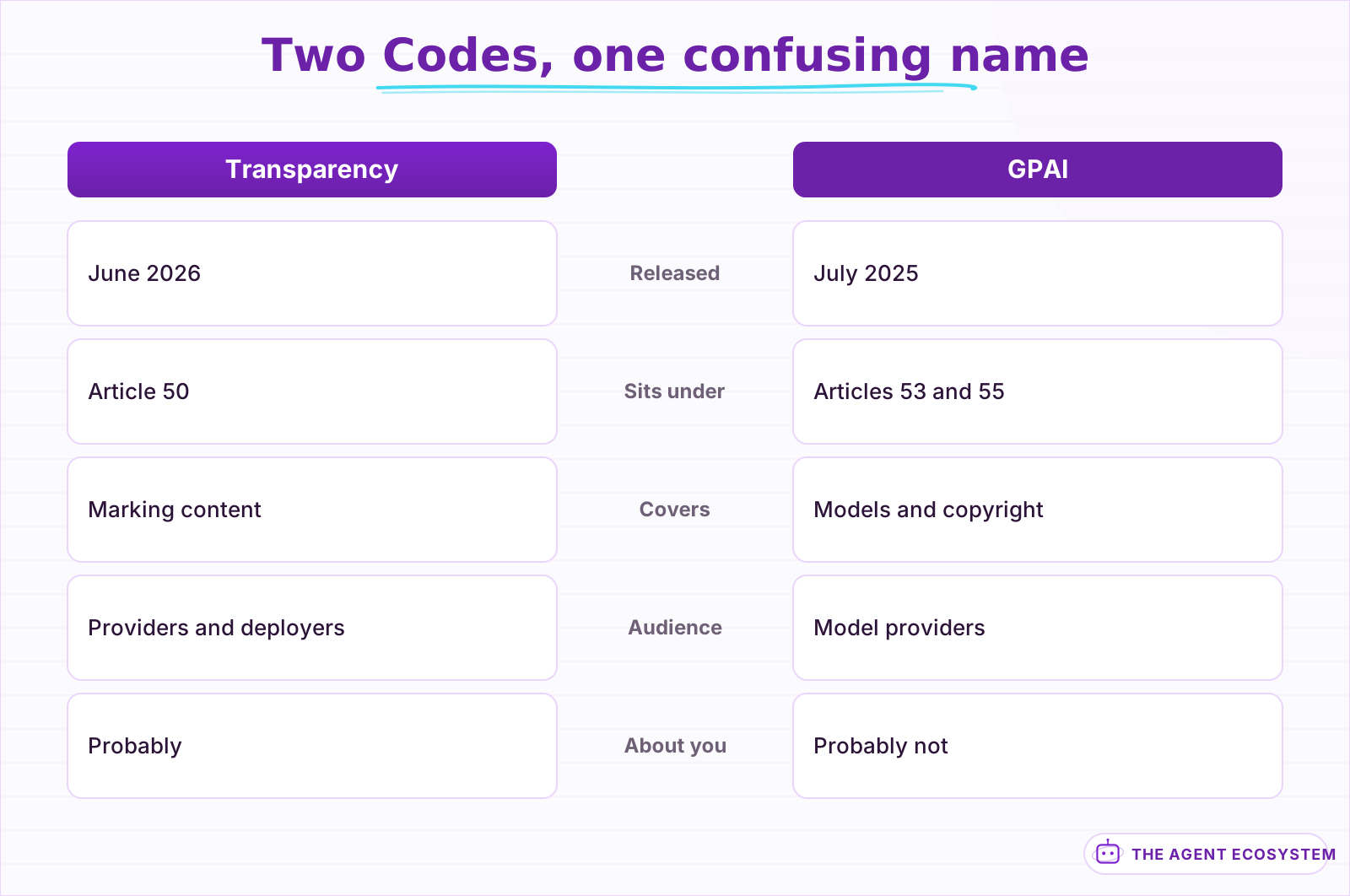 Scope decides which one you read. Most teams never need the right-hand column at all.
What do signatories actually commit to?#
Concrete, visible things. Signatories commit to visually disclose the presence of AI-generated markings using a set of generalised icons supplied by the AI Office, together with information on whether the content was created or manipulated using AI. That icon set is the practically valuable part.
It matters because the underlying obligation is abstract. The law requires that content be marked and that people be informed, without describing what a compliant label looks like on a page. A shared icon set turns that into a design decision somebody has already made, which is a considerable saving.
The deployer section is the one worth reading closely if you build products rather than models. Most teams are deployers of a generative system and providers of their own product simultaneously, so the 2 sections are not alternatives to choose between; they describe different duties landing on the same organisation at the same time.
Standardisation also helps the reader, which is the actual point. Labels that differ across every site teach people nothing, while a recognisable mark accumulates meaning over time in a way that a bespoke badge never does.
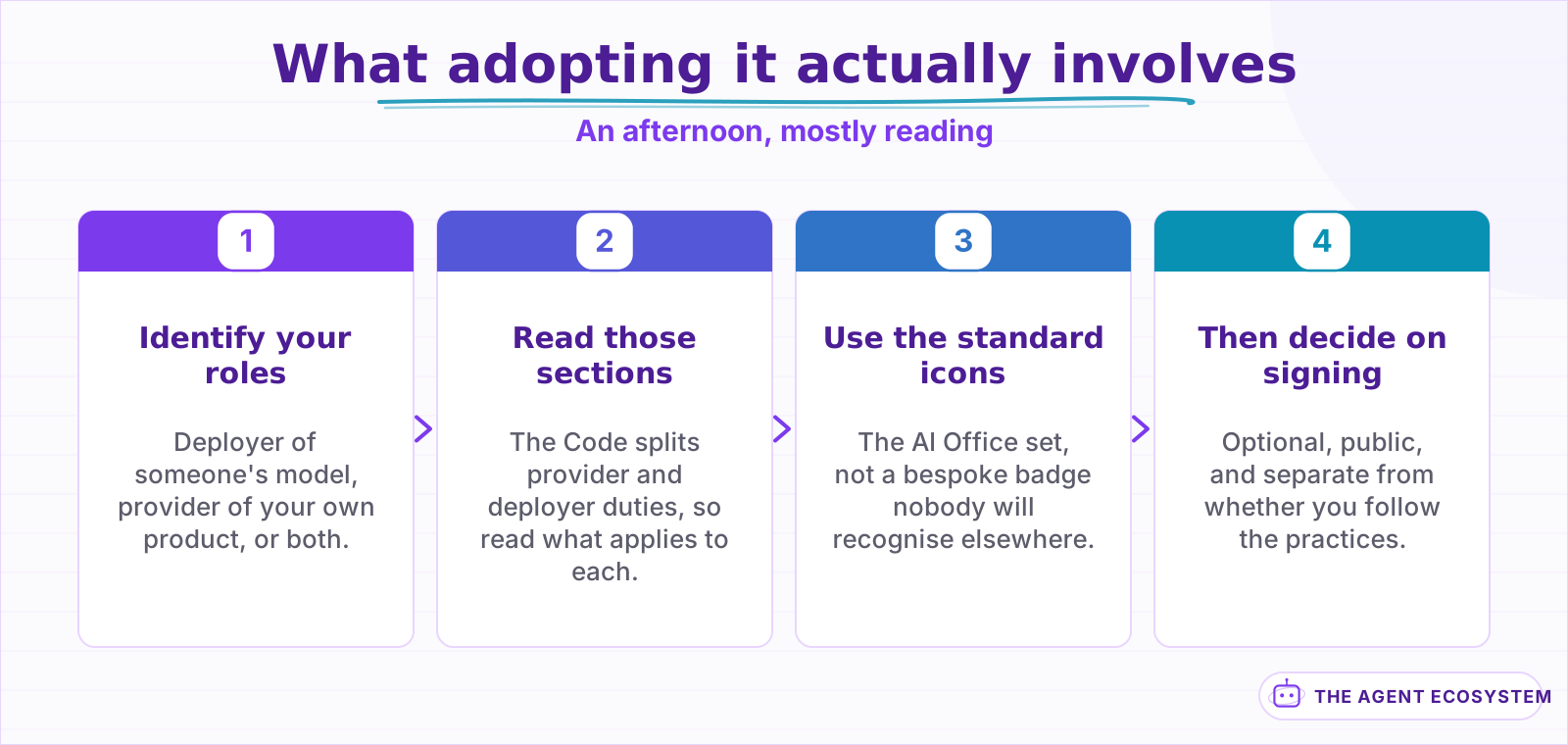 Steps 1 to 3 are worth doing regardless. Step 4 is a separate decision with different tradeoffs.
Uptake has been substantial rather than symbolic. More than 180 organisations had signed by the time enforcement began in August 2026, spanning sectors well beyond technology, including telecoms, education and retail.
Does signing actually help you?#
It gives you a documented route to demonstrating compliance, which is worth something when the alternative is arguing from first principles. The Commission confirmed the transparency Code as adequate and published final guidelines alongside it, so adherence is a recognised way of showing you took the obligation seriously.
What it does not do is change the obligation. A Code is a means of demonstrating compliance with duties that apply whether or not you sign, and declining to sign is not a violation of anything. The question is practical rather than moral: does following it cost less than devising your own defensible approach.
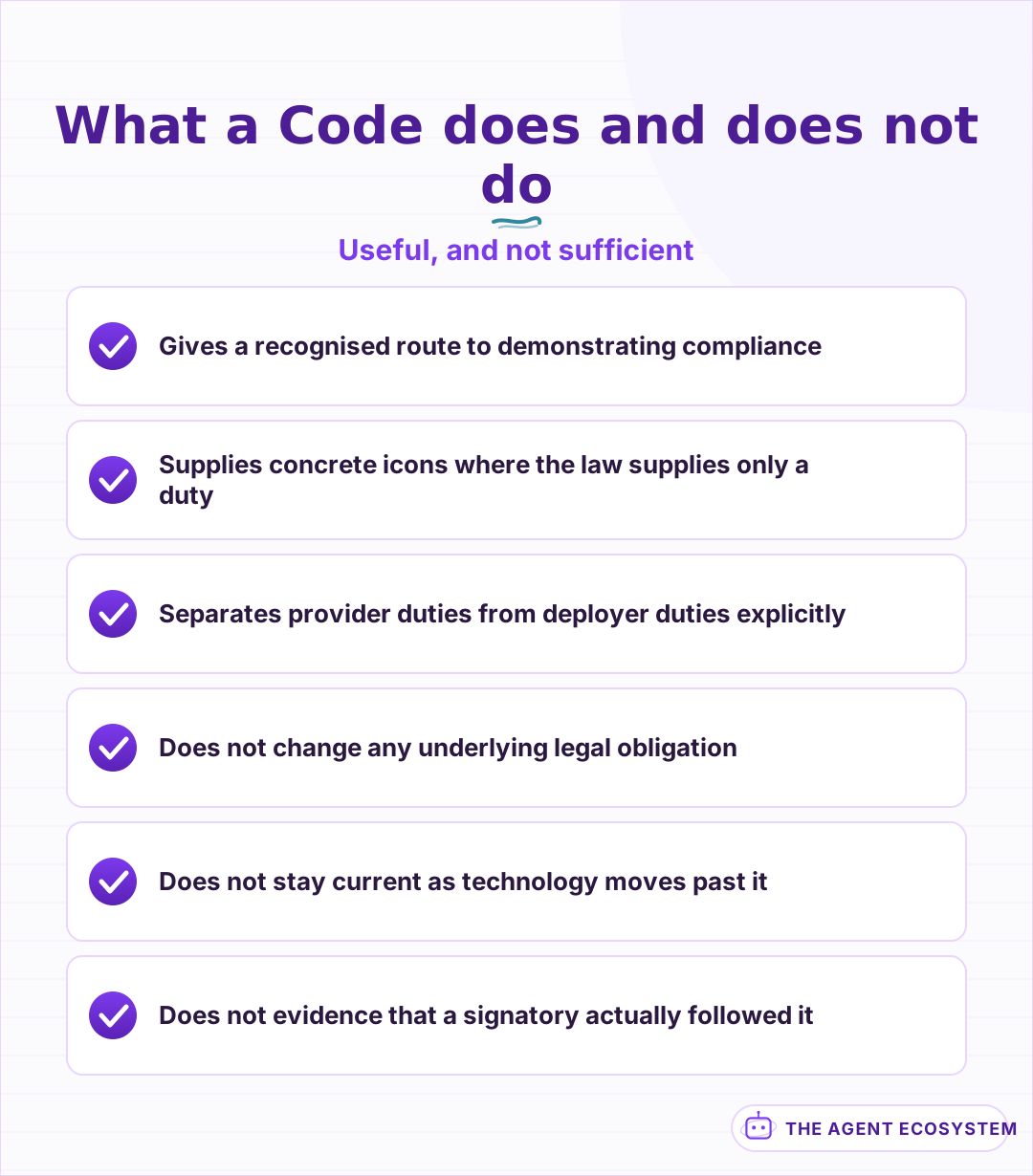 The first three are real benefits. The last three are the reasons it is not the end of the work.
For most small teams the honest answer is that adopting the practices costs little and signing is optional. The icons, the disclosure wording and the provider-deployer split are useful even to a company that never adds its name to a list.
Where do voluntary instruments genuinely fall short?#
Where they are read as ceilings. A Code describes an accepted way of meeting an obligation at the time it was written, and technology moves faster than the document. Treating adherence as the end of the question produces a system that is compliant on paper and behind in practice.
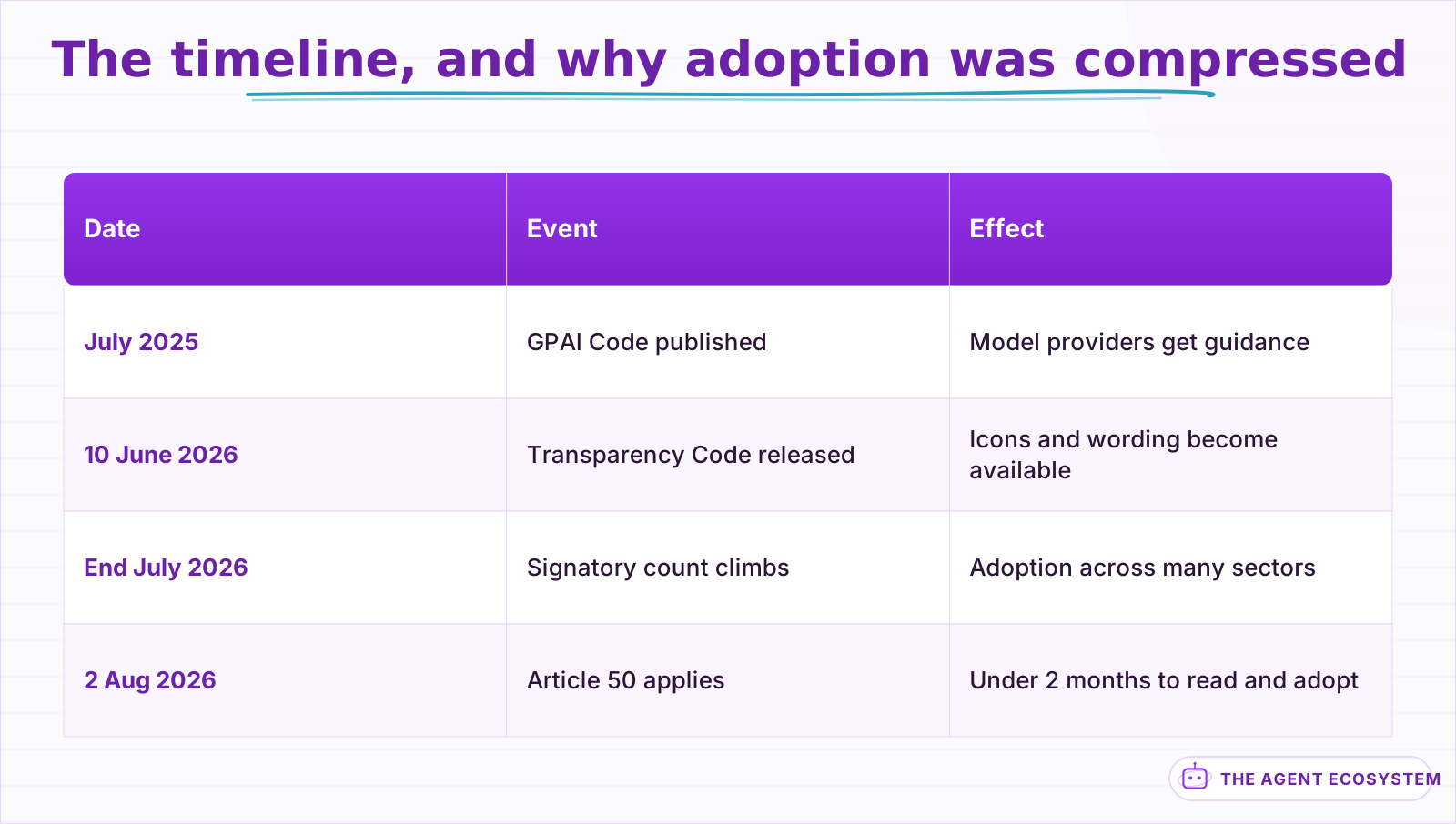 53 days between publication and enforcement is less than one procurement cycle at most companies.
There is a timing problem too. The transparency Code was released on 10 June 2026 and the obligations it supports began applying on 2 August, which is under 2 months for an organisation to read it, decide, implement and sign. Anyone who has run a procurement cycle knows what that window does to adoption.
The second limitation is enforcement asymmetry. Signing is public and visible, while following through is neither, so a signatory list measures intent rather than behaviour. That is not a criticism of the instrument, it is a reason not to treat someone else's signature as due diligence you performed.
What should you actually do with this?#
Read the section that addresses your role, adopt the icon set, and keep the underlying obligation in view rather than the document. That sequence takes an afternoon and leaves you in a better position than either ignoring the Code or signing it without reading the part that applies to you.
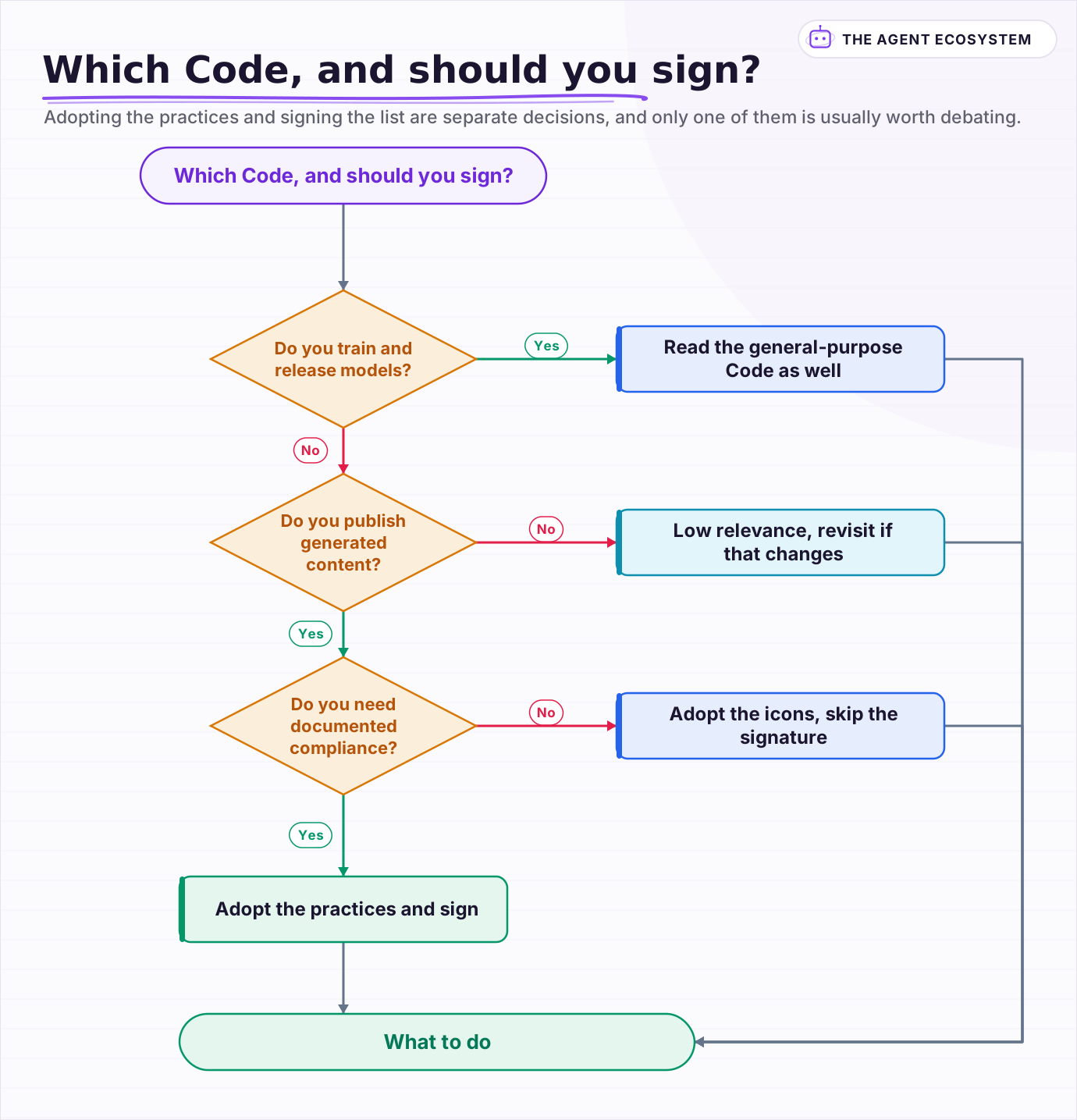 Adopting the practices and signing the list are separate decisions, and only one of them is usually worth debating.
Then treat it as a supplier question too. Asking a vendor which Code they follow and whether they use the standard markings tells you whether the provenance arriving with their output will be recognisable to anybody downstream. The questions worth asking a vendor covers the rest of that conversation, and what the labelling duty actually requires covers the obligation the Code sits beneath.
Frequently asked questions
Which AI Code of Practice applies to my company?
What do signatories to the transparency Code commit to?
Do we have to sign a Code of Practice?
Is adopting the practices useful even without signing?
What are the limits of a voluntary code?
Sources
Primary references and vendor documentation used while drafting and reviewing this article.
Written by

Muhammad Qasim Hammad is an AI agent and automation expert and the founder of Cart Gaze LLC (cartgaze.com). He builds product for the love of it: when an idea lands, a working prototype is usually running within hours, built with the same AI agents and automations he sells. He puts his own output at roughly 20× what it was before agents, and the Agentic OS behind this site is the working proof, documented in public with the tools he actually ran and what they really cost.
AI & Automation Services
Want a pipeline like this running in your business?
I'm Qasim — I design and ship AI agents and n8n automations for solo operators and small teams. Tell me what's eating your team's week, and I'll scope a fix.
Related reading
Does a Chatbot Have to Say It Is AI? Yes, Since August
For years the answer was a matter of taste. Since 2 August 2026 it is a legal duty in the EU, the exemption is narrower than teams hope, and the deadline has already passed.

AI Generated Content Labeling Requirement: Who It Binds
Two labeling regimes took effect on the same day, and that was not a coincidence. One of them has a size threshold and the other does not, which inverts the usual assumption.
EU AI Act Fines for Providers: Who Actually Gets Asked
The headline numbers travelled further than the detail. Almost none of that ceiling is aimed at the people quoting it nervously, and the first contact is a question.
AI Vendor Due Diligence: Questions Worth Asking First
Most AI vendor evaluations test the demo and skip the contract. The questions that matter are the ones whose answers you cannot discover later.

The EU AI Act Reaches Agents on August 2: A Builder Primer
EU AI Act transparency duties and enforcement started on 2 August 2026, while high-risk rules moved to December 2027 and August 2028. This is a dated, non-legal primer on what that means for a small team shipping agents.
Fable 5 vs GLM 5.2 vs GPT-5.6: The 2026 Frontier Landscape
Three frontier models landed in June 2026: Claude Fable 5, Z.ai's open-weight GLM-5.2, and OpenAI's limited-preview GPT-5.6. The numbers do not all measure the same thing, so here is an honest, dated comparison on coding score, price, and openness.