Claude Code vs Codex vs Gemini CLI: Terminal AI Agents Compared
The three terminal coding agents in 2026: model backing, MCP, sandbox, and what each really costs.
AI-drafted, reviewed by Muhammad Qasim Hammad on July 5, 2026. See our AI disclosure.
Table of contents
- What is an AI coding agent CLI, and why did everyone move to the terminal?
- How does Claude Code work, and what does it cost?
- What makes Codex CLI different: open source and sandboxed?
- Is Gemini CLI dead? Meet Antigravity CLI
- How do they compare on MCP, sandbox, models, and price?
- Which terminal coding agent should you pick?
You open a terminal, type one command, and an agent reads your repo, edits a dozen files, runs the tests, and fixes what broke. Three tools now own that workflow, and the "which one" articles went stale almost as fast as they were published. The honest answer to which ai coding agent cli to run in 2026 comes down to three things: the model behind it, whether it sandboxes and speaks MCP, and what the usable tier actually costs.
This compares Claude Code, OpenAI's Codex CLI, and Google's terminal agent, which changed names this quarter. The goal is to be correct as of late June 2026 on model, features, and price, and to send you to each vendor's own page to re-check before you commit.
What is an AI coding agent CLI, and why did everyone move to the terminal?#
An AI coding agent CLI is a tool that reads your repo, edits files, runs commands, and calls external tools through MCP, all from the shell. It is not editor autocomplete; it is an autonomous agent in your terminal. Developers moved there for composability, repo-wide context, and scriptable headless runs.
The terminal wins because it composes. You can pipe a failing log straight in, run the agent inside CI, and chain it with the Unix tools you already know. The same engine is usually reachable from the CLI, an IDE extension, and a headless script, so one mental model covers your laptop and your pipeline.
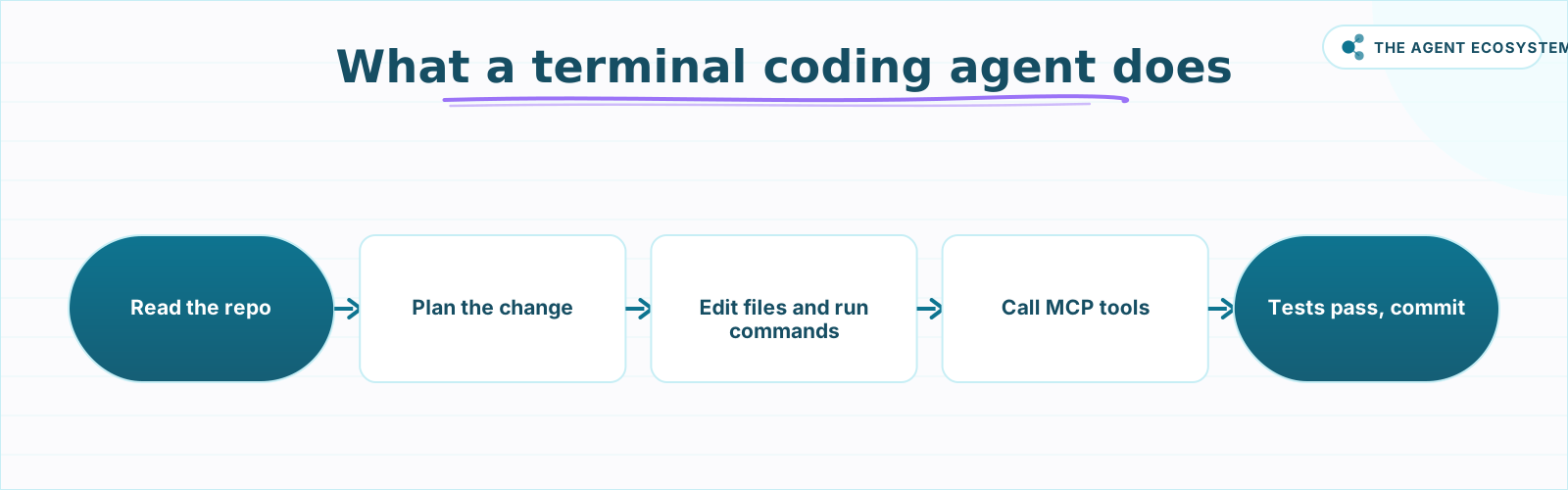 A terminal coding agent runs the whole loop from the shell: read the repo, plan, edit and run, call tools, and commit.
Three agents matter in 2026: Anthropic's Claude Code, OpenAI's Codex CLI, and Google's terminal agent, which as of 18 June 2026 is Antigravity CLI, the announced replacement for Gemini CLI. They overlap heavily on the basics and differ on the things that actually decide a daily driver, which is what the rest of this covers.
How does Claude Code work, and what does it cost?#
Claude Code is Anthropic's agentic CLI, run with the claude command in any project and also available in VS Code, JetBrains, and the web. It runs Claude Opus 4.8 and Sonnet 4.6, has the deepest MCP ecosystem, and needs a Claude subscription or API key. There is no free tier.
You install it with a shell script or a package manager, drop a CLAUDE.md in your repo for persistent memory, and extend it with skills, hooks, and sub-agents. Because Anthropic created the Model Context Protocol, the MCP server ecosystem is the most mature here, which matters if you want the agent to reach your real tools and data. The current Sonnet and Opus models also carry a 1M-token context window, so the agent can hold a large slice of your codebase in working memory during a refactor.
Access runs through Claude Pro at about $20 a month, or Max at $100 or $200 a month, or an Anthropic API key. Usage is governed by a 5-hour rolling window plus a weekly active-compute cap, and those limits were doubled on 6 May 2026. Claude Code is strongest on complex multi-file refactors and raw code quality, and weakest if you need a free on-ramp or sandboxed execution out of the box.
What makes Codex CLI different: open source and sandboxed?#
Codex CLI is OpenAI's lightweight terminal agent, open source under Apache-2.0 and written mainly in Rust. It is backed by GPT-5.5 by default, supports MCP and skills, and is the only one of the three that sandboxes command execution by default, with selectable approval modes. It ships with ChatGPT plans.
You install it with the official script, with npm i -g @openai/codex, or with brew install --cask codex, and because the client is open source you can read exactly what it does or self-host it. GPT-5.5 is positioned as using fewer tokens for comparable results, which is part of why Codex feels economical on tight single-file work.
That sandbox is the real differentiator. Codex runs commands in a configurable, isolated environment with approval modes you choose, so an autonomous run cannot casually touch your whole machine. If you want an agent to grind through a task unattended, kernel-level isolation by default is a meaningful safety net the other two ask you to assemble yourself.
Codex is included in ChatGPT Free, Go at $8 a month, Plus at $20 a month, and Pro from $100 a month, or through an OpenAI API key. The Plus tier gives a set number of local messages and cloud tasks per 5-hour window. The latest release was 0.142.3 on 26 June 2026. It is best at safe autonomous runs, token-efficient single-file edits, and teams that want a client they can actually read and self-host.
Is Gemini CLI dead? Meet Antigravity CLI#
Mostly, yes. Google announced that Gemini CLI stops serving requests on 18 June 2026, replaced by Antigravity CLI for individual plans, while enterprise Code Assist keeps it longer. Antigravity exposes Gemini 3.1 Pro and 3 Flash, and unusually also Claude and GPT-OSS models. The old free 1,000-requests-a-day tier is the part most in flux.
This is the single fact that breaks half the existing comparisons. Gemini CLI's headline draw was a generous free allowance, and that "free pick" story is exactly what the move to Antigravity puts in question. Sources disagree on whether Antigravity keeps a genuine free tier or pushes you to AI Pro, so treat "free" as the number-one thing to verify for yourself.
On price, Antigravity is commonly listed as Free, Pro at $20, Ultra at $100, and Ultra Max at $200, while Google's own pages show AI Pro at $19.99 and AI Ultra from $99.99, with a 5-hour quota refresh and a weekly ceiling. The credit-to-token conversion is not disclosed. Historically the Google agent was best at very large context and monorepo exploration, plus a zero-cost on-ramp, and the second of those is now uncertain.
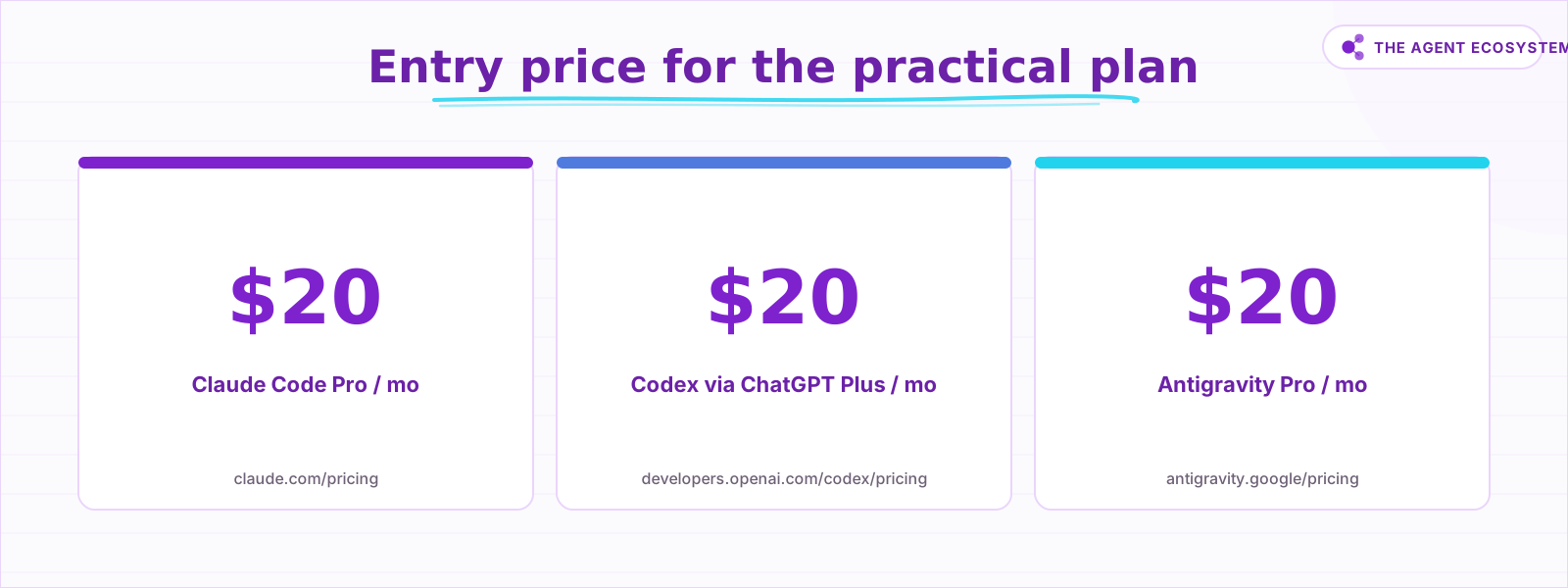 All three converge near $20/mo for the usable solo tier in 2026; the differences are quota shape and what free includes, not headline price.
How do they compare on MCP, sandbox, models, and price?#
All three support MCP, but Claude Code's ecosystem is deepest since Anthropic created the protocol. Only Codex CLI sandboxes by default. Codex and Antigravity are open source; Claude Code is proprietary. On price, all three land near twenty dollars a month for the usable solo tier, so quota shape matters more than headline cost.
Here is the at-a-glance view, stated from each vendor's docs as of late June 2026:
| Agent | Default model | MCP | Sandbox by default | Open source | Entry price |
|---|---|---|---|---|---|
| Claude Code | Opus 4.8 / Sonnet 4.6 | Yes (protocol author) | No | No | $20/mo Pro |
| Codex CLI | GPT-5.5 | Yes | Yes | Apache-2.0 | $20/mo Plus |
| Antigravity CLI | Gemini 3.1 Pro / 3 Flash | Yes | No | Apache-2.0 | $20/mo Pro |
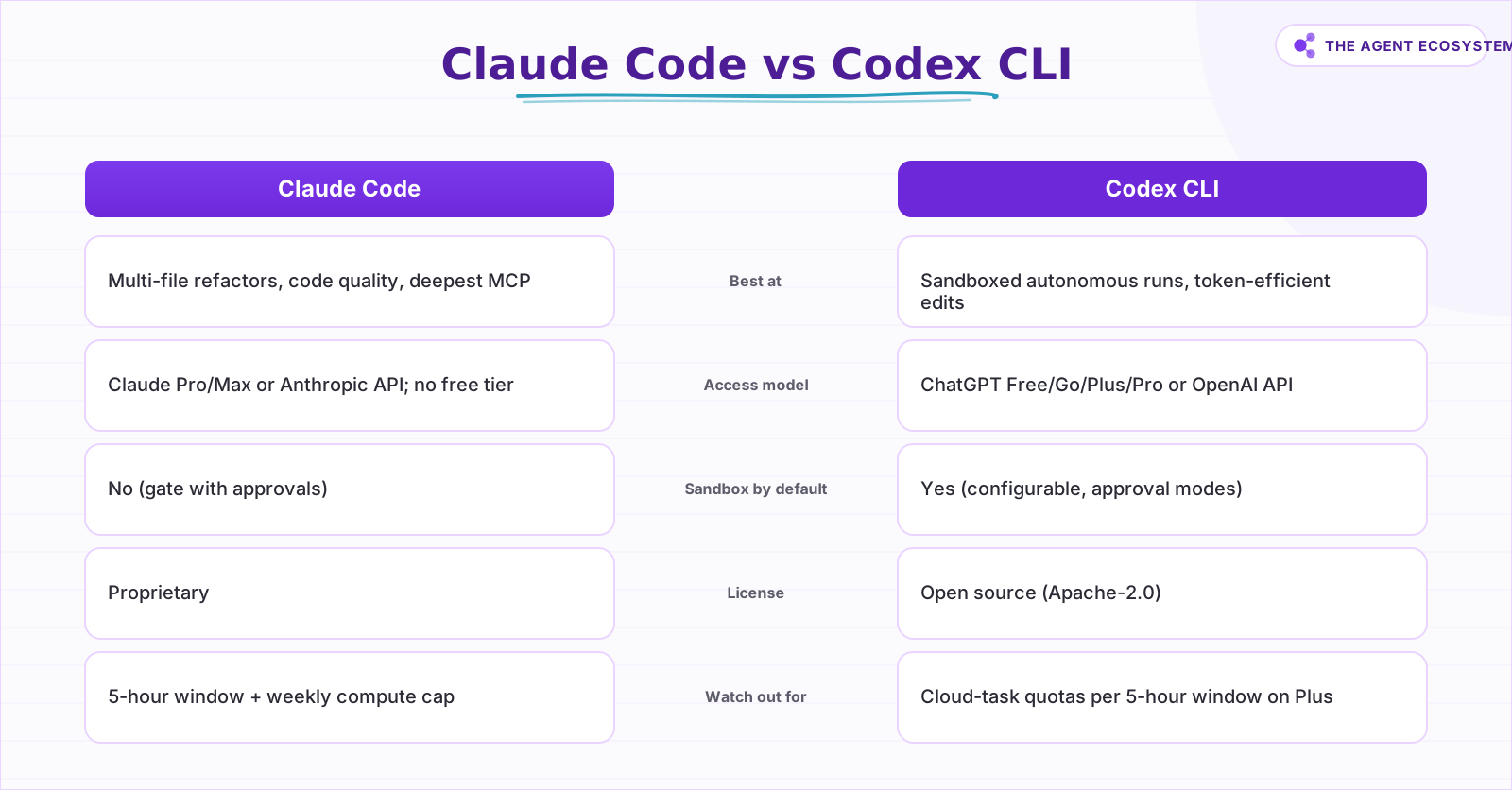 The two front-runners split the job: Claude Code wins on code quality and MCP depth, Codex CLI on sandboxed autonomy and an open client. Vendor docs, June 2026.
There is one number worth citing, carefully. On the public Terminal-Bench 2.1 leaderboard, snapshot dated 18 June 2026, Codex CLI with GPT-5.5 sat at the top near 83%, Claude Code with Opus 4.8 close behind near 79%, and the Gemini and Antigravity entries in the low-to-mid 70s. That is a third-party leaderboard that changes week to week, not a test we ran, and a four-point gap does not decide your daily driver. If you want a workflow-level comparison instead of a single score, the tested cost-and-speed breakdown of these models in real agents is more useful than any leaderboard.
Open source matters more than it looks on that table. A readable, self-hostable client means you can audit what the agent runs, pin a version, and keep it working inside locked-down environments, which is why Codex and Antigravity appeal to teams with compliance constraints. Claude Code trades that openness for the deepest tool ecosystem and the strongest code quality.
The honest summary is that there is no overall winner, only a best tool per job. Fit, price, and sandbox needs decide it, and the gap between the top two on quality is smaller than the gap in how they bill you and how they isolate what they run.
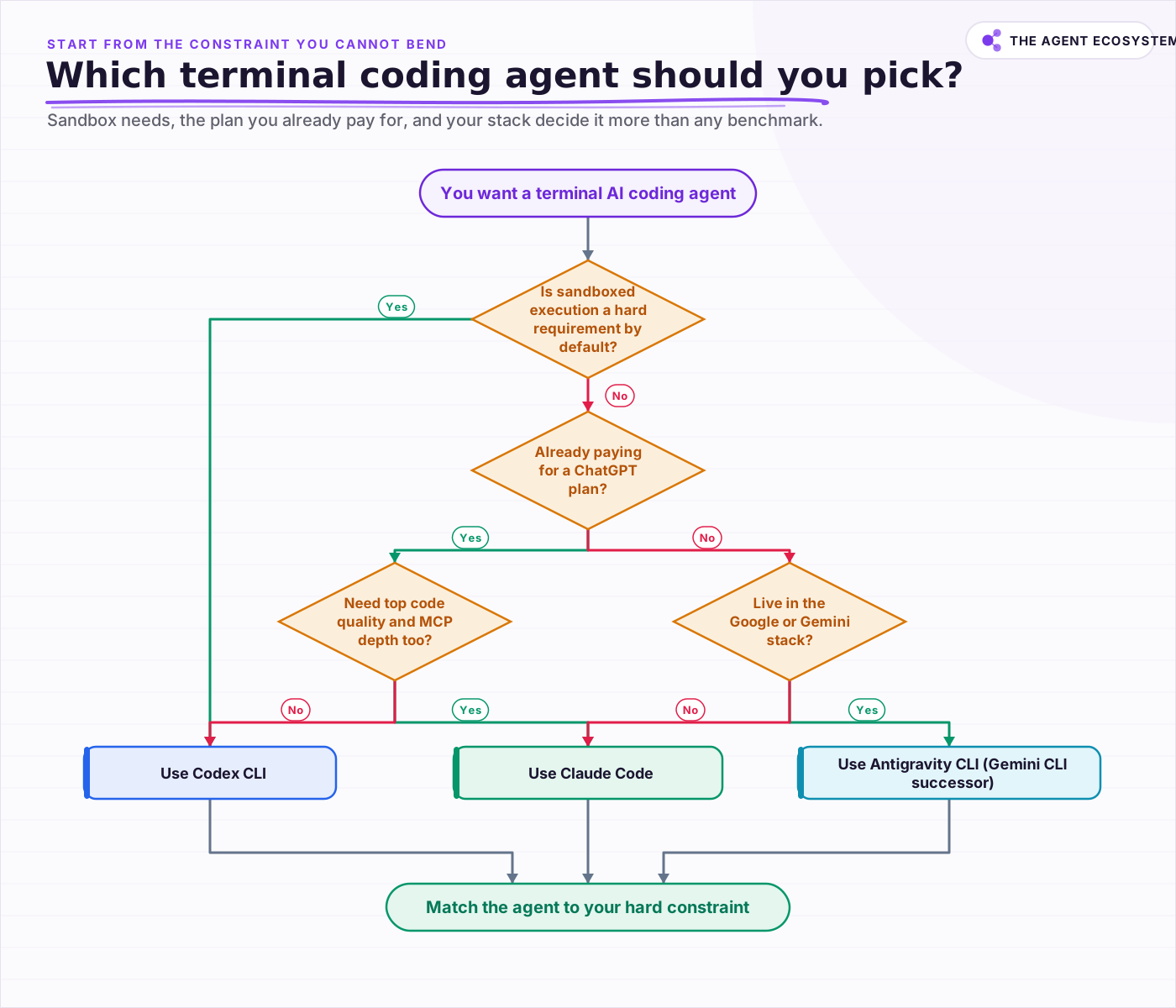 Start from the constraint you cannot bend (sandbox, existing plan, or stack) and the agent usually picks itself.
Which terminal coding agent should you pick?#
Start from your hard constraint, not the benchmark. Need sandboxed execution by default, choose Codex CLI. Want the deepest MCP ecosystem and best multi-file code quality, choose Claude Code. Live in the Google stack, move to Antigravity CLI. Already paying for one ecosystem usually settles it without a second bill.
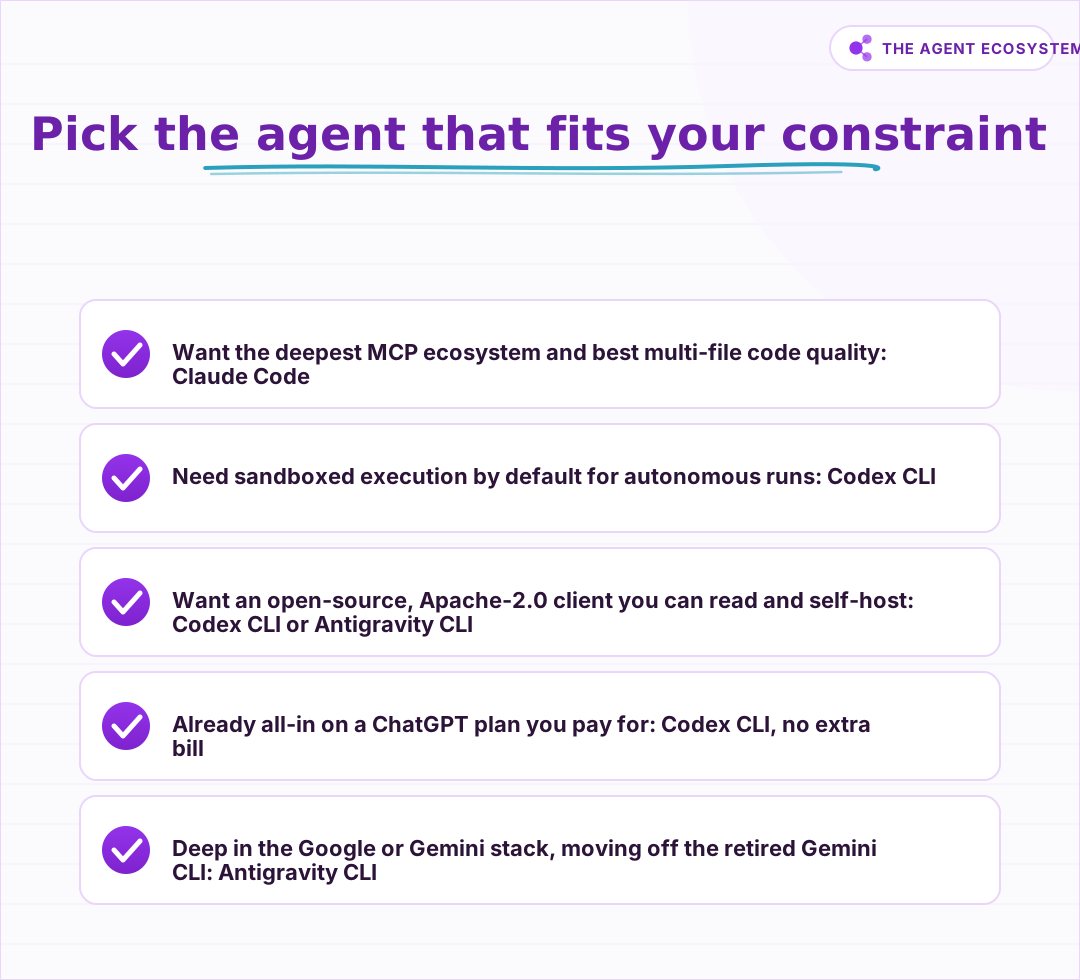 Start from your hard constraint (budget, sandbox, ecosystem) and the choice usually makes itself.
Most people already have the answer in their wallet. If you pay for ChatGPT, Codex adds nothing to the bill and gives you the sandbox for free. If you live in Claude for writing and code already, Claude Code is the natural extension. If you are deep in Google's stack, Antigravity is the migration path off the retired Gemini CLI. If you want a zero-cost start, that used to be Gemini's pitch, so confirm the current free tier before you plan around it, and weigh a free AI IDE as an alternative on-ramp.
Whatever you pick, re-read the vendor's pricing and model pages first, because this list will move again within weeks. The right move is to match one agent to the constraint you cannot bend, run it for a real week of work, and switch only if it fights you. See the Claude Code docs, the Codex CLI docs, and Antigravity pricing for the current details.
Frequently asked questions
What is an AI coding agent CLI?
Is Claude Code or Codex CLI better?
Is Gemini CLI still available?
How much does each terminal coding agent cost?
Which is fastest or most accurate?
Sources
Primary references and vendor documentation used while drafting and reviewing this article.
Written by

Muhammad Qasim Hammad is an AI agent and automation expert and the founder of Cart Gaze LLC (cartgaze.com). He builds product for the love of it: when an idea lands, a working prototype is usually running within hours, built with the same AI agents and automations he sells. He puts his own output at roughly 20× what it was before agents, and the Agentic OS behind this site is the working proof, documented in public with the tools he actually ran and what they really cost.
AI & Automation Services
Want a pipeline like this running in your business?
I'm Qasim — I design and ship AI agents and n8n automations for solo operators and small teams. Tell me what's eating your team's week, and I'll scope a fix.
Related reading
Best Free AI IDEs in 2026: Truly Free vs Free-Trial
Most "free AI IDE" lists mix up four completely different things. This guide splits 11 tools into truly free, BYOK, freemium, and trial-only, so you know exactly what you're getting before you build.

Best AI Coding Tool 2026: Cursor vs Windsurf vs Copilot
Cursor, Windsurf, and GitHub Copilot are the three names most teams weigh in 2026, but two changes broke the old rankings: Windsurf is now Devin Desktop, and Copilot moved to usage-based billing. Here is the honest price-and-fit comparison.
Fable 5 vs GLM 5.2 vs GPT-5.6: The 2026 Frontier Landscape
Three frontier models landed in June 2026: Claude Fable 5, Z.ai's open-weight GLM-5.2, and OpenAI's limited-preview GPT-5.6. The numbers do not all measure the same thing, so here is an honest, dated comparison on coding score, price, and openness.
Claude vs GPT vs Gemini in n8n: Tested Cost and Speed
There is a 25x cost spread between the cheapest and priciest LLM tier for the exact same n8n AI Agent workflow. This post prices all three providers across 11 model tiers so you can pick the right Chat Model sub-node and stop overpaying.
Coding Agents Have 4 Autonomy Levels. Most Teams Never Leave Level 2.
The tool you pick is not what decides the risk, the autonomy level is. This is a tool-agnostic, 4-level framework for how much a coding agent should actually be allowed to do, from a diff that waits for your approval to a merge and deploy with no human step at all, grounded in
Claude Fable 5: Anthropic's Mythos-Class Model, Explained
Anthropic's Claude Fable 5 shipped on June 9, 2026 topping the coding benchmarks it publishes and priced near twice Opus 4.8. Here is an honest read on the reported numbers, the real trade-off, and who should pay the premium.