LLM Context Windows: Tokens, Limits, and Lost in the Middle
What a context window actually is, and why a bigger one does not guarantee better recall.
AI-drafted, reviewed by Muhammad Qasim Hammad on July 19, 2026. See our AI disclosure.
Table of contents
You pasted a 40-page contract into a model with a huge window, asked one question, and got a confident answer that quietly missed the clause buried in the middle. The window was big enough. The recall was not. That gap is the whole story, and it is why a larger context window does not automatically make a model smarter about your document.
What is an LLM context window?#
An llm context window is the token budget for one request, and input plus output share it. A token is roughly 4 characters of English text, so about 1,000 tokens is close to 750 words. When you fill the window with a long document, you leave less room for the answer, because both live in the same pool.
That token math is the part people skip. If a model advertises a 128,000-token window and you feed it 120,000 tokens of source text, you have left roughly 8,000 tokens for the reply. Ask for a long summary and you can hit the ceiling mid-sentence. The window is not "input space plus separate output space"; it is one shared budget you spend on both.
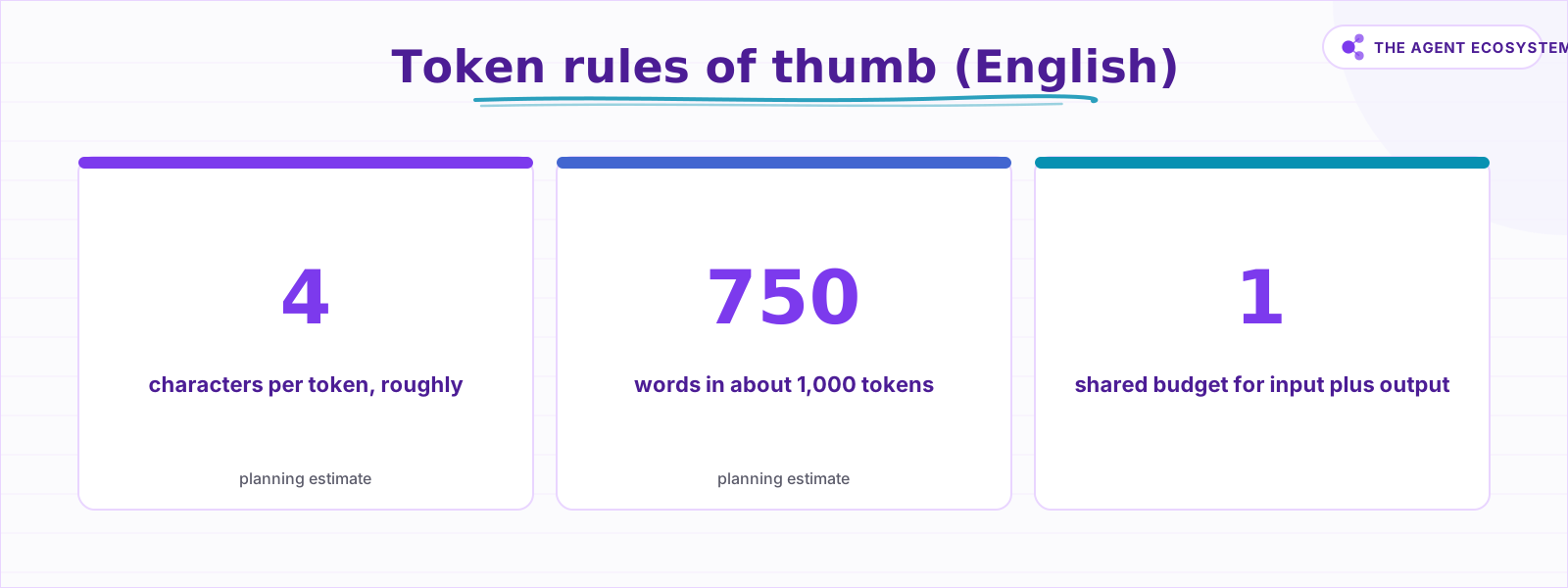 Planning estimates for plain English, not exact conversions. Rare words, URLs, and code split into more tokens.
Tokens are also not words. Common words often map to a single token, while a rare word, a long URL, or code can split into several. The 4-characters-per-token and 750-words-per-1,000-tokens figures are rules of thumb for plain English, not exact conversions, so treat them as planning estimates rather than a guarantee for your specific text.
How big are context windows in 2026?#
As of 2026, window sizes vary widely across providers, so treat any single number as perishable and verify it on the vendor's own page. Many mainstream models sit around 128,000 tokens, Anthropic's Claude family has offered roughly 200,000, and Google's Gemini has advertised 1,000,000 tokens or more for long-context work.
Those headline numbers move often and differ by model tier, region, and API version, so do not hardcode them into a workflow. A 1,000,000-token window sounds like it removes every limit, but it changes the economics more than it changes the behavior. You still pay for every token you send, and you still depend on whether the model can actually retrieve what you buried inside those tokens.
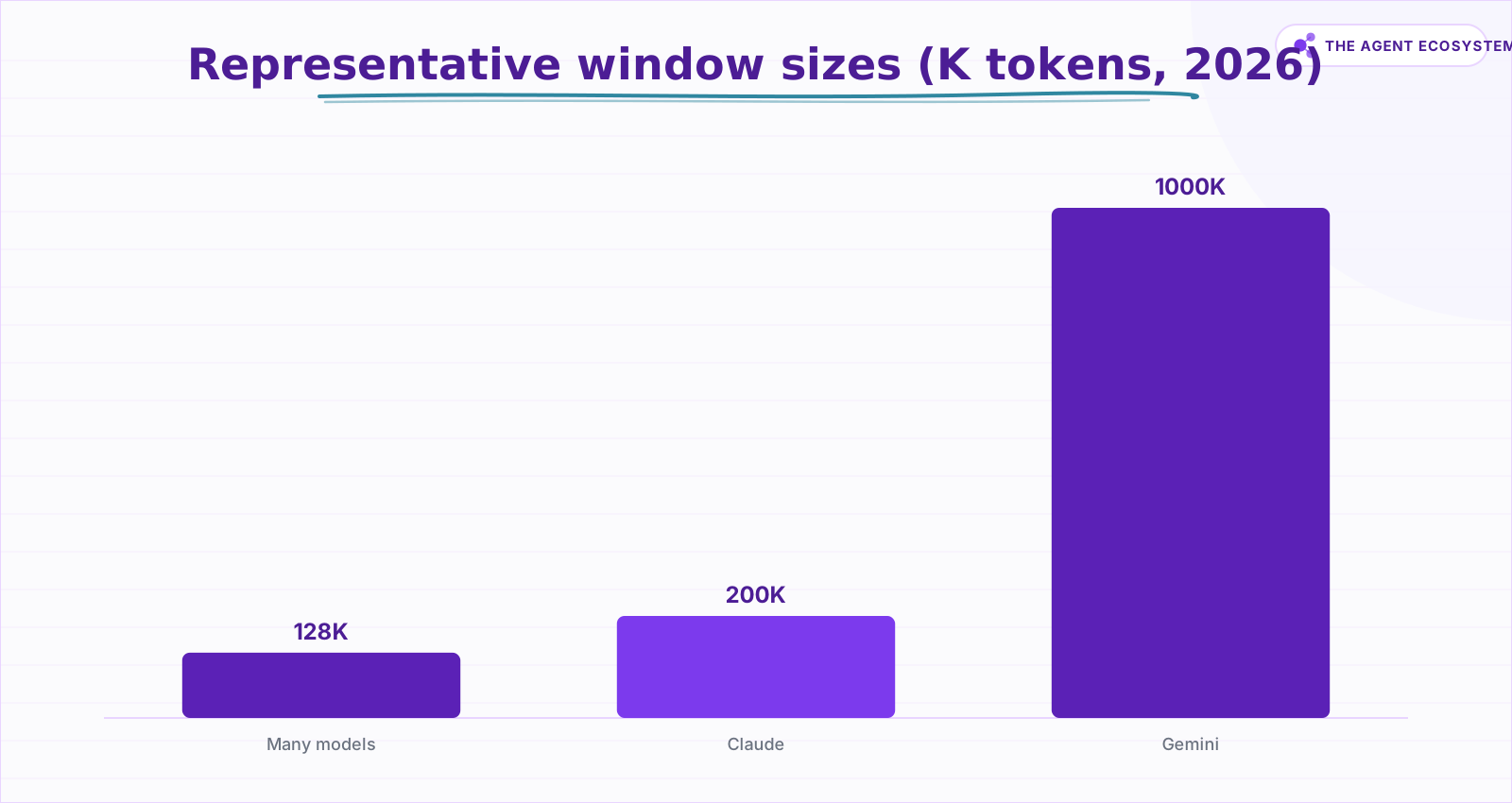 As of 2026, verify. Sizes are perishable ballparks in thousands of tokens; confirm the exact number on the vendor's own page.
The table below sketches what each rough size class is good for and what to watch. Read the sizes as 2026-era ballparks, not fixed specs, and confirm the exact figure for your chosen model before you design around it.
| Window size (2026, verify) | Good for | Watch out for |
|---|---|---|
| ~8K to 32K tokens | Chat, short docs, single files | Long PDFs overflow fast |
| ~128K tokens | Reports, small codebases, transcripts | Cost climbs; middle recall drops |
| ~200K tokens | Large docs, multi-file review | Same middle-recall risk, higher spend |
| ~1M tokens and up | Whole repositories, book-length input | Priciest per call; recall still uneven |
Why does a bigger context window not fix recall?#
A bigger window holds more text but does not read all of it equally. Liu et al. (2023), in "Lost in the Middle" (arXiv:2307.03172), showed that models retrieve facts best when the relevant text sits near the start or the end of the input, and noticeably worse when it lands in the middle of a long context.
That "U-shaped" pattern is the catch. Adding a 1,000,000-token window does not remove it; a larger window just gives you a longer middle to lose things in. If the one clause that answers your question is at position 300 of 500 pasted pages, the model can still miss it even though the text technically fit. Capacity and attention are not the same property.
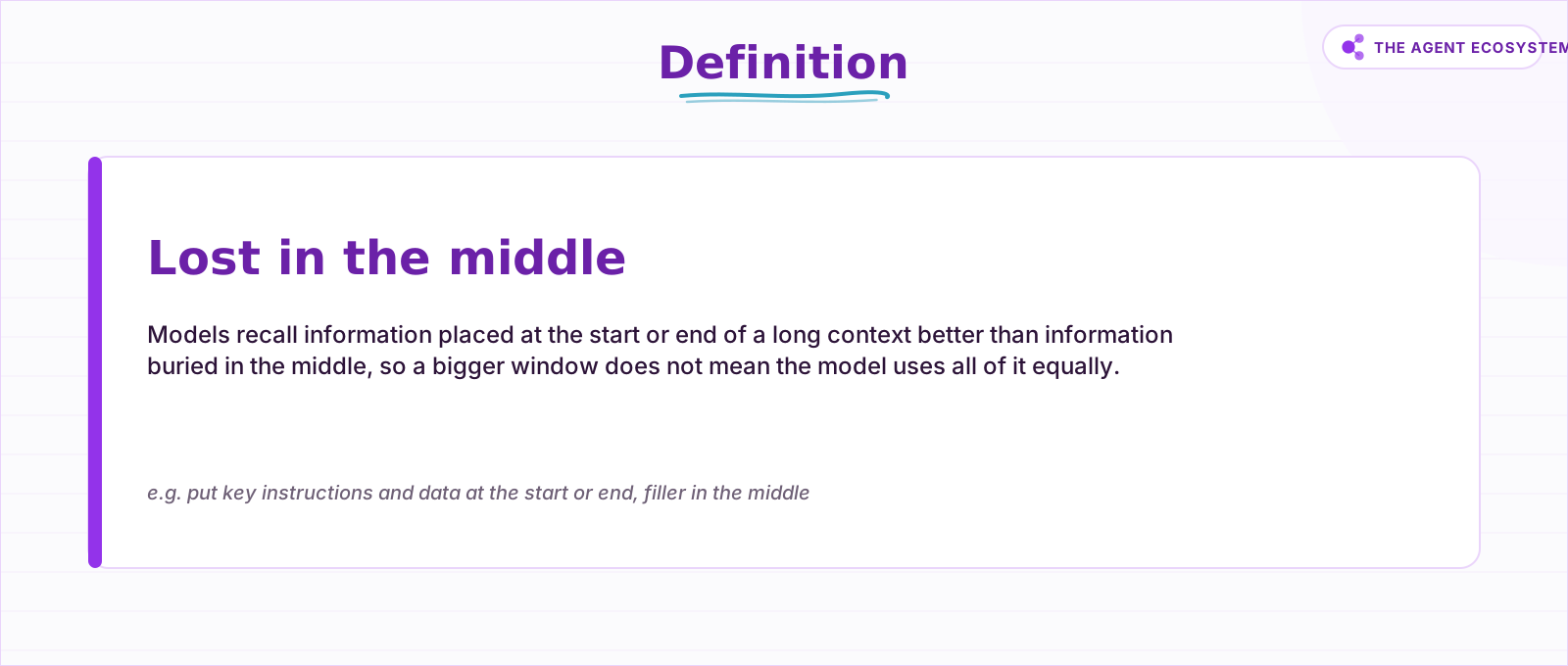 From Liu et al. (2023), arXiv:2307.03172. A longer window just gives you a longer middle to lose facts in.
There is a second cost that is easy to ignore. You pay per input token, so filling a 128,000-token window on every call is expensive and slow, whether or not the model uses all of it. Paying to stuff the window and then losing the middle is the worst of both outcomes, which is exactly why placement and retrieval still matter.
How do you place context so the model uses it?#
Put the load-bearing content where recall is strongest: the start and the end. Lead with your key instructions and the most important facts, then close by restating the question or the exact output you want. Keep the noisy, low-value filler in the middle, where a weaker recall does the least damage to your answer.
Two habits follow from this. First, do not dump 200 documents in and hope; retrieve the 5 or 10 most relevant chunks and send only those, which cuts cost and shortens the middle. Second, order what you keep so the critical material bookends the prompt. If your retrieval is returning the wrong chunks in the first place, our guide to fixing a RAG chatbot that gives wrong answers covers the retrieval side.
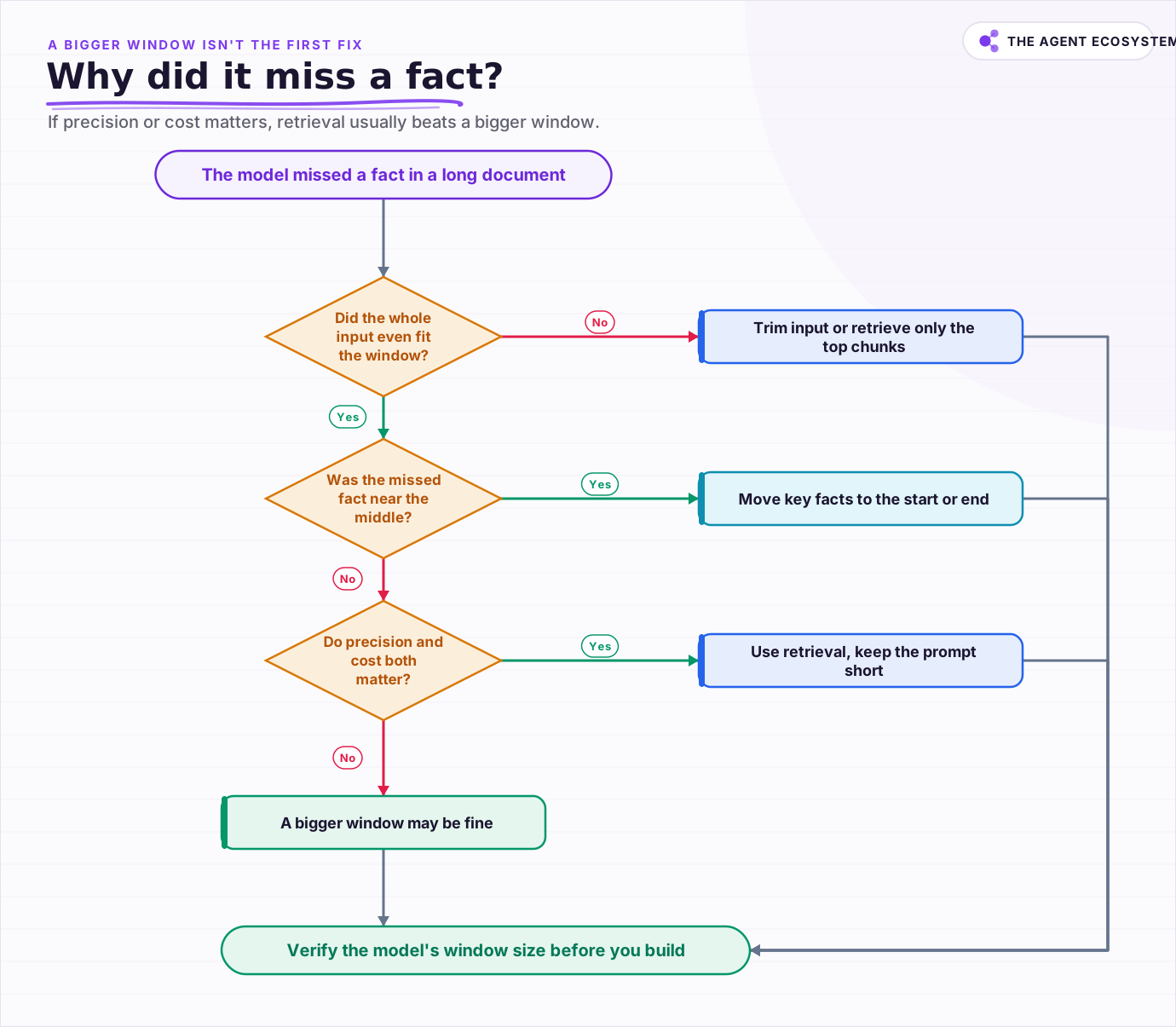 Start from your real constraint; if precision or cost matters, retrieval usually beats simply buying a bigger window.
This is also why retrieval-augmented generation did not die when windows grew. A 1,000,000-token window lets you skip retrieval, but you then pay for every token and inherit the middle-recall problem at full scale. Retrieval keeps the prompt short, cheap, and front-loaded with only what matters, which plays directly to the model's strengths.
Does a bigger window or retrieval win for your task?#
Neither wins by default; the right choice depends on how much text you have and how precise the recall must be. A large window is convenient for one-off, whole-document questions. Retrieval is better when accuracy matters, cost matters, or the same corpus gets queried many times, because it keeps prompts short and front-loaded.
The honest summary is that a context window is a budget, not a comprehension guarantee. Bigger windows remove the "it did not fit" problem but not the "it did not notice" problem. Spend the first tokens and the last tokens on what matters, verify the current window size before you build, and reach for retrieval when precision or cost is on the line. When you are comparing model options and per-token prices, our cheapest AI API in 2026 guide applies the same dated-pricing discipline.
Frequently asked questions
What is an LLM context window?
How many tokens is a word?
How big are context windows in 2026?
What is the lost-in-the-middle effect?
Does a bigger context window replace retrieval?
Sources
Primary references and vendor documentation used while drafting and reviewing this article.
Written by

Muhammad Qasim Hammad is an AI agent and automation expert and the founder of Cart Gaze LLC (cartgaze.com). He builds product for the love of it: when an idea lands, a working prototype is usually running within hours, built with the same AI agents and automations he sells. He puts his own output at roughly 20× what it was before agents, and the Agentic OS behind this site is the working proof, documented in public with the tools he actually ran and what they really cost.
AI & Automation Services
Want a pipeline like this running in your business?
I'm Qasim — I design and ship AI agents and n8n automations for solo operators and small teams. Tell me what's eating your team's week, and I'll scope a fix.
Related reading
Long-Context vs RAG: When a 200K-1M Token Window Beats Chunking
Now that 1M-token windows ship at flat pricing, should you stuff the whole corpus in one prompt or build a retrieval pipeline? This breaks long context vs RAG into reproducible per-query cost math, the recall limits of big windows, and four variables that decide it.

Contextual Retrieval: Fix RAG Chunks That Lose Context
Plain RAG embeds chunks that have lost their document context, so 'revenue grew 3%' matches nothing useful. Contextual retrieval writes a short per-chunk context and prepends it before embedding and BM25. Here is the method, the build, and the honest ingest trade-off.
Cut Your AI API Bill: 7 Levers That Actually Work
To reduce AI API costs you need levers that change the bill by a verifiable mechanism, not vague advice. This hub names all seven, right-size the model, prompt caching, the Batch API, routing and fallback, local versus API, token discipline, and RAG over long-context, with a
RAG Chunking Strategies: Fixed vs Recursive vs Semantic (and What to Pick)
RAG chunking strategies decide whether the right passage is whole, findable, and small enough to rank before your model sees it. Here is how fixed, recursive, and semantic splitting differ, what chunk size and overlap to start with, why the public benchmarks disagree, and a
How to Build a RAG System That Retrieves the Right Thing
Most RAG systems fail at retrieval, not at the model. Twelve lessons on chunking for the question, hybrid search for exact strings, re-ranking, making it refuse, and measuring retrieval separately from generation.
n8n AI Agent Pricing: What It Really Costs to Run
An n8n AI agent has two bills that behave nothing alike: a flat n8n platform fee and a per-run LLM token cost. Here is what each one comes to, with modeled per-run math across Claude, GPT, and Gemini, and the levers that actually lower the total.