Your AI Stack's Weakest Link Is a Dependency, Not a Prompt
A poisoned package and an endpoint that gave away admin tokens. Two 2026 incidents that never touched a model.
AI-drafted, reviewed by Muhammad Qasim Hammad on October 31, 2026. See our AI disclosure.
Table of contents
The 2 most instructive AI security incidents of 2026 had nothing to do with models. Nobody jailbroke a chatbot or smuggled instructions into a document. One was a poisoned package on PyPI and the other was a web endpoint that handed out admin tokens to anyone who asked. The AI part of the stack was the target, not the technique.
Why are AI dependencies a bigger prize than most packages?#
Because of where they sit. An AI gateway or agent framework holds provider keys, cloud credentials and database passwords by design, since its whole job is brokering access between your code and everything else. Compromise it and you do not need to move laterally; you have already arrived.
A logging library that gets backdoored gives an attacker whatever the logging library could see. An AI gateway that gets backdoored gives them the keys to every model provider you use, the cloud role the service runs as, and usually the database connection string sitting in the same environment. The category is unusually concentrated: these components are chosen precisely because they centralise access.
The deployment pattern makes it worse. A lot of AI tooling is self-hosted quickly, on the reasoning that it is internal, experimental, or "just a prototype". Prototypes acquire real credentials early and lose their prototype status late, which is how a service nobody owns ends up holding production keys.
There is a third factor, and it is cultural rather than technical. This category moves fast enough that pinning versions feels like falling behind. A framework shipping several releases a week trains teams to upgrade reflexively, and an ecosystem where the useful integration landed 4 days ago does not reward caution. The result is a dependency graph that updates faster than anyone reviews it, in exactly the component holding the most valuable secrets you have.
What happened when an AI gateway shipped a backdoor?#
Two malicious versions of LiteLLM went up on PyPI. They were live from 10:39 UTC on 24 March 2026 for roughly 40 minutes before PyPI quarantined them, and in that window they harvested environment variables, SSH keys, cloud credentials, Kubernetes tokens and database passwords.
The versions were 1.82.7 and 1.82.8. According to the project's own advisory, attackers obtained credentials to the publishing pipeline and bypassed the normal CI/CD workflow to upload the packages directly, an incident the maintainers say may be linked to a broader compromise of a security scanner used in the build chain. That detail is the uncomfortable one: the malicious release did not come through a pull request anybody could have reviewed.
Harvested data was encrypted and sent out over a POST request to a lookalike domain, which is a deliberate choice. Traffic to something resembling the project's own infrastructure attracts far less attention in an egress log than a connection to an unfamiliar host.
The persistence mechanism is the detail worth learning from. The package dropped a file named litellm_init.pth. A .pth file in a Python environment is executed on interpreter startup, so the payload runs again on every future Python process in that environment, whether or not the malicious version is still installed. Removing the bad package does not remove the backdoor.
| Remediation step | Why it matters |
|---|---|
| Rotate every secret the environment could see | Assume anything readable was read within the window |
Search for and remove litellm_init.pth | It re-executes on interpreter start, independent of the package |
| Audit version history in CI/CD, Docker builds and deploy logs | A local check misses images built during the window |
Pin to v1.82.6 or earlier until a verified release | Prevents a rebuild pulling the bad version back in |
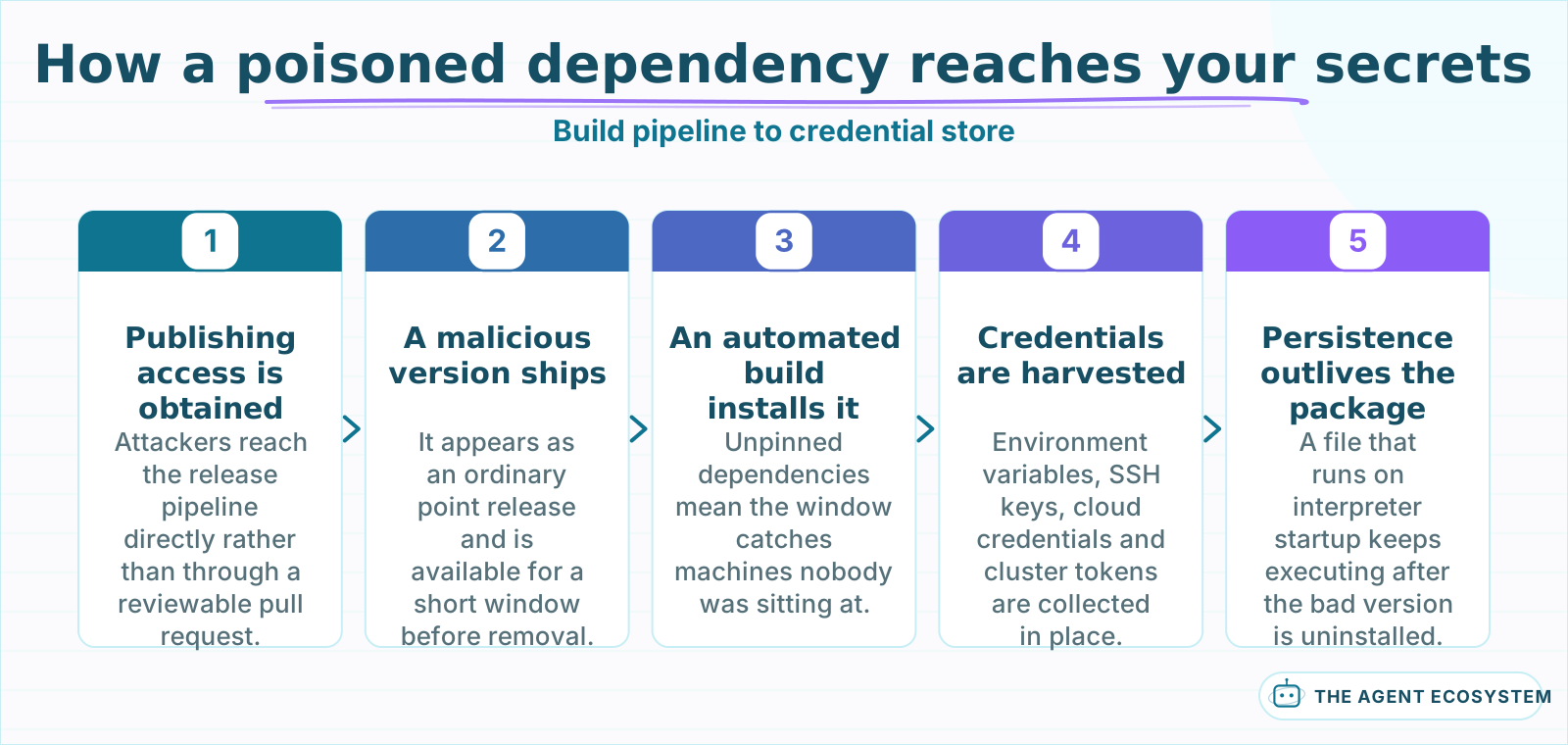 No step here involves a model. The chain ends at the credential store because that is where the package already runs.
Note what is absent from that list: any way to tell whether you were affected without checking. A 40-minute window on a package installed by automated builds means the honest answer for most teams is that they need to look at logs rather than reason from memory.
Why did a self-hosted agent builder end up on CISA's list?#
Because 2 endpoints combined into an unauthenticated remote code execution chain. In Langflow versions 1.0.0 through 1.10.0, one endpoint issued superuser tokens to any caller that could reach it on the network, and a second endpoint executed attacker-supplied Python once holding such a token.
The specifics are almost too neat. /api/v1/auto_login did not enforce authentication and was not bound to loopback, so it minted a SUPERUSER token for any network caller. /api/v1/validate/code then evaluated Python supplied by whoever held that token. Chained, they produce unauthenticated remote code execution with a CVSS base score of 9.8, classified as CWE-94 code injection.
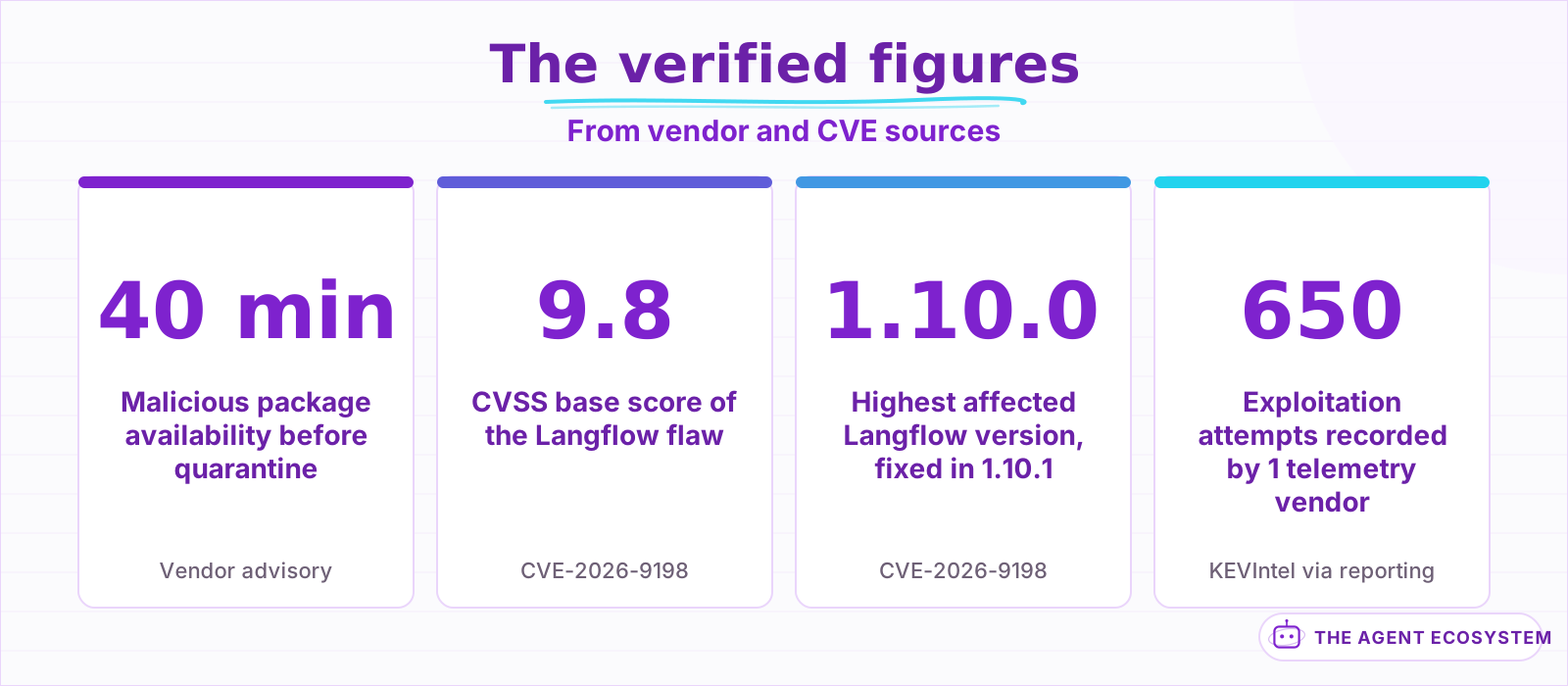 Vendor advisory and CVE record only. Widely-quoted download counts are not published anywhere primary.
The timeline is the part worth internalising. The flaw was disclosed on 17 July 2026 and patched the same day in version 1.10.1. CISA added it to the Known Exploited Vulnerabilities catalog on 4 August 2026, which is the point at which "there is a patch" became "this is being used against people right now". One telemetry vendor recorded 650 exploitation attempts from 244 unique addresses across 41 countries, with activity starting in early July.
Worth being precise about what went wrong, because it is instructive rather than exotic. Neither endpoint was a subtle memory-safety bug or a novel class of flaw. One was an authentication check that did not run and a bind address that was more permissive than intended. The other was a feature doing exactly what it said: evaluating code, for callers who were assumed to be trusted. The vulnerability lives in that assumption, which is why an internal-only design decision becomes critical the moment the service is reachable.
That pattern recurs across agent tooling because so much of it is built to execute code by design. A visual builder that runs Python nodes, a framework that evaluates expressions, an agent that shells out: all of them ship a code-execution primitive as a feature. The question for any such tool is never whether it can run arbitrary code, because it can. The question is who is allowed to ask.
A same-day patch is a good outcome from the maintainers and changes nothing for an instance nobody updated. Self-hosted AI tooling tends to be deployed once and revisited rarely, which is precisely the profile that turns a fixed vulnerability into an exploited one. The same care that goes into hardening an MCP server belongs on every agent-adjacent service you run.
What do these 2 incidents have in common?#
Neither needed a clever exploit against a model, or a prompt at all. One arrived through a build pipeline and one through a default configuration, and both ended with attacker code running exactly where your credentials live. The AI part of the stack was the target, not the technique.
They differ in one way that matters operationally. A poisoned dependency is a point-in-time event: there is a window, and either you installed during it or you did not. An exposed service is a standing condition that persists until somebody changes it. The first needs forensics; the second needs an inventory.
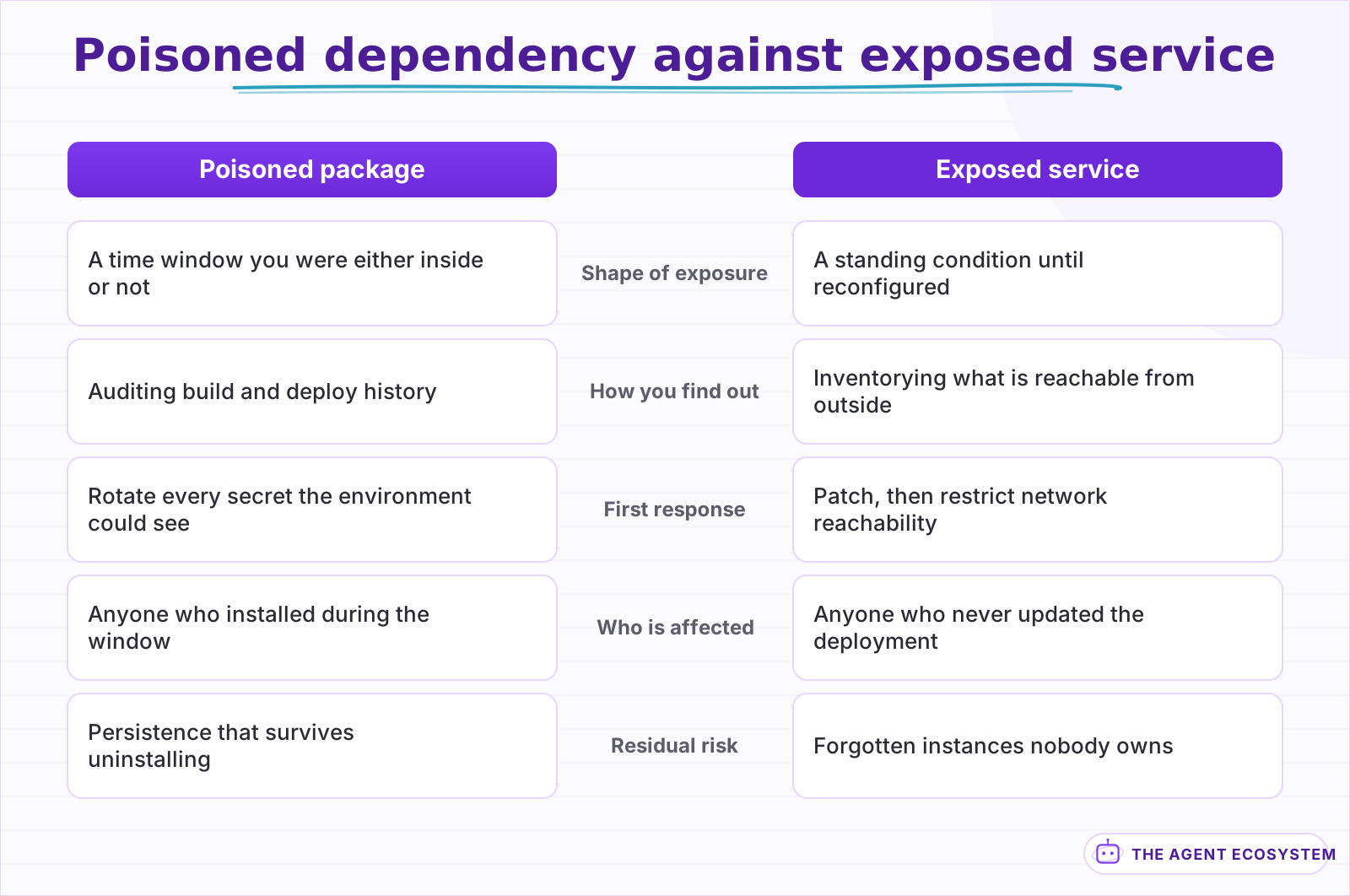 One is an event with a window. The other is a condition that persists until somebody changes it.
Both also share a property that makes detection hard. Neither produced obviously anomalous behaviour: a credential-harvesting import looks like an import, and a request to a login endpoint looks like a login. Egress monitoring catches the first only if you know what normal egress looks like, which most teams do not for a service that legitimately talks to several model providers.
What actually reduces the blast radius?#
Assuming compromise and limiting what it can reach. Pinning versions and scanning dependencies help at the margin, but the durable wins are narrower credentials, network isolation for anything self-hosted, and a secret rotation process you have actually rehearsed rather than merely written down somewhere.
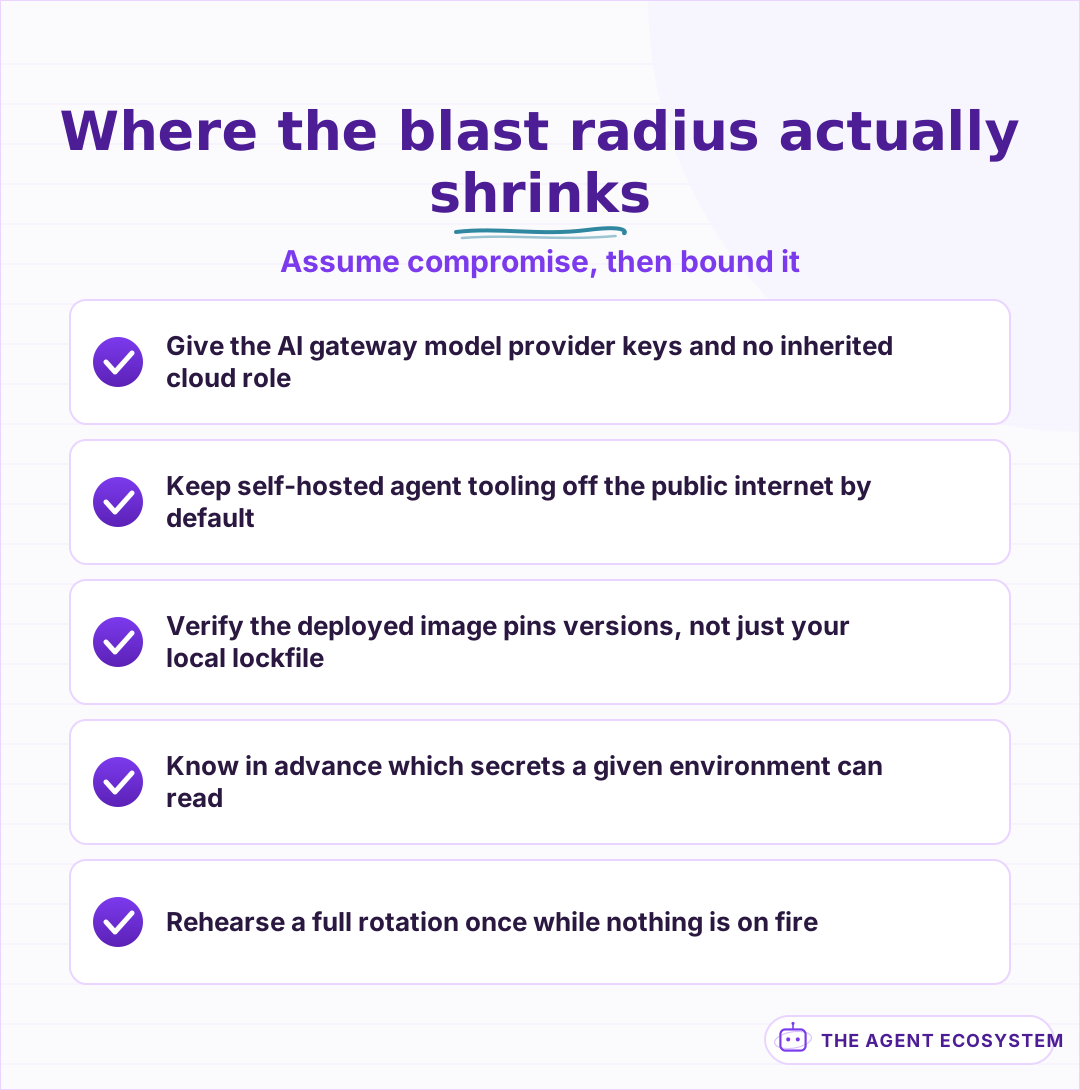 Scanning finds known bad versions. These 5 limit what an unknown one can do.
Take credential scope first, because it is the highest-leverage and the least done. An AI gateway usually needs model provider keys and nothing else, yet it frequently runs with a cloud role inherited from whatever deployed it. Splitting those apart converts "attacker owns the account" into "attacker owns some model spend", which is a bad afternoon rather than a company-wide incident. The same reasoning drives the permission boundaries in agent sandboxing.
Network isolation is the direct answer to the Langflow shape. An endpoint that hands out superuser tokens to any caller is catastrophic on an internet-reachable host and merely embarrassing on one that only accepts connections from a private subnet. Nothing about a visual agent builder requires public exposure, and the same principle applies to any self-hosted automation service you run alongside it.
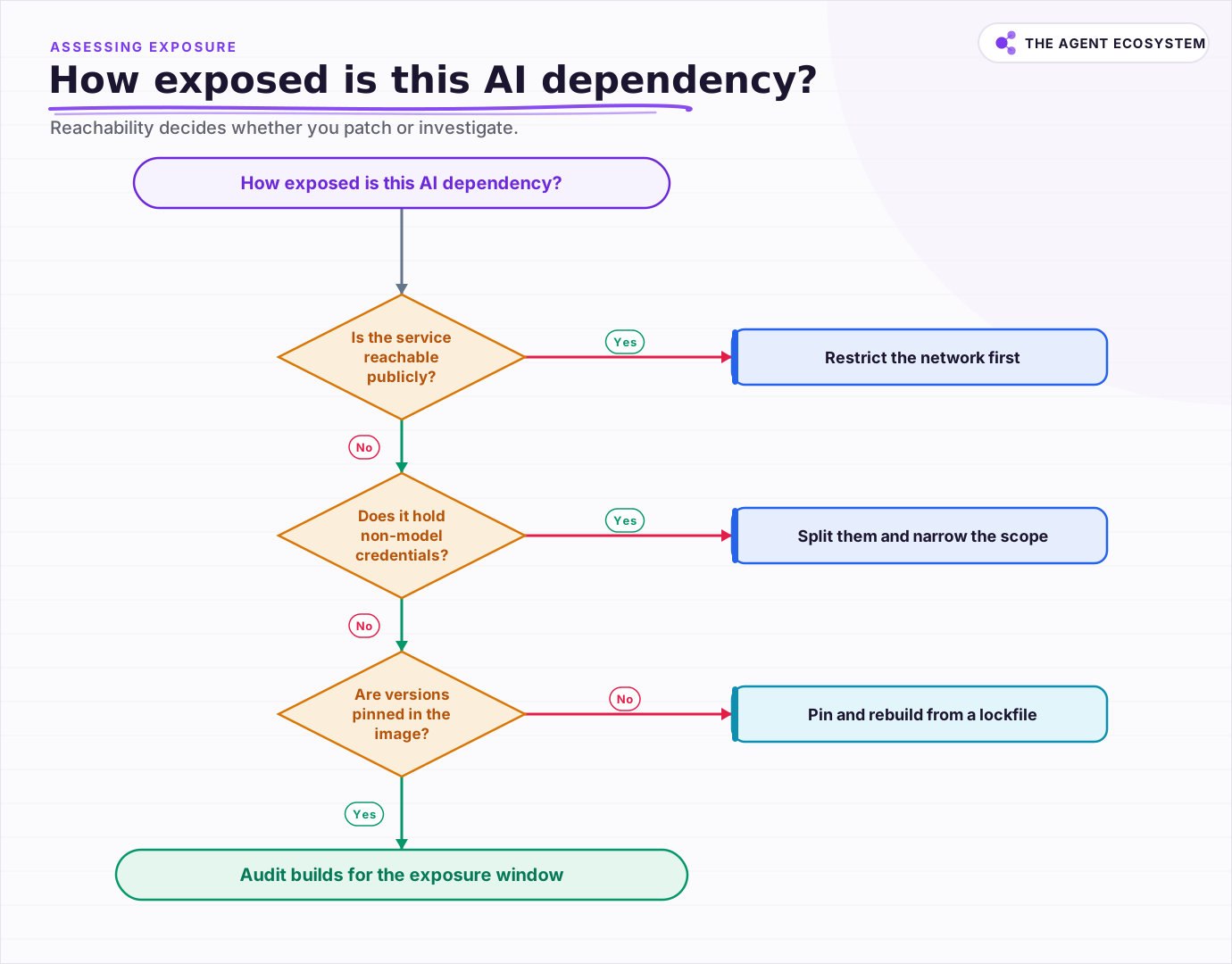 The first question is reachability, because it decides whether you are patching or investigating.
Rotation deserves more respect than it gets. Every credible response to a package compromise begins with "rotate everything the environment could see", and teams discover during the incident that they do not know what that set is or how long rotating it takes. Knowing both, in advance, converts the worst day into a long one.
The uncomfortable summary is that none of this is AI-specific. It is ordinary supply-chain and deployment hygiene, applied to a category of software that got adopted faster than it got reviewed. The novelty is not the attack. It is that we handed a new class of tooling the most sensitive credentials we have, on the strength of a demo, and then left it running.
Frequently asked questions
What made the LiteLLM package compromise dangerous?
How do I know whether I installed a compromised version?
What was CVE-2026-9198 in Langflow?
Is this the same problem as prompt injection?
What is the single highest-leverage fix?
Written by

Muhammad Qasim Hammad is an AI agent and automation expert and the founder of Cart Gaze LLC (cartgaze.com). He builds product for the love of it: when an idea lands, a working prototype is usually running within hours, built with the same AI agents and automations he sells. He puts his own output at roughly 20× what it was before agents, and the Agentic OS behind this site is the working proof, documented in public with the tools he actually ran and what they really cost.
AI & Automation Services
Want a pipeline like this running in your business?
I'm Qasim — I design and ship AI agents and n8n automations for solo operators and small teams. Tell me what's eating your team's week, and I'll scope a fix.
Related reading
Blast Radius: Sandboxing and Permissions for AI Agents
An AI agent with real tool access is only as safe as its weakest credential and its execution boundary. This post covers the containment half of agent security: scoping every tool to its own narrow credential instead of one shared key, and running anything that executes code

MCP Server Security: Tool Poisoning, Rug Pulls, and Confused Deputies
Installing a community MCP server means running someone else's code with your credentials, and nothing resembling an app-store review checks it first. Here is what the research and the official spec actually document about tool poisoning, supply-chain risk, confused-deputy
Stop Prompt Injection in n8n AI Agents: Practical Defenses
Your n8n agent reads emails, scraped pages, and RAG chunks nobody on your side wrote, and a planted instruction can hijack it. Here is the layered prompt injection defense, mapped to OWASP LLM01 and to nodes you can actually toggle.
AI Agent Guardrails: Stop Your n8n Agent From Going Off the Rails
An AI agent is a language model with hands. Without guardrails it can follow a malicious instruction, leak data, loop until your bill spikes, or return output the next node cannot parse. This guide maps the five ways an n8n agent breaks to the exact control that stops each.
Giving AI Agents Web Access: Search Tools, Grounding, and Cost
A search tool turns post-cutoff questions from hallucination bait into retrievable facts, and it brings 3 problems with it: choosing sources, paying for pages that become tokens, and reading text that may be aimed at the model rather than the user. This is the wiring guide: the
n8n vs LangChain (and Make): I Built the Same AI Agent in All Three
I built the exact same order-status AI agent in n8n, Make.com, and LangChain, then compared setup effort, cost model, portability, and who each platform actually suits.