Agent Handoffs and Supervisor Patterns: Who Decides What Runs Next
A handoff is just a tool call. What that means for supervisors, swarms, context filtering, and the coordination bill.
AI-drafted, reviewed by Muhammad Qasim Hammad on October 19, 2026. See our AI disclosure.
Table of contents
The moment you split one agent into several, you inherit a question single-agent systems never ask: who decides what runs next? Every multi-agent framework answers it the same way underneath, and the answer is less exotic than the architecture diagrams suggest. A handoff is a tool call. The model does not "pass control" through some special channel; it calls a tool named something like transfer_to_refund_agent, and your runtime interprets that call as a routing decision.
What is a handoff, mechanically?#
It is a tool the model can call whose effect is routing rather than computation. The model sees a normal function in its tool list, decides the request belongs elsewhere, and calls it. The runtime intercepts that call and starts a different agent instead of returning a result to the same one.
That framing explains most handoff bugs. If an agent never hands off when it should, the problem is usually the tool description, exactly as it would be for any other underused tool. If it hands off constantly, the description is too inviting or the agent's own instructions are too narrow. You are debugging tool selection, not some separate coordination layer, which is why the reliability work on structured outputs and tool calling applies here directly.
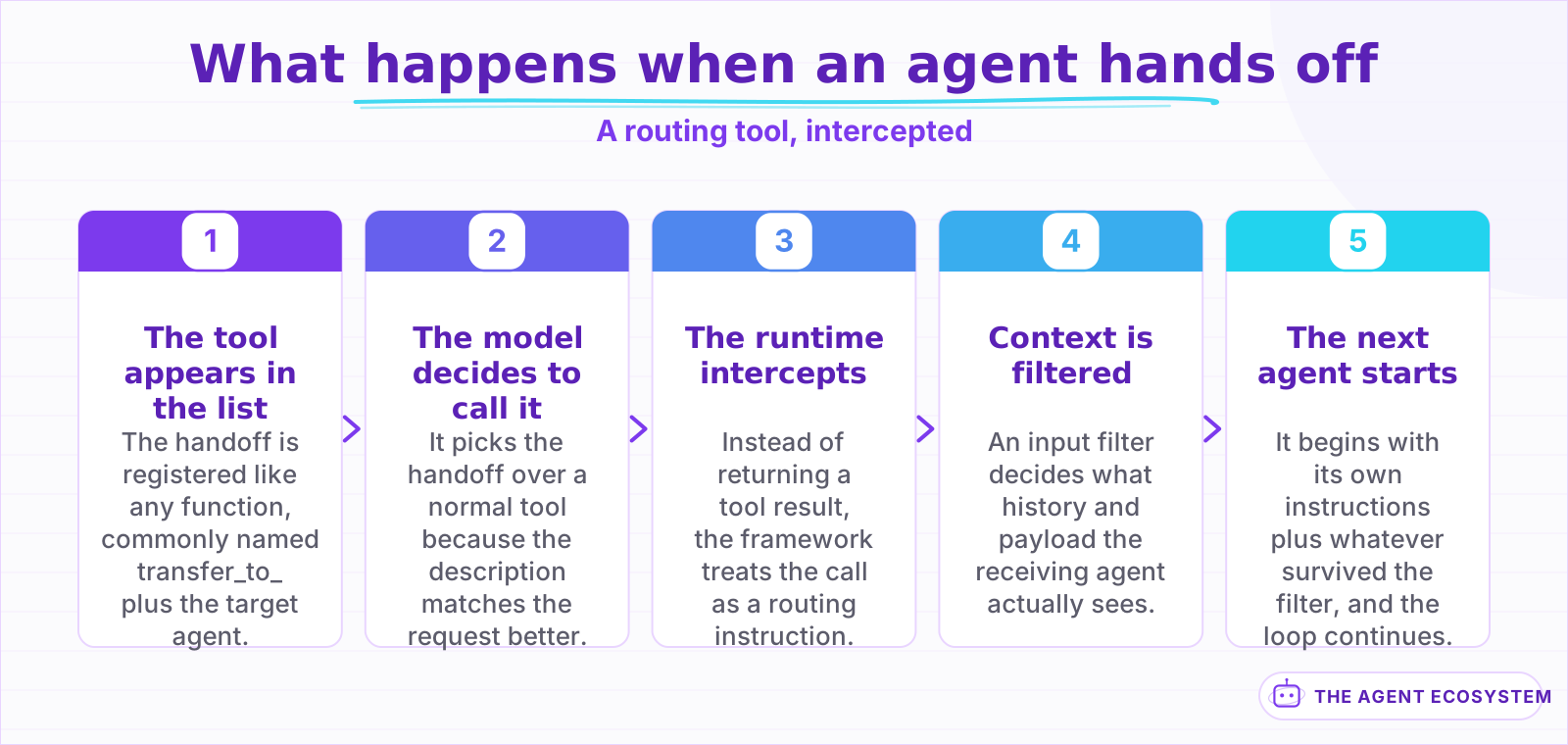 Nothing here is a special coordination channel. It is tool selection plus an interception in your runtime.
LangGraph reaches the same place from a different direction. It models agents as graph nodes, and a node returns a Command object that combines control flow and a state update in one move. A handoff there specifies a destination, meaning the agent to navigate to, and a payload, meaning the information travelling with it. Different vocabulary, same 2 ingredients: where next, and with what.
Supervisor or swarm: who decides where control goes?#
Two shapes dominate. In a supervisor system, one coordinating agent holds the routing decisions and workers report back to it. In a swarm, every agent can hand off directly to any other, so routing is distributed. The difference is whether control returns to a center after each step.
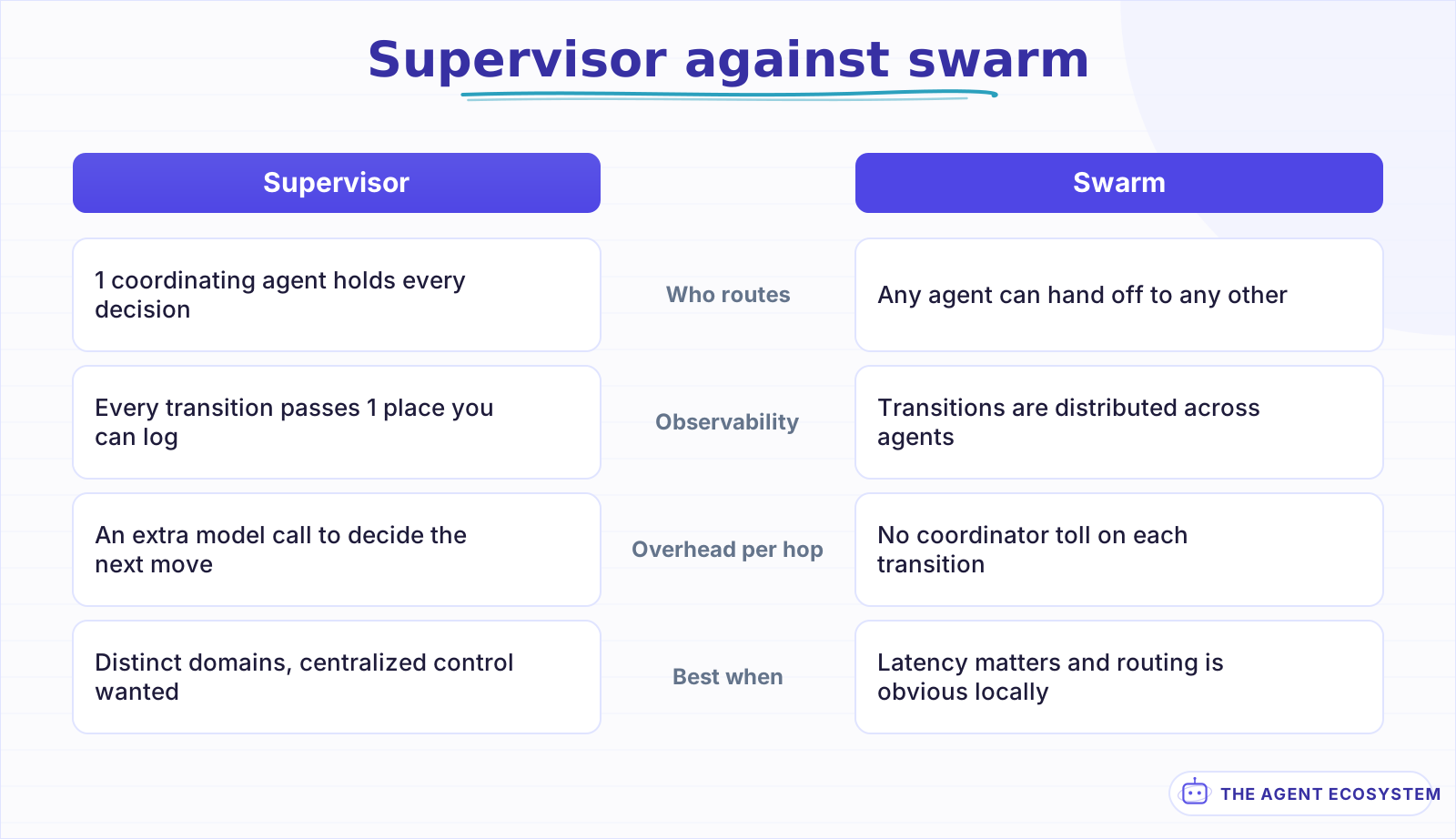 The single variable is whether control returns to a center after each step. Everything else follows from it.
LangGraph documents both, and ships them as separate libraries: a supervisor implementation where the supervisor hands off to individual agents, and a swarm implementation where an individual agent can hand off to other agents. Its guidance for reaching for the supervisor pattern is concrete: multiple distinct domains such as calendar, email, CRM, or database, each with multiple tools or complex logic, where you want centralized workflow control and sub-agents do not need to converse with users directly.
Supervisors are easier to reason about and easier to instrument, because every transition passes through 1 place you can log. They also become a bottleneck, since each hop costs an extra model call from the supervisor to decide the next move. Swarms remove that toll and remove the single point of observation with it, which tends to be a bad trade until you have a specific latency reason to make it.
For deeper trees, LangGraph notes you can build multi-level hierarchies by creating a supervisor that manages other supervisors. That works, and it multiplies the coordination overhead at every level, so it earns its place only when the domains genuinely nest.
There is a third shape worth naming because it is often mislabelled as multi-agent: the subagent-as-tool pattern. Here the "worker" never receives control at all. The coordinating agent calls it like any other function, gets a result back, and keeps the conversation. Nothing is handed off, so there is no routing decision to debug and no shared history to filter. It is strictly simpler, and it covers a surprising share of what teams build supervisors for. The distinction that matters is whether the second agent needs to keep talking to the user or make further routing decisions of its own. If it just needs to answer a question and return, it is a tool, and calling it an agent adds vocabulary rather than capability.
Choosing between these is mostly a question of who owns the conversation. A supervisor owns it and lends it out. A swarm passes ownership around. A tool-shaped subagent never gets it. Ranked by how hard they are to reason about when something goes wrong, that ordering runs in reverse.
What actually gets passed when control moves?#
Whatever you choose to pass, which is the part teams get wrong. By default a receiving agent may inherit the entire conversation so far, including tool outputs and reasoning that have nothing to do with its job. Filtering that inheritance is an explicit decision, not a framework default you can ignore.
The OpenAI SDK exposes 3 controls for exactly this. An input_filter receives a HandoffInputData object holding the conversation history and generated items, and returns what the next agent should actually see. An input_type defines a schema for the handoff tool call's arguments, so the handing-off agent must state its payload explicitly. An on_handoff callback fires when the handoff triggers, useful for fetching data or logging. Where both a per-handoff filter and a run-level filter exist, the SDK documents the per-handoff one taking precedence.
| Concern | What happens by default | The lever |
|---|---|---|
| History inheritance | Receiving agent sees prior turns and tool output | input_filter over HandoffInputData |
| Payload discipline | Intent is implied by conversation, not stated | input_type schema on the handoff tool |
| Side effects at the boundary | Nothing fires between agents | on_handoff callback |
| Filter conflicts | Ambiguous which filter wins | Per-handoff filter overrides run-level |
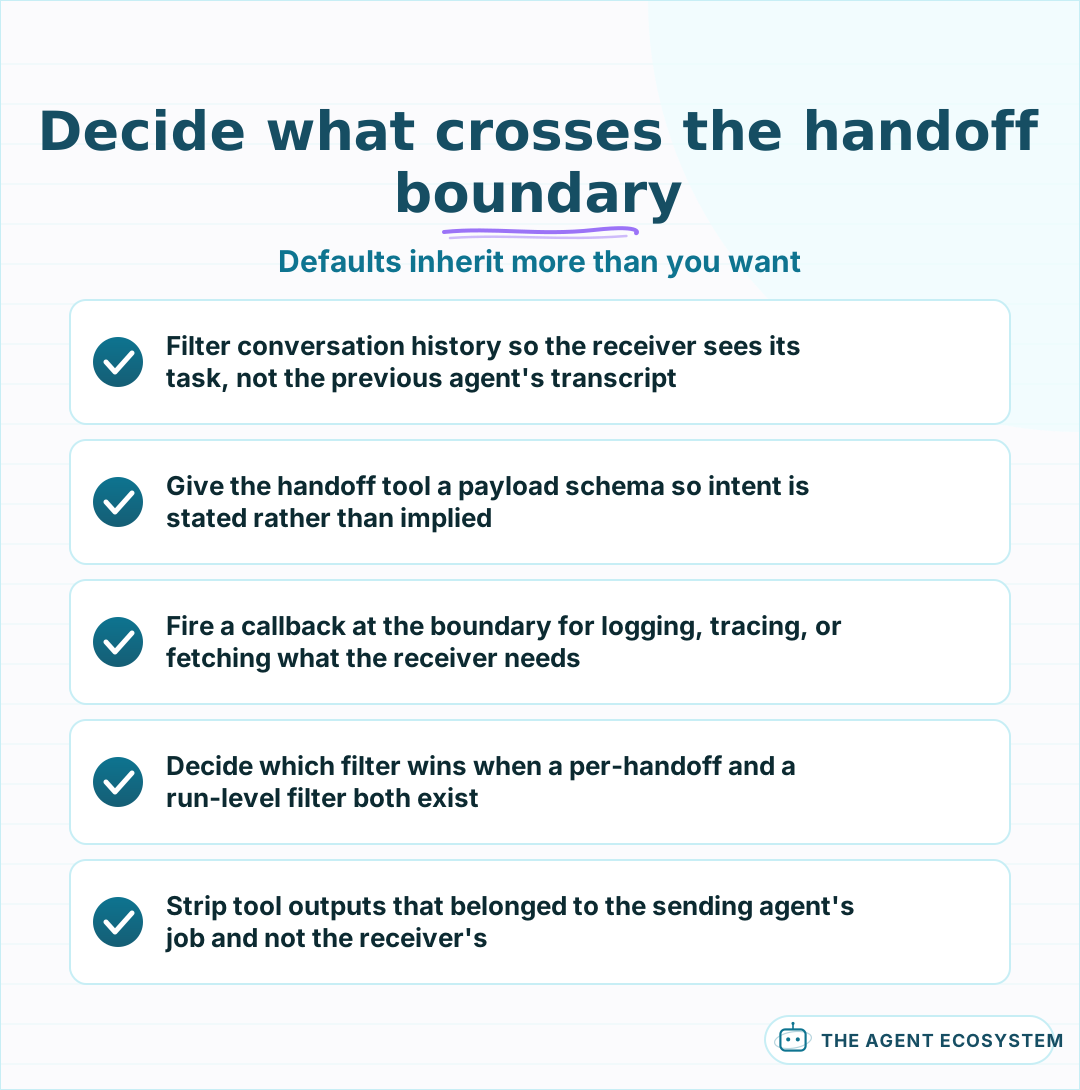 Each item is a default worth overriding. Inheriting everything is the expensive path.
Unfiltered inheritance is expensive twice over. It costs tokens on every hop, and it degrades the receiving agent's focus by burying its actual instruction under someone else's transcript. That is the same pressure described in context engineering for agents, arriving at a specific architectural seam where you have a clean place to act on it.
What does the coordination actually cost?#
Roughly an order of magnitude in tokens. Anthropic reports that agents typically use about 4 times more tokens than chat interactions, and that multi-agent systems use about 15 times more tokens than chats. That multiple is the real budget question behind any topology decision.
The same write-up is where the strongest published result for the pattern comes from. Anthropic describes an orchestrator-worker system in which a lead agent coordinates while specialized subagents work in parallel, and reports that a system with Claude Opus 4 as lead and Claude Sonnet 4 subagents outperformed single-agent Claude Opus 4 by 90.2% on their internal research evaluation. Source
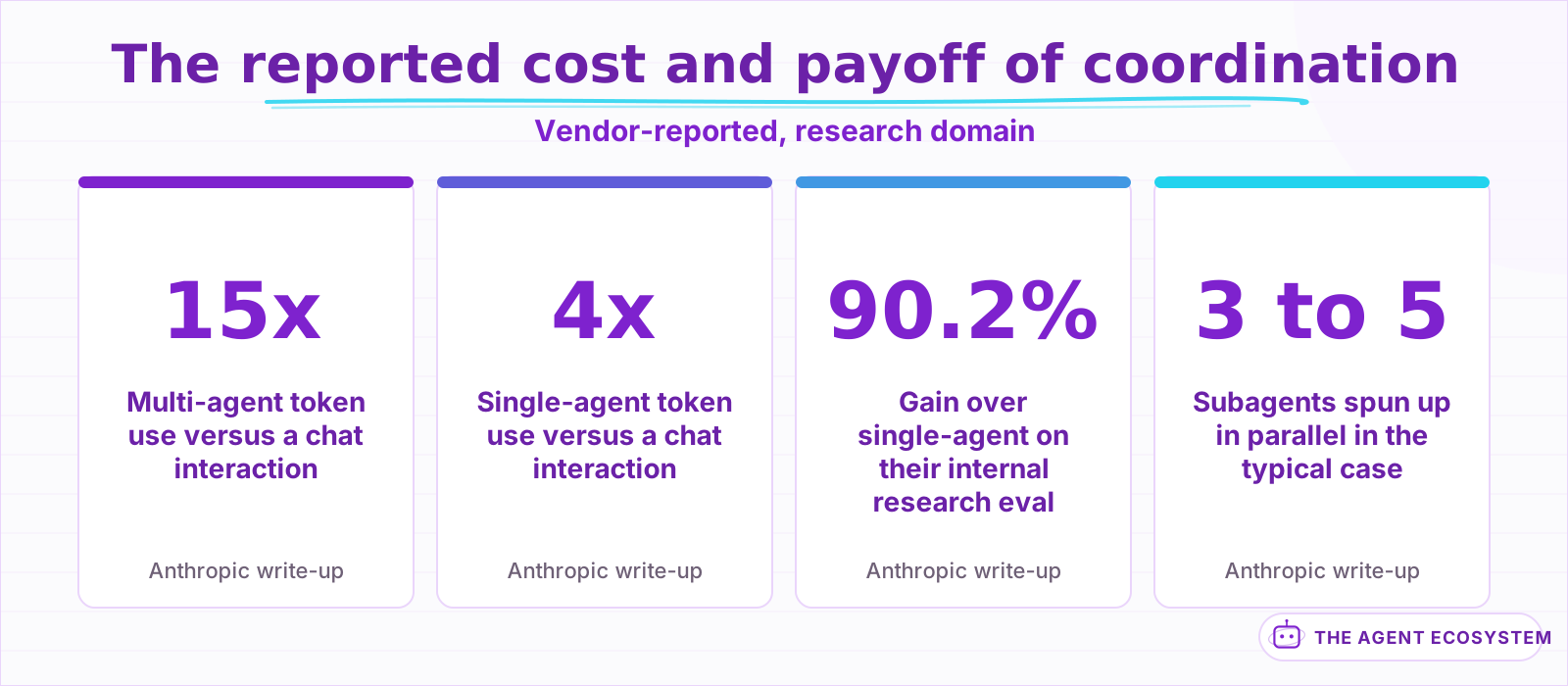 All 4 figures come from Anthropic's own write-up. The gain is domain-specific; the overhead is structural.
Both numbers deserve to be read together, and read carefully. This is a vendor evaluating its own system on its own internal benchmark, in the research-and-search domain where parallel exploration is unusually well suited to being split up. A 90.2% gain does not transfer automatically to a customer-support router or a data-entry pipeline. The 15 times token figure, on the other hand, transfers to almost everything, because coordination overhead is structural rather than domain-specific.
How many agents should a task get?#
Fewer than the diagram tempts you to draw. Anthropic's own scaling guidance is that simple fact-finding needs just 1 agent, direct comparisons might need 2 to 4 subagents, and complex research might use more than 10, with its typical case spinning up 3 to 5 in parallel.
That is a useful calibration because it anchors on the shape of the work rather than the number of tools. A common mistake is giving every tool its own agent, which produces a system where most hops exist to move a request past an agent that had nothing to contribute. Agents should map to domains that need genuinely different instructions or different context, not to individual capabilities.
Parallelism is the one place where extra agents pay for themselves cleanly. When subtasks are independent, running them concurrently converts token spend into wall-clock savings. When subtasks are sequential, more agents just add hops, and you would often be better served by decomposing the task inside 1 long-horizon agent than by splitting it across several.
When is a single agent still the right answer?#
Whenever the work fits in 1 context window and does not branch into independent subtasks. Multi-agent systems buy parallelism and instruction isolation. If a task needs neither, the extra agents add token cost, latency, and failure modes while delivering coordination you were not short of.
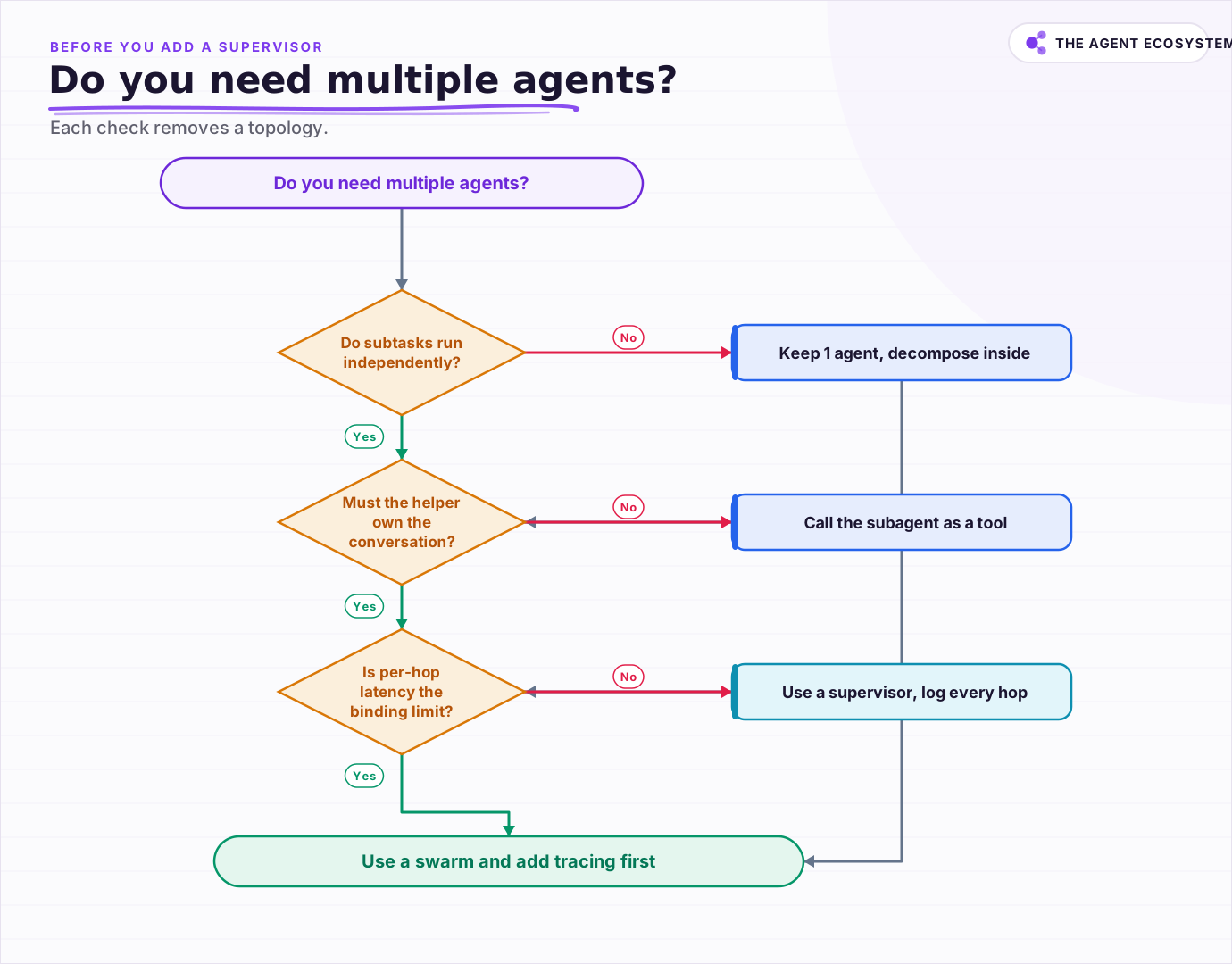 Each check removes a topology. Most systems stop before they reach the distributed end of the chart.
The honest default is to start with 1 agent and split only when you can name what the split fixes. Good reasons exist and they are specific: the instructions for 2 parts of the job genuinely conflict, subtasks are independent enough to run at the same time, or 1 stage needs a different model tier than another. Vague reasons, such as wanting the architecture to look modular, tend to produce systems that cost 15 times as much to do the same work.
It also helps to remember what the pattern does not fix. Splitting into agents does not make an unreliable tool call reliable, does not repair a retrieval layer that returns the wrong documents, and does not create durability, which is a property of the runtime you execute on rather than of your topology. Before adding a supervisor, it is worth confirming the single-agent version fails for a reason a supervisor would actually address, and instrumenting it with proper agent tracing is usually how you find out.
Frequently asked questions
What is a handoff in a multi-agent system?
What is the difference between a supervisor and a swarm?
Does the next agent see the whole conversation?
How much do multi-agent systems cost compared to one agent?
How many subagents should I use?
Sources
Primary references and vendor documentation used while drafting and reviewing this article.
Written by

Muhammad Qasim Hammad is an AI agent and automation expert and the founder of Cart Gaze LLC (cartgaze.com). He builds product for the love of it: when an idea lands, a working prototype is usually running within hours, built with the same AI agents and automations he sells. He puts his own output at roughly 20× what it was before agents, and the Agentic OS behind this site is the working proof, documented in public with the tools he actually ran and what they really cost.
AI & Automation Services
Want a pipeline like this running in your business?
I'm Qasim — I design and ship AI agents and n8n automations for solo operators and small teams. Tell me what's eating your team's week, and I'll scope a fix.
Related reading
What Is an AI Agent? A Plain-English Guide for Builders
An AI agent is a language model running in a loop that decides its own next action, not a chatbot and not a chain. Here is how the perceive-decide-act-observe loop works, how an agent differs from a chatbot, chain, and workflow, and a checklist for when you actually need one.

n8n Multi-Agent Orchestration: One Orchestrator, Many Sub-Agents (2026)
Your single n8n AI Agent has 10+ tools and keeps picking the wrong one. n8n multi-agent orchestration fixes this: one coordinator routes each job to a small, specialized sub-agent on the right model.
How to Build an AI Agent: The 80% That Survives Week Two
Most tutorials get you a working agent in ten minutes and skip what breaks it in week two. Sixteen lessons covering the loop, tool descriptions, memory, fallbacks, guardrails, evaluation, and the cost levers that decide your bill.
Context Engineering Isn't a Bigger Window. It's What You Leave Out.
Prompt engineering wrote the instructions. Context engineering decides what an agent actually sees on any given turn: which tools stay in scope, which documents survive the cut, and when a long run needs to compact its own history or spin off a sub-agent instead of dragging
ReAct vs Plan-and-Execute: AI Agent Reasoning Patterns
ReAct and Plan-and-Execute get blurred into one fuzzy idea, but they are two different agent control loops. ReAct decides one step at a time after each result; Plan-and-Execute writes the whole plan up front. Here is the honest split, the trade-offs, and a decision map.
Long AI Agent Runs Don't Fail on Context. They Fail on the Plan.
Long-horizon AI agents don't fail because they run out of context. Andon Labs' Vending-Bench found no correlation between failed runs and how full the context window was. Here is what the verified research says about why agents actually drift on long runs, and the