Your Agent Crashed at Hour 6. Here's Why It Didn't Restart From Zero.
What checkpointing and replay actually do when a long-running agent crashes, and when you do not need any of it.
AI-drafted, reviewed by Muhammad Qasim Hammad on August 25, 2026. See our AI disclosure.
Table of contents
- What Does Durable Execution Actually Mean for an AI Agent?
- Why Doesn't a Simple Retry Loop Already Solve This?
- What Are the 4 Building Blocks Every Durable Agent Needs?
- How Do Temporal, Inngest, DBOS, and Restate Actually Differ?
- Does Every AI Agent Actually Need This?
- What Does Durable Execution Actually Cost You?
- What Should You Actually Do Before You Reach for One?
Your agent has been working for 6 hours, called dozens of tools, and is one step from finishing a report a client is waiting on. Then a deploy restarts the process mid-task. Durable execution is the pattern that lets an agent resume from its last completed step instead of starting the entire run over.
What Does Durable Execution Actually Mean for an AI Agent?#
Durable execution is the pattern that checkpoints an AI agent's progress after every completed step, so a crash, a redeploy, or a rate limit only costs the current step, not the whole run. On restart, the runtime replays its recorded history, skips finished work, and resumes exactly where the process stopped.
This is the same idea distributed systems call event sourcing: instead of storing only the current state, the system stores the sequence of events that produced it, and can always reconstruct where things stand by replaying that sequence. Temporal, one of the older durable execution platforms, models this as a Workflow (the orchestration code) plus Activities (the actual LLM calls, tool calls, and API requests), with every step written to a recorded Event History; on restart, the workflow code replays against that history, and each Activity call short-circuits to its recorded result instead of actually re-executing. Source
This matters more for agent workloads than for a typical microservice retry, because a single step, one LLM call chained through a few tool calls, can cost real money and take real seconds to minutes, not milliseconds. Losing that step to a restart is not just wasted compute, it is a wasted API bill.
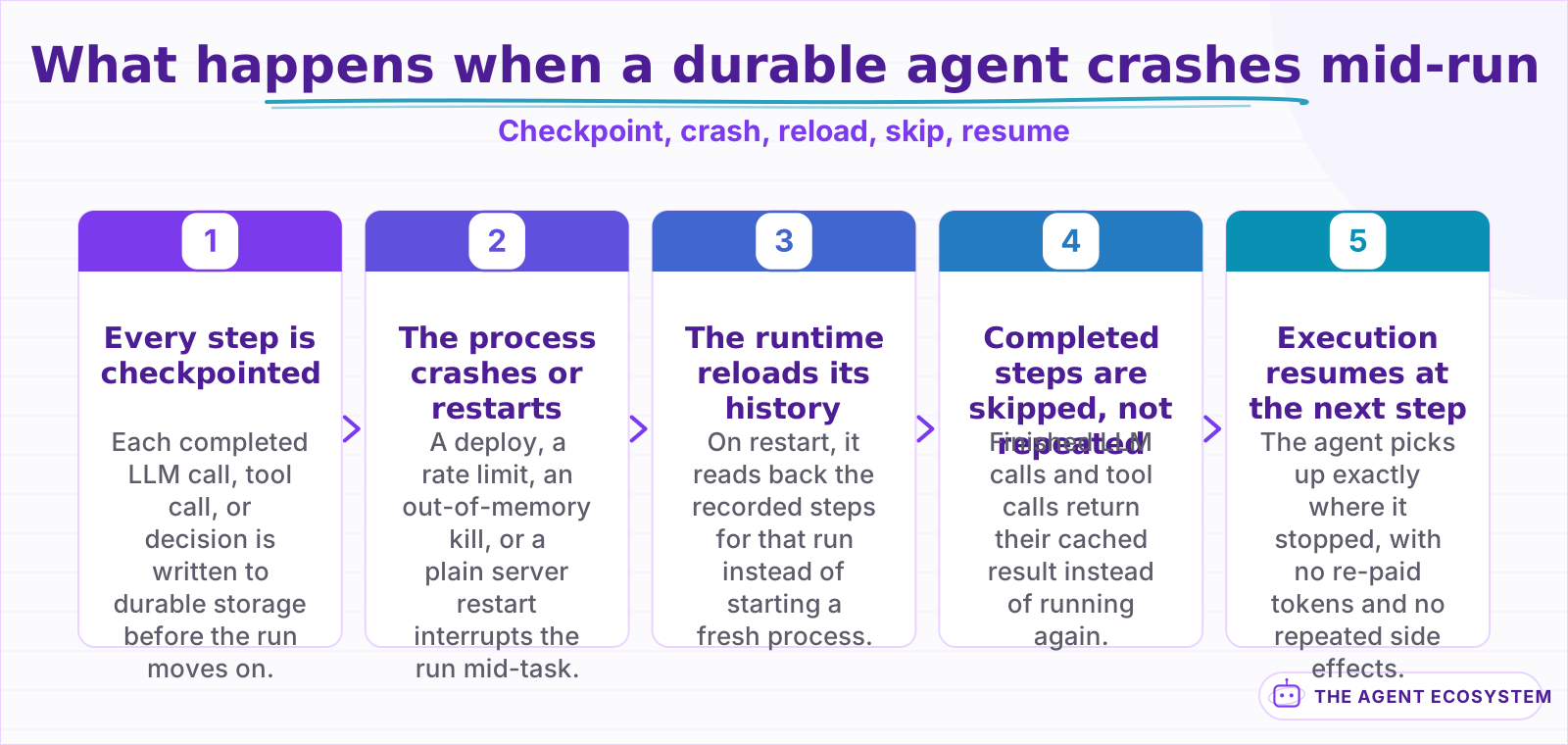 The runtime never re-runs a finished step; it reads the recorded result and moves on.
If you have not covered what an agent actually is first, our what is an AI agent primer is the foundation this post builds on. Everything below assumes an agent that calls tools and an LLM across more than one step, not a single request and response.
Why Doesn't a Simple Retry Loop Already Solve This?#
A plain retry loop that just re-runs a failed function from the top will call the same LLM prompts and repeat the same side effects it already finished before the crash. Durable execution instead persists the result of each completed step, so a retry replays the run's history and skips whatever already finished instead of doing it again.
Inngest makes the cost concrete: in its own February 2026 write-up, it frames the problem as doubling or tripling inference spend on every retry, and says its step-level caching means you pay for each LLM call exactly once, since a completed step returns its stored result instead of calling the model again. Source Under the hood this is usually at-least-once delivery paired with idempotent step caching, which behaves like exactly-once from the outside even though the underlying retry mechanism can technically fire more than once. If you already build in n8n, you have met a lighter version of both ends of this: Retry On Fail is the plain-retry-loop end, and a Wait node that survives a restart is a primitive durable step, not the full checkpoint-and-replay model.
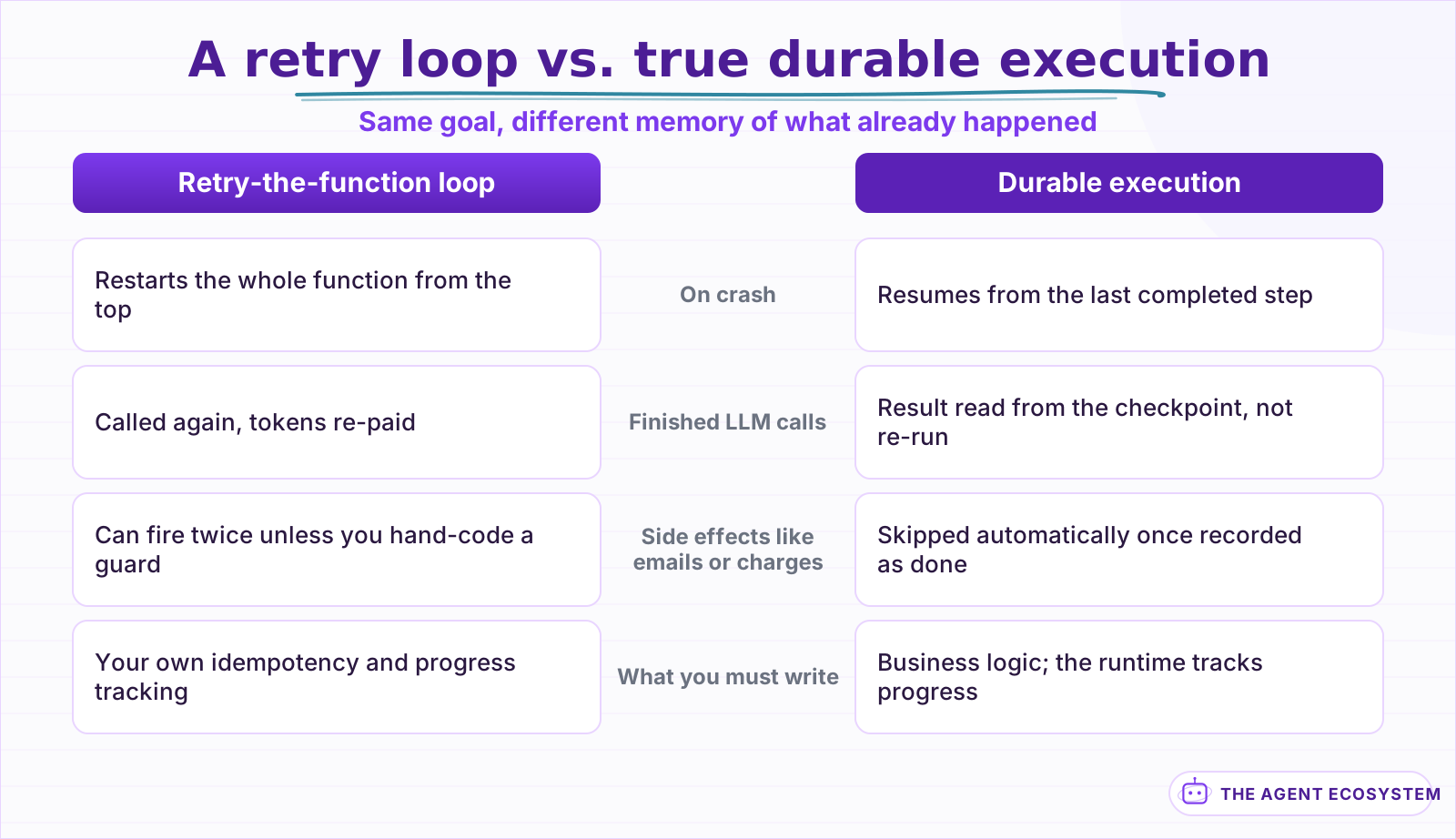 The difference is not whether it retries, it is whether it remembers what already finished.
The gap between the two only grows with run length. A retry that repeats 2 finished LLM calls after a crash is annoying. One that repeats 40 finished calls, several tool writes, and a payment confirmation is a production incident.
What Are the 4 Building Blocks Every Durable Agent Needs?#
Every durable agent runtime rests on 4 primitives: checkpointing state after each step, idempotent tool calls so a replay never double-charges or double-sends, durable waits that survive a restart instead of a process just sleeping, and a way to pause for a human approval that can resolve minutes or days later without burning compute.
Checkpointing is the baseline: every completed step, an LLM call's output, a tool's return value, a routing decision, gets written to durable storage before the run continues. Idempotency covers what checkpointing alone cannot: Restate's own documentation notes that LLM responses specifically must be recorded for replay because LLMs are non-deterministic, and the same discipline applies to any tool call with a side effect, a charge, an email, a database write. Source None of the 4 stand alone: a runtime that checkpoints but skips idempotency will happily replay a duplicate charge, and one that adds durable waits but no checkpointing still re-runs the reasoning that led up to the wait.
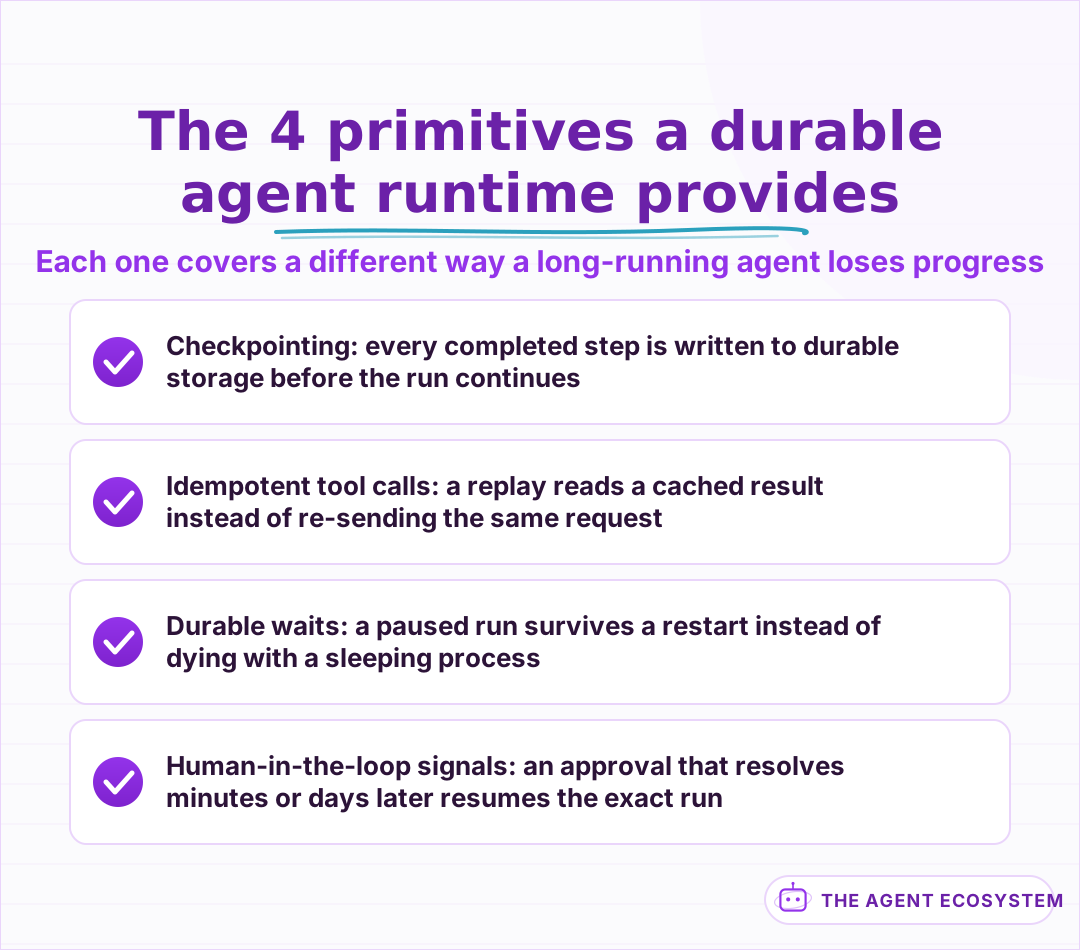 Miss one of these and a runtime only solves part of the crash-recovery problem.
Durable waits are the primitive that is easy to miss: a plain sleep call dies with the process, but a durable wait is a promise the runtime persists, so it survives a restart and resumes when the event or the timer fires. Restate's own framing of this is specific: an agent waiting on a human approval suspends without charging for the waiting time, whether that approval lands in minutes or days. Source That is also why human-in-the-loop belongs on this list as a first-class primitive rather than a footnote; Google's Agent Executor, announced May 21, 2026, lists resuming after exactly this kind of interruption as a core capability, not an add-on. Source
How Do Temporal, Inngest, DBOS, and Restate Actually Differ?#
Temporal replays an entire workflow function deterministically, so anything non-deterministic, like an LLM call, has to sit inside a separate Activity. Inngest instead memoizes each step's result independently and, by its own account, drops that determinism requirement. DBOS and Restate take a third path: a Postgres-backed library and a journal-based server, both wrapping your existing code rather than replacing it.
| Runtime | Core model | Hosting | Best fit |
|---|---|---|---|
| Temporal | Workflow plus Activity, replays a recorded Event History, strict workflow determinism | Self-hosted Temporal Server or Temporal Cloud | Complex multi-agent orchestration when you can invest in the workflow/activity split |
| Inngest | Step functions with per-step memoization, no orchestration-level determinism rule | Managed platform, deploys next to your existing serverless functions | The fastest path to durable steps without a new execution model |
| DBOS | Annotated functions checkpoint into Postgres, a library rather than a server | Runs inside your own app, needs only a Postgres database | You already run Postgres and want durability with no new infrastructure |
| Restate | A per-invocation journal, replays and skips completed steps | Single binary, self-hosted or Restate Cloud | Wrapping an existing agent framework like the Vercel AI SDK or OpenAI Agents SDK |
| Azure Durable Task | SDK plus Durable Functions plus a Durable Task Scheduler, pairs with any agent framework | Azure Functions, or self-hosted | Already building on Azure Functions or Microsoft Agent Framework |
| AWS Step Functions | State machine with a native Bedrock AgentCore integration | Fully managed, serverless | Already orchestrating with Step Functions or running agents on Bedrock |
Microsoft's own documentation, updated May 2026, splits agentic workflow patterns into 2 categories worth borrowing regardless of which runtime you pick: deterministic workflows, where your code defines the control flow and the LLM is just one step in it, and agent-directed workflows, where the LLM itself decides which tool to call next. Source AWS took the integration route: as of March 2026, Step Functions added Bedrock AgentCore as a native integration alongside over 1,100 new API actions across 28 services, so a state machine can invoke an agent runtime with built-in retries. Source Google's entrant is the newest and least proven: Agent Executor, open-sourced the same month, adds checkpoint-based branching for testing alternate agent paths, but it is still in preview. None of the runtimes above are mutually exclusive with your existing stack; most are built to wrap whatever agent framework or LLM SDK you already call, not to replace it.
Does Every AI Agent Actually Need This?#
Most agents do not need a dedicated durable execution runtime. A chatbot that answers in a single request and response, or a script that finishes in under a minute, gets little from checkpointing beyond what a basic try/except retry already covers. The signals that actually justify it are long wall-clock runs, expensive steps, and waits that outlive a single process.
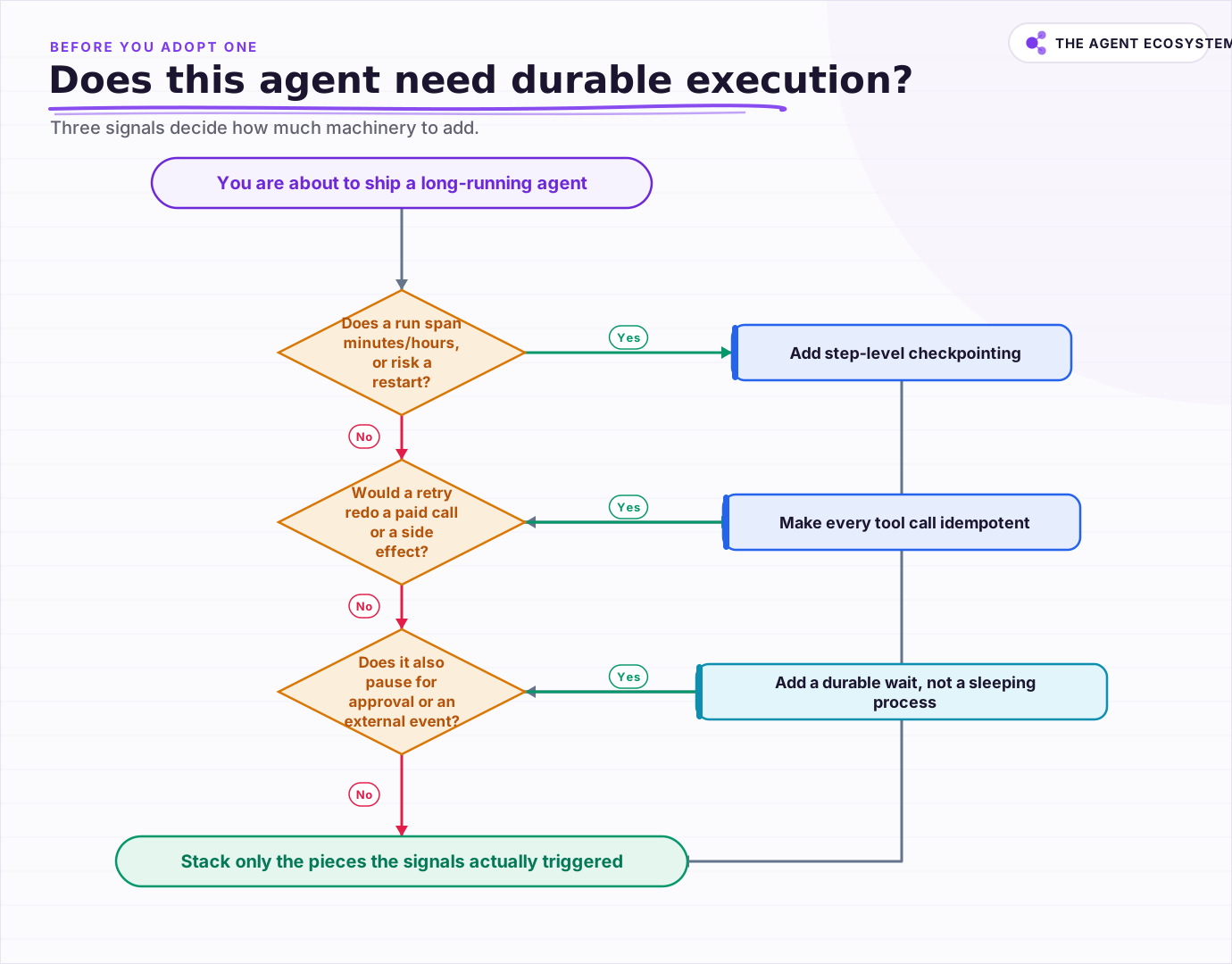 Three cumulative signals decide how much durability machinery an agent actually needs.
Long-horizon agents are exactly the shape of workload where this stops being optional. If a run is already built around planning and re-planning across dozens of sub-goals, the crash-and-restart problem compounds with every extra hour on the clock; our guide to breaking a long-horizon task into sub-goals covers the planning side of that same problem. The 3 questions in the diagram above are cumulative, not exclusive: an agent can trip 1, 2, or 3 of them, and each one adds a specific piece of machinery instead of a single blanket verdict.
What Does Durable Execution Actually Cost You?#
Durable execution is not free. You take on a new mental model where some code must be deterministic or step-scoped, a journal or event history to debug instead of a normal stack trace, version drift risk when you change code mid-flight on a long-running instance, and either a managed platform's bill or the operational weight of running one yourself.
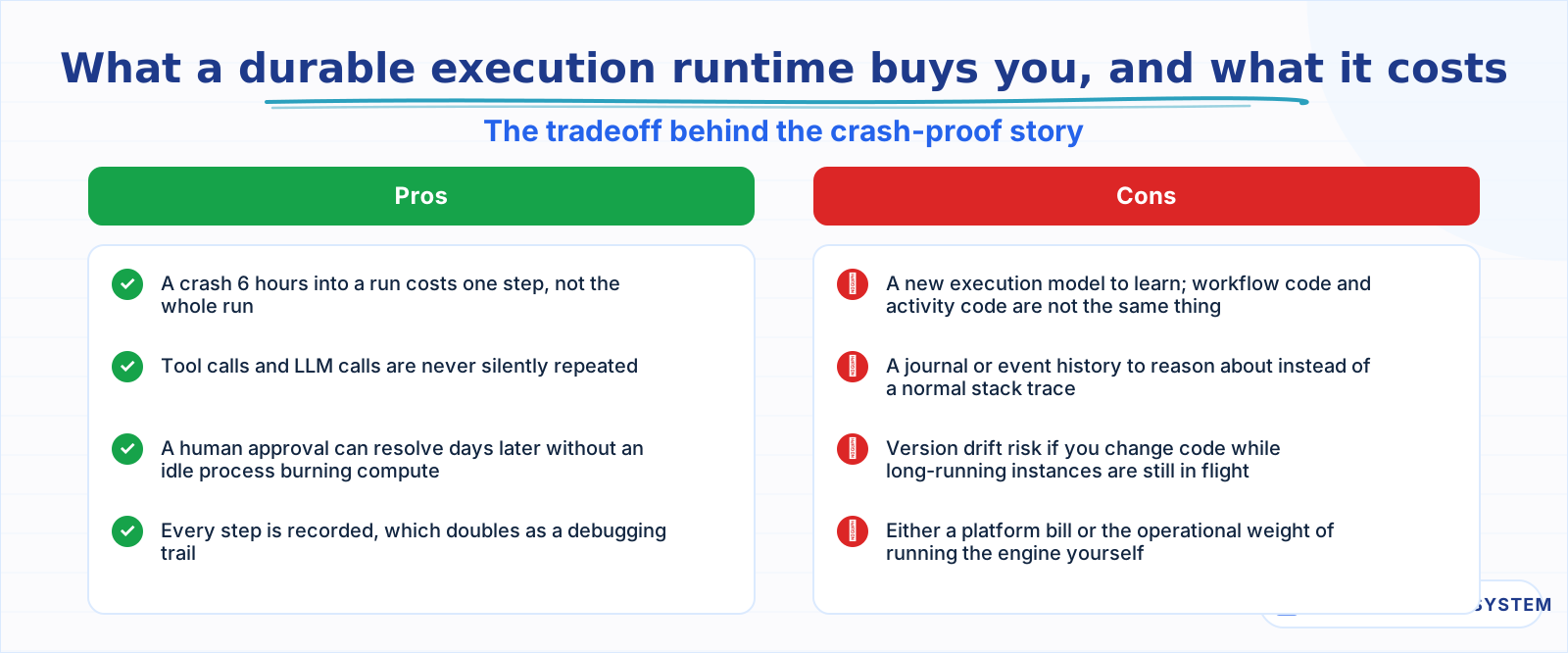 None of this is free; it trades a rebuild-from-scratch risk for a new operational surface.
Version drift is the sharpest edge of the 4. A workflow that has been running for days can outlive the code that started it; if you deploy a change to the logic mid-flight, a naive replay can diverge from the recorded history because the code path no longer matches what was recorded. Every mature durable execution platform ships some form of versioning to manage this, and it is worth reading before your first production deploy, not after a replay failure teaches you the hard way. None of this is a reason to avoid durable execution once the signals in the checklist above are real; it is a reason to treat the runtime as infrastructure you commit to, not a library you casually swap out later.
What Should You Actually Do Before You Reach for One?#
Start by writing down your agent's failure mode: what breaks today, how often, and what it costs when it does. If nothing has crashed in production yet, a plain retry with idempotent tool calls covers you. If a run already died 6 hours in and re-paid for every finished step, that cost is your business case for a runtime.
Pick the smallest tool that matches the actual failure: DBOS if you already run Postgres and want zero new infrastructure, Inngest if you want durable steps without adopting a new execution model, Restate if you are wrapping an existing agent framework, and Temporal, Azure Durable Task, or Step Functions with Bedrock AgentCore if you are already inside one of those ecosystems. If you want the debugging half of this story rather than the survival half, AI agent observability covers how to trace what a live run actually did, including the runs your new checkpointing just saved. Either way, write the decision down: what you checked, what you chose, and why, so the next person debugging a stuck run at 2 a.m. is not reverse-engineering your reasoning from scratch.
Frequently asked questions
What is durable execution for an AI agent?
Do I need Temporal or a similar runtime for a simple chatbot?
What is the difference between a retry loop and durable execution?
Can I build durable execution myself without adopting a dedicated runtime?
Which durable execution runtime should a solo builder start with?
Sources
Primary references and vendor documentation used while drafting and reviewing this article.
- Temporal: Durable Execution Meets AI
- Inngest: Durable Execution, the Key to Harnessing AI Agents in Production
- Inngest vs Temporal: Durable execution that developers love
- DBOS: What's the Use Case for Durable Execution?
- Restate: AI Agents Should Be Serverless and Durable
- Microsoft Learn: Durable Task for AI Agents
- AWS: Step Functions adds 28 new service integrations, including Amazon Bedrock AgentCore
- Google Cloud: Agent Executor, Google's Distributed Agent Runtime
Written by

Muhammad Qasim Hammad is an AI agent and automation expert and the founder of Cart Gaze LLC (cartgaze.com). He builds product for the love of it: when an idea lands, a working prototype is usually running within hours, built with the same AI agents and automations he sells. He puts his own output at roughly 20× what it was before agents, and the Agentic OS behind this site is the working proof, documented in public with the tools he actually ran and what they really cost.
AI & Automation Services
Want a pipeline like this running in your business?
I'm Qasim — I design and ship AI agents and n8n automations for solo operators and small teams. Tell me what's eating your team's week, and I'll scope a fix.
Related reading
Long AI Agent Runs Don't Fail on Context. They Fail on the Plan.
Long-horizon AI agents don't fail because they run out of context. Andon Labs' Vending-Bench found no correlation between failed runs and how full the context window was. Here is what the verified research says about why agents actually drift on long runs, and the

How to Build an AI Agent: The 80% That Survives Week Two
Most tutorials get you a working agent in ten minutes and skip what breaks it in week two. Sixteen lessons covering the loop, tool descriptions, memory, fallbacks, guardrails, evaluation, and the cost levers that decide your bill.
What Is an AI Agent? A Plain-English Guide for Builders
An AI agent is a language model running in a loop that decides its own next action, not a chatbot and not a chain. Here is how the perceive-decide-act-observe loop works, how an agent differs from a chatbot, chain, and workflow, and a checklist for when you actually need one.
Best AI Agent Framework in 2026: CrewAI vs LangGraph vs AutoGen vs n8n
There is no single best AI agent framework, only the best fit for your task and whether you build in code or no-code. This honest 2026 chooser puts CrewAI, LangGraph, AutoGen, and n8n on one table, flags that AutoGen is in maintenance mode, and ends with a decision tree plus the
AI Agent Observability: Tracing, Metrics, and Cost in Production
Your agent gave a wrong answer and you have no idea where it broke. Observability captures the run (every LLM call, tool call, prompt, and cost) so you can replay it and point at the exact failing step. Here are the three pillars, what to log per step, and when a dedicated tool
ReAct vs Plan-and-Execute: AI Agent Reasoning Patterns
ReAct and Plan-and-Execute get blurred into one fuzzy idea, but they are two different agent control loops. ReAct decides one step at a time after each result; Plan-and-Execute writes the whole plan up front. Here is the honest split, the trade-offs, and a decision map.