Intercept Prompts Before They Are Sent: A Real Policy Gate
Every governed prompt held for an allow or deny verdict from a server you run. Stronger than in-prompt guardrails, and blind in 3 specific ways.
AI-drafted, reviewed by Muhammad Qasim Hammad on November 15, 2026. See our AI disclosure.
Table of contents
Almost every AI guardrail people build asks the model to behave, when the enforceable move is to intercept prompts before they are sent. System prompts, refusal instructions, output filters: all of them run inside or after the thing they are trying to constrain. An inference hook sits in front of it. The request goes to your policy server first, and a denied prompt never reaches the model at all. That ordering is the entire point, and it is a different kind of control from anything you can write into a prompt.
What is an inference hook?#
A synchronous policy check between the user and the model. When someone submits a prompt, the platform posts the conversation transcript to an HTTPS service your organisation runs, waits for an allow or deny verdict, and only then lets inference begin. A denied request never reaches the model.
The verdict itself is deliberately small. An allow is {"action": "allow"}, and a deny carries a deny_reason that becomes part of what the user sees. The blocked message the user reads is assembled from 2 pieces: your per-request reason, followed by a standing message your administrators configure, typically naming who to contact for an exception. If nobody configured one, a built-in default points the user at their administrators.
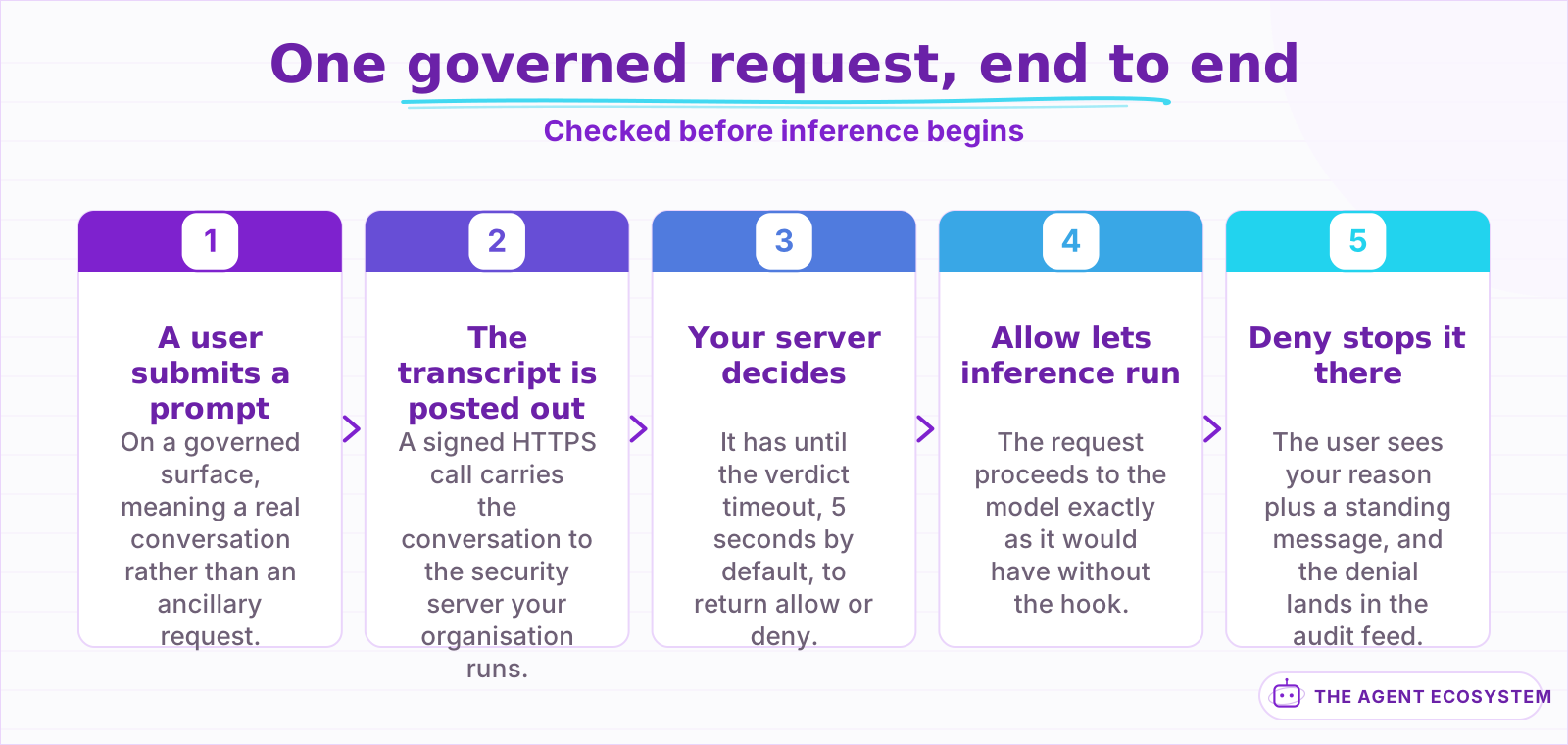 The model is not consulted about the verdict. That is what makes this different from a guardrail.
Requests are signed under the Standard Webhooks specification once your organisation generates a signing secret, so the receiving server can confirm the call genuinely came from the platform rather than from anyone who discovered the URL. That matters more than usual here, because this endpoint receives complete conversation transcripts.
Two structural details shape what you can build on it. There is currently 1 hook event, prompt, which fires once per governed inference request, with response-side enforcement described as planned rather than shipped. And the hook fires on returning tool results as well as on the incoming prompt, so an agent that pulls data mid-conversation gets that data inspected too, which is the more interesting half for anyone running agents.
What does your security server actually see?#
Roughly what the user sees, and deliberately no more. Transcript text, tool calls and their results, and text extracted from attachments all arrive. Raw file and image bytes, system prompts, and internal platform context never do, which bounds both your visibility and your liability.
| Sent to your server | Never sent |
|---|---|
| Transcript text of the conversation | Raw file and image bytes |
| Tool calls and the results they return | System prompts |
| Text extracted from attachments | Platform-internal context |
| Attachment metadata | Tool definitions |
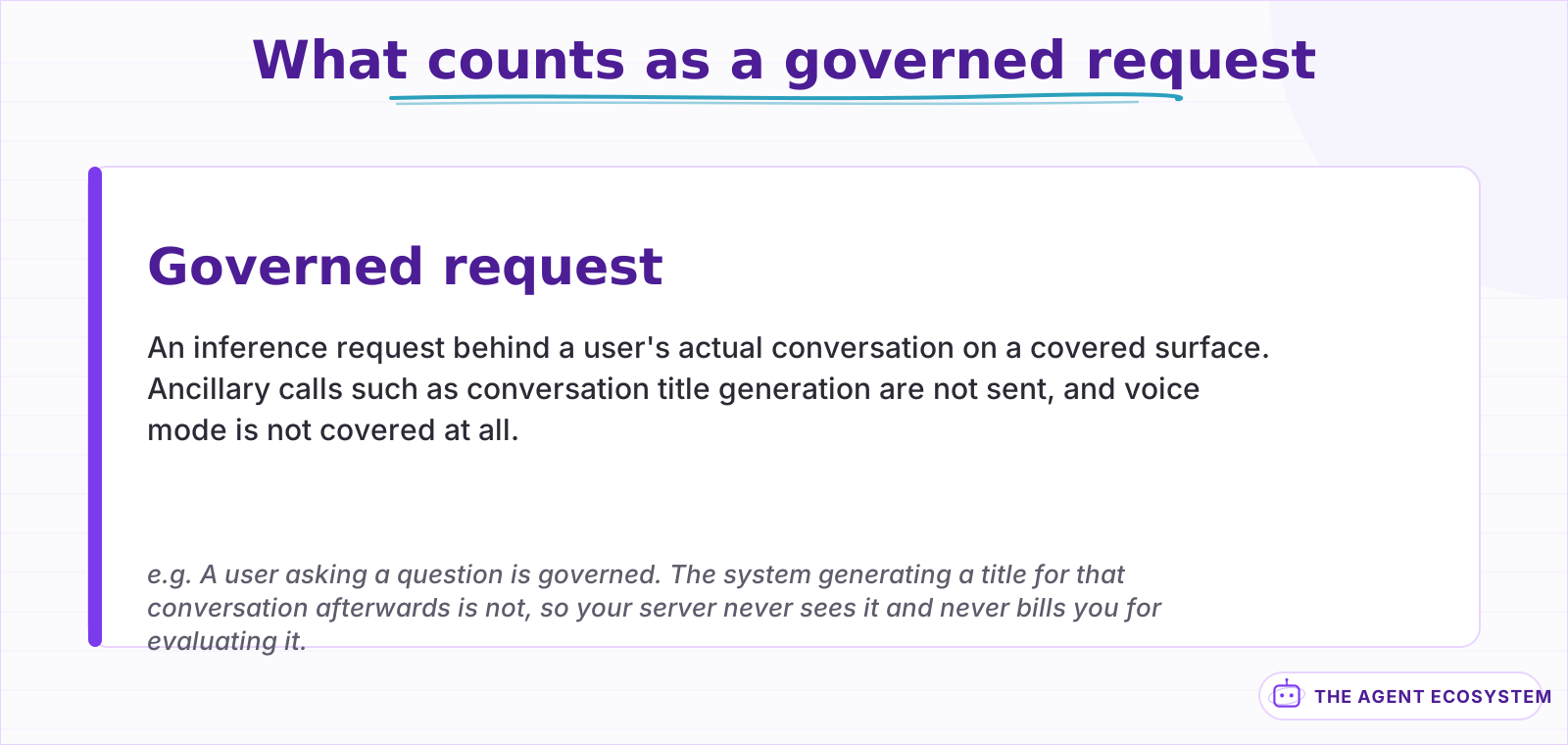 The scope is narrower than every request, which keeps volume proportional to real usage.
The exclusions are as informative as the inclusions. Not receiving system prompts or tool definitions means your policy server cannot make decisions based on how the assistant was configured, only on what is being said. And ancillary requests, such as generating a conversation title, are never sent, which keeps the volume proportional to real usage rather than to interface chrome.
There is a design consequence in that exclusion list worth drawing out. Because the hook sees the conversation but not the configuration, 2 organisations running very different assistants send structurally identical payloads. That makes the security server portable across deployments and, less conveniently, means a policy cannot depend on which assistant was involved. Any such distinction has to be carried in the transcript or inferred, neither of which is satisfying.
The most common deployment is data loss prevention: forward the transcript to a scanner and deny anything carrying regulated material. But the same shape supports quieter uses. A server that archives every transcript and always returns allow is a push-based alternative to polling an audit API, and one that records without blocking is straightforward prompt telemetry. Policy engines are the fourth case, enforcing rules like model allowlists or project-scoped restrictions that have nothing to do with content at all.
What happens when your server is down?#
Whatever you configured, which is the most consequential setting in the feature. If your endpoint is unreachable, errors, or misses the verdict timeout, the organisation's failure handling decides: block the request, or let it through uninspected. One of those is a security control and the other is a suggestion.
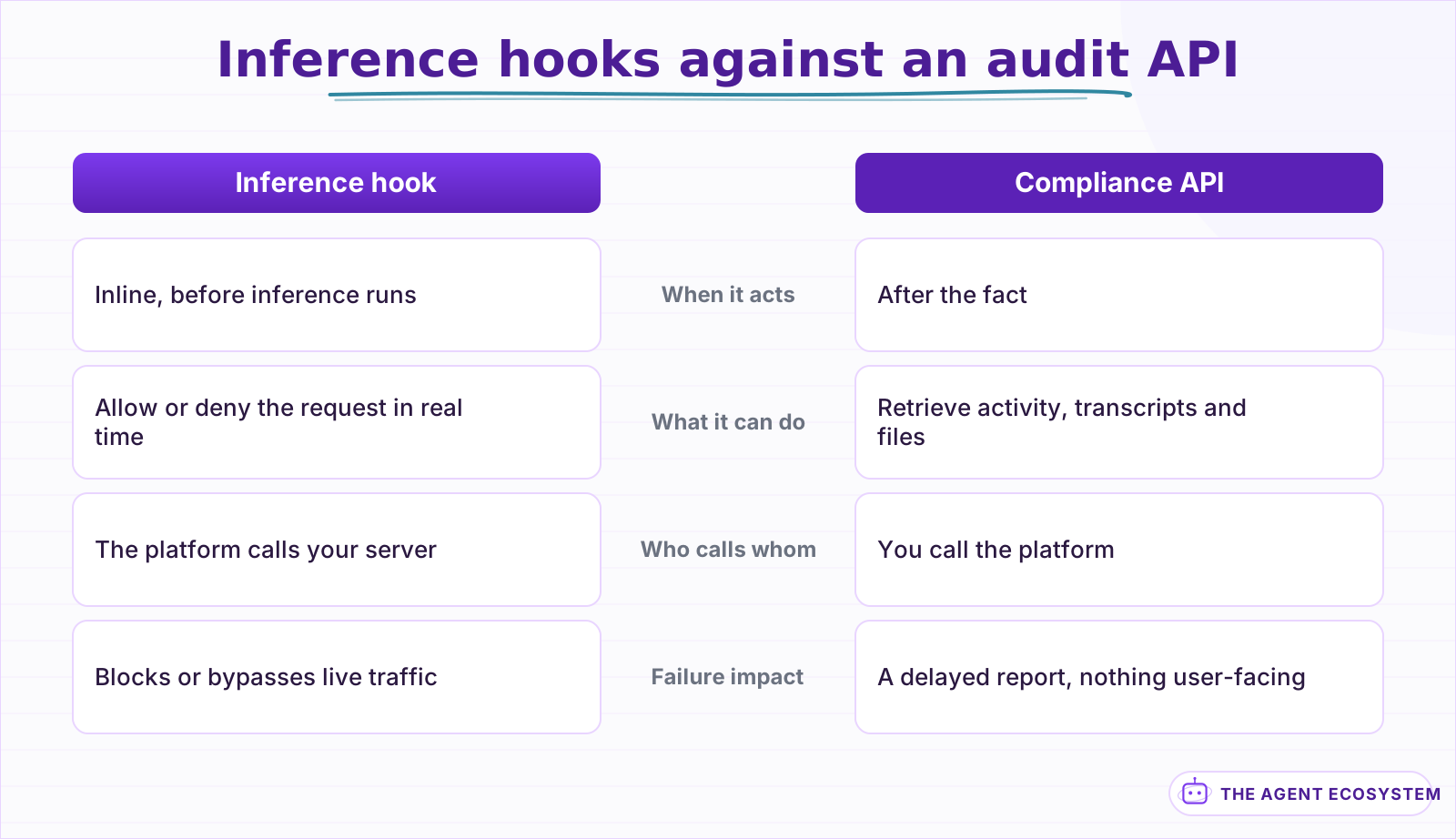 One prevents, the other explains. Most compliance programmes end up wanting both.
This is worth dwelling on because the tempting choice is the wrong one. Failing open keeps people working during an outage, which is exactly what your operations instinct wants. It also means that anyone who can make your policy server unavailable can turn the control off, and that a quiet misconfiguration produces a system which appears governed and inspects nothing. Failing closed means an outage stops work, which is unpleasant and honest.
It is also the setting most likely to drift. A team enables the hook in fail-open while they build confidence, entirely reasonably, and then nobody revisits it once enforcement is real. Because a fail-open system behaves identically to a working one right up until the moment it matters, nothing prompts the review. Writing the intended mode down, and checking it on a schedule, is the unglamorous fix.
The verdict timeout, 5 seconds by default and configurable, is the other half of that decision. A synchronous check in front of every request puts your policy server on the critical path of every conversation, so its availability target is now your product's availability target. Teams that treat the security server as an internal tool and then wire it in front of production traffic tend to discover this during their first deploy of it.
Where are the blind spots?#
Images, redaction and coverage. Attachments arrive as metadata and extracted text, so a screenshot of a document is not inspected at all. Verdicts are allow or deny with no option to rewrite, and voice mode plus ancillary requests sit outside the governed set entirely.
The image gap is the one that will surprise a security team. A policy that reliably blocks a pasted customer record will not notice the same record as a screenshot, because raw image bytes are never sent and extraction covers text rather than pixels. That is a reasonable engineering boundary and a genuine hole in a DLP story, and the honest response is to say so in the control description rather than discover it in an incident review.
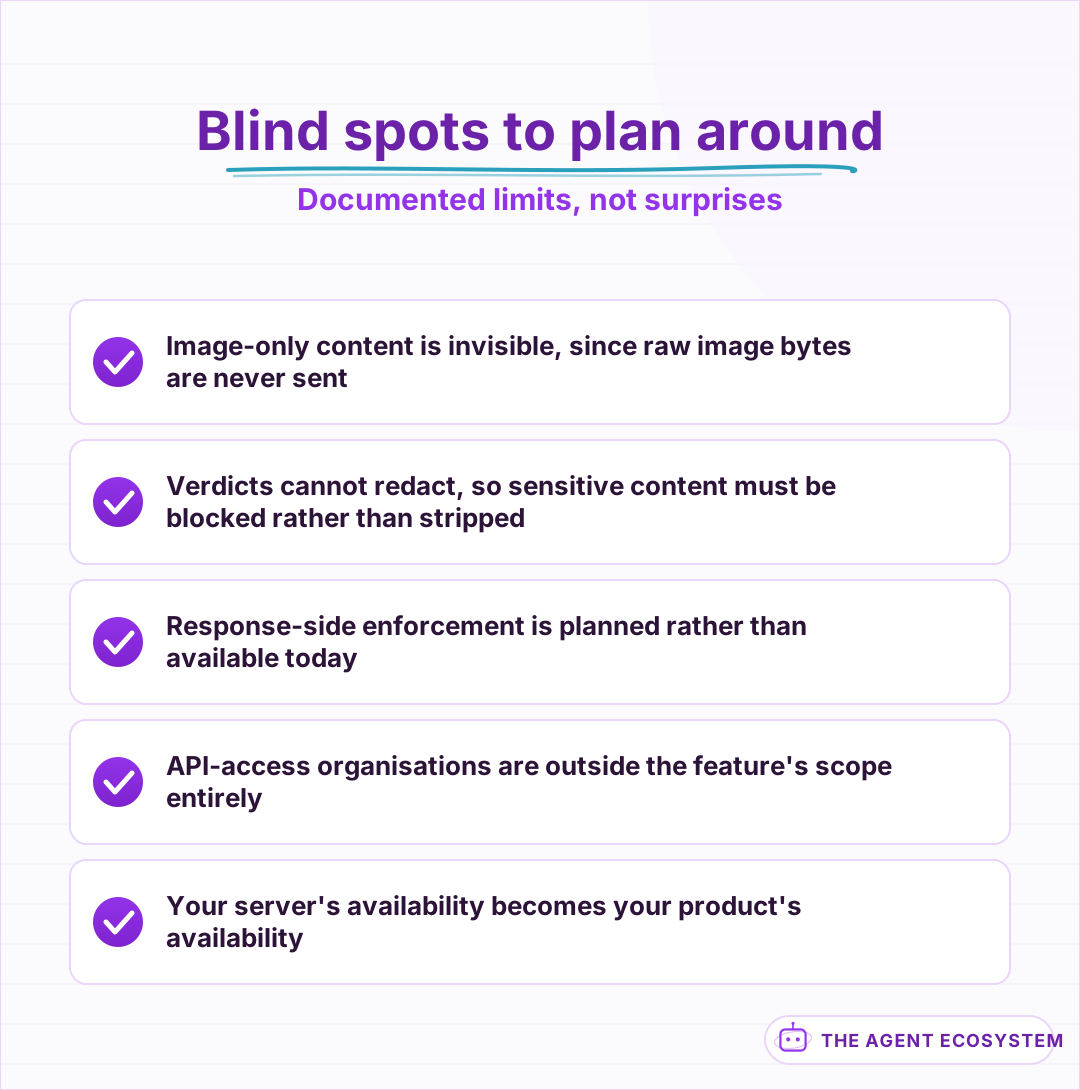 Each of these is documented rather than hidden. A control description that omits them is overselling.
The absence of redaction is a design choice with real consequences. Because a verdict is binary, there is no way to say "let this through with the account number removed". Anything you would want to strip has to be blocked instead, which pushes the policy toward being either too permissive or too disruptive. If your requirement is really redaction rather than refusal, that work belongs upstream in your own pipeline, in the same place PII redaction for LLM pipelines has always lived.
Coverage limits round it out. The hook governs conversations across the web, desktop and CLI surfaces of an enterprise organisation, but it is not available on Amazon Bedrock or Google Cloud, and API-access organisations are out of scope entirely. A company running both an enterprise deployment and its own API integrations therefore has 1 governed half and 1 ungoverned half, which is a fact worth stating plainly in any policy document that claims coverage.
How do you roll this out without blocking everyone?#
In 3 stages the feature provides directly. Shadow mode watches live traffic and records verdicts while blocking nothing at all, a rollout percentage inspects a chosen fraction of requests, and role exclusions exempt specific groups entirely while you tune the policy.
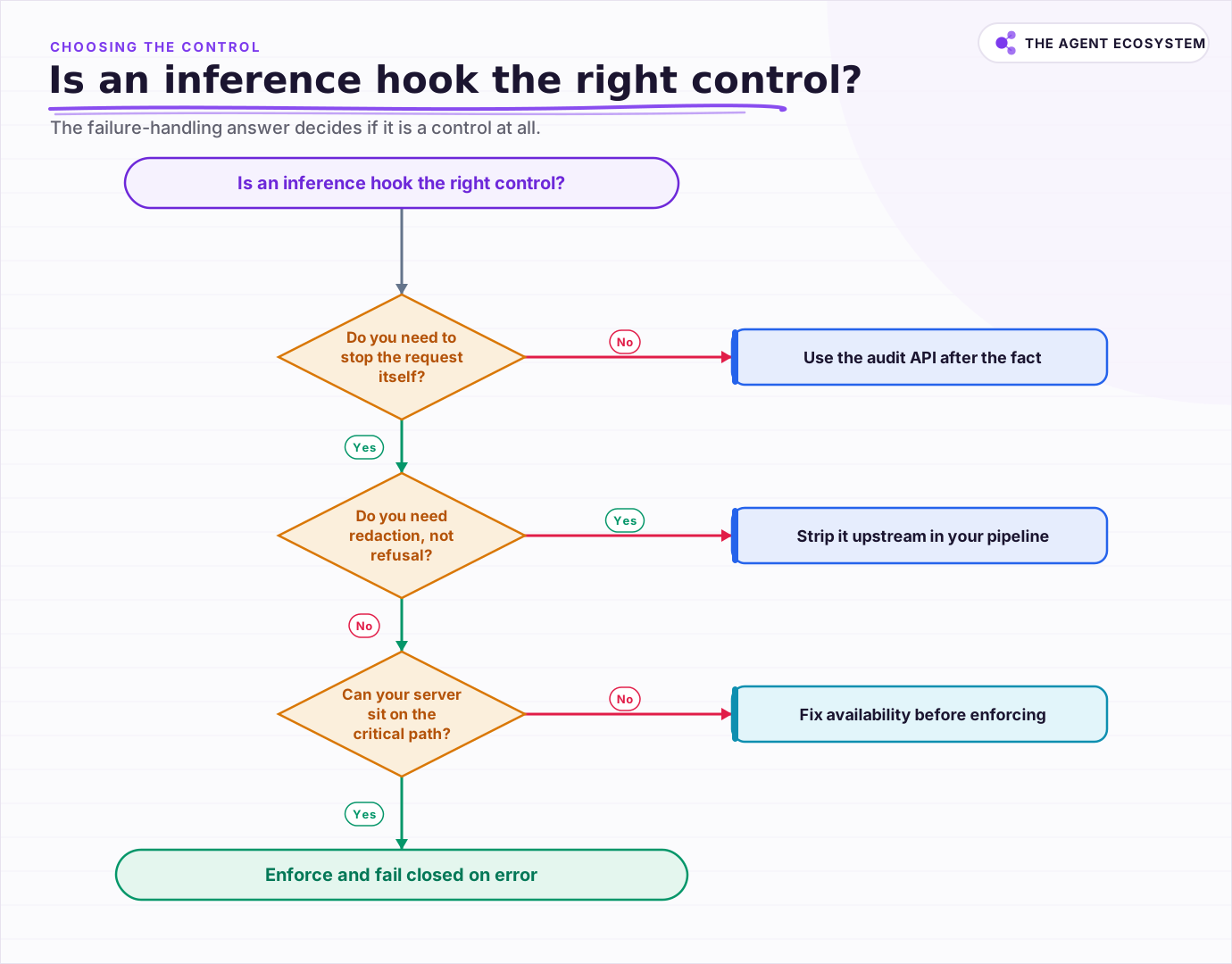 The failure-handling question is the one that decides whether you built a control or a suggestion.
Shadow mode is the one to spend real time in. A policy that looks correct in review will produce false positives against actual traffic, and the cost of discovering that in enforcement is that people cannot work. Running it against live prompts while blocking nothing gives you the denial rate you would have caused, which is the number that should decide whether you are ready rather than any amount of internal testing.
Rolling out by percentage is useful for a different reason: it bounds the damage of a policy bug to a fraction of your users, and it tells you about the latency your server actually adds under real concurrency rather than under a test harness. Role exclusions are the pragmatic escape hatch that keeps a critical team working while you tune.
Once enforcement is on, every denial lands in the compliance activity feed, which is what turns this from a blocking mechanism into something auditable. That record is also the feedback loop worth watching: a rising denial rate is either a policy that is too tight or a genuine change in behaviour, and the 2 are distinguishable only if somebody is reading it.
The honest summary is that inference hooks give security teams something they have not had, which is a decision point before the model rather than a request to the model. That is strictly stronger than in-prompt guardrails for the things it covers. It is also binary, blind to images, and only as reliable as the server you put on the critical path, and a control described without those 3 caveats is being oversold.
Frequently asked questions
What is an inference hook?
What does the security server receive?
What happens if my policy server goes down?
Can an inference hook redact sensitive data instead of blocking?
Does it inspect images and screenshots?
Written by

Muhammad Qasim Hammad is an AI agent and automation expert and the founder of Cart Gaze LLC (cartgaze.com). He builds product for the love of it: when an idea lands, a working prototype is usually running within hours, built with the same AI agents and automations he sells. He puts his own output at roughly 20× what it was before agents, and the Agentic OS behind this site is the working proof, documented in public with the tools he actually ran and what they really cost.
AI & Automation Services
Want a pipeline like this running in your business?
I'm Qasim — I design and ship AI agents and n8n automations for solo operators and small teams. Tell me what's eating your team's week, and I'll scope a fix.
Related reading
Data Privacy for AI Tools: The Decisions to Make First
Most small businesses decide what data may reach their AI tools retroactively, when a client asks. Eleven lessons on the inventory, the three data tiers, what zero retention actually covers, and why the model is rarely the leak.

The Lethal Trifecta: The 3 Things Your Agent Must Not Combine
An agent that can read your private data, process attacker-controlled content, and talk to the outside world is exploitable, and careful prompting does not change that. Here is the threat model, the rule that makes it checkable, and the cheapest leg to cut.
AI Agent Guardrails: Stop Your n8n Agent From Going Off the Rails
An AI agent is a language model with hands. Without guardrails it can follow a malicious instruction, leak data, loop until your bill spikes, or return output the next node cannot parse. This guide maps the five ways an n8n agent breaks to the exact control that stops each.
Stop Prompt Injection in n8n AI Agents: Practical Defenses
Your n8n agent reads emails, scraped pages, and RAG chunks nobody on your side wrote, and a planted instruction can hijack it. Here is the layered prompt injection defense, mapped to OWASP LLM01 and to nodes you can actually toggle.
Human in the Loop AI Automation: What to Gate and What to Let Run
Gate everything and you have rebuilt the manual process with added latency. Gate nothing and you learn what the agent did from a customer. Eleven lessons on sorting actions by reversibility, matching oversight to damage, and telling whether a gate still does anything.
PII Redaction in LLM Pipelines: Strip the Names, Keep the Meaning
Every prompt containing personal data becomes 5 copies of that data: provider logs, your traces, caches, eval exports, bug reports. This is the redaction architecture that actually holds: a single boundary function, layered detectors, consistent pseudonyms like [PERSON_1] that