AI Agent Wallet and Payments Risk: Authority Design
An agent's spending is bounded by the account it can reach, never by the instructions you gave it. Design the container, not the behaviour.
AI-drafted, reviewed by Muhammad Qasim Hammad on October 30, 2026. See our AI disclosure.
Table of contents
On 20 August 2026 a major exchange shipped a standardised way for agents to reach trading, wallets and payments. AI agent wallet and payments risk is not really about the model's judgement, and treating it that way is the mistake. An agent's spending is contained by the account it can reach, never by the instructions you gave it.
Why can prompts not constrain spending?#
Because a prompt is a request and an account balance is a fact. Telling a system not to spend more than a set amount relies on the system correctly interpreting, remembering and honouring that instruction on every path, including paths taken after a confusing tool result or a partially failed retry.
The architecture that shipped reflects this. Execution is kept inside user-funded sub-accounts while the agent logic lives outside the platform entirely, which is a clear admission that the reasoning cannot be the control. The boundary is the account, its balance, its permissions, and the ability to revoke.
That inversion is the whole design. You are not trying to build an agent that behaves; you are trying to build a container where misbehaviour is survivable, and then putting the agent inside it. One of those is achievable today.
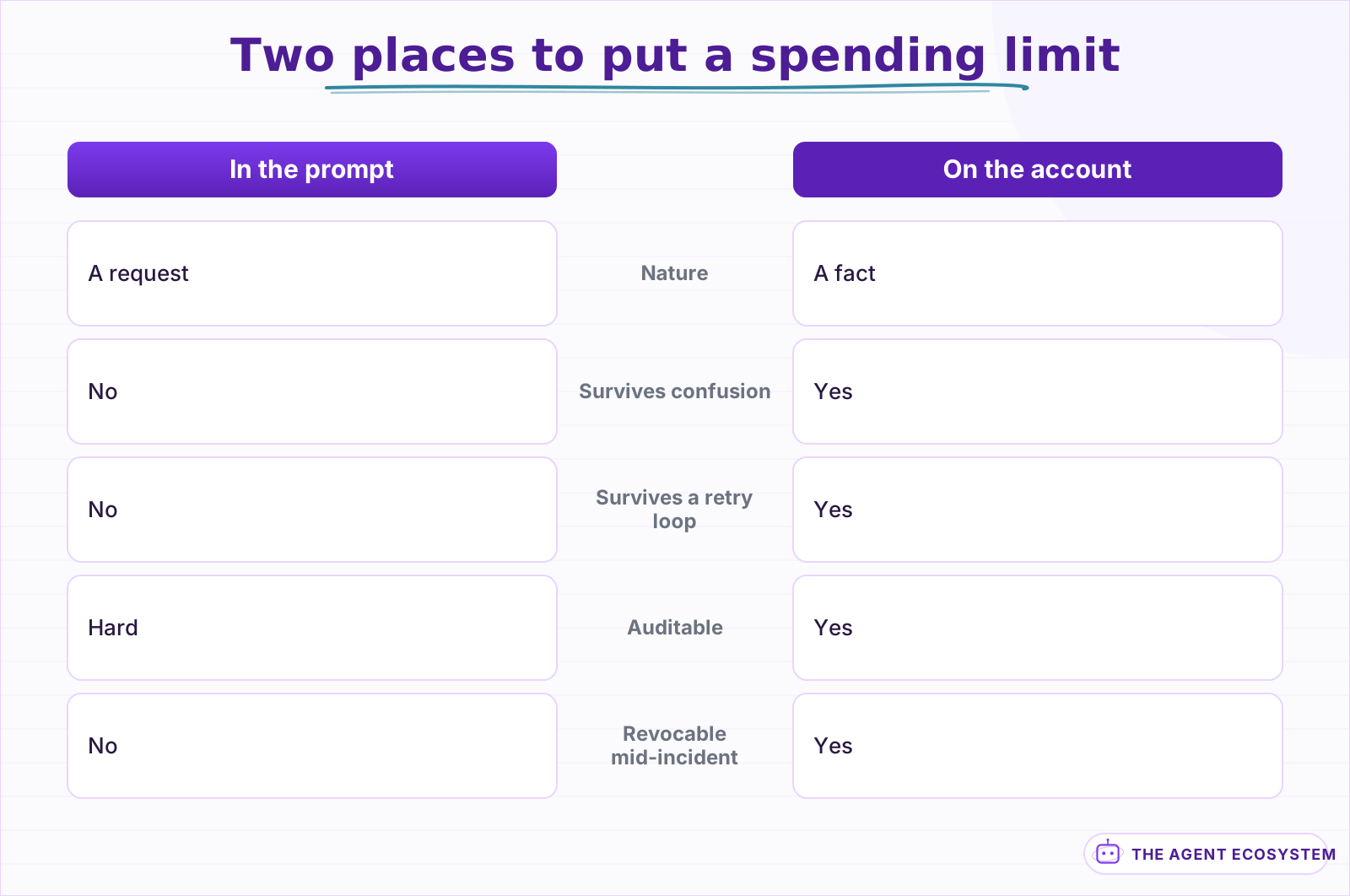 One of these holds when the model is confused. That is the entire difference and it decides the design.
What shipped is a bundle rather than a single feature: exchange APIs, an agentic wallet hub, programmable payments, a skill hub and support for the Model Context Protocol, usable from at least 4 different coding and chat clients. The breadth is the point, and it is also why the authority question arrives all at once rather than gradually.
The corollary is uncomfortable and worth stating. If an agent can reach an account, assume the entire balance of that account is at risk, and size the account accordingly rather than sizing your confidence in the prompt.
What does the containment actually look like?#
A dedicated sub-account, funded deliberately, with per-agent permissions and limits, and revocation available at any time. Each of those four controls is doing separate work, and dropping any one of them quietly collapses the guarantee that the other three appear to provide.
Funding is the one people get wrong. A sub-account topped up to cover a quarter of activity is a quarter of your money exposed to a loop, and a sub-account topped up weekly is a week's worth. The refill cadence, not the balance, is what actually sets the blast radius over time.
| Control | What it bounds | Fails when |
|---|---|---|
| Dedicated sub-account | Total funds reachable | It is funded generously "to avoid interruptions" |
| Per-agent permissions | Which actions are possible | Broad scopes are granted for convenience |
| Explicit limits | Size of any single action | Limits are set in the prompt, not the platform |
| Revocation | Duration of exposure | Nobody is watching, so nothing is revoked |
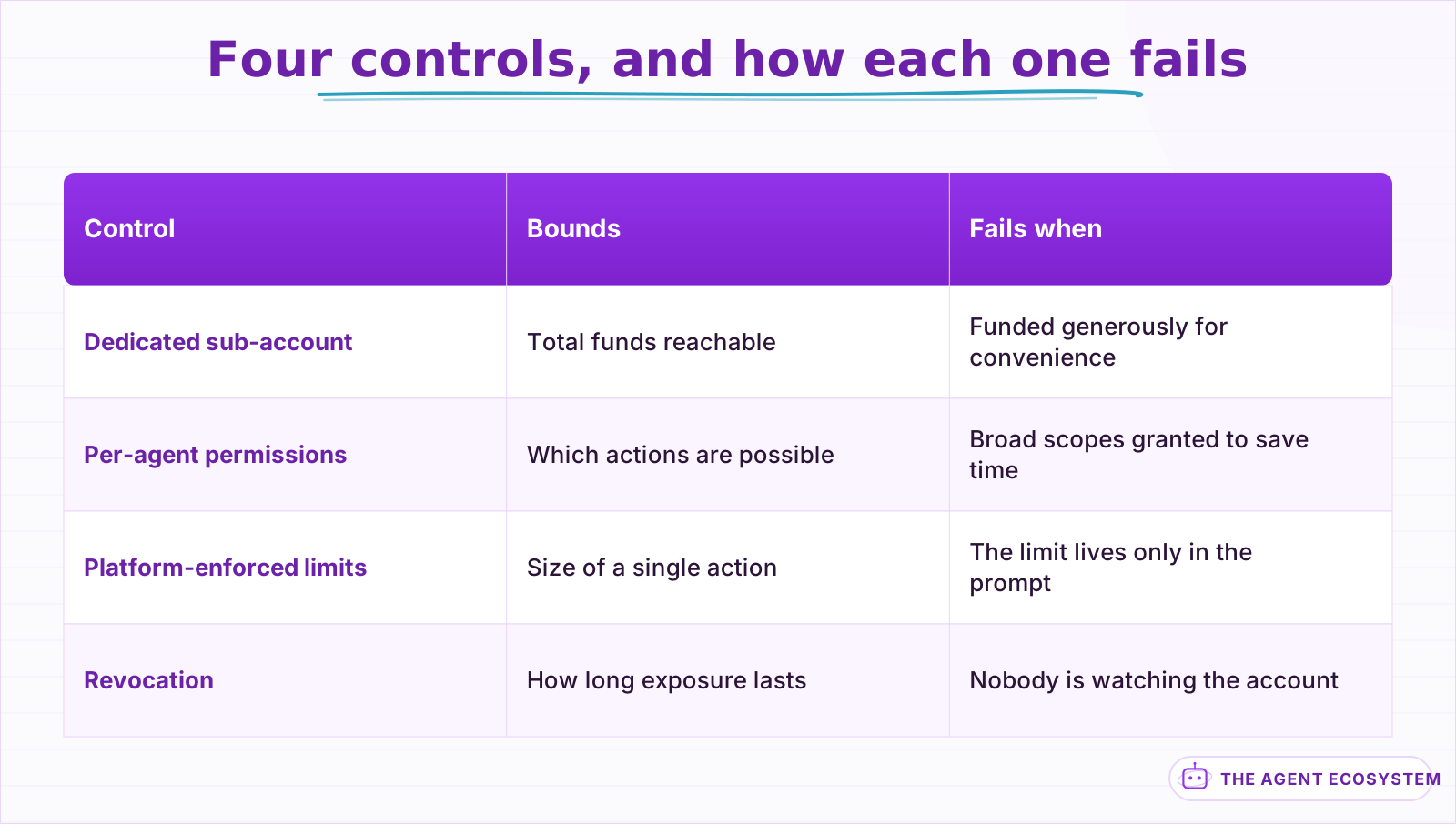 Each failure column is an ordinary operational decision rather than a mistake anybody would flag at the time.
Revocation deserves particular attention because it is the only control that works after something has already gone wrong. It is also the one that depends on a human noticing, which means the real question is what monitoring sits alongside it rather than whether the button exists.
Who is actually responsible for the limits?#
You are, and coverage of the launch made that point directly: keeping agents in check is largely left to users. That is not a criticism of the design so much as a description of where the boundary sits, and it is the same boundary in every agent platform that grants real authority.
The platform provides mechanisms. Choosing conservative values, reviewing them, and noticing when something is wrong are the parts nobody can provide for you, and they are exactly the parts that decay quietly after the first month when nothing has gone wrong.
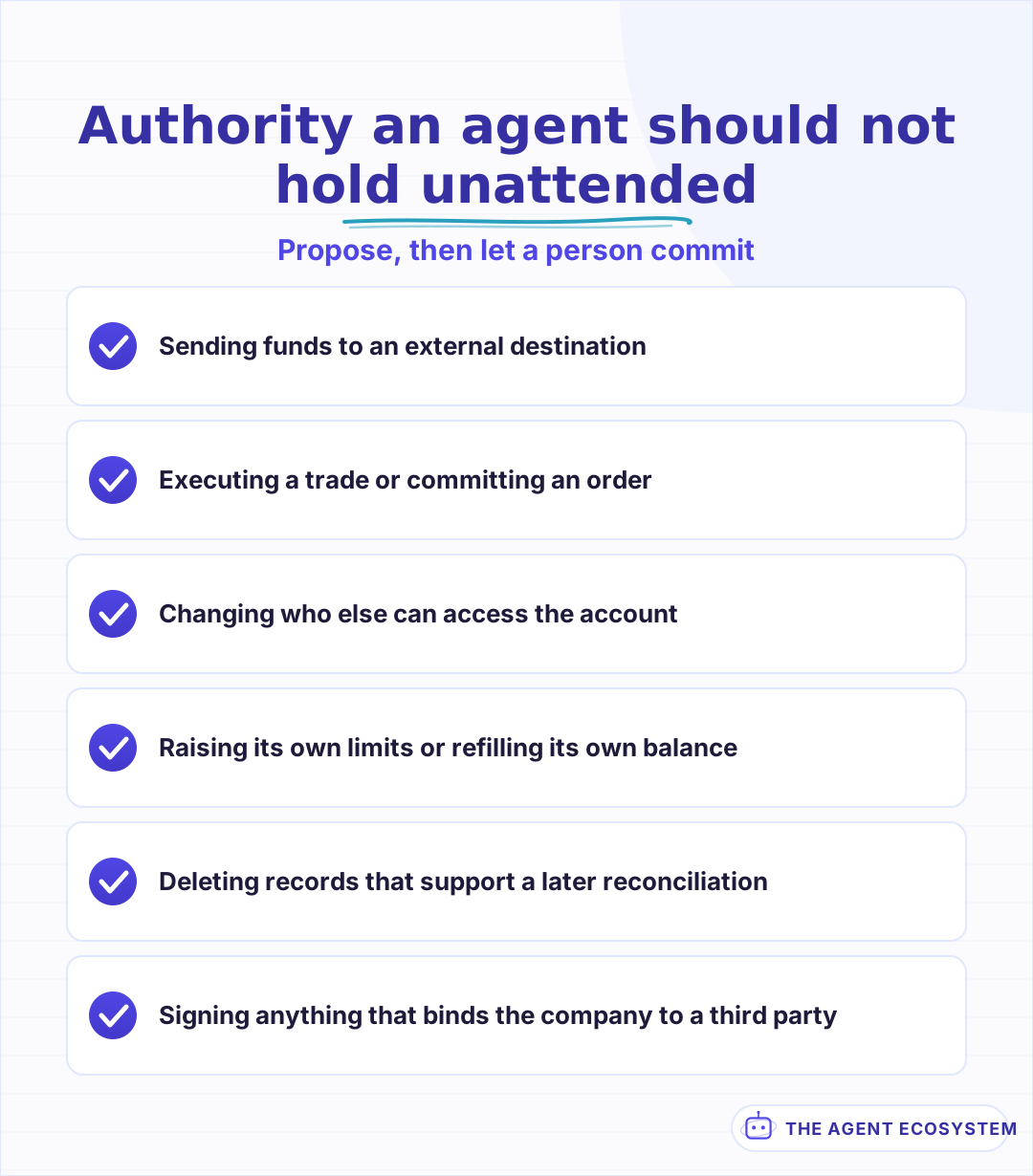 Each is irreversible or expensive to undo, which is the property that matters rather than the amount involved.
What generalises beyond financial accounts?#
Almost all of it. An agent holding a payment card, a cloud account, a metered API key or an ad budget is in the same position, and the same four controls apply with different names. Scope the account, narrow the permissions, enforce the limit outside the model, and keep revocation available.
The failure that recurs across all of them is a retry loop meeting an unmetered resource. Nothing about it requires bad judgement from the model; a transient error, an over-eager retry policy and a resource that bills per call are sufficient on their own, and the cost accrues at machine speed rather than human speed.
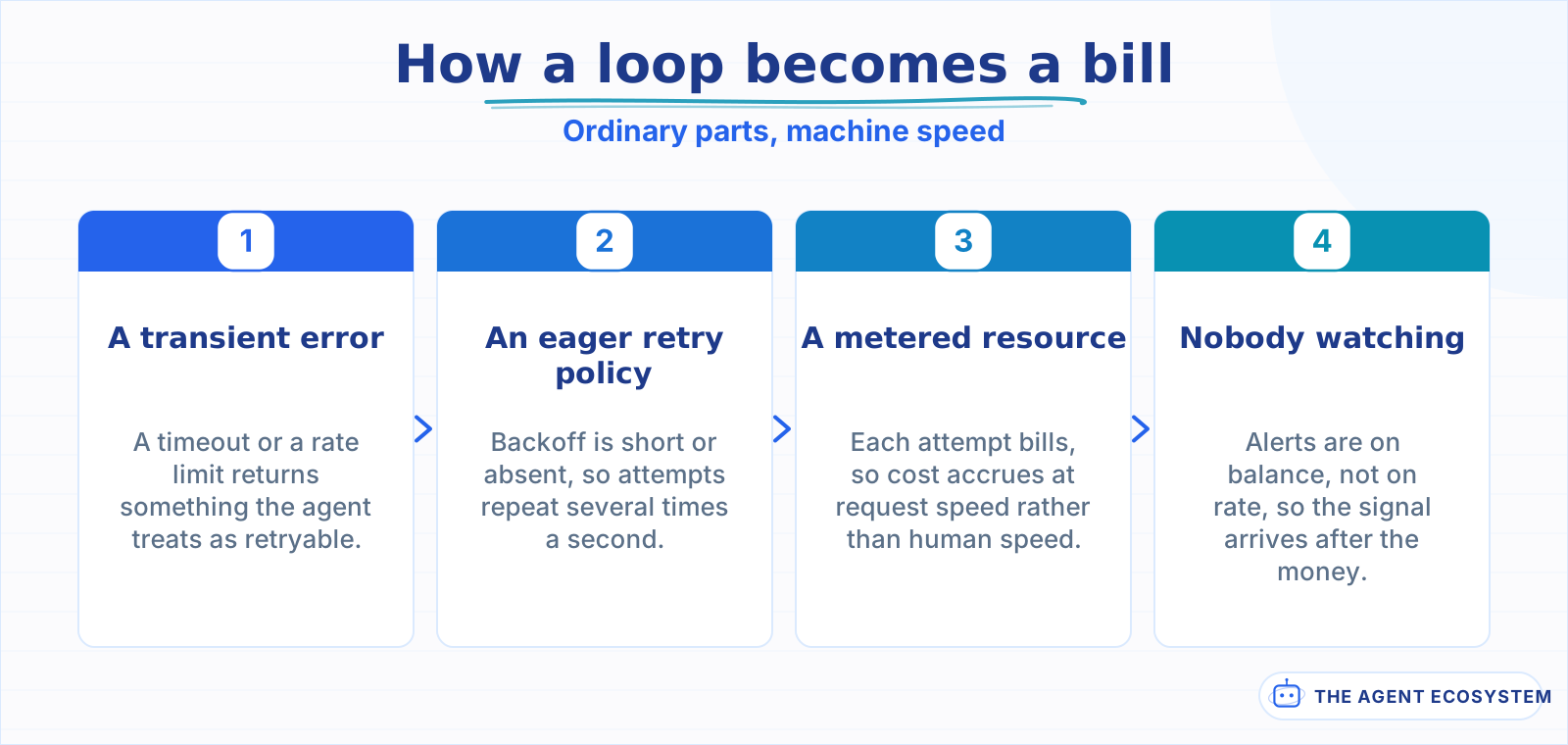 No step here requires poor judgement from the model. The sequence runs on ordinary components.
Put a number on it before it happens. An agent retrying a failing call 5 times a second against an endpoint costing a tenth of a cent per request burns roughly $432 in a day, and a loop nobody notices across a 3 day weekend is closer to $1,300. Neither figure requires the model to do anything unreasonable.
Rate limiting is therefore a spending control and should be treated as one. A cap on actions per minute bounds the damage of a loop far more reliably than a cap expressed in currency, because the loop hits the action limit long before anyone reads a balance alert.
When should an agent not have this authority at all?#
When the action is irreversible and the verification is weak. Moving money, executing a trade and sending an external payment share the property that undoing them ranges from expensive to impossible, which puts them in the category where an agent proposes and a person commits.
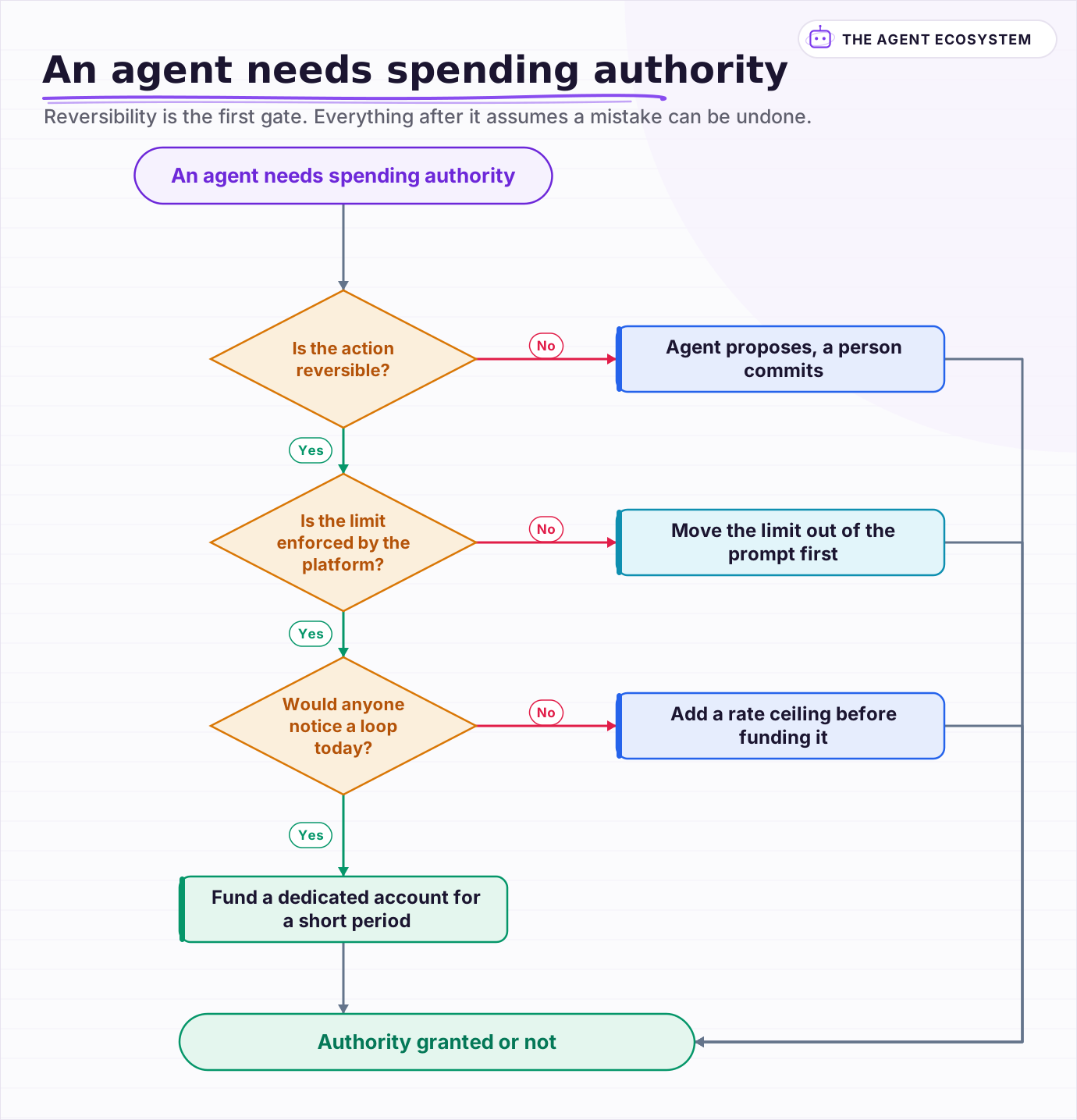 Reversibility is the first gate. Everything after it assumes a mistake can be undone.
That split costs less than it sounds. An agent that prepares a complete, reviewable action and waits captures most of the value while leaving the irreversible step with someone accountable. Deciding what an agent may do alone is the general form of this decision, and what happens when it gets one wrong is why the split is worth the friction.
Frequently asked questions
Can I limit an agent's spending in the prompt?
What actually contains an agent with payment authority?
How much money should be in the agent's account?
Does this only apply to crypto and trading?
Why is rate limiting a spending control?
Sources
Primary references and vendor documentation used while drafting and reviewing this article.
Written by

Muhammad Qasim Hammad is an AI agent and automation expert and the founder of Cart Gaze LLC (cartgaze.com). He builds product for the love of it: when an idea lands, a working prototype is usually running within hours, built with the same AI agents and automations he sells. He puts his own output at roughly 20× what it was before agents, and the Agentic OS behind this site is the working proof, documented in public with the tools he actually ran and what they really cost.
AI & Automation Services
Want a pipeline like this running in your business?
I'm Qasim — I design and ship AI agents and n8n automations for solo operators and small teams. Tell me what's eating your team's week, and I'll scope a fix.
Related reading
Blast Radius: Sandboxing and Permissions for AI Agents
An AI agent with real tool access is only as safe as its weakest credential and its execution boundary. This post covers the containment half of agent security: scoping every tool to its own narrow credential instead of one shared key, and running anything that executes code

AI Agent Error Budget: Pick a Failure Rate You Can Ship
Nobody ships an agent that is right every time, so the only honest question is how often it may be wrong. The version borrowed straight from web reliability breaks on the first day.
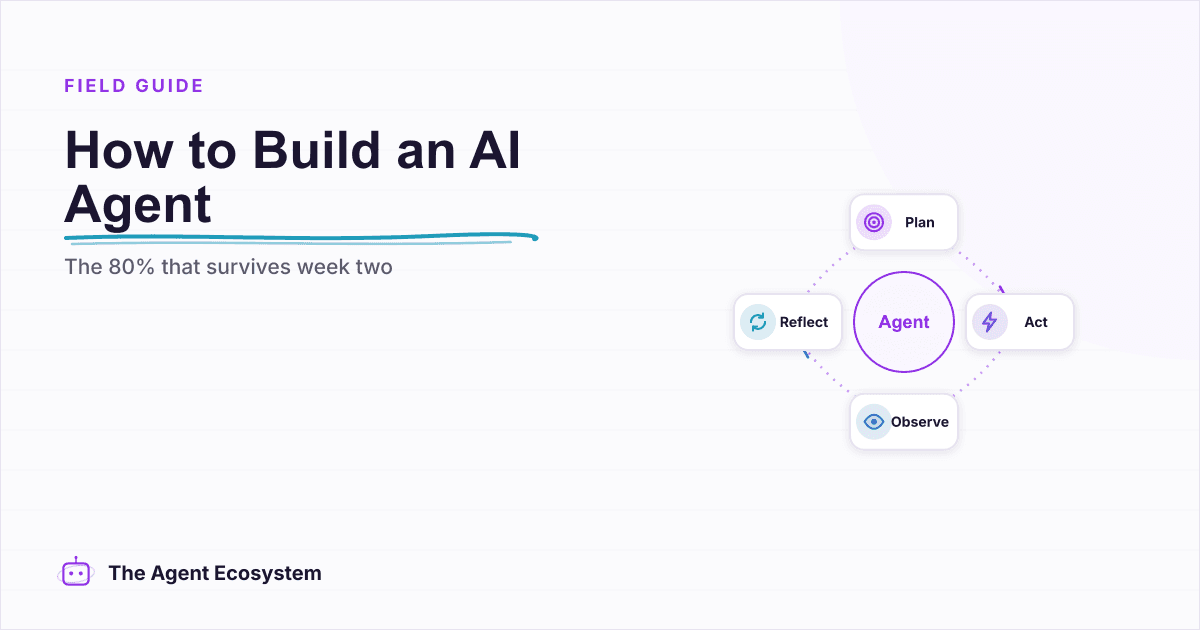
How to Build an AI Agent: The 80% That Survives Week Two
Most tutorials get you a working agent in ten minutes and skip what breaks it in week two. Sixteen lessons covering the loop, tool descriptions, memory, fallbacks, guardrails, evaluation, and the cost levers that decide your bill.
Who Is Liable When an AI Agent Makes a Mistake in 2026?
An agent you deployed emailed a customer the wrong refund amount. The answer is always a person or a company, never the software, and which one is decided long before the incident.
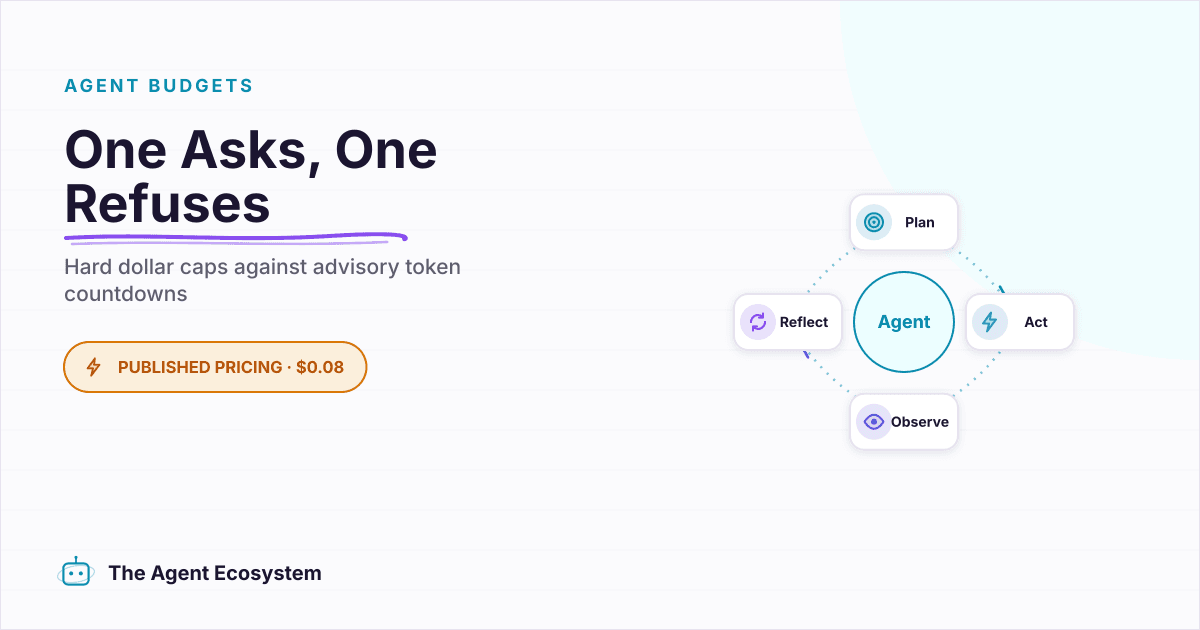
Hard Caps and Soft Hints: Two Ways to Budget an AI Agent
Two mechanisms are both called budgets and behave nothing alike. A session budget is a dollar ceiling the platform enforces by refusing new requests; a task budget is a token countdown only the model can see. Here is what each guarantees and where each breaks.
AI Agent Guardrails: Stop Your n8n Agent From Going Off the Rails
An AI agent is a language model with hands. Without guardrails it can follow a malicious instruction, leak data, loop until your bill spikes, or return output the next node cannot parse. This guide maps the five ways an n8n agent breaks to the exact control that stops each.